

What’s the Right Way to Decline a Procedure You’re Not Comfortable With?
What do you actually say when a resident hands you the needle, the scope, or the scalpel—and your gut says, “I shouldn’t be doing this”?
Let me be clear: the worst option is to just fake it and hope it works out. The second-worst is to freeze and mumble something incoherent while everyone stares at you.
There is a right way to decline a procedure. You can protect the patient, protect yourself, and still look professional and teachable. That’s the target.
Here’s how.
First Principle: Patient Safety Beats Ego. Every Time.
If you remember one rule, make it this: you never owe anyone a risky attempt at a procedure just to prove you’re “eager.”
If you’re not ready and there’s a real risk of harm, you must speak up. Ethically, legally, clinically—it’s not optional. I’ve watched students get praised for stepping back, and I’ve seen careers get a quiet black mark because someone was reckless with a central line or a lumbar puncture they had no business touching.
So your priorities, in order:
- Patient safety
- Honest assessment of your skill
- Maintaining a professional relationship with your team
Your pride and fear of looking bad are fourth. Maybe fifth.
The Core Script: How to Decline Without Looking Weak
Here’s the baseline “I’m not comfortable” script that works in almost every setting:
“I appreciate the opportunity. I haven’t done this before and I don’t feel comfortable doing it independently. I’d be happy to assist or observe, and I really want to learn how to do it properly with supervision.”
Short. Clear. Respectful. Patient-centered.
You’re doing 4 things at once:
- Acknowledging the opportunity (shows you’re engaged)
- Owning your limits (shows honesty and insight)
- Offering an alternative way to participate (shows you’re not avoiding work)
- Signaling interest in learning (shows you’re teachable, not fearful)
If you can memorize one phrase, memorize that.
Situations Where You Should Decline
There are times when “no” is not just acceptable—it’s the only correct answer.
1. You Literally Don’t Know How
First time someone hands you a needle for an arterial line and all you’ve ever done is watch a YouTube video?
Say something like:
“I haven’t been trained on this yet. I don’t feel comfortable doing it on my own, but I’d like to watch you and have you walk me through the steps.”
If they insist with, “You’ll be fine, just do it,” and you’re still totally lost, you double down:
“I really don’t know the steps well enough to do this safely. I’d be worried about hurting the patient.”
Nobody has a good counter-argument to “I’m worried I’ll hurt the patient.”
2. You’re Being Asked to Do Something Outside Student Scope
Examples I’ve seen:
- Intern on night float: “Can you go consent this patient for surgery?”
- Senior: “Just push this dose of propofol while I set up.”
- Surgeon: “Why don’t you close this entire wound by yourself; I’ll be in the other room.”
These are not “student tasks.” A safe version:
“I don’t think this is within my scope as a medical student. I’m happy to help gather information / assist, but I’m not comfortable doing this independently.”
You’re not just protecting yourself, you’re protecting the team from a nasty chart review later.
3. You’re Past Your Fatigue Limit
If you’re 27 hours into a “24-hour” call and someone hands you a needle for a procedure that requires precision, you’re not heroic if you say yes. You’re dangerous.
Try:
“I’m pretty fatigued right now and I’m concerned I won’t be precise. I’d rather assist or observe this time than risk a complication.”
Is that awkward? Yes. Is it better than injuring someone because your hands are shaking and your brain is at 40%? Also yes.
How to Decline Based on the Person in Front of You
Let’s be blunt: how you phrase your “no” will depend on who’s asking.

With Attendings
Most attendings care about one thing: did you think about the patient?
Use that:
“I’d like to, but I haven’t done this procedure before and I don’t feel comfortable doing it on this patient without more supervision. Could I assist you and have you talk through it so I can learn it correctly?”
You’re framing it as a learning opportunity, not avoidance.
With Residents
Some are great teachers. Some are tired and just want help.
If they’re reasonable:
“I haven’t done this yet and I don’t want to slow things down or risk a complication. Can I watch you first and then try on an appropriate patient with you right next to me?”
If they’re pushing you inappropriately:
“I get that you’re trying to help me get experience, and I appreciate that. I’m being honest that I don’t know this procedure well enough to do it safely. I’d rather assist than guess.”
If they’re still pushing hard and you feel cornered, you escalate later—not in the room. Speak to the attending, clerkship director, or student coordinator after.
When You Should Not Decline (But Can Adjust the Ask)
There are also times when your instinct is to bail, but actually, you should step up—with guardrails.
You’re Nervous, But Basically Ready
You’ve watched multiple times, you know the steps, you’ve practiced on models or sim, and the procedure is low-risk (e.g., blood draws, simple suturing, basic injections).
That’s not a reason to say no. That’s your brain doing what it always does before a first attempt.
You can ask for support instead of declining:
“I’d like to try, but I’m a bit nervous since this is my first time. Would you walk me through it step-by-step and be ready to take over if needed?”
Now you’re honest, but not avoiding growth.
The Risk Is Low and You Have Back-Up
Things like:
- Removing superficial sutures
- Simple IV starts on a stable patient
- Checking a fundus with an ophthalmoscope
- Basic pelvic exam with supervision
These are bread-and-butter skills. You’re in medical school to get comfortable with this level of responsibility.
If your only reason is “I’m scared I’ll look stupid,” that’s not enough to decline. You lean into the learning, with supervision.
What to Do Instead When You Decline
Never just say “no” and step away. Offer a constructive alternative. You want to stay engaged, not vanish.
Good alternatives:
- “Can I observe closely and talk through the steps with you?”
- “Can I set up the tray and then assist you so I learn the flow?”
- “Can I suture part of the wound after you start?”
- “Can I do the consent while you’re present so you can correct me?”
You’re telling them: “I’m not trying to escape. I’m trying not to harm your patient while still learning.”
Handling Pushback and Guilt Trips
You’ll eventually hear things like:
- “You’re going into [X] and you’re not comfortable with this?”
- “If you don’t start now, when will you learn?”
- “We all had to learn somehow; just do it.”
You stay calm and repeat your frame: patient safety + honest limits + interest in learning.
Example response:
“I do want to learn this, and I know I need to start. I’m saying honestly that I don’t yet know the steps well enough to be safe doing it without very close supervision. I’d rather watch once or twice and then try with you right at the bedside.”
If someone keeps pushing in front of the team or patient, do not get into a debate. You can use a line like:
“I think we may see this differently, but I’m not comfortable taking this on right now.”
Then let them proceed. Decompress later with someone you trust.
Special Cases: Sensitive Procedures and Personal Boundaries
Not all discomfort is about skill. Sometimes it is about culture, trauma, or personal boundaries.
Pelvic exams, rectal exams, breast exams, genital exams—these can be loaded for students and patients.
You’re allowed to have boundaries. You just need to handle them professionally.
Say:
“I’m not comfortable performing this particular exam today. I’m happy to observe and learn the proper technique, and I’m continuing to work on my comfort with sensitive exams.”
If this is an ongoing issue—e.g., due to past trauma—you should also speak privately with your clerkship director or student affairs early. You don’t want this coming up for the first time in a crowded clinic.
Documentation, Consent, and “Who Did What”
One thing students forget: if something goes badly, the question later is: who consented, who performed, who supervised?

You protect yourself by:
- Not consenting independently for high-risk procedures
- Not acting as if you’re the primary operator if you’re not
- Not letting your name show up in the chart as sole proceduralist
If someone asks you to “just sign here” or “document it as you doing it,” and that’s not accurate, you simply say:
“I need the documentation to reflect the actual roles. I can chart that I assisted or that I performed it under your supervision.”
You’re not being difficult. You’re being sane.
How to Talk About This in Evaluations and Feedback
Students worry this will tank their evaluations. It will not—if you frame it correctly.
When asked about your performance, you can say:
“When I felt I was at my limit—for example, with [X procedure]—I spoke up to prioritize patient safety, but I always stayed involved by assisting or observing and asked for more teaching so I could do it safely in the future.”
That sounds mature and professional. Because it is.
If you had a resident or attending who pressured you beyond reason, bring that up privately with your clerkship director. Keep it factual, not dramatic:
“There was a situation where I felt pressured to do [procedure] despite saying I wasn’t trained. I assisted instead, but it was uncomfortable. I’d appreciate guidance on how to handle that better next time.”
Quick Comparison: When to Decline vs When to Proceed
| Scenario | Best Move |
|---|---|
| Never seen the procedure, zero idea of steps | Decline, observe/assist |
| Seen several times, low-risk, close supervision | Proceed, ask for guidance |
| High-risk procedure, minimal oversight | Decline |
| Sensitive exam with personal boundary issues | Decline, discuss later |
| Tired but safe, simple skill (IV, sutures) | Proceed with supervision |
A Simple Decision Flow You Can Use

| Step | Description |
|---|---|
| Step 1 | Asked to do a procedure |
| Step 2 | Decline, ask to observe/assist |
| Step 3 | Consider assisting or partial role |
| Step 4 | Proceed, ask for step-by-step |
| Step 5 | Reflect after, seek feedback |
| Step 6 | Know the steps? |
| Step 7 | Risk level & supervision? |
A Few Real-World Example Scripts
Let’s get you some copy-paste phrases you can adapt.
First time central line, you’re clueless:
“I really appreciate the chance, but I haven’t been trained on central lines yet and don’t know the steps. I’d prefer to watch you do it and have you explain as you go, so I can be safer when I try in the future.”Pressured pelvic exam you’re not ready for:
“I’m not comfortable performing this exam today, but I’d like to observe your technique and learn. I’m still working on building my comfort with sensitive exams.”Simple suturing, you’re nervous but capable:
“I’d like to try, but this is my first time closing on a real patient. Could you walk me through the first couple stitches and stay close in case I need help?”Resident wants you to push meds you shouldn’t:
“As a medical student, I’m not allowed to administer medications independently. I’m happy to help prepare things or double-check doses with you.”Exhausted and shaky on post-call LP:
“I’m worried that I’m too tired to do this lumbar puncture safely. I’d prefer to assist you instead of being the primary operator right now.”
The Bottom Line
You’re not there to impress people by pretending you’re a resident. You’re there to learn how to be a safe physician.
Say no when:
- You truly don’t know what you’re doing
- The risk is high and supervision is thin
- The task is outside a student’s scope
- Your fatigue or boundaries make you unsafe
Say yes—with support—when:
- You know the steps
- The risk is modest
- You have real supervision
- Your main barrier is fear, not incompetence
If you stay anchored in patient safety, honest self-assessment, and a clear willingness to learn, declining a procedure will not hurt you. Done right, it actually makes you look like exactly what you’re trying to become: a responsible, thoughtful clinician.
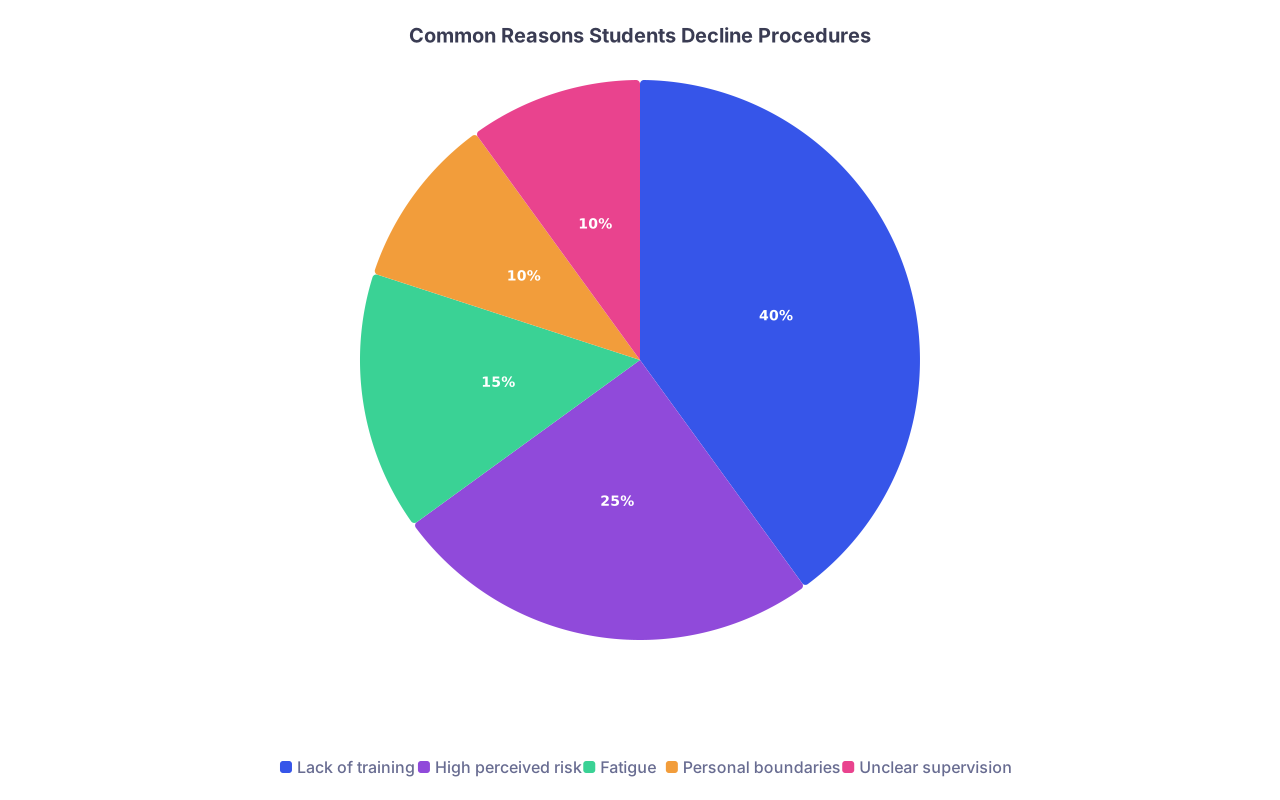
| Category | Value |
|---|---|
| Lack of training | 40 |
| High perceived risk | 25 |
| Fatigue | 15 |
| Personal boundaries | 10 |
| Unclear supervision | 10 |

FAQ (Exactly 5 Questions)
1. Will declining a procedure hurt my evaluation?
Not if you handle it properly. If you clearly explain that you’re prioritizing patient safety, stay involved by assisting or observing, and show interest in learning the skill for next time, most attendings will view that as maturity, not weakness. What does hurt you is repeatedly avoiding all procedures without explanation or interest in improving.
2. What if the resident gets annoyed when I say I’m not comfortable?
Sometimes they will. Residents are stressed and overworked, and some forget what it felt like to be a student. Your job is not to manage their emotions—it’s to protect the patient and yourself. Stay calm, restate your concern about safety, offer to assist instead, and then debrief later with someone you trust if the interaction felt inappropriate.
3. How do I know if a procedure is “in scope” for a medical student?
A good rule: students participate under direct supervision and do not independently perform invasive, high-risk, or irreversible procedures. Things like independently administering potent meds, consenting for surgery, or doing high-risk central procedures alone are out of bounds. When in doubt, ask: “Is this something students are allowed to do independently here?” If nobody can answer clearly, that’s already a red flag.
4. What if I keep feeling uncomfortable with almost every procedure?
Then you should talk to someone early—clerkship director, student affairs, a trusted attending. It might be anxiety, lack of preparation, past trauma, or simply lack of exposure. You’re not the first student to feel this way. Getting targeted support, more simulation practice, or structured step-by-step teaching can move you from “I’m terrified of everything” to “I’m nervous, but capable with support.”
5. Should I ever tell the patient I’m not comfortable?
You don’t need to overshare your internal panic, but you must be honest. It’s fine to say: “I’m a medical student and I’ll be performing/assisting with this procedure under the supervision of Dr. X.” If you’re truly not comfortable, you shouldn’t be in a position where you’re primary operator anyway. Fix that with your team before you walk into the room, not in front of the patient.


