
It’s 6:45 a.m. You’re standing outside the workroom door on your first real clinical rotation. You got there early “like everyone says,” you pre-rounded, your notes are written. You’ve memorized your patient’s creatinine, last hemoglobin, and home meds.
And then sign-out happens. The resident doesn’t even look at you. Attending walks in. Everyone laughs about something from yesterday you weren’t there for. They start rounds—and you can’t quite figure out when to talk, when to shut up, where to stand, or why the intern keeps giving you that sideways look.
Two weeks later your eval comes back:
“Pleasant, eager, but needs to work on team communication and professionalism.”
That vague, polite knife in the back? That’s what this article is about.
Let me walk you through the rules no one writes down. The stuff attendings complain about in the workroom after you leave. The things that quietly turn “Honors” into “Pass.”
The Real Game: You’re Being Graded on Things No One States
On paper, you’re being evaluated on “clinical reasoning, fund of knowledge, professionalism, communication, and teamwork.”
In practice, here’s what actually happens.
The residents and attendings build a story about you in week one and then spend the rest of the rotation looking for confirmation. They rarely change their minds unless you force them to.
The story they build about you isn’t just based on knowledge. It’s based on etiquette. How you move in the team. When you ask questions. How many times you page. Whether the nurses roll their eyes when your name comes up.
Nobody tells you that. But they use it to decide your grade.
Let’s walk through the unwritten rules that shape that narrative.
Rule #1: Show Up Early, But Correctly Early
You’ve heard “get there early.” Lazy advice. Everyone parrots it. Almost no one explains the nuance.
There’s “good early” and “creepy/tone-deaf early.”
Good early:
You arrive 20–30 minutes before your first real clinical task. You use that time to:
- Pre-round on your patients
- Check overnight events, new labs, imaging
- Update your notes
- Learn the layout of the unit
You’re present, but you’re not in the way.
Bad early:
You show up an hour before anyone else. Then you start:
- Calling nurses for updates at 5 a.m.
- Ordering vitals or disturbing sleeping patients
- Asking the cross-cover resident detailed questions while they’re just trying to sign out and go home
Attending feedback I’ve heard more than once:
“Student is trying hard but lacks understanding of clinical flow; occasionally disruptive.”
That’s code for: “They’re annoying at the wrong times.”
If you’re brand new to a service, ask on day one:
“What time do you want me here, and what do you expect done before rounds?”
Then do exactly that. Not twice that. Not your own imaginary version of “gunner early.”
Rule #2: Know the Social Hierarchy — And How Not to Get Burned by It
On rotations, nobody will draw you a map of the power structure. But everyone lives by it. Here it is.
| Role | Practical Power Over Your Eval |
|---|---|
| Attending | Official final say, but usually follows resident input |
| Senior resident | Massive influence, shapes the story the attending hears |
| Intern | Surprisingly high influence on your day-to-day eval |
| Fellow (if present) | Variable, but can tip the scale either way |
| Nurses | Soft power—bad impressions leak back to residents/attendings |
You keep thinking the evaluation is all about impressing the attending. That’s only half of it.
Behind closed doors, the attending turns to the senior:
“How was the student?”
If the senior shrugs and says, “They were fine, a little quiet, needed some hand-holding,” your eval is done. That’s a “Pass with a polite blurb.”
I’ve sat in those rooms. The phrasing matters.
- “Hard-working, thoughtful, easy to work with” → strong eval
- “Nice, very pleasant” with nothing else → you were invisible
- “Needed a fair amount of direction” → they were babysitting you and resented it
You need the residents on your side. That means: you learn their workflow first. You respect their time. You ask them how they like presentations organized. You do not correct them in front of the attending unless it’s glaring patient-safety-level wrong.
And you absolutely do not try to bypass them to “show initiative” with the attending every five minutes. That always backfires.
Rule #3: The Art of Asking Questions Without Being That Student
Faculty love “curiosity,” but they hate time-wasting and performative questioning.
The mistake students make is thinking more questions = more engagement. Wrong. Better questions, at the right time, to the right person—that’s what impresses.
Here’s the rough etiquette that no one spells out:
On rounds:
Ask one, maybe two targeted clinical questions max.
Example: “For this patient with new Afib post-op, what pushes you toward rate control vs rhythm control in the immediate setting?”
Short. Relevant. Shows thought.In the workroom during downtime:
This is where you can ask deeper questions. But still keep them contained. Don’t ambush the resident while they’re 30 notes behind and 10 pages deep.Attendings vs residents:
Use the resident for “how we do it” and workflow questions.
Use the attending for “why we do it” and high-level clinical reasoning.
What drives people nuts is this pattern:
Student is silent all morning, then as soon as attending shows up they fire off every pent-up question rapid-fire to show how “engaged” they are.
Residents see straight through it. So do most attendings.
On day one or two, ask explicitly:
“When’s the best time for me to ask you questions—during rounds, after, or in the afternoon?”
Then honor whatever they say. That one move alone reads as “mature, professional, aware.”
Rule #4: Notes, Orders, and EMR Etiquette
No one wants to fix your mess in the chart. That’s the quiet truth.
You’re not just being evaluated by what you say out loud. They read your notes. They see your clicks. They hear about it if you make more work.
A few behind-the-scenes truths:
- Most attendings don’t trust student notes by default. Residents even less. You have to earn that.
- Students who chart too aggressively and order things without confirmation become “safety risks.” That label absolutely kills your eval.
If your institution lets students write notes:
Ask: “How do you want my notes formatted? SOAP? Problem-based? Copy-forward acceptable or not?”
Different attendings have strong opinions. Violate their style and they subconsciously downgrade you as “doesn’t follow direction.”Never, ever place orders (labs, imaging, meds) without explicit permission, even if you “know” what should happen. Put it in your assessment/plan. Say it on rounds. Let them co-sign or place it.
Do not copy-and-paste whole notes from day to day with no changes. Everyone can see it. They talk about it. They mock it.
If your notes are consistently clear, concise, and accurate, I’ve watched that single-handedly push a borderline student from “Pass” to “High Pass/Honors.”
Rule #5: Page, Text, and Call Like You Understand Their Life
You are graded on how much you respect other people’s time. That’s not listed in your eval form. It’s baked into “professionalism” and “teamwork.”
Here’s the unspoken paging etiquette:
- Don’t page for every tiny clarification. Batch questions when possible.
- Avoid paging residents/attendings during sign-out or known chaos times unless patient safety is involved.
- If your question can be answered by chart review or asking another student, do that first.
Example that gets you silently downgraded:
You page the intern at 1:30 a.m. on night float to ask, “Do we usually do DVT prophylaxis for this patient?”
Believe me, that story gets told the next morning. With your name attached.
Instead, you write:
“Will discuss DVT ppx with resident; likely start LMWH if no contraindications.”
Then you ask on rounds or in the workroom.
From the attending side, the student who seems to “get” when to escalate and when to wait is labeled with one key word: safe. That’s gold.
Rule #6: Where You Stand and When You Talk on Rounds
You’re laughing, but this one destroys students.
Rounds are choreography. That choreography changes by service.
Some attendings want tight, efficient table rounds in the workroom. Some want full bedside production. Some do hallway speed rounds. They rarely spell it out clearly; they just expect you to adapt.
Introvert students often get tagged as “disengaged” because they physically hang at the edge of the group. Extrovert students get labeled “overbearing” because they’re always center stage.
You want to be physically close enough to see vitals, imaging on screen, and your resident’s face. That way:
- You can read when they want you to speak.
- You can see when the attending is running out of patience.
- You don’t have to shout over three people to present.
On bedside rounds, don’t position yourself so that:
- You’re between the team and the patient
- You’re blocking the monitor
- You’re leaning on the wall scrolling on your phone
Yes, people see it. Yes, it ends up in “professionalism” comments.
If you’re unsure how formal to be with presentations, defer to the senior. On day one say:
“How do you want me to present? Full H&P the first time and then focusedSOAP, or always problem-based?”
The student who asks that on day one always looks sharper than the one who stumbles around for a week.
Rule #7: Never Throw Anyone Under the Bus (Even If They Deserve It)
This one gets violated constantly.
Scenario: Attending finds an error. A missed lab. A med reconciliation mistake. A patient not seen yet.
You know it wasn’t you. Maybe it was the intern. Maybe the night float. Maybe the nurse. You’re itching to clarify that.
Bad move:
“Well I told the intern about that yesterday…”
or
“The nurse said she was going to do it…”
Congratulations. Now you’ve labeled yourself as someone who deflects responsibility. That sticks.
Better play:
Own what’s yours. State facts neutrally. Then pivot to solution.
“Labs were ordered yesterday but not drawn. I can follow up with the nurse now and make sure they’re sent today.”
Or:
“I didn’t appreciate that change in creatinine yesterday; I’ll keep a closer eye on trends and bring those to the team’s attention.”
You just converted a mistake into a maturity point. Attendings see that and absolutely comment on it.
Behind closed doors, the phrase you want them to use is:
“Doesn’t blame, takes ownership, solution-focused.”
That’s a strong eval no matter what your shelf score is.
Rule #8: Studying Without Looking Checked Out
Yes, the shelf matters. Yes, everyone expects you to study.
What kills students is how they study in public.
If you’re on your phone or laptop in the workroom and a nurse walks in, a resident is clearly buried, or something is happening with your patient—and you stay seated scrolling UWorld?
People notice. They remember.
If you’re going to study on shift:
- Keep a small pocket book or a couple printed articles.
- When the team is actively working, offer help first: “Anything I can do?” If they say no three times, then you quietly study.
- If someone stands up or a page comes in, you look up. Be interruptible.
You never want the narrative:
“Strong knowledge base, but not very engaged with the team or patient care.”
That’s the polite way of saying: “They just sat on UpToDate all day while we worked.”
Rule #9: Working With Nurses — The Evaluation Channel You Don’t See
Let me tell you what really happens.
If a nurse complains about you—even once—the residents hear about it. If the complaint is about attitude, lateness, or ignoring pages, it can stick for the rest of the rotation.
You need nurses on your side. Not just because it’s decent. Because they’re the ones who see whether you actually care about the patient or just your eval.
Hidden etiquette with nurses:
- Introduce yourself on day one: “Hi, I’m [Name], the med student with [Team]. I’m following [Patients A/B]. If you need anything for them and can’t reach the resident, I’m happy to help track things down.”
- If a nurse asks for help (calling family, finding supplies, relaying something to the team), and you blow them off? They might not confront you. They will mention it later.
- Never, ever talk down to them or correct them harshly in front of others. You will lose that war every time.
Residents are very simple here. If nurses like you, they assume you’re a good team player. If nurses don’t, they assume they’re right.
Rule #10: Enthusiasm Without Desperation
Faculty want to see that you care. Residents want to see that you’re normal.
The desperate med student archetype is real:
Always volunteering for every task in a performative way. Repeating “I’ll do it! I can do it!” so everyone hears. Exhausting.
Better approach: targeted initiative.
- Volunteer for concrete, useful tasks: calling family with updates, following up labs, finding old outside records, doing a focused literature search on a question that actually came up.
- Don’t hover over the resident shoulder every second. Give them some physical and mental space.
- Don’t remind everyone 10 times how “interested” you are in that specialty. It gets old fast.
I’ve seen students who were average on shelves but consistently taking quiet, useful ownership—calling SNFs, chasing records, putting in real time with patient counseling—walk out with Honors because every resident said: “Rotation was better with them here.”
That’s what you’re aiming for.
Rule #11: How You End a Rotation Matters More Than You Think
Most students burn out by the final week. They disappear mentally. Slack on notes. Show up exactly on time or a little late. Stop reading.
And then they’re surprised when the eval mentions “inconsistent engagement.”
Here’s the behind-the-scenes reality:
Residents usually don’t sit down to fill your evaluation until after you’re gone. Sometimes a week or two later. What do they remember most vividly? The last week.
You want them to miss you when you leave. Not be relieved.
Two small moves:
In the last 2–3 days, ask your senior:
“Is there anything specific I can improve on in these last few days?”
That signals maturity. Also nudges them to reflect on what you have been doing well.On the last day, thank people individually, not just a generic “thanks guys”:
- “Thanks for letting me present today; your feedback on structuring A/P was really helpful.”
- “I learned a lot from watching how you talk to families in tough situations.”
If you’ve been at least solid, that kind of exit often bumps your “meh” eval to “strong team member, would work with again.”
Rule #12: The Hidden Timing of Impressing an Attending
Another secret students don’t hear.
Not all attendings’ opinions matter equally for your grade. Depends on how your program or clerkship is structured, but on many services:
- The attending who’s there the first half of your rotation shapes the story about you.
- The attending in the final half often signs the actual evaluation and leans heavily on resident input.
Meaning: You don’t have forever to “turn it around.” If you spend the first two weeks lost, quiet, and passive on a 4-week rotation, you’re playing from behind.
Your goal in week one:
- Learn workflow.
- Learn preferences.
- Get one or two small “wins” people notice (nice note, good patient connection, catching a lab trend, thoughtful differential).
That’s enough to build the right story early:
“Quiet but solid and improving.”
You can turn that into “strong” by the end. Harder to resurrect “checked out and behind” in the last three days.
A Visual: How Behavior Shifts Your Eval
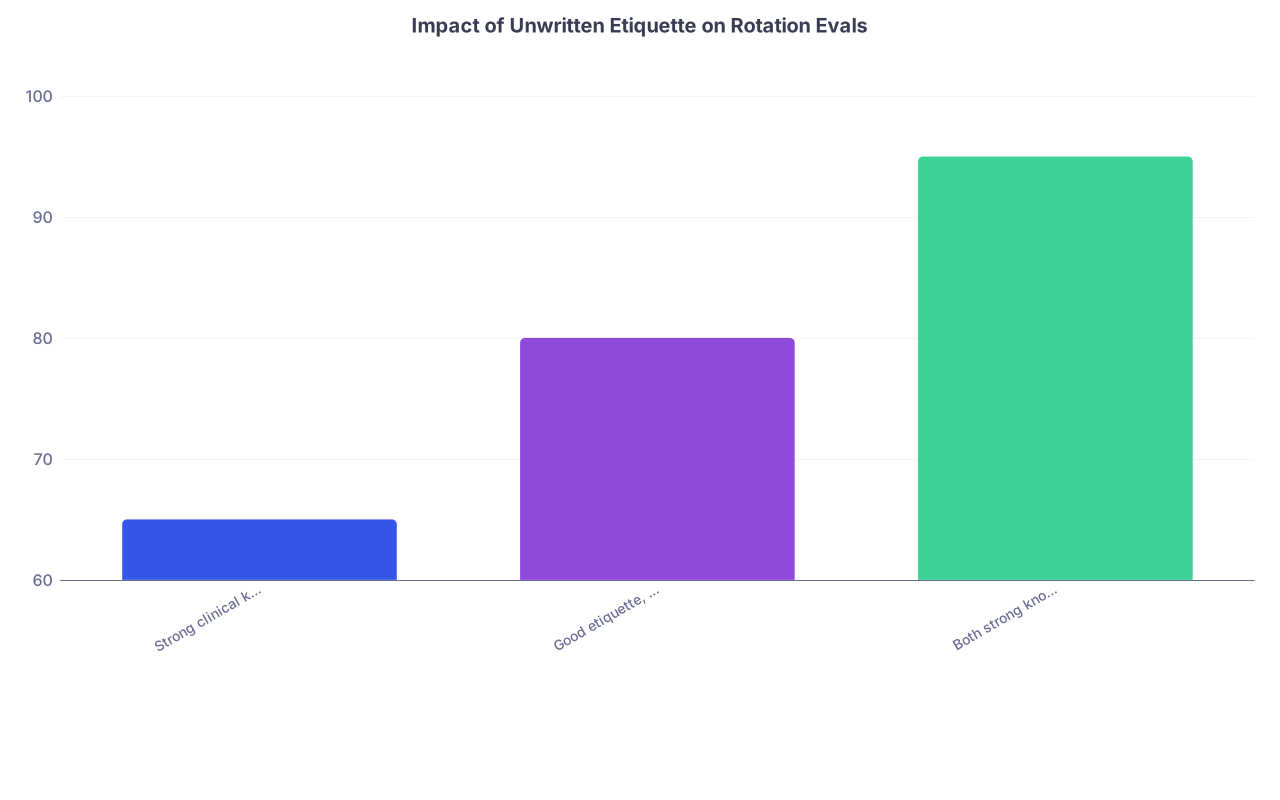
| Category | Value |
|---|---|
| Strong clinical knowledge only | 65 |
| Good etiquette, average knowledge | 80 |
| Both strong knowledge and etiquette | 95 |
Those aren’t literal percentages from a paper. That’s real-world.
Students with mediocre knowledge but excellent team etiquette often outscore walking UpToDate engines who are painful to work with.
A Quick Rotation Flow Map

| Step | Description |
|---|---|
| Step 1 | Arrive & Pre-round |
| Step 2 | Touch base with resident |
| Step 3 | Workroom prep & notes |
| Step 4 | Rounds |
| Step 5 | Post-round tasks & orders (shadow/assist) |
| Step 6 | Midday teaching or studies |
| Step 7 | Afternoon check-ins & follow-up |
| Step 8 | Sign-out & next-day prep |
Your behavior at each of those points is being watched. Not constantly. But enough for patterns to emerge.
Example: Two Students, Same Knowledge, Different Rules
Let’s make this concrete.
Student A
- Shows up early. Pre-rounds. Knows their patients cold.
- Stands with the group but hangs back, rarely speaks unless called on.
- Does notes, looks at UpToDate, but doesn’t offer to help with tasks.
- Asks good questions—when the attending is around. Silent with residents.
Eval usually reads:
“Quiet but pleasant. Needed some prompting. Good knowledge base. Could be more proactive.” → Pass / maybe High Pass.
Student B
Same knowledge. But:
- On day one: “How do you like presentations?” “What time should I be here?”
- On rounds, gives crisp 3–4 minute presentations, then one thoughtful question.
- Between cases: “Anything I can help with?” If no, quietly reads on actual patient problems.
- Helps call a family back, walks a patient to CT, prints old EKGs without being asked after hearing the plan.
Eval reads:
“Great team player, took ownership of patient care tasks at a student level, thoughtful questions, would definitely work with again.” → High Pass / Honors.
Same brain. Different etiquette.
A Glimpse at How Residents Actually Talk
Here’s the kind of thing I’ve heard in real resident rooms, after you walk out:
- “She’s actually really sharp, but man, she asks me 500 questions while I’m drowning.”
- “He’s not the fastest, but he cares, and he’s always looking for ways to help. I’d give him Honors.”
- “Honestly, I barely noticed her. Nice, but she was basically wallpaper.”
- “Great on paper, terrible teammate. I don’t want him on my service as an intern.”
Your job on rotations is to make sure you’re never “wallpaper” and never “terrible teammate.” If you land in “cares, helpful, safe, improving,” you’ll do fine—even if you’re not the smartest person on the team.
Key Takeaways
- You’re not just graded on knowledge; you’re graded on unwritten etiquette—how you move through the team’s workflow, respect their time, and handle responsibility.
- Residents and nurses shape your evaluation more than you think. Make their lives easier, not harder.
- Ask early about expectations, adapt to preferences fast, and end strong. That combination quietly pushes your eval from “fine” to “impressive.”