Rounds are not “office hours on wheels.”
Treat them that way and you will irritate everyone and learn less.
I have watched excellent students get mentally blacklisted by teams not because they were lazy or unprepared, but because they asked questions the wrong way, at the wrong time, for the wrong reasons. Their knowledge was fine. Their judgment was not.
You are not just being evaluated on what you know. You are being evaluated on how you think, when you speak, and whether you understand the clinical context you are stepping into with every question.
Let’s walk through the most common ways students ruin their credibility on rounds by asking questions badly—and how you can avoid that trap.
Mistake #1: Asking “Google-Level” Questions In Front of Everyone
If a question can be answered in under 15 seconds with UpToDate, Google, or a handbook, do not ask it in the middle of rounds.
Examples I have actually heard on ward rounds:
- “So… what is furosemide again?”
- “Wait, what does COPD stand for?”
- “What is the normal potassium range?”
Those questions tell the team three things immediately:
- You did not prepare.
- You expect others to do your basic work.
- You do not respect their time.
On rounds, attention is a scarce resource. The senior is juggling dispositions, the intern is thinking about orders and notes, the attending is tracking big-picture risks. When you pull the entire team’s attention to answer something you should already know, you are effectively shouting, “My convenience matters more than patient care.”
How to avoid this
Use a simple filter:
If it is definitional, normal-range, or basic pharmacology, you look it up yourself. Quietly. On your phone. After rounds. Or between patients.
You should know:
- Normal vital signs and major electrolyte ranges
- First-line treatments for common conditions on that service
- What each common med class does (ACEi, beta-blocker, diuretic types, insulin types, etc.)
If you are not there yet, fine. But then your questions need to be invisible to the team—asked before or after rounds or answered by your own reading, not during the middle of a time-pressured patient encounter.
Mistake #2: Hijacking Rounds With Off-Topic Curiosity
Curiosity is good. Undisciplined curiosity is not.
You will absolutely think of interesting side questions:
- “How does IL‑6 blockade change the long-term immune profile?”
- “What is the latest data on PCI vs CABG in left main disease in low-SYNTAX patients?”
- “How do we model volume status changes mathematically in cirrhosis?”
Interesting? Yes. Relevant to why you are standing outside bed 7 right now? No.
Rounds are for:
- Making decisions for this patient
- Teaching concepts tied to those decisions
- Moving the day along
When you interrupt that with a deep, lateral question that sends the attending into a 10-minute digression, you are not “impressing” anyone. You are delaying notes, delaying orders, and irritating residents who now leave an hour later.
How to avoid this
Channel your curiosity into one of three safer formats:
- “Parking lot” questions after rounds
- “Dr. K, I had a broader question about PCI vs CABG in left main disease. Could I ask you quickly after rounds if you have time?”
- Email or message follow-up
- “I looked up X after rounds; can I run my understanding by you sometime this week?”
- Short, tightly framed questions that connect directly to the current patient
- “For this patient with left main disease and diabetes, is the main reason we prefer CABG here their long-term mortality benefit?”
If it is not about this patient, this decision, or this service, it probably does not belong in the middle of rounds.
Mistake #3: Asking Questions That Expose You Did Not Listen
Nothing annoys a tired resident faster than you asking something they just answered.
Common offenders:
Attending: “…so we held the ACE inhibitor because of the elevated creatinine.”
Student 30 seconds later: “Why are we holding the ACE inhibitor?”Senior: “She had a CT last week that ruled out PE.”
Student 1 minute later: “Should we get a CT angiogram to rule out PE?”
This is not just “oops I missed a detail.” It tells the team:
- You are not listening.
- You are trying to “participate” without tracking the conversation.
- They cannot trust you to follow a story from beginning to end.
On rounds, if your mouth is active when your ears were not, you are in trouble.
How to avoid this
Three habits:
Take short, structured notes
Do not rely on memory. Jot bullets: “ACEi held ↑Cr,” “CTA done last week – negative.” You are less likely to re-ask something already covered.Pause before speaking
When you feel the urge to ask, mentally scan: “Was this answered already? Did I zone out?” If you were not fully present, you do not get to ask. You go back later and read the chart.Own it if you missed it
If you genuinely did not hear:
“I apologize, I think I missed part of that. Did you say the CTA was already done last week?”
Better to show awareness than pretend you are asking something new.
Mistake #4: Weaponizing Questions to Show Off
Nothing turns a team against a student faster than the “gotcha” question.
You know the type:
- “But is that still true given the 2022 NEJM trial that showed…?”
- “Actually, I thought the ACC guidelines recommended something different?”
- “Is that always how you manage this, or is that just your preference?”
Residents recognize what you are doing. You are trying to prove you are smarter than someone above you on the hierarchy during a public performance.
Even if you are correct, you lose.
Because you forgot the most basic rule: your job is to make the team’s life easier, not harder. Publicly challenging someone’s decision without context, humility, or timing is a guaranteed way to be labeled “difficult.”
How to avoid this
If you disagree or have read something different:
Ask privately when possible
After rounds, one-on-one:
“Dr. S, I read X in the 2022 guidelines and was trying to reconcile it with what we did today. Can I ask you about that?”Frame it as clarification, not correction
“I thought I had read that [X] was recommended. Am I misremembering, or are there exceptions like in this case?”Offer to bring evidence, not throw it
“I can look that trial up again tonight and summarize it if that would be helpful.”
You can absolutely discuss evidence. Just do not use it like a knife in front of an audience.
Mistake #5: Asking Questions at Clinically Dangerous Moments
Timing matters as much as content.
Some of the worst questions are not bad in themselves, they are just dropped at exactly the wrong moment:
- Right as the patient starts crying.
- While the attending is on the phone arranging an ICU transfer.
- When nursing is trying to clarify a STAT order.
- During rapid-paced sign-out type discussions on “sick list” patients.
If the energy shifts to urgency, you go quiet. End of story.
How to avoid this
Watch for signals that mean “now is not the time”:
- People suddenly move closer to a room or computer.
- Tone changes: more clipped, more direct.
- Questions are short, about vitals, labs, disposition.
- People stop joking.
In those windows, you do three things only:
- Listen
- Learn
- Stay out of the way
If a question comes to mind that feels genuinely urgent for patient safety (“Are we sure no contrast allergy is documented?”), ask it concisely. Anything else waits.
Mistake #6: Asking Questions You Should Have Prepared Before Rounds
Your attending asks each student to read about one patient’s main problem the night before. Next morning, you show up, present, then ask:
- “So… what is the pathophysiology of cirrhosis again?”
- “What are the main complications of nephrotic syndrome?”
You were literally assigned this. You had a chart. You had time. You chose not to use it.
Residents and attendings quickly separate students into two categories:
- The ones who fight their own ignorance before rounds
- The ones who bring raw, unprocessed ignorance to rounds
You want to be in the first group.
How to avoid this
Your pre-round routine should always include:
- The problem list: “What are the main diagnoses?”
- For each major problem:
- What it is
- How it presents
- Typical workup
- First-line management
Then, your questions can be higher-level:
- Instead of: “What is nephrotic syndrome?”
Ask: “I read that hypercoagulability is an underappreciated risk in nephrotic syndrome; for this patient, would we ever consider prophylactic anticoagulation?”
That kind of question shows work. Teams respond very differently to that.
Mistake #7: Asking Ten Questions in a Row
Serial questioning kills goodwill.
You know the pattern:
You ask one decent question. Attending answers. You immediately pounce with four follow-ups, none of which you have tried to think through first. Suddenly the whole team is standing in a hallway frozen while you and the attending hold a mini-conference.
You are not “engaged.” You are monopolizing.
Even if the attending plays along, the residents are silently checking how many notes they still have to write.
How to avoid this
Cap yourself.
On rounds, per patient, aim for:
- Zero to one questions. Zero is fine. One thoughtful question is plenty.
If the attending invites more:
“That’s a good question—what else are you wondering?”
You can ask a second, maybe third. But you still watch the team. If people are shifting, glancing at watches, checking pages, you stop.
Also, batch your curiosity. Write down follow-ups to ask after rounds, on a walk between rooms, or during down time. Do not force the whole group to stand while you unpack everything in your head.
Mistake #8: Asking Without First Trying to Answer
A smart attending trick you will see:
Student: “What causes A-fib in this setting?”
Attending: “What do you think?”
If your response is a blank stare and “I don’t know,” repeatedly, you send a clear message: you expect spoon-feeding.
You are not in high school. You are in a profession that requires thinking under uncertainty. If you refuse to even attempt an answer, many educators will stop investing in you. It gets old fast.
How to avoid this
Build a habit: whenever you want to ask a question, form your own provisional answer first.
Then ask like this:
- “My understanding is that in hyperthyroidism, A-fib is driven largely by increased beta-adrenergic tone and atrial remodeling. Is that right, or am I oversimplifying it?”
- “I thought the reason we avoid beta-blockers in acute decompensated heart failure is the negative inotropy worsening cardiac output. Is that the key concern here?”
Now your “question” becomes a check on your thinking. It shows effort, structure, and that you are not just demanding information.
Mistake #9: Making the Question About You, Not the Patient
Some questions are not wrong scientifically, they are wrong socially:
- “How many points would I get on my eval for managing this overnight?”
- “Do you think answering that pimp question helps my grade?”
- “Do programs care if I scrub into this case?”
Rounds are about patients. Not your Step score. Not your eval. Not your future fellowship.
When you turn patient care into your personal performance stage in front of a sick human being, you break a basic professional norm. Teams remember who did that.
How to avoid this
Save career- and evaluation-related questions for:
- One-on-one sit-downs
- End of day check-ins
- Dedicated feedback conversations
And even then, frame them professionally:
- “I want to grow clinically—what is one or two concrete things I can improve this week?”
- “For someone interested in cardiology, what do you think would be most valuable to focus on during this rotation?”
But do not ask those on rounds, in front of patients, or immediately after an emotionally charged interaction.
Mistake #10: Asking Sensitive Questions in Front of the Patient
Students often forget the patient can hear everything. Their questions sometimes show it.
Examples I have seen:
- “So her prognosis is pretty poor, right?” (at the doorway, curtain half-open)
- “Is he a transplant candidate or is he too old?”
- “Did he do this to himself by not taking his meds?”
- “Why are we doing comfort care instead of trying more?”
Even if you are quiet, patients and families hear tone and fragments. They know when they are being discussed like an interesting case, not a person.
You will also see attendings shut students down harshly for this, because they are protecting that boundary.
How to avoid this
If your question touches on:
- Prognosis
- Decision-making capacity
- Transplant eligibility
- “Self-inflicted” disease
- End-of-life reasoning
Do not ask it where the patient or family can hear you. Ask in:
- A hallway away from the room
- A team room
- After the family leaves
And consider your language.
Not: “Did she bring this on herself by drinking?”
Better: “Can we talk later about how you approach counseling patients with alcohol-related liver disease? I want to avoid framing it poorly.”
Quick Visual: What Teams Actually Want From Your Questions
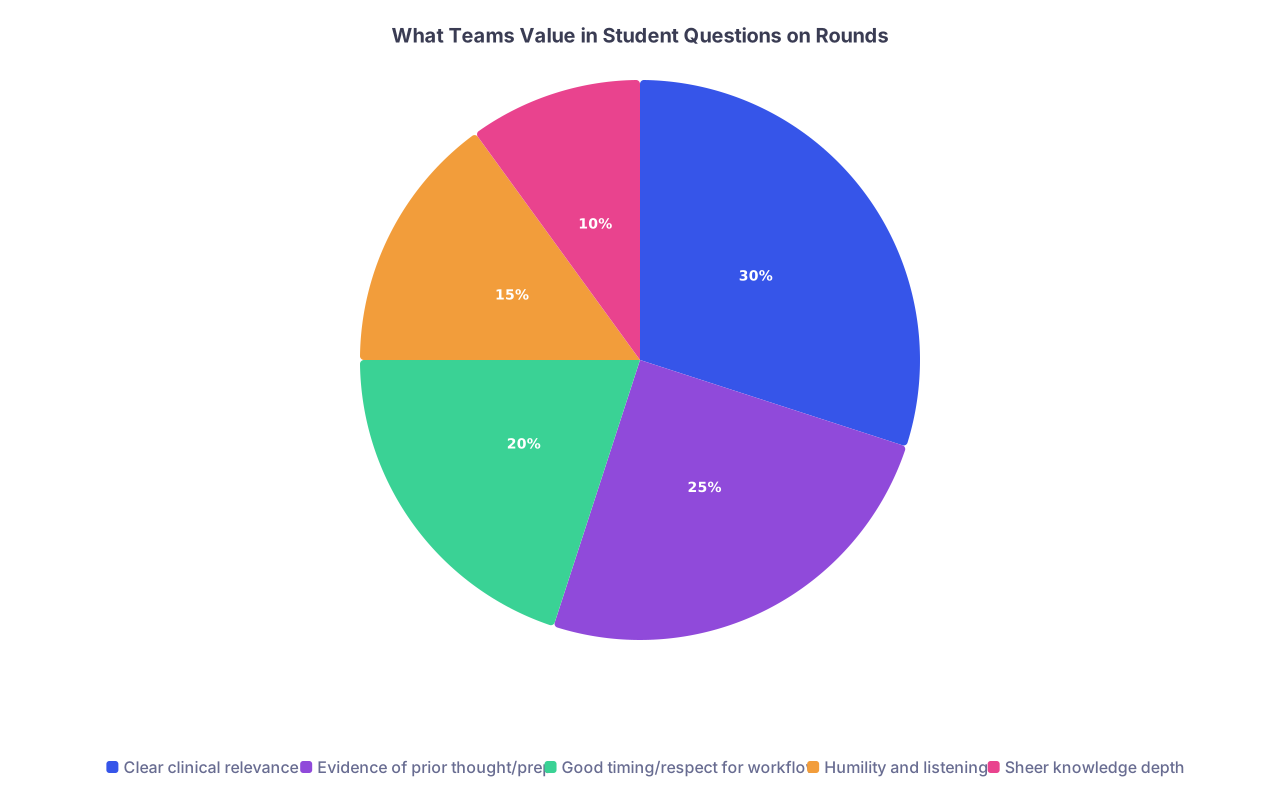
| Category | Value |
|---|---|
| Clear clinical relevance | 30 |
| Evidence of prior thought/prep | 25 |
| Good timing/respect for workflow | 20 |
| Humility and listening | 15 |
| Sheer knowledge depth | 10 |
Notice what is at the bottom: sheer knowledge depth.
Nobody cares how “advanced” your question is if you ask it at the wrong time, for the wrong reason, in the wrong way.
A Better Way To Ask Questions on Rounds
Let me spell out what good looks like, because it is not complicated.
Before rounds
- Skim your patients and read about 1–2 main problems.
- Write down questions you genuinely have.
- Star the ones that are clearly about:
- Today’s decision
- This patient
- Something that will come up repeatedly on the service
During rounds
Aim for this kind of question:
- Short
- Directly tied to the current decision
- Shows you have thought first
Examples:
- “For this patient with both COPD and heart failure, what helps you decide whether dyspnea is mainly cardiac or pulmonary today?”
- “I read that DAPT duration after stenting can vary. For this patient at high bleed risk, what helps you decide between 6 vs 12 months?”
Notice the pattern:
Patient → Decision → Your thinking → Their refinement.
Rounds Are a Test of Social Intelligence, Not Just Knowledge
The hidden curriculum of clinical rotations: everyone is quietly scoring your social judgment.
Asking questions badly on rounds broadcasts three things you must avoid:
- You do not prepare.
- You do not read the room.
- You do not distinguish between your learning needs and patient care needs.
If that is the story people tell themselves about you, your grade is done before the shelf exam even happens.
Flip that. You want them to think:
- “She asks sharp, relevant questions.”
- “He clearly thinks before he speaks.”
- “They make rounds smoother, not slower.”
You get there not by being the smartest person, but by not making the same predictable mistakes every year’s students make.

| Step | Description |
|---|---|
| Step 1 | Think of Question |
| Step 2 | Look up later on your own |
| Step 3 | Save for after rounds |
| Step 4 | Wait, write it down |
| Step 5 | Form your own answer first |
| Step 6 | Ask concise, patient-focused question |
| Step 7 | Google-level? |
| Step 8 | About this patient/decision? |
| Step 9 | Bad timing? Sick pt, urgency, emotions |
| Situation | Annoying Question | High-Value Question |
|---|---|---|
| New CHF admission | “What is heart failure again?” | “For this patient with reduced EF and CKD, how do you pick between ACEi and ARNI to start inpatient?” |
| COPD exacerbation | “What does COPD stand for?” | “He is still hypercapnic on BiPAP; at what point would you say this has failed and consider intubation?” |
| Starting anticoagulation | “What is the dose of apixaban?” | “I saw the usual apixaban dose is 5 mg BID, but we reduced it for him. Which criteria did he meet that changed the dose?” |

FAQs
1. Is it better to ask fewer questions so I do not annoy anyone?
No. The goal is not silence. The goal is selective, high-yield questions. One thoughtful, relevant question per attending per day is more than enough to show engagement. You can always ask more privately after rounds, in the team room, or during calmer teaching moments.
2. What if my attending says “any questions?” and nobody speaks?
You still follow the same rules. Ask something you have actually thought about that ties to a real patient you saw that morning. If you have nothing that meets that bar, it is acceptable to say, “Nothing from me right now, thank you,” and keep listening. Forced, low-quality questions are worse than silence.
3. How do I recover if I already asked a really bad question on rounds?
You do not over-apologize or disappear. You quietly adjust. For the next few days, prepare more before rounds, take better notes, and limit yourself to one strong, clearly relevant question per day. You can also say to a resident: “I realized I have been asking some low-yield questions on rounds. I am working on tightening that up—if you notice anything I should change, please tell me.” That kind of insight usually resets their impression quickly.
Key points:
Protect rounds. Your questions must serve patient care and the team’s workflow, not your ego or convenience.
Think first, prepare before, and time your questions to match clinical reality.
Do that, and your questions stop annoying people and start marking you as the student everyone actually wants on their team.