
The fastest way to sabotage your MS3 year is not laziness. It’s bad judgment about when to open your mouth and when to keep it shut.
Most students worry about not knowing enough medicine. Honestly? That’s usually not what hurts you. What hurts you is talking when you should be listening, staying quiet when patient safety is at stake, or choosing exactly the wrong moment to show off what you know.
Let’s walk through the most common judgment errors I’ve seen MS3s make on the wards—and how to avoid them before they poison your evals.
The Rounds Minefield: Speaking Up vs. Showing Off
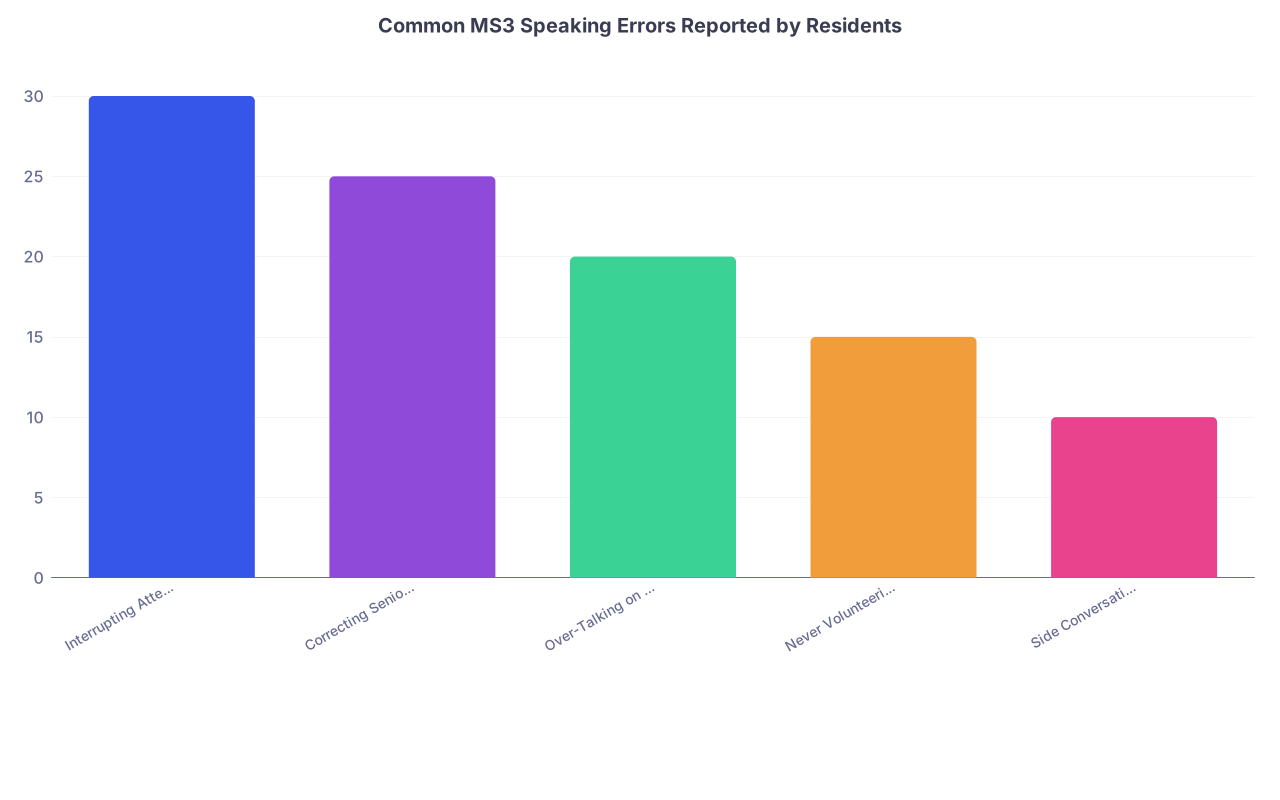
| Category | Value |
|---|---|
| Interrupting Attending | 30 |
| Correcting Seniors Publicly | 25 |
| Over-Talking on Rounds | 20 |
| Never Volunteering | 15 |
| Side Conversations | 10 |
Rounds are where most students blow it. Not because they’re dumb. Because they misread the room.
Mistake #1: Answering Every Question Like It’s a Game Show
You’ve seen this student. Attending asks a broad question to the group and one person answers. Every. Single. Time.
What happens:
- Interns get annoyed.
- Co-students hate you.
- Attending thinks you lack awareness.
The red flag line you’ll hear later in feedback: “Smart, but doesn’t always know when to step back.”
Better pattern:
- Volunteer early on a few questions to signal engagement.
- If you’ve already answered 2–3 questions in a row, consciously pause and let someone else speak.
- If the attending clearly directs a question to you—answer. That’s different from group questions.
Concrete rule: If you’ve spoken more than any intern on your team during rounds, you are talking too much.
Mistake #2: Interrupting the Attending or Resident
You think you’re being helpful. You jump in with:
- “Actually, I think her creatinine was 1.3, not 1.4.”
- “I read that SGLT2s are first line now—”
- “Wait, but isn’t that contraindicated in…”
You’ve just stepped on your senior’s sentence in front of their boss. People remember that.
When to absolutely not interrupt:
- While the attending is teaching.
- While the intern is presenting.
- While a plan is being summarized to the patient on rounds.
How to handle it correctly:
- Write your thought down.
- Let the person finish.
- Then say, when there’s a clear pause: “Can I ask something about her creatinine trend?”
You give them the option to say yes or no. That’s respect.
Mistake #3: Monologuing During Presentations
New MS3s often think “saying everything I know” = “good presentation.” Wrong. The worst ones:
- Recite the entire chart.
- Add irrelevant review-of-systems items.
- Dramatize basic complaints (“excruciating 3/10 pain”).
Residents don’t want every fact. They want what matters.
What you should do:
- Hit structure: ID, chief complaint, brief HPI, focused PMH/meds/allergies, key exam, key labs/imaging, assessment, plan ideas.
- Do not speak at 200 words per minute because you’re nervous. It sounds like you’re covering insecurity with noise.
- Stop when you’re done. No “and um… yeah… that’s it… I think.” Finish with a clear, “That’s all I have for Ms. X.”
If your resident says, “Shorter tomorrow,” they mean “That was too long,” not “Try again with slightly less detail.” Cut it in half.
Correcting Others: High-Risk, Sometimes Necessary

Here’s where judgment really matters. Sometimes you must speak up. Sometimes you absolutely should not do it in public.
Mistake #4: Publicly Correcting Your Senior to Impress the Attending
Classic disaster move.
Scenario: Intern presents: “He’s on 5 units of Lantus at night.” You, eager: “It was actually 10 units on the MAR.”
Technically correct. Socially dumb if:
- It wasn’t high-stakes.
- You could have told your intern quietly afterward.
- You did it in front of the attending.
Everyone hears it as: “See, I’m paying better attention than the intern.” That intern will later write your evaluation.
Safer version: If it’s minor and not safety-related:
- Say nothing on rounds.
- As you walk out of the room: “Hey, I think I saw 10 units on the MAR—want me to re-check?”
If it’s important but not immediately life-threatening:
- Wait for a pause, then: “I might be mixing this up, but I thought I saw 10 units of Lantus. I can confirm after rounds.”
You’re offering help, not scoring points.
Mistake #5: Staying Silent During True Safety Issues
Opposite error. You see something dangerous and freeze because you “don’t want to be wrong.”
Examples where you do speak up, even if it’s awkward:
- Wrong-side procedure.
- Documented anaphylaxis to a drug that’s about to be given.
- Massive med dose error (heparin, insulin, potassium, chemo).
- Patient clearly unstable but plan is “discharge today.”
In those cases:
- Use “I” language and uncertainty if needed, but do not disappear.
- “I might be misunderstanding, but I thought she had a documented anaphylaxis to ceftriaxone—should we double-check her allergy history before we start it?”
- Or even more direct if seconds matter: “Sorry to interrupt, but I’m worried that’s the wrong side. The consent says left.”
If you’re wrong? People might correct you. If you’re right? You just prevented harm. Residents remember that. In a good way.
Teaching Moments: Asking and Answering Questions Without Digging a Hole

| Step | Description |
|---|---|
| Step 1 | Thought arises |
| Step 2 | Speak up now, respectfully |
| Step 3 | Write down, ask at pause |
| Step 4 | Stay quiet, listen |
| Step 5 | Offer brief answer |
| Step 6 | Safety issue? |
| Step 7 | Clarification or trivia? |
| Step 8 | Already answered a lot today? |
Teaching is where you can shine or sink.
Mistake #6: Asking “Look How Smart I Am” Questions
Attending: “Any questions?”
Student: “So in resistant pulmonary hypertension when you’re deciding between epoprostenol and treprostinil, like in WHO group 1 vs 3, how do you…”
It’s transparent. You’re not confused; you’re flexing what you read last night.
Good questions:
- Clarify the plan: “Can I ask how you decided on ceftriaxone instead of piperacillin-tazobactam in this case?”
- Build a framework: “For AKI in hospitalized patients, what are the first 2–3 things you want to know to narrow the differential?”
Bad questions:
- Anything obviously just to signal how niche your knowledge is.
- Questions you could have answered by quickly checking UpToDate yourself.
Rule of thumb: If your question takes longer than 15 seconds to ask, it’s probably too long for rounds.
Mistake #7: Turning Teaching Into a Debate
You read something different last night. Now you’re convinced the attending is wrong. You decide to “discuss the evidence.”
Don’t.
On rounds:
- If your info contradicts what the attending is saying and is not about safety, you save it for later.
- “Dr. X, earlier you mentioned we don’t use steroids in COPD unless they’re severe. I saw a paper suggesting benefit even in moderate exacerbations—would this afternoon be a good time to ask you about that?”
That tone says: I’m interested, not combative.
What you absolutely do not do:
- “But UpToDate says…”
Instant credibility loss.
Talking in Front of Patients: Where Kindness and Restraint Matter

Patients are listening more than you think. Or their families are. This is where some MS3s accidentally cause harm with casual words.
Mistake #8: Speculating Out Loud
You’re thinking through a differential in your head and start talking before filtering.
You say:
- “Well, it could be cancer, or maybe a blood clot, or some weird autoimmune thing.”
- “Sometimes these can be fatal if not treated.”
You’ve just dropped a bomb the team then spends thirty minutes trying to defuse.
Out loud, at the bedside:
- Stick to what’s been reasonably established and what your senior has already shared.
- If the attending is doing bedside teaching and invites your thoughts in front of the patient, keep them structured and calm.
“I’m thinking about infection, blood clot, or fluid from heart failure as possibilities.”
If you’re not sure whether it’s appropriate to speculate in front of the patient? Don’t. Ask questions away from the bedside.
Mistake #9: Overpromising or “Translating” the Plan Incorrectly
Student to patient (thinking they’re being helpful):
- “It sounds like you’re probably going home tomorrow.”
- “This surgery should fix the problem.”
- “Once the antibiotics kick in, you’ll feel a lot better.”
Then the plan changes. Or surgery finds something worse. Or they get sicker first.
You have just unintentionally lied.
Your level-appropriate language:
- “The team is hoping you may be able to go home soon; they’ll reassess each day.”
- “The goal of the surgery is to fix the problem, but the surgeon is the best person to talk through risks and expectations.”
- “Many people start to feel better with antibiotics, but everyone’s course is different. We’ll be checking on you closely.”
If you aren’t the one placing orders or making final decisions, you should never sound more certain than the attending.
The Workroom: When to Join In, When to Shut Up
| Topic Type | Safe for MS3? |
|---|---|
| Asking about patient care | Yes |
| Clarifying expectations | Yes |
| Gossip about staff | No |
| Complaints about other services | No |
| Political / controversial topics | No |
The workroom feels casual. This is exactly where students torpedo their reputation.
Mistake #10: Joining in on Complaints and Gossip
You hear residents venting:
- “Cards always dumps on us.”
- “That attending is impossible.”
- “ED never does a proper workup.”
You think joining in will make you “part of the team.”
Wrong. They’ve known each other for months or years. You’ve been here 6 days. You have no social capital.
Your best move:
- Neutral listening noises at most.
- Shift focus to work: “Do you want me to call the nurse to check on his urine output?”
Or - “I can look up her last echo if that’d be helpful.”
Never criticize:
- Nurses
- Consultants
- Other students
- Other attendings
Even if someone else did first.
The fast track to a bad reputation is being known as “the student who talks trash.”
Mistake #11: Oversharing Your Opinions and Life Story
You’re tired. People are chatting. You start:
- Long rants about your med school.
- Complaints about grading.
- Stories that are way too personal for week 1.
Residents are vetting: Can I trust this person with patients? With families? With sensitive information?
Sharing some of yourself is fine:
- Where you’re from.
- What you’re interested in.
- Very light personal details.
What you keep to yourself:
- Your hot takes on controversial topics.
- Your frustration with previous attendings or rotations.
- Drama from your personal life.
You are not “fake” for being reserved early. You’re professional.
Knowing When Silence Hurts You
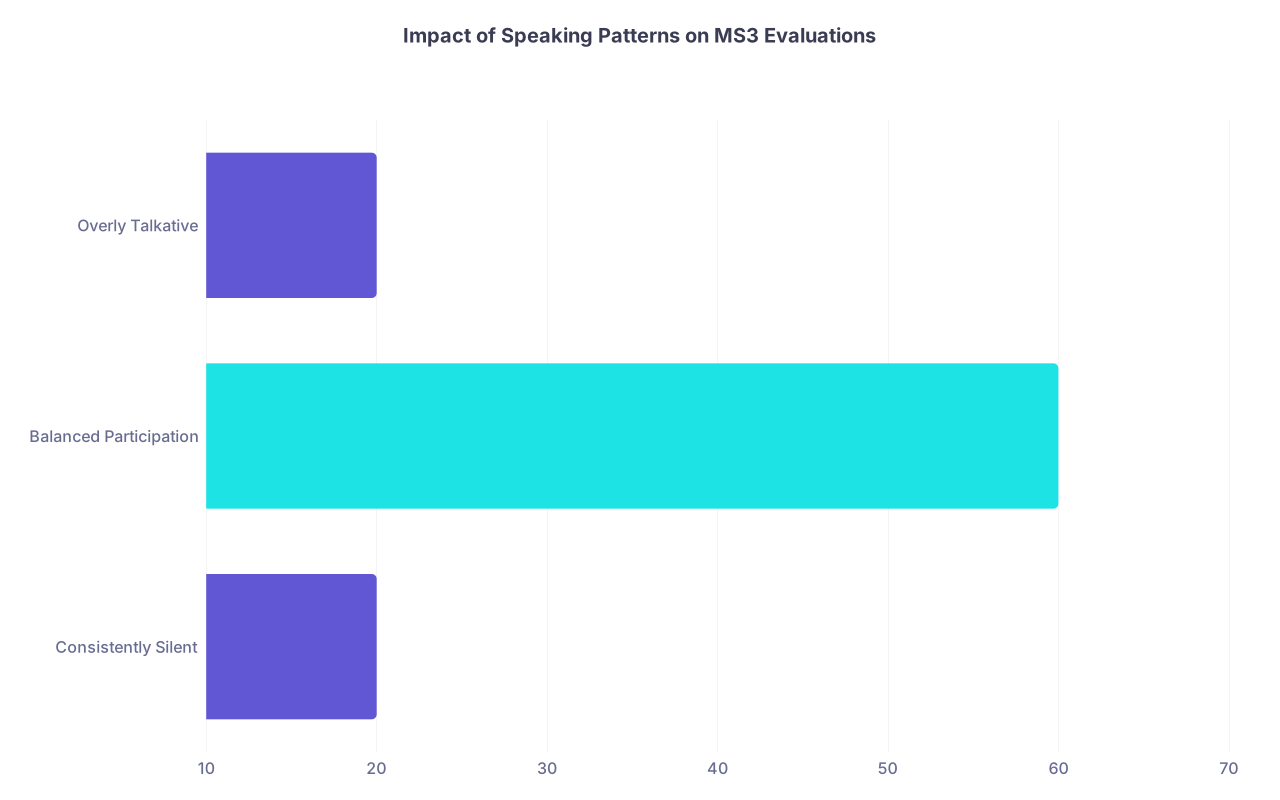
| Category | Value |
|---|---|
| Consistently Silent | 20 |
| Balanced Participation | 60 |
| Overly Talkative | 20 |
Staying quiet all the time is not “safe.” It just makes you invisible—or worse, look disengaged.
Mistake #12: Never Volunteering, Never Asking
A lot of high-achieving introverts fall into this. They think:
- “I’ll speak when called on.”
- “I don’t want to bother anyone.”
- “I’d rather be invisible than annoying.”
That reads to residents as:
- “Not interested.”
- “Low initiative.”
- “Hard to evaluate because I barely saw them do anything.”
You need to be verbally present enough that:
- They remember your name.
- They can comment on your clinical reasoning.
- They can say something concrete in “Strengths” on your eval.
Simple, safe ways to speak up:
- At the end of rounds: “Is there anything specific I can help with this afternoon? I was thinking of following up on pending cultures for Ms. X.”
- Before going home: “Anything left that I can help with before I head out?”
- During teaching: Answer 1–2 questions per session if you know the answer. It’s okay to say, “I’m not sure, but I’d guess…”
Being wrong sometimes is fine. Being blank is not.
Mistake #13: Withholding That You Don’t Understand the Plan
You nod along. You don’t really get why they’re doing what they’re doing. You don’t ask. You’re “polite.” You’re also not learning.
You don’t need to ask in the middle of a time crunch. But you do need to loop back:
- “When you have a minute later, could you walk me through why we chose heparin over DOAC in his case?”
- “I’m a little lost on how we’re thinking about his shock. Could I run the differential by you this afternoon?”
This signals engagement, not incompetence.
A Simple Mental Checklist Before You Speak

| Step | Description |
|---|---|
| Step 1 | About to speak |
| Step 2 | Attending present |
| Step 3 | Residents only |
| Step 4 | Patient/family present |
| Step 5 | Speak up now, be concise |
| Step 6 | Wait for natural pause, then ask/answer briefly |
| Step 7 | Stay quiet, write it down to ask later |
| Step 8 | Who is present? |
| Step 9 | Is it safety related? |
| Step 10 | Is it clarifying or necessary? |
Train yourself to run a 3-second filter:
- Is this about safety?
- If yes, speak up.
- Is this about clarifying the plan or learning?
- If yes, choose timing carefully.
- Is this mainly about showing what I know?
- If yes, probably stay quiet—or reframe it as a genuine question later.
FAQs
How do I recover if I already spoke up in a bad way?
Own it quickly and cleanly.
“Hey, I realized I interrupted you on rounds earlier when you were presenting. I’m sorry about that—I’ll be more careful.”
Most residents will immediately forgive and forget when a student shows insight. What they do not forget is the student who keeps doing it and never notices.
What if I’m naturally quiet and this all just makes me want to talk even less?
Then you need a minimum participation floor, not zero. Set tiny, specific goals:
- Answer at least one question per teaching session.
- Ask one thoughtful question per day.
- Verbally volunteer to help with one task per day.
You don’t have to become the loudest person in the room. You just have to be visible enough that someone can honestly say, “Engaged and interested.”
What if a resident is openly wrong and the attending might not catch it?
Separate ego from safety.
If it’s safety-critical (wrong dose, wrong patient, dangerous plan), you speak up—now, respectfully.
If it’s non-critical (slightly outdated guideline, minor detail), you:
- Write it down.
- Confirm on your own.
- Ask about it later and in private: “I saw something different in UpToDate—can you help me reconcile that?”
Protect patients first. Protect relationships second. Protect your need to be “right” dead last.
Key points:
- Over-talking, correcting publicly, and “show-off” questions will tank your evals faster than not knowing every guideline.
- Silence during true safety issues is worse than being wrong. Speak up—calmly, respectfully—when harm is on the line.
- Aim for balanced participation: present clearly, ask real questions, volunteer thoughtfully, and always read the room.