
Most “malignant” rotations do not destroy students. Students’ choices on those rotations do.
You cannot turn a truly toxic attending into a saint. You can, however, turn a likely bad evaluation into a neutral or even solidly positive one if you stop playing defense and start using a deliberate strategy.
This is not about being a doormat. It is about understanding power, patterns, and how evaluations actually get written. Then exploiting that knowledge.
Step 1: Diagnose What Kind of “Malignant” You’re Dealing With
Before you “fix” anything, you need to know what you’re up against. “Malignant” gets thrown around so much it has lost meaning. There are at least four very different beasts hiding under that label.

| Type of Malignancy | Primary Threat to Your Eval |
|---|---|
| Screamer / Bully | Emotional wear-down, fear-based mistakes |
| Nitpicky Micromanager | Death by small cuts, 'not detail-oriented' narrative |
| Ghost Attending | No face time, vague low eval from ignorance |
| Systemic Chaos | You look disorganized by association |
1. Screamer / Bully
Pattern:
- Public shaming during rounds.
- Uses “You’re not serious about medicine” as a weapon.
- Explodes on small mistakes but gives vague feedback.
Threat to your eval:
- They anchor on one or two bad moments and write a narrative of “unprepared,” “doesn’t handle stress,” “needed frequent redirection.”
Your counter:
- Minimize visible mistakes.
- Control what your allies (residents, nurses) see and say.
- Document your efforts so a single blow‑up does not define the paper trail.
2. Nitpicky Micromanager
Pattern:
- Corrects your note formatting for 10 minutes.
- Obsesses over “you didn’t pre‑read that one obscure guideline.”
- Loves phrases like, “You need to be more detail oriented.”
Threat:
- You seem constantly “almost there but not quite;” eval becomes lukewarm or quietly negative with words like “inconsistent,” “needs close supervision.”
Your counter:
- Treat them like a checklist puzzle. Once you decode their pet peeves, you can manufacture “improvement.”
3. Ghost Attending
Pattern:
- You see them 15 minutes a day.
- They do not know your name mid-rotation.
- They ask the resident team, “So how is the student?” then free‑type nonsense in the eval.
Threat:
- Random grade, often driven by the loudest opinion on the team, or generic comments that default to “meets expectations.”
Your counter:
- Structured visibility. Make your work and progress impossible to ignore in the few minutes you get.
4. Systemic Chaos (malignant culture)
Pattern:
- No one eats. Everyone stays late “because that’s how we do it.”
- Nurses are angry, staff is burned out, residents coping with sarcasm.
- No one has time to teach. But everyone has time to complain.
Threat:
- You get swept into the dysfunction and appear disorganized, unmotivated, or “not a team player.”
Your counter:
- Predictability and calm. You become the one stable, low-drama node in the system.
Your first task today: Write down which of these four matches your rotation most closely. That determines your next moves.
Step 2: Build a Survival Protocol for the Next Week
You are not trying to “win” the rotation in one day. You are trying to turn the aircraft carrier 5 degrees each week.
Here is a one‑week protocol that reliably shifts a malignant rotation toward at least a neutral evaluation.

| Step | Description |
|---|---|
| Step 1 | Today |
| Step 2 | Self-audit: identify malignancy type |
| Step 3 | Gather intel from residents & students |
| Step 4 | Set 2-3 measurable behavior goals |
| Step 5 | Execute daily: pre-round, prep, debrief |
| Step 6 | Mid-week feedback check |
| Step 7 | Adjust & document improvements |
| Step 8 | End-of-week summary email to senior/resident |
Day 0–1: Intel and Self‑Audit
Stop guessing. You need data.
Ask a trusted resident (privately):
- “What do students usually get criticized for on this rotation?”
- “If you had to pick the top 3 things that make a ‘strong student’ here, what are they?”
- “What sunk people in the past?”
Ask a slightly senior student (MS4, someone who survived):
- “If you were starting this rotation again with this attending, what would you do differently from day 1?”
- “What annoyed them the most about students?”
Do a blunt self‑audit on paper:
Columns:- Things I am clearly doing well
- Things I am getting subtle criticism on
- Things no one mentions (often means “too invisible”)
From this, extract 2–3 specific behaviors to change that week. Not vague nonsense like “work harder.” Concrete moves like:
- “Be the first to volunteer to present at least one patient daily.”
- “Have a one‑line update and plan ready for every patient without being asked.”
- “Clarify expectations on arrival and send a short summary email mid‑week.”
Day 2–5: Lock In Three High-Yield Behaviors
These are the behaviors that most reliably move an eval from negative‑leaning to at least neutral, often better.
1. Pre‑round like your eval depends on it (because it does)
On malignant rotations, being even slightly underprepared is blood in the water.
Your rule:
- For each patient you might touch on rounds, know:
- Overnight events (any PRNs, rapid, hypotension, new consults).
- Vital trends (not just “vitals stable” – mention the key change).
- Labs/imaging that matter for today’s decision.
- One sentence of assessment + next step.
If you have limited time:
- Prioritize the sickest 2–3 patients and new admits.
- For lower acuity patients, at least have “NAD, no new complaints, no changes” plus one idea to streamline their care (de‑escalate, remove lines, dispo step).
This is not about being brilliant. It is about never being obviously clueless.
2. Make your reliability extremely visible
Malignant attendings often accuse students of being “checked out” or “unreliable” because they simply do not see their work.
You fix that with:
- Clear check‑ins. “I will go see Ms. X and update her med list now; I will be back in 20 minutes with an updated note.” Then do it.
- Mini‑summaries. After tasks: “I called radiology, CT is scheduled for 3 pm, contrast precautions in note. Anything else on that patient?”
Short, direct, unemotional. You are building a narrative: “This student gets things done.”
3. Control your face and your volume
Minor but lethal:
- Eye‑rolling, sighs, micro‑expressions during rounds.
- Whispering with other students.
- Looking at your phone (even if it is UpToDate).
You can be exhausted internally. Externally, you are:
- Calm.
- Neutral.
- Slightly forward in posture, pen in hand, looking at whoever is speaking.
If this sounds basic, that is because it is. But I have seen multiple students tanked on evals with lines like, “seemed disengaged” or “did not appear interested in the field” based on facial expressions alone.
Step 3: Use Feedback as a Tool, Not a Threat
Most students treat “Do you have feedback for me?” as a ritualistic line they mumble once mid-rotation. Then they do nothing with the answer.
That is useless. On malignant rotations, you weaponize feedback in your favor.
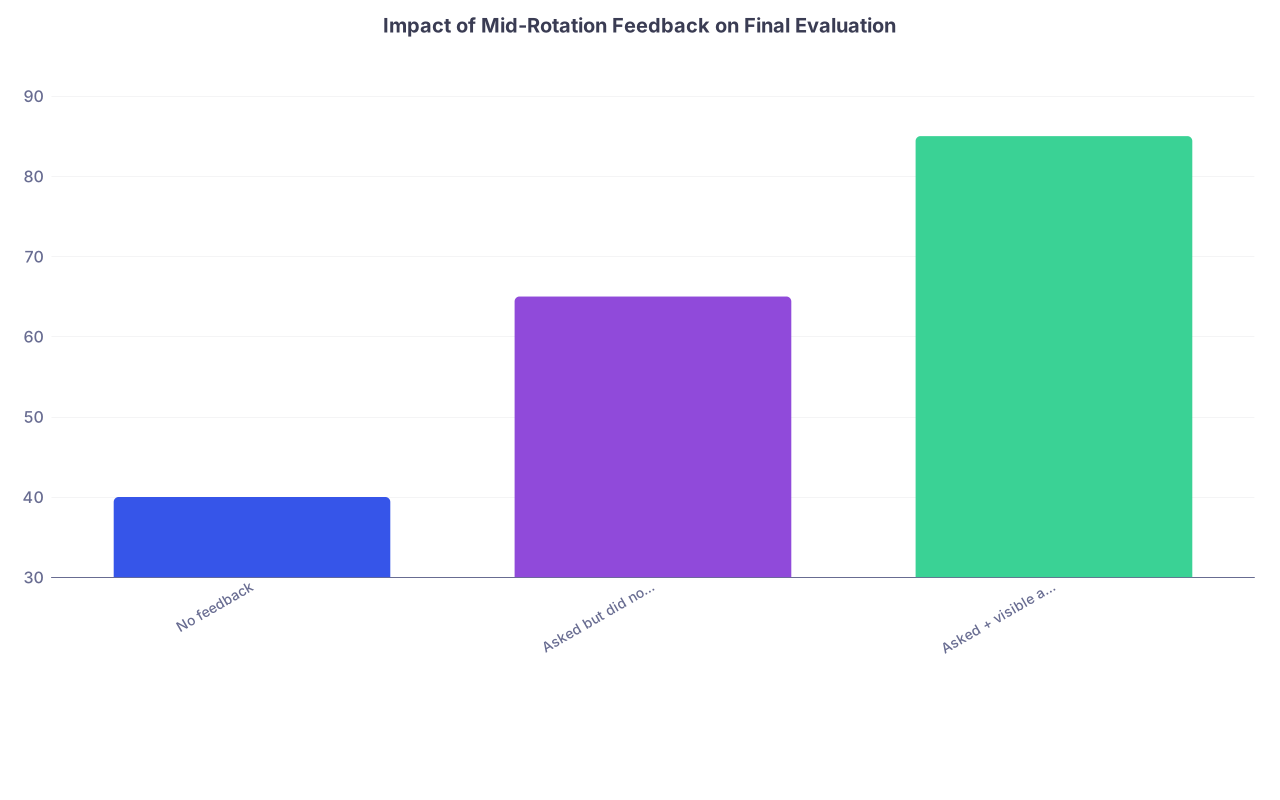
| Category | Value |
|---|---|
| No feedback | 40 |
| Asked but did not adjust | 65 |
| Asked + visible adjustment | 85 |
(Those numbers mirror what I have seen anecdotally: your chance of at least a neutral eval skyrockets when supervisors can see you adjust.)
How to ask for feedback in a way that helps you
Do this around the 25–40% mark of the rotation, not the last week.
Use a script like this with your senior resident or attending:
“I want to make sure that by the end of this rotation, I am meeting or exceeding expectations. If you had to pick one or two things I should change or focus on over the next week, what would they be?”
Then shut up. Write it down. Repeat it back:
- “So, focus on being more concise in my presentations, and reading more about our ICU patients, especially ventilator management. Did I get that right?”
How to visibly implement feedback
Implementation is where students usually fail.
You need:
- A clear signal back to the evaluator: “I heard you and I changed.”
Example:
- Feedback: “Be more concise in presentations.”
- Your move: Next day on rounds, you start with: “For the patients I follow, I tried to tighten my presentations to under 2 minutes; let me know if this is closer to what you are looking for.”
Now when you present succinctly, the attending mentally checks a box: “Improves with feedback.” This phrase alone can rescue a rotation that started rocky.
If feedback is vague (“Just keep reading”), translate it:
- “Would it be more helpful if I read about core topics in general, or should I prioritize reading about my specific patients tonight and coming prepared with one or two learning points?”
Force them to choose something measurable. Then execute.
Step 4: Create Allies Who Quietly Defend You
On a malignant rotation, you will not always change the attending. But you can build a coalition around you.
Residents: your primary shield
Residents usually write input that attendings glance at while filling formal evals. If you are suffering under a malignant attending, residents can save you if:
- They see you being prepared.
- You make their lives easier in small but real ways.
- You never throw them under the bus.
High‑yield resident moves:
- Ask, “What’s the most helpful thing a student can do for you on call?” Then just do that. No drama.
- Offer, “I can pre‑chart or update the sign‑out for these 2 patients if that helps.”
- Before you leave: “Is there anything else small I can wrap up before I head out?”
This is boring. It is also exactly how you earn lines like “Essential part of the team” on your eval.
Nurses and staff: quiet influence
They do not fill your eval. But their complaints or praise leak.
Do three things:
- Learn and use names. Not “nurse,” not “tech.” Names.
- Ask once per patient: “Is there anything I can do to help with Ms. X right now?”
Sometimes the answer is “no.” Sometimes it is “can you help her order her tray,” which takes 2 minutes and buys you significant goodwill. - Never be in the way. If you are standing where they need to reach, you move first.
Small details. Big effect on the overall vibe around you.
Step 5: When You’ve Already Screwed Up
Maybe you were late twice. Maybe you froze on rounds. Maybe you snapped back at a malignant attending who was absolutely baiting you.
Rotation is not over. You can still salvage.
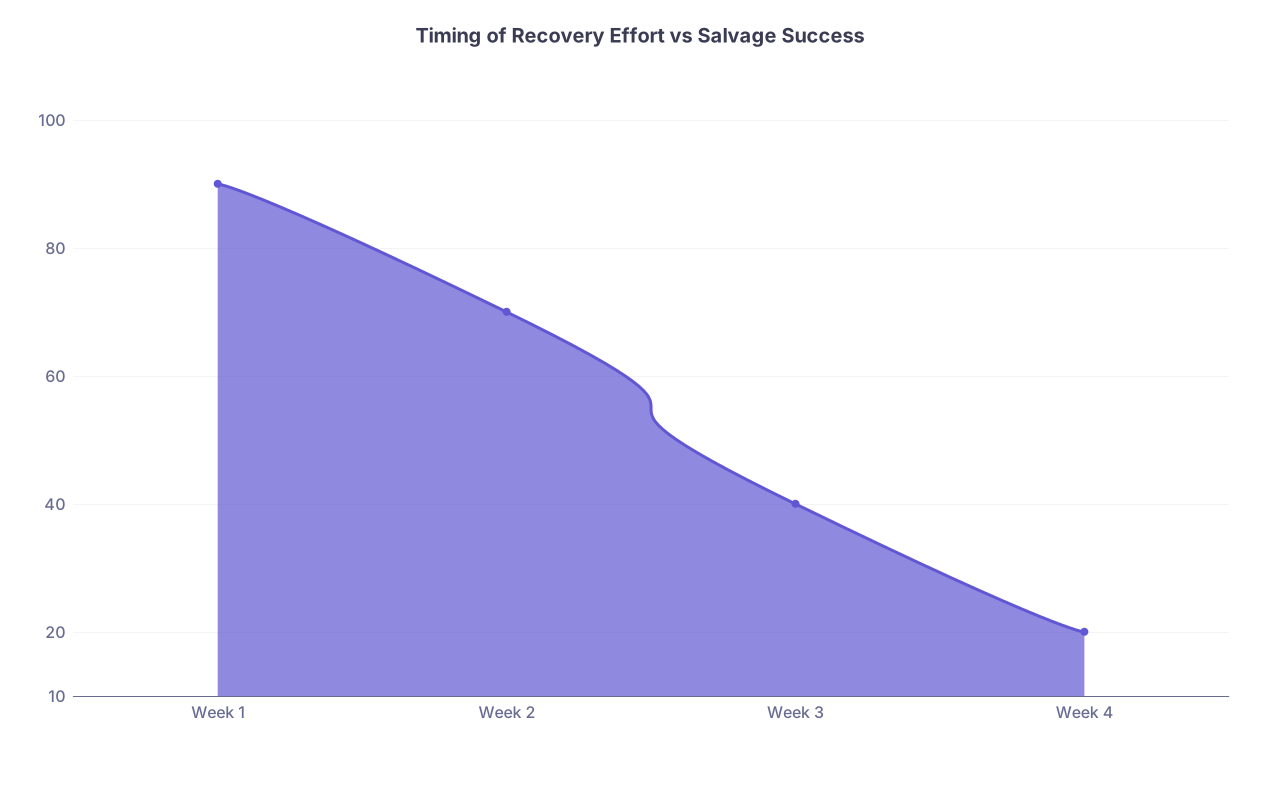
| Category | Value |
|---|---|
| Week 1 | 90 |
| Week 2 | 70 |
| Week 3 | 40 |
| Week 4 | 20 |
The longer you wait, the harder it gets. But here is the protocol.
Step A: Own it once, cleanly
To the person who matters most for your eval (often senior resident or attending):
“I wanted to acknowledge that I [was late on Monday / got flustered and did not know basic facts on Ms. X / came across as defensive yesterday]. That is not the standard I have for myself. I have already changed [specific behavior: set two alarms, pre‑chart earlier, outline presentations]. I appreciate any chance to show you I can do better.”
Key points:
- One sentence of ownership.
- One sentence of specific fix.
- No long explanations unless they directly impact patient care realism (e.g., you had a genuine emergency, which should have been communicated earlier anyway).
Step B: Over‑correct visibly for 5–7 days
You will feel like you are overdoing it. Good.
- If you were late: you are now the first one in the work room, logged in, computer on.
- If you were underprepared: you become the reference person for your 2–3 patients.
- If you were defensive: you start explicitly thanking people for correction.
“Thanks for pointing that out; I will adjust how I present those labs.”
Are you being slightly performative? Yes. You are performing professionalism and growth. That is the game.
Step C: Ask for a micro‑check-in
After several better days:
“You gave me feedback about [issue]. I have been focusing on [specific changes]. Is this more in line with what you expect, or is there something else I should be doing?”
You are trying to force a mental reset in their head:
- Old narrative: “This student is unprepared / sloppy / defensive.”
- New narrative: “Student had a rough start but improved significantly.”
That “improved significantly” line is pure gold on evals.
Step 6: Protect Yourself When Things Cross the Line
Some rotations are not just malignant. They are unsafe or abusive. You still want to protect your evaluation, but not at the cost of your sanity or safety.
You need two parallel tracks:
- Short‑term: Survive the rotation and salvage the eval as much as possible.
- Long‑term: Create an official record that you were dealing with a problem environment.
What should trigger escalation
Non‑negotiables:
- Sexist, racist, or otherwise discriminatory remarks about you or patients.
- Threatening behavior (physical intimidation, throwing objects).
- Humiliation that is persistent and personal (not educational “pimping,” but targeted degradation).
- Being asked to do something clearly unsafe or unethical and then punished for refusing.
If any of that is happening:
- Start a dated log. Short entries:
- “2026‑01‑05: Attending X said Y in front of team; resident A and nurse B witnessed.”
- Keep copies of relevant emails or messages (screenshots if needed).
- Identify one outside person you trust: clerkship director, dean of students, a faculty mentor not tied to that department.
You are not “overreacting.” You are building documentation.
How to escalate without immediately blowing up your eval
The finesse move: focus on learning environment, not personal feelings, at first.
Example email to clerkship director:
Subject: Concern about learning environment on [Service]
Dear Dr. [Name],
I am a [MS3/MS4] currently on [rotation] with [attending]. I am committed to doing well and learning as much as I can, but there have been several situations that have made the environment feel less conducive to learning and occasionally uncomfortable.
I would appreciate the chance to briefly discuss this with you and to get your guidance on how best to handle the rest of the rotation while maintaining professionalism and meeting expectations.
Best,
[Name], [School, Class Year]
On the call or meeting, bring:
- Your log.
- Concrete examples, not just “They’re mean.”
- A clear statement: “My goals are to learn, to remain professional, and to end the rotation with a fair evaluation. I would appreciate your help aligning those.”
Sometimes the director will quietly talk to the attending. Sometimes they will adjust how much weight that attending’s eval carries. Sometimes they will move you. All are better than suffering in silence.
Step 7: Write Your Own Narrative Before the Eval is Filed
You do not control what they write. But you can strongly influence how they think when they write it.
End‑of‑rotation summary email (underused and very effective)
Send a short email to your primary attending or senior resident in the last 2–3 days:
Subject: Thank you / summary from [Your Name]
Dear Dr. [Name],
Thank you for the opportunity to work with you on [service]. I learned a great deal, especially about [2–3 specific topics, e.g., managing decompensated cirrhosis, structuring focused daily assessments, and understanding peri‑operative risk].
Based on your feedback, I focused on [being more concise in presentations / improving my pre‑rounding / taking more initiative with patient tasks], and I felt I made progress in those areas by [brief concrete example].
I appreciate your teaching and the chance to care for your patients.
Best regards,
[Your Name], [MS3/MS4, School]
Why this works:
- It reminds them that you did improve with feedback.
- It gives them language they can lazily reuse in the eval (and many do).
- It ends the rotation on a professional, non‑defensive note.
Common Scenarios and How to Flip Them

Scenario 1: Attending grills you on rounds, you blank, they look disgusted
Do NOT:
- Argue: “We did not learn that yet.”
- Sulk for the rest of rounds.
- Avoid eye contact for 3 days.
Do:
- After rounds, ask resident: “What should I specifically read about from that case for tomorrow?”
- That night, read targeted material, not a 400‑page textbook.
- Next day, early in rounds, say: “I read about [topic] last night after our discussion and had a question about how it applied to Ms. X…”
You just converted a humiliation into “teachable moment + clear improvement.”
Scenario 2: Resident clearly dislikes you and is bad‑mouthing you
First, confirm. Do not assume.
Ask a neutral resident:
- “I feel like I am not meeting [Resident Y]’s expectations, but I want to do better. Have they said anything specific about what I should improve?”
If you confirm there is a problem:
- Direct calm conversation with that resident:
- “I get the sense that I am not meeting your expectations, and I want to fix that. If you are comfortable sharing, what are 1–2 behaviors I should change over the rest of the rotation?”
- Implement exactly what they say.
- If they stay hostile and petty despite visible change, you now have evidence for your clerkship director that you attempted good‑faith improvement.
Final Checklists: What To Do Starting Tomorrow
10 Moves That Shift a Malignant Rotation Toward Neutral/Positive
- Identify your malignancy type (screamer, micromanager, ghost, chaotic).
- Get explicit intel from residents and prior students.
- Pick 2–3 concrete behavior changes per week.
- Pre‑round on “your” patients and know overnight events cold.
- Make tasks and follow‑through highly visible to the team.
- Ask for feedback early and implement it visibly.
- Build allies: be meaningfully helpful to residents and staff.
- If you screw up, own it once, then over‑correct for a week.
- Document any truly abusive patterns and loop in a clerkship leader.
- Send a concise end‑of‑rotation summary / thank‑you email that highlights your improvement.