You are here
It’s Friday afternoon. Orientation just ended. You’ve got your badge, a loose idea of where to show up on Monday, and that pit in your stomach that says, “I am absolutely not ready for this.”
You’ve got one weekend before your next core rotation starts—maybe it’s your first (terrifying), maybe it’s your third (you’re tired), maybe it’s surgery and you’re already mourning your sleep.
Here’s how to use this weekend correctly, hour by hour, so you’re not that lost MS3 wandering the halls at 5:03 a.m. clutching a cold coffee and a dead pager.
Friday Evening: Close Out, Then Reset
Friday night is not for “grinding.” It’s for closing the last chapter and setting the stage for the next one.
1. 5–7 p.m.: Officially close the previous rotation
At this point you should:
Check your email and LMS:
- Confirm all eval forms are done.
- Make sure your end-of-rotation exam scores and evaluations are submitted or pending only from faculty.
- Download/print any feedback you got. You will forget later.
Document what you learned:
- Take 10–15 minutes to type a quick debrief:
- What attendings liked about you.
- What they told you to fix (e.g., “know vitals cold,” “be more concise,” “read on your patients”).
- Save that in a “Clinical Rotations Master Doc.” You’ll reference it later.
- Take 10–15 minutes to type a quick debrief:
Administrative cleanup:
- Return old pagers, equipment, or any site-specific items if required.
- Confirm there’s no lingering paperwork from the last site (immunization updates, training modules, etc.).
If something from the old rotation is still hanging over you—late assignment, missing eval—send the email now asking for clarification or an extension. Do not carry that anxiety into Monday.
2. 7–9 p.m.: Get your rotation logistics rock solid
You cannot “wing it” on basic logistics. That’s how people show up on the wrong floor in business casual while everyone else is in scrubs.
At this point you should:
Re-read your rotation welcome email.
- Highlight:
- Exact start time and location for Day 1.
- Dress code (scrubs vs formal; white coat vs no coat).
- Contact person for Monday (chief resident, coordinator, attending).
- Call schedule or any pre-assigned shifts.
- Highlight:
Text or message classmates who already did this rotation at your site:
- Ask very specific questions:
- “Where exactly did you meet on day one?”
- “What time did people actually arrive?”
- “What did you carry in your pockets that you actually used?”
- “Any attendings notorious for hating late arrivals?”
- Copy their answers into your doc.
- Ask very specific questions:
Put details into your calendar:
- Add:
- Daily start times with travel time built in.
- Known call shifts.
- Shelf exam date.
- Mandatory didactics.
- Add 1–2 recurring blocks for studying (example: 7–8 p.m. weeknights, 2–4 p.m. Sunday).
- Add:
You want zero ambiguity about when and where you need to be on Monday.
Saturday Morning: Systems, Not Cramming
Saturday morning is where you build your systems. Not where you read 12 chapters of surgery and remember none of it.
3. 8–10 a.m.: Set up your tools and tech
You’re still fresh. Good time to do mentally light but important setup.
At this point you should:
Build your “pocket brain”:
- Decide your format:
- Small notebook, index cards on a ring, or a note app (Notion, Apple Notes, OneNote).
- Create quick-reference pages tailored to the rotation:
- For IM/FM: H&P template, daily progress note skeleton, common admission orders (fluids, DVT ppx, diet).
- For Surgery: Pre-op note template, post-op check, fluid/electrolyte cheat sheet, pain/nausea orders.
- For OB/GYN: Labor note template, GTPAL, prenatal labs, postpartum hemorrhage steps.
- For Peds: Weight-based dosing note, PEDs vitals by age, dehydration assessment.
- Decide your format:
Install/update clinical apps:
- Essentials:
- UpToDate or similar.
- MDCalc.
- Epocrates / Micromedex or whatever your hospital uses.
- qMD / AMBOSS / UWorld app if you use them for questions.
- Log in to each. Make sure offline access is set up where possible.
- Essentials:
Create 2–3 common note templates:
- On your laptop (or in a secure document if allowed), create:
- One full H&P.
- One daily progress note.
- One brief sign-out template.
- Keep them generic but structured. You’ll adapt per service.
- On your laptop (or in a secure document if allowed), create:
4. 10 a.m.–12 p.m.: Rotation-specific light prep
This is not the time to try to learn the entire field. You’re setting the skeleton.
Focus on:
- What attendings expect in the first week.
- The most common presentations.
Here’s what to do, rotation by rotation.
| Rotation | Focus for Weekend | Key Topics (Examples) |
|---|---|---|
| Internal Med | H&P and presentations | Chest pain, SOB, sepsis |
| Surgery | Workflow and post-op care | Post-op orders, fluids, pain |
| OB/GYN | L&D basics | Labor stages, FHTs, PPH |
| Pediatrics | Age-based norms | Vitals, dosing, vaccines |
| Psych | Interview structure | MSE, suicide risk, psychosis |
| Family Med | Outpatient visits | DM, HTN, well visits |
Practical plan:
Spend 60–90 minutes on:
- Reading the first 1–2 high-yield chapters or sections (case-based is better than dense textbooks).
- Skimming a “Day 1 on X rotation” blog/post if your school provides it or older students have written one.
Spend another 30–60 minutes on:
- Watching 2–3 short videos on “Approach to [X]” that you’ll definitely see (e.g., chest pain, abdominal pain, vaginal bleeding, post-op fever).
You should finish Saturday morning with:
- A basic mental model of common patients.
- A rough idea of how to present those patients without sounding totally lost.
Saturday Afternoon: Gear, Environment, and Life Setup
By now you’re probably tempted to lie down and scroll. Don’t. This next block saves you from so much pain mid-rotation.
5. 1–3 p.m.: Gear check and physical prep
At this point you should lay everything out like you’re packing for a short deployment. Because you sort of are.
Do a full “gear audit”:
Wardrobe:
- Confirm:
- You have 3–5 sets of scrubs that fit and are rotation-appropriate (no wild colors if your hospital hates that).
- 1–2 pairs of comfortable, closed-toe shoes that you can stand in for 10+ hours.
- Clean white coat(s) with your name clearly visible.
- Try them on. If something’s uncomfortable now, it’ll be unbearable on post-call day.
- Confirm:
Bag / backpack:
- Pack:
- Small notebook and pens (plural; pens walk away).
- Highlighter.
- Clipboard or folio if you like structure for rounding lists.
- Badge and keys.
- Charger and possibly a small battery pack.
- A non-perishable snack stash (protein bars, nuts).
- Refillable water bottle.
- Pack:
Pockets (yes, this matters):
- Decide your default pocket layout. Example:
- Right white-coat pocket: pocketbook / small reference.
- Left: mini-notebook, folded patient list.
- Chest pocket: 2 pens + 1 backup, small flashlight or penlight.
- You want muscle memory. Not fumbling.
- Decide your default pocket layout. Example:
Hygiene/comfort prep:
- Stock:
- Blister Band-Aids or moleskin.
- Tylenol or ibuprofen.
- Hand lotion and chapstick (especially with constant handwashing).
- Put a small “comfort kit” in your locker or bag.
- Stock:
6. 3–4 p.m.: Home base logistics
Rotations fall apart not just from medical stress, but from life chaos. Fix what you can now.
At this point you should:
Plan your food:
- Decide:
- Who’s cooking and when (if you live with someone).
- What you’ll eat for breakfast for the first 3–4 days. Make it automatic (yogurt + granola, overnight oats, egg sandwich).
- Do a brief grocery run:
- Breakfast food for the week.
- Packable lunches/snacks if your hospital cafeteria is unreliable or expensive.
- Decide:
Prep your commute:
- Do a trial run if the site is new:
- Drive, bus, ride-share, whatever you use.
- Check real-world timing. Parking situation. Which door is actually open early.
- Plan your leave-the-house time for Monday. Then move it 10–15 minutes earlier.
- Do a trial run if the site is new:
Sleep environment:
- Wash bedding.
- Blackout curtains or sleep mask if you’re going into nights or surgery-type hours.
- Set a bedtime alarm on your phone that says “GO TO BED. SERIOUSLY.” at a reasonable time.
Saturday Evening: Light Review, Then Off
You’re not a hero for studying until midnight the night before 4:30 a.m. rounds. You’re just tired and slower on Monday.
7. 5–7 p.m.: Learn the language of the rotation
At this point you should get fluent in how people talk on that service. The buzzwords. The rhythms.
Focus on:
How to present:
- Internal med: SOAP style, assessment with prioritized problem list.
- Surgery: Problem-based but surgical, focused on overnight events, exam, lines/drains/tubes, I/Os.
- OB: Brief, targeted—gestational age, problem, FHT, cervical exam.
- Peds: Include weight, immunizations, parents’ concerns, feeding/diaper output.
How sign-out works:
- Look up or ask:
- What system your hospital uses (Epic handoff, paper, sign-out list).
- What elements are essential (code status, active issues, pending labs/imaging).
- Look up or ask:
Quick drill:
- Write 1–2 fake presentations in your notes:
- “Admit: 65-year-old male with chest pain, rule-out NSTEMI.”
- “Post-op day 1 s/p laparoscopic cholecystectomy.”
- Practice saying the presentation out loud, once or twice. Yes, out loud. You’ll instantly hear where you ramble.
8. 7–10 p.m.: Off the clock
At this point, you log off. Seriously.
- No more reading.
- No more “just a few more questions.”
Do something that:
- Gets you away from a screen.
- Actually relaxes you (not fake relax like doomscrolling).
Walk. See a friend. Watch one movie. Just don’t stay up late trying to become an expert in OB in one sitting. You’ll be worse for it on Monday.
Sunday Morning: Set the Academic Plan
Sunday morning is where you decide how you’re going to study sustainably during this rotation. If you skip this, you’ll be cramming 1,000 questions the last week and hating everything.
9. 8–10 a.m.: Map the shelf prep
At this point you should:
Pick your primary study resources:
- One main text / outline:
- IM: Step-Up, OnlineMedEd notes, or AMBOSS articles.
- Surgery: Pestana, OnlineMedEd surgery, or equivalent.
- OB/GYN: UWise, Blueprints, or AMBOSS.
- Peds: BRS Peds, Case Files, or AMBOSS.
- Psych: First Aid Psych, Case Files, or AMBOSS.
- One question bank:
- UWorld / AMBOSS / NBME/UWise questions depending on rotation.
- One main text / outline:
Do the math:
- Count:
- How many chapters/cases.
- How many questions in your QBank section.
- Divide by the number of weeks.
- Then divide by days you realistically can study (e.g., 5 days/week, not 7).
- Count:
Example:
Surgery:
- 300 questions over 8 weeks.
- You realistically study 5 days/week.
- 300 ÷ (8×5) ≈ 7–8 questions/day.
- So set a floor: 10 questions per study day. More on lighter days.
Put this into your calendar:
- “Daily: 10–20 questions + review explanations (30–45 min).”
- “Weekly: 1–2 chapters/cases.”
You’re building a minimum plan that you can hit even post-call. Anything more is bonus.
10. 10–11 a.m.: Learn the “first week topics”
Pick 3–5 topics you are almost guaranteed to see in week one, tailored:
Internal Med:
- Chest pain.
- Shortness of breath.
- AKI.
- Sepsis.
Surgery:
- Post-op fever.
- Abdominal pain.
- SBO vs ileus.
- Fluid resuscitation.
OB:
- Labor stages.
- Pre-eclampsia.
- Fetal heart tracings.
- Postpartum hemorrhage.
Peds:
- Fever by age.
- Bronchiolitis.
- Dehydration.
- Well-child visits.
Psych:
- Suicidal ideation assessment.
- Psychosis vs delirium.
- Mood disorders.
Spend an hour doing:
- One focused video or section per topic.
- 2–5 related questions if you have them.
You’re not trying to master the rotation. You’re aiming to not blank on the most bread-and-butter cases.
Sunday Afternoon: Script Your First Day
Now you zoom in. Monday.
11. 1–2 p.m.: First-day script and mental rehearsal
At this point you should:
Write down your Monday timeline:
- Example for surgery:
- 4:30 a.m. – Wake up.
- 4:45 – Quick breakfast / coffee.
- 5:10 – Leave apartment.
- 5:30 – Park and walk in.
- 5:40 – Change into scrubs.
- 5:50 – On the floor, print patient list (if allowed) / find resident.
- Adjust for your specific rotation.
- Example for surgery:
Pack your bag for Monday:
- Everything from your gear list goes in the bag.
- Lay out:
- Scrubs.
- Undershirt.
- Socks.
- Shoes.
- White coat.
- Badge.
Decide your 1–2 goals for Day 1:
- Make them behavioral, not outcome-based:
- “Introduce myself to every team member and learn their names.”
- “Ask to follow at least 1–2 patients and present on rounds, even if rough.”
- “Write at least one note, even if it needs heavy editing.”
- Make them behavioral, not outcome-based:
Write these down. Glance at them in the morning.
12. 2–3 p.m.: Clarify expectations
If anything is still unclear—timing, where to go, what to wear—you deal with it now, not at 10 p.m.
You can:
- Re-skim emails for details you might’ve missed.
- If absolutely necessary, send a brief, respectful email to:
- The coordinator or chief resident, not the PD, asking:
- “Just to confirm, for tomorrow should I arrive at [time] at [location] in [dress code]?”
- The coordinator or chief resident, not the PD, asking:
This email should be one to two sentences. Do not send a wall of questions. Show you’ve read what they already sent.
Sunday Evening: Wind Down and Protect Sleep
This part most people botch. They panic-study and then sleep like garbage. Do it differently.
13. 5–6 p.m.: Final light touch
At this point you should:
- Do one very low-stress task:
- Skim your pocket brain.
- Review your first-day timeline.
- Look over the 3–5 first-week topics headings to refresh.
No new heavy learning. Just reinforcing structure.
14. 6–9 p.m.: Downshift aggressively
- Eat something easy on your gut.
- Avoid heavy/greasy food that’ll make you miserable at 4:30 a.m.
- Limit caffeine after mid-afternoon.
- Put your phone on Do Not Disturb by 8–9 p.m. if you need an early wake-up.
Aim for:
- In bed at least 7–8 hours before your alarm.
- If you can’t fall asleep, fine. Just lying there resting is still better than scrolling.
Set:
- 1 main alarm.
- 1 backup alarm.
- If you’re paranoid, put your phone across the room.
Quick Visual: Weekend Prep Timeline
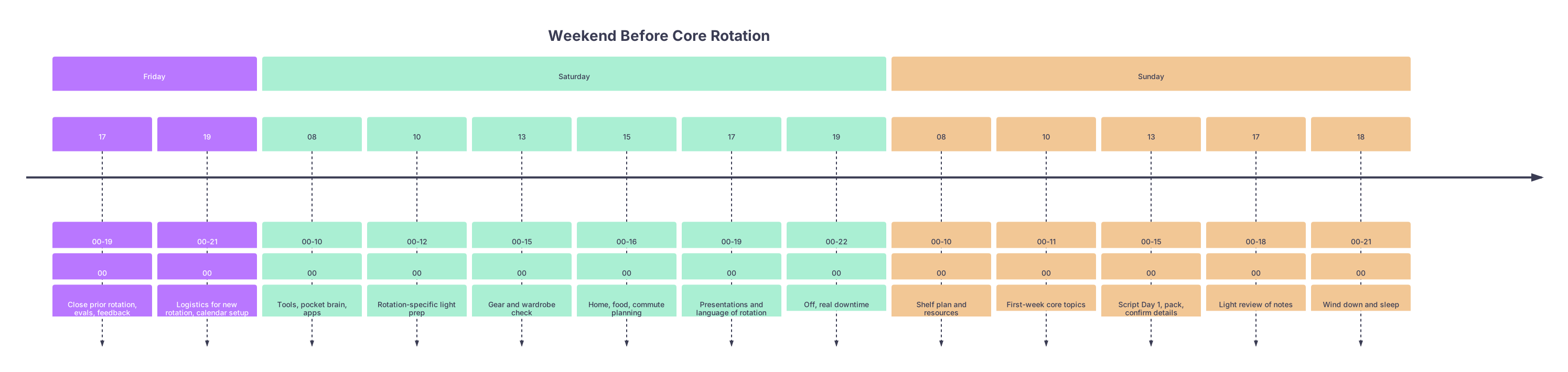
| Period | Event |
|---|---|
| Friday - 17 | 00-19 |
| Friday - 19 | 00-21 |
| Saturday - 08 | 00-10 |
| Saturday - 10 | 00-12 |
| Saturday - 13 | 00-15 |
| Saturday - 15 | 00-16 |
| Saturday - 17 | 00-19 |
| Saturday - 19 | 00-22 |
| Sunday - 08 | 00-10 |
| Sunday - 10 | 00-11 |
| Sunday - 13 | 00-15 |
| Sunday - 17 | 00-18 |
| Sunday - 18 | 00-21 |
What Actually Matters Most
By the time you go to bed Sunday, you should have:

- Zero confusion about logistics. You know when and where to show up, what to wear, who to look for, and how long it takes to get there.
- A basic clinical structure. You have a pocket brain, a few core topics in your head, and a plan for how you’ll study a little every day.
- Life supports in place. Food, commute, sleep, and gear are stable enough that you’re not fighting fires all week.
The students who do well on rotations aren’t usually the ones who read the most this one weekend. They’re the ones who use this weekend to build a system they can actually sustain for six or eight weeks straight. You’ve got 48 hours. Use them for structure, not panic.