

Clinic days and inpatient days are not the same job wearing different clothes. They are different games with different rules, and students who treat them as interchangeable waste a lot of learning potential.
Let me break this down specifically: if you walk into clinic with an “inpatient preround and present” mindset, you will frustrate your preceptor and see three patients all day. If you walk onto the wards with a “quick outpatient visit” mindset, you will miss subtle decompensations, fumble sign-out, and look unprepared. The content might overlap—hypertension, heart failure, diabetes—but the cognitive workflow, time horizon, and expectations are completely different.
You need two playbooks.
Below, I am going to spell out how clinic and inpatient differ, how to adjust your workflow hour by hour, and how to set rotation goals that actually match the environment you are standing in.
The Core Difference: Time Horizon and Purpose
On paper, both settings are “patient care.” In practice, they are built around different questions.
- Inpatient medicine asks:
“Why is this person sick enough to be here today, and what do we have to do in the next 24–72 hours to change that?” - Clinic asks:
“Where is this person headed over months to years, and what can we realistically change in the next 15–30 minutes?”
If you do not adjust to that time horizon, your workup and presentations will feel wrong. For example:
- New heart failure patient, decompensated, in the ED going upstairs: you center your thinking on acute precipitant, volume status, oxygenation, need for diuresis, monitoring level, and short-term risk.
- Chronic heart failure patient, euvolemic, seen in clinic: your frame shifts to medication adherence, titration, comorbidities, vaccination, symptom trajectory, and follow-up.
Same disease. Different job.
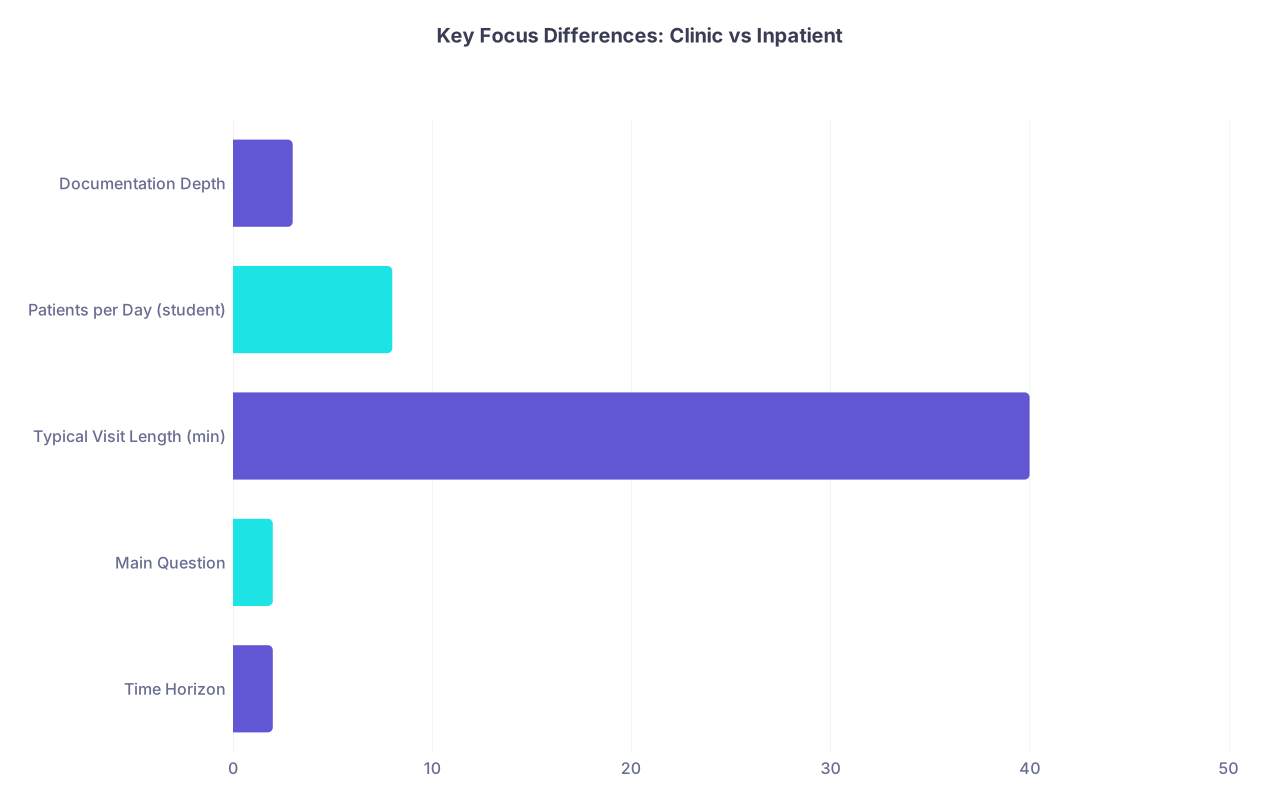
| Category | Value |
|---|---|
| Time Horizon | 2 |
| Main Question | 2 |
| Typical Visit Length (min) | 40 |
| Patients per Day (student) | 8 |
| Documentation Depth | 3 |
Legend for the above (because otherwise the numbers are meaningless):
- Time horizon: 1 = hours-days, 2 = weeks-years
- Main question: 1 = “why sick now?”, 2 = “trajectory and prevention”
- Typical visit length: clinic ~20–30 min vs inpatient encounters are scattered but deeper
- Patients per day (student): clinic ~6–10 vs inpatient ~3–6 (depending on service and level)
- Documentation depth: 1 = brief note, 3 = fully detailed daily note
The point is not the exact numbers; the point is the axis shift.
Structuring Your Day: Clinic vs Wards
How a Good Clinic Day Flows
Clinic is about throughput + focused thinking + micro-decisions.
A typical decent-functioning clinic day for a student might look like this:
07:45–08:00
Review schedule in the EMR. Flag complex patients (new diagnoses, multiple chronic conditions, recent hospitalization). Jot two questions you want to answer for each: “What’s the main question I want to answer for this visit?”08:00–12:00 (morning session)
You are assigned 1–2 patients per hour, depending on level and preceptor tolerance. Your job: see the patient first, get a focused history and exam, come out with a 3–5 sentence “clinic-style” presentation and a clear proposed plan.12:00–13:00
Lunch, chart review, quick reading on a case or two (not entire UpToDate chapters—targeted questions).13:00–17:00 (afternoon session)
Repeat. End of day: help with follow-up tasks—calls, patient messages, refills, maybe a prior auth if your preceptor trusts you.
In clinic, the bottleneck is almost always time. The attending cannot spend 45 minutes with every patient and still get home. If you consume 35 minutes fumbling through a scattered history, you are dead weight.
So your workflow has to be:
Narrow your question early.
“Why is she here today?” is not a rhetorical question. Ask it in the first minute.Build a focused problem list.
In clinic you rarely manage 8 problems in one visit. You triage: 2–3 key issues now, schedule follow-up for the rest.Commit to a plan.
“I think we should increase her lisinopril, repeat BMP in 1 week, and schedule follow-up in 4 weeks” plays much better than “I am not sure, maybe we could adjust meds?”
Contrast that with the wards.
How a Solid Inpatient Day Flows
Inpatient medicine is about depth + evolution over time + coordination.
A reasonably run ward day for a student:
06:00–07:30
Prerounds. You see your 3–6 patients, check overnight events, vitals, I/Os, labs, imaging, consult notes. You do your own focused exam. You refine yesterday’s problem list.07:30–08:00
Update your notes and plan. Identify: What changed? What decisions must be made today?08:00–08:30 or 09:00 (depending on institution)
Team sign-out or morning huddle. Brief updates, flag sick patients.08:30–11:30
Attending rounds. You present each patient in full inpatient style: overnight events, subjective, focused exam, labs/imaging, assessment and plan—organized by problem.11:30–16:00+
Documentation, follow-up on orders/results, calling consults with residents, family updates, more admissions coming in, procedures if you are lucky. The day does not have a neat end; it ends when the work is done and sign-out is safe.
Here, the bottleneck is not 15-minute visit slots. It is clinical complexity and sheer volume of tasks.
Your workflow must be:
Track trend not snapshots.
Vitals, labs, mental status, urine output. You care about where they were yesterday, last night, and now.Maintain a structured, updated problem list.
Not “CHF, DM, HTN” as a vague heading, but “Acute hypoxic respiratory failure secondary to CHF exacerbation – improved with diuresis; plan for step-down today, transition to PO diuretics.”Think about disposition and safety every day.
“What is keeping this patient in the hospital?” is the central question. When that answer is “nothing that could not be done outpatient,” the discharge plan should exist.
Different game, different skills.
How Your Presentations Should Change
Clinic Presentation: Compressed, Decision-Oriented
In clinic, your attending has heard thousands of rambling student monologues. Do not add to the pile.
Your goal: in 60–90 seconds, hand them a coherent picture that supports a specific plan.
Example – clinic follow-up for diabetes and hypertension:
“Ms. Lopez is a 58-year-old woman with type 2 diabetes and hypertension here for a routine follow-up.
Her main concern today is increased fatigue over the last month. No chest pain, dyspnea, or new edema. She checks her blood sugars twice daily; fasting runs 150–180, post-prandials 180–220. She admits missing metformin about 3 times a week and drinks regular soda ‘a couple times a day.’ Blood pressure at home is usually 140s/80s.
On exam, BP is 148/86, BMI 32, heart and lungs normal, no edema, feet without ulcers but decreased monofilament sensation bilaterally.
I think her fatigue is most likely related to uncontrolled diabetes and poor sleep. I would like to reinforce lifestyle changes, increase her metformin to 1000 mg BID, start a GLP-1 if covered, check an A1c and basic labs today, and schedule follow-up in 3 months. I also want to address neuropathy and update vaccines at her next visit, unless you would prioritize those today.”
Notice:
- The story is tight and targeted to today’s concern.
- The plan acknowledges limitation of time.
- There is an actual proposal, not just recitation.
Inpatient Presentation: Longitudinal, Problem-Based
On the wards, for the same patient admitted for DKA, the pitch is different:
“Ms. Lopez is a 58-year-old woman with poorly controlled type 2 diabetes and hypertension, hospital day 2 for DKA.
Overnight she remained hemodynamically stable, no chest pain or dyspnea. She reports improved nausea, is tolerating clear liquids, and feels less fatigued.
Vitals: afebrile, HR 92, BP 132/78, RR 16, SpO2 98% on room air. Intake 2.1 L, urine output 1.8 L.
Exam: alert, oriented, mucous membranes now moist, lungs clear, no focal deficits, no edema.
Labs this morning: glucose 180, anion gap closed at 10 from 18, bicarb 22, creatinine 0.9 from 1.1. Electrolytes otherwise normal, beta-hydroxybutyrate down significantly.
Assessment and plan:
- DKA – improving, anion gap closed. Transition off insulin drip to subcutaneous basal-bolus today; start glargine 20 units QHS and lispro with meals, overlap with drip for 1–2 hours. Advance diet as tolerated.
- Type 2 diabetes, chronically uncontrolled – A1c 10.2. Arrange diabetes education prior to discharge, adjust outpatient regimen, consider GLP-1 for weight and glycemic control as an outpatient.
- Hypertension – stable on home lisinopril 20 mg; continue and monitor.
- Disposition – likely home tomorrow if sugars stable on subcutaneous regimen and she completes education.”
Here you sound like someone tracking an evolving illness in a controlled environment, not someone “seeing patient for DKA today” as if it were a one-off visit.
Learning Goals: Stop Copy-Pasting Between Settings
Students often carry the same vague learning goals everywhere:
- “Improve my presentations”
- “See more patients”
- “Read more about my patients’ conditions”
That is fine but lazy. Clinic and inpatient give you completely different opportunities. If you do not tailor your goals, you miss them.
Clinic: What You Should Actually Aim For
Outpatient is where you build the muscles of:
- Efficient, targeted history taking
- Ambulatory management and preventive care
- Longitudinal relationship-building
- Shared decision making within time constraints
Concrete clinic goals that make sense:
“By the end of this week, I want to independently see and present at least 6 patients per half-day, with presentations under 2 minutes, and have my attending accept my initial plan >50% of the time.”
“For every new diagnosis I see in clinic (e.g., new HTN, new T2DM, new depression), I will write a one-page summary of first-line treatments, follow-up intervals, and basic monitoring.”
“I will practice delivering at least 3 brief lifestyle counseling spiels (diet for HTN, exercise for obesity, smoking cessation) and ask my attending for feedback on each.”
Outpatient is also the best place to learn guidelines and apply them. HTN, lipids, diabetes, COPD, asthma, depression, osteoporosis. These are clinic creatures.
Inpatient: Different Muscles Entirely
The wards are where you learn to:
- Recognize and respond to acute decompensation
- Manage multi-morbidity in the context of acute illness
- Communicate within a team and across shifts
- Think about disposition, social barriers, and system-level issues
Realistic inpatient goals:
“By the end of this week, I will be able to preround, write, and present on 4 patients daily with well-organized, problem-based plans, and my resident will have to correct fewer than 2 major elements per day.”
“For each admission I see, I will identify the primary reason for hospitalization, list 3 key safety issues (e.g., DVT prophylaxis, delirium risk, aspiration risk), and check that we addressed them.”
“I will give at least two concise, accurate cross-cover updates or sign-outs under resident supervision.”
Different terrain, different training.
Time Management and Documentation: Adjust or Suffer
This is where many students bleed points on evaluations without realizing why.
Clinic Time Management
Your biggest traps in clinic:
- Letting the patient monologue for 15 minutes before you define an agenda.
- Over-documenting like you are on the ICU.
- Spending break time doomscrolling instead of quickly reading about a common condition you just saw.
Practical clinic adjustments:
Agenda setting in the first 1–2 minutes:
“I see we have blood pressure follow-up and your knee pain on the schedule. Is there anything else you were hoping to address today? We might not get to everything in one visit, but I want to prioritize what matters most.”Limit your HPI to the problems you are actually going to address today.
Your note does not need a full organ-system ROS block copied from the EMR garbage. Write what you asked and what matters to the problem.
Use the built-in downtime. If your attending is tied up, do a 5-minute read on “initial outpatient management of…” whatever you just saw. Then, in the next visit, you sound less like a blank slate.
Inpatient Time Management
On the wards, the traps are different:
- Spending 45 minutes prerounding on one patient and having nothing on the other three.
- Starting your notes too late, so you are charting until 7 pm.
- Reacting to pages and tasks in a purely linear way instead of continuously re-prioritizing.
Practical inpatient adjustments:
Hard cap your preround per patient.
On a typical medicine service: 10–15 minutes per patient, max.
Checklist: overnight events, current vitals, last 24h I/Os, labs, new imaging/consults, brief exam.Start your notes during or immediately after rounds.
Fill in the assessment and plan while the attending is talking. You will capture their reasoning live instead of trying to reconstruct it at 3 pm.Keep a running task list in your pocket (or digital).
Labs to follow up, consults to call, imaging to check, family updates needed. Update it after each patient. Re-prioritize when something new comes up.
On the wards, your attending notices if you consistently know the trend in creatinine, or can tell them “the CT is still pending, it was scheduled for 14:00, transport just picked the patient up.” That is how you look “on top of it.”
Communication and Role on the Team
You are not the same type of actor in clinic and inpatient.
In Clinic: You Are an Extender of One Physician
You generally work 1:1 (or 1:2 with another student) with a single attending. The social dynamic is more direct, often more relaxed, but the expectations for independence can actually be higher in terms of seeing patients alone.
Your goals:
- Be useful by increasing the attending’s efficiency, not slowing them down.
- Take ownership of the visits you see—know what happened, what was decided, and what the follow-up plan is.
Smart clinic moves:
- Ask: “For today, how many patients would you like me to see independently per session? Do you prefer I present in the room or outside first?”
- After each visit, confirm: “So for Mr. X we’re adding amlodipine 5 mg, ordering BMP in 2 weeks, and bringing him back in 4 weeks, right?” Then make sure it is documented.
You may also be the bridge between patient and physician after the visit—calling with lab results, clarifying instructions, etc. That is a different kind of responsibility.
On the Wards: You Are One Node in a Web
Here you are part of a hierarchy: attending, senior resident, intern, you (and maybe another student). Nursing, RT, PT, OT, case management, pharmacy are also orbiting the patient.
Your success is judged not just on what you know, but how well you integrate.
Practical inpatient communication skills:
Learn your resident’s preferences quickly: “Short bullets on preround check-ins or full SOAP?” “Want me to pre-write notes for sign-out?”
During rounds, speak up when you actually know the answer—vitals trend, labs, results. Do not be wallpaper.
For cross-cover or night float experiences, practice safe sign-out:
“Ms. Y, 74, CHF/COPD, stable on 2L O2, diuresing well, weight down 1.2 kg today. Watch for hypotension after evening furosemide; if SBP <90, hold additional diuretics and page senior.”
The wards are where you learn the choreography of handoffs. Clinic is where you learn how to close the loop in a single encounter.
How Exams and Shelf Prep Fit Differently
This “Clinical Rotations” category is supposed to serve your test scores too, so let us be blunt.
If you rely only on clinic for your medicine or family med shelf prep, you will be underexposed to:
- Acute decompensation (DKA, sepsis, GI bleed, PE)
- Inpatient-level decision thresholds (ICU vs floor, when to call surgery, etc.)
- Hospital-acquired issues (delirium, HAP/VAP, DVT prophylaxis decisions)
If you rely only on inpatient for step-style outpatient questions, you will miss:
- Initial management of chronic conditions
- Preventive care nuances (screening intervals, vaccines, ASCVD risk)
- Bread-and-butter ambulatory psych, derm, and MSK
Your study strategy must mirror the setting imbalance:
On clinic-heavy weeks:
Add targeted reading or qbanks focused on acute inpatient issues. Keep a list: “all the conditions I have not seen in person this week” and drill them.On ward-heavy weeks:
Spend 20–30 minutes a day on outpatient-focused questions. USPSTF screenings, initial HTN management, first-line depression treatment, etc.
| Setting | Clinical Skills Focus | Shelf/Exam Focus |
|---|---|---|
| Clinic | Focused history, ambulatory plans, counseling | Chronic disease guidelines, screening, prevention |
| Inpatient | Trend interpretation, acute management, disposition | Emergencies, inpatient thresholds, hospital complications |
You will not get a perfectly balanced case mix from any single rotation. Your job is to notice the gap and fill it on your own time.
Practical Shift Checklist: Clinic vs Inpatient
Sometimes you just need a one-page mental reset before walking into a different environment. Use this as a pre-game checklist.

| Step | Description |
|---|---|
| Step 1 | Arrive at Rotation |
| Step 2 | Time horizon: weeks-months |
| Step 3 | Time horizon: hours-days |
| Step 4 | Plan 1-2 key problems/visit |
| Step 5 | 60-90 sec presentations |
| Step 6 | Focus on guidelines & prevention |
| Step 7 | Track trends: vitals & labs |
| Step 8 | Problem-based daily plan |
| Step 9 | Disposition & safety every day |
| Step 10 | Clinic or Inpatient? |
Before clinic, ask yourself:
- What is my goal per half-day? (# of patients, presentation time, specific counseling skill)
- How will I keep my notes short and useful?
- What guideline topic will I focus on today? (e.g., “statin use” or “initial depression treatment”)
Before wards:
- How many patients do I own today, and what changed overnight for each?
- Which two are sickest or most unstable?
- For each patient: what is keeping them in the hospital, and what must happen today?
This takes 3 minutes, and it shifts your brain into the correct mode.
Closing: The Two Playbooks You Need
Let us keep this tight.
Clinic and inpatient are different games.
Clinic = short time horizon, focused visits, guideline-driven chronic care and prevention. Inpatient = longer daily interaction with fewer patients, trend tracking, acute management, and disposition.Your workflow and presentations must adapt.
In clinic, you prioritize efficiency, narrow problem lists, and 60–90 second decision-oriented presentations. On the wards, you preround systematically, present longitudinal problem-based assessments, and own daily trends.Set setting-specific learning goals.
Use clinic to master ambulatory guidelines and counseling; use wards to internalize acute management and system-level care. Do not drag one generic “be better at medicine” goal from site to site and call it enough.
Run the right playbook in the right arena, and suddenly your days feel coherent, your attendings are calmer, and your evaluations start saying what you actually want them to say.


