SOAP notes do not exist to make your life miserable. They exist to expose whether you are actually thinking like a clinician.
Let me be blunt: attendings and residents decide very quickly if they can trust you based on your notes on medicine and surgery. Not your Step score. Not your small talk on rounds. Your documentation.
Let me break this down specifically so you can stop writing fluffy, bloated, or useless notes and start writing sharp clinical documents that make your team’s life easier.
1. The Real Purpose of a SOAP Note on Rotations
SOAP is not “just a format.” On inpatient medicine and surgery, your SOAP progress notes are doing four jobs at once:
- Prove you understand what is going on with the patient.
- Show that you know what was done in the last 24 hours.
- Demonstrate your clinical reasoning for what should happen next.
- Communicate clearly with people who will not ask you to clarify.
The mistake students make? Treating SOAP as a checklist instead of a story with structure. They dump data into each section without synthesis, then wonder why residents rewrite their notes from scratch.
Your goal: a precise, prioritized note that:
- Highlights what changed.
- Connects symptoms → exam → labs → assessment.
- Ends with a bulletproof plan that could be executed if nobody spoke to you again that day.
On medicine and surgery, the SOAP format is the same. The emphasis is different:
- Medicine: physiologic reasoning, diagnostic clarity, medical management details.
- Surgery: operative course, post-op milestones, complications, lines/tubes/drains, discharge trajectory.
You need slightly different mental templates for each. I will give you both.
2. Core SOAP Structure: The Gold Standard Template
Here is the exact SOAP skeleton I teach students. If you follow this rigidly for 1–2 weeks, it will become automatic.
S – Subjective
One sentence opener, then focused relevant elements. Not a transcript.
Template:
- ID + hospital day + reason for admission.
- Overnight events + new complaints.
- Focused ROS tied to active problems.
Example (medicine, CHF patient):
67-year-old male, HD#4 for acute decompensated HFrEF. No acute overnight events. This morning he reports improved dyspnea, now able to lie flat on 2 pillows (was 4), mild exertional SOB walking to bathroom, denies chest pain, palpitations, dizziness, new cough, or leg pain.
Example (surgery, POD2 post-colectomy):
55-year-old female, POD2 s/p laparoscopic sigmoid colectomy for diverticulitis. No acute overnight events. Reports incisional pain 5/10 controlled with PO meds, mild nausea without vomiting, tolerating clear liquids, has not yet passed flatus or had BM, denies chest pain, SOB, or urinary symptoms.
What students do wrong:
- List full 14-point ROS. Waste of time.
- Ignore key rotation-specific ROS:
- Medicine: chest pain, SOB, cough, palpitations, dizziness, fevers/chills, urinary changes.
- Surgery: pain, nausea/vomiting, diet tolerance, flatus/BM, ambulation, urinary complaints, wound issues.
If you are on surgery and do not document flatus/BM and ambulation on a post-op abdomen, you look like you have never been on a surgical service in your life.
O – Objective
This is where you show that you know what matters in this patient out of the firehose of EHR data.
Vital Signs
You do not need eight numbers. You need a concise summary plus abnormalities.
Good:
Vitals: Afebrile (Tmax 37.4°C). BP 118–134/68–78. HR 82–96. RR 16–18. SpO₂ 96–98% RA.
If something changed overnight, call it out:
Overnight: transient hypotension to 88/52 at 0300, improved after 500 mL LR bolus, now stable 112/64.
I/O (Critically important on wards)
Especially on medicine (CHF, AKI, sepsis) and surgery (post-op, bowel surgery, shock).
Template:
I/O last 24h: IN ___ mL (PO ___, IV ___), OUT ___ mL (urine ___, drains ___, stool/NG ___), net ___ mL.
Example:
I/O last 24h: IN 1.8 L (PO 1.2 L, IV 600 mL). OUT 2.9 L (urine 2.5 L, drain 200 mL, stool 200 mL). Net –1.1 L.
If you never mention I/O on a decompensated CHF patient or a fresh laparotomy, your note is incomplete. Full stop.
Physical Exam
Two rules:
- Start with “sick or not sick.”
- Emphasize system related to the active problems.
Example (medicine, pneumonia + sepsis):
Gen: Awake, alert, answering appropriately, appears mildly uncomfortable but non-toxic.
HEENT: MMM, no JVD at 45°.
CV: RRR, no m/r/g.
Pulm: Mild tachypnea, speaking full sentences. R lung: decreased breath sounds with crackles at base; L lung clear. No wheezes.
Abd: Soft, non-tender, non-distended, normoactive BS.
Ext: No edema, WWP.
Skin: No rash.
Neuro: AOx3, grossly non-focal.
Example (surgery, POD1 bowel resection):
Gen: Resting in bed, appears uncomfortable but non-toxic.
CV: RRR.
Pulm: Non-labored respirations, lungs clear bilaterally.
Abd: Soft, appropriately tender to palpation around incision, no rebound/guarding. Incision with clean, dry, intact staples, no erythema, drainage, or dehiscence. Hypoactive bowel sounds.
GU: Foley in place draining clear yellow urine.
Ext: No calf tenderness or edema, SCDs in place.
Do not fake exams (“lungs CTAB” on a patient clearly on 4L NC struggling to breathe). Residents notice.
Labs / Imaging / Micro
You are not a lab dump. You are a filter.
Rule: Only include what changed or is relevant to your assessment / active problems.
Good summary:
Labs (today vs yesterday): WBC 14.2 (↑ from 10.8), Hgb 10.4 (stable), Plt 230. Na 136, K 4.2, Cl 101, CO₂ 25, BUN 32 (↑ from 22), Cr 1.5 (↑ from 1.0). Lactate 2.4 (down from 3.6).
Micro: Blood cultures from 1/3: 1/2 bottles growing G+ cocci in clusters, speciation pending.
Imaging: No new imaging.
Use trends, not single numbers, especially on medicine.
On surgery, specify new post-op imaging (KUB, CXR, CT) only if it changes management.
3. The Assessment: Where Most Students Fall Apart
The Assessment is not “restating the H&P.” It is you saying: “Here is what is going on right now and what I am prioritizing.”
Ideal structure:
- One-sentence problem-based summary.
- Prioritized problem list (3–7 problems, not 20).
- Brief interpretation for each key problem.
Example (medicine):
67-year-old male with HFrEF (EF 25%), CAD, CKD3 admitted with acute decompensated heart failure, improving on IV diuresis, now with mild AKI.
Problem list:
- Acute on chronic HFrEF exacerbation – improving.
- Acute kidney injury on CKD3 – likely pre-renal.
- CAD s/p stent 2017 – stable.
- Type 2 diabetes – moderate control.
- Hypertension – controlled.
- Discharge planning.
For each problem, you then pair it immediately with a plan (I will show structure in the next section).
Example (surgery, POD2):
55-year-old female POD2 s/p laparoscopic sigmoid colectomy for recurrent diverticulitis, clinically stable, progressing appropriately but not yet with return of bowel function.
Problem list:
- POD2 s/p laparoscopic sigmoid colectomy – expected post-op course.
- Post-operative pain.
- Risk of post-op ileus – no flatus/BM yet.
- VTE prophylaxis.
- Nutrition / diet advancement.
- Foley and lines.
- Disposition planning.
Common student errors:
- Writing one giant paragraph with 7 problems buried inside.
- Failing to actually state “what hospital day / post-op day” and “overall trajectory.”
- Not identifying the single highest-risk problem (sepsis, hemorrhage, respiratory failure) at the top.
If your top problem on a hypotensive septic patient is “Hypertension,” your note is clinically embarrassing.
4. The Plan: Medicine vs Surgery – Precise Templates
This is where you either impress people or get your note deleted. The Plan is not “continue management per primary team.” That line should die forever.
The Plan has a few non-negotiable features:
- Problem-based, matching your assessment list number for number.
- Actionable (what, why, dose, frequency, “monitor X”).
- Shows that you understand next steps AND failure points.
Medicine Plan Template (Deep Version)
Use this skeleton for each active problem:
- One-line restatement.
- Immediate management (meds, fluids, O₂, monitoring).
- Diagnostics pending / to order.
- Contingency (“if X, then Y”).
- Disposition implications if relevant.
Example, medicine – heart failure exacerbation:
- Acute on chronic HFrEF exacerbation (EF 25%), improving
- Continue IV furosemide 40 mg BID; yesterday net negative 1.1 L, goal today net –1 to –1.5 L.
- Maintain strict I/Os, daily weights, low sodium (2 g) and fluid restriction (1.5 L).
- Monitor BMP daily; pay attention to K and Cr.
- Continue carvedilol 12.5 mg BID, losartan 50 mg daily; hold up-titration until volume status optimized.
- Education: reinforce daily weights and sodium restriction before discharge.
- Contingency: If hypotension (SBP <90) or worsening Cr >2.0, re-evaluate diuretic dosing and ACEi/ARB.
Example, AKI:
- Acute kidney injury on CKD3, likely pre-renal from aggressive diuresis
- Trend BMP daily; avoid nephrotoxic meds (no NSAIDs, avoid IV contrast if possible).
- Adjust diuretic dosing as above; consider switching to once daily if Cr continues to rise.
- Maintain MAP >65; monitor for hypotension.
- No urgent need for renal ultrasound given clear pre-renal picture and good urine output.
Notice how those bullets are concise but give clear direction.
Surgery Plan Template (Post-Op Focused)
Surgery notes orbit around a few core themes: pain, bowel function, wound/drains, mobility, prophylaxis, and discharge.
For a typical post-op abdominal surgery:
- POD2 s/p laparoscopic sigmoid colectomy – expected course
- Continue daily CBC/BMP; monitor for leukocytosis, anemia, electrolyte abnormalities.
- No evidence of anastomotic leak clinically (afebrile, soft abdomen, no peritoneal signs).
- Encourage incentive spirometry q1h while awake.
- Post-operative pain
- Continue scheduled acetaminophen 1 g q6h.
- Oxycodone 5–10 mg PO q4h PRN for breakthrough.
- Avoid IV opioids if possible; encourage early transition to PO only.
- Reassess pain control after ambulation.
- Risk of post-op ileus – no flatus/BM yet
- Continue clear liquid diet; advance to full liquids once passing flatus.
- Chewing gum TID while awake.
- Early ambulation: goal at least 3 hallway walks today.
- Monitor for abdominal distension, vomiting; if develops, consider NGT placement and KUB.
- VTE prophylaxis
- Continue SQ heparin 5000 units q8h and SCDs while in bed.
- Reassess need for extended prophylaxis at discharge depending on mobility and risk factors.
- Foley and lines
- Foley: remove today if urine output remains >0.5 mL/kg/hr; monitor for retention with bladder scan PRN.
- PIVs: maintain 2 working peripheral IVs; no central line indicated.
- Disposition
- Anticipate discharge POD3–4 if tolerating diet, adequate pain control on PO, ambulating independently, and passing flatus/BM.
Notice the surgical obsession with milestones: flatus, diet advancement, ambulation, Foley removal, and discharge timing. If your plan omits all of those, you are not writing a surgical note.
5. Complete Sample Notes: Medicine vs Surgery
Let’s put this together.
A Strong Medicine SOAP Note (Complete Example)
Patient: 67M, HFrEF, admitted for acute decompensated HF.
S:
67-year-old male, HD#4 for acute decompensated HFrEF on background of ischemic cardiomyopathy (EF 25%). No acute overnight events. Reports improved breathing; now able to lie flat on 2 pillows (previously 4). Mild exertional dyspnea walking to bathroom. Denies chest pain, palpitations, dizziness, cough, fevers, or leg pain. No new urinary symptoms.
O:
Vitals: Afebrile (Tmax 37.2°C). BP 118–134/68–78. HR 82–96. RR 16–18. SpO₂ 96–98% RA.
I/O last 24h: IN 1.8 L (PO 1.2, IV 0.6). OUT 2.9 L (urine 2.5 L, stool 0.2, other 0.2). Net –1.1 L.
Exam:
Gen: Alert, sitting upright, appears comfortable, non-toxic.
CV: JVP ~8 cm at 45°. RRR, no murmurs/rubs/gallops.
Pulm: Mild bibasilar crackles, improved from prior. No wheezes. Non-labored respirations.
Abd: Soft, NT/ND, normal bowel sounds.
Ext: Trace bilateral pitting edema to ankles, improved from mid-shin. Warm, well-perfused.
Neuro: AOx3, no focal deficits.
Labs (today vs yesterday):
CBC: WBC 8.6 (↓ from 9.2), Hgb 11.0 (11.1), Plt 240.
BMP: Na 136, K 4.3, Cl 101, CO₂ 25, BUN 32 (↑ from 28), Cr 1.5 (↑ from 1.3).
BNP not repeated. No new imaging. Micro: No new cultures.
A:
67-year-old male with ischemic cardiomyopathy (EF 25%), CAD, CKD3 admitted with acute decompensated HFrEF, improving on IV diuresis, now with mild AKI likely from volume depletion.
- Acute on chronic HFrEF exacerbation – improving.
- Acute kidney injury on CKD3 – mild, likely pre-renal.
- CAD s/p PCI 2017 – stable.
- Type 2 diabetes – moderate control.
- Hypertension – controlled.
- Disposition planning.
P:
Acute on chronic HFrEF exacerbation
- Continue IV furosemide 40 mg BID today; goal net –1 to –1.5 L.
- Strict I/Os, daily weights, 2 g Na diet, 1.5 L fluid restriction.
- Continue carvedilol 12.5 mg BID, losartan 50 mg daily, spironolactone 25 mg daily.
- Monitor for orthostasis; if symptomatic or SBP <90, consider adjusting diuretics/afterload reduction.
- Arrange outpatient cardiology follow-up within 1–2 weeks of discharge.
AKI on CKD3
- Trend BMP daily; avoid NSAIDs, IV contrast.
- Accept mild bump in Cr given need for decongestion; reassess if Cr >2.0 or oliguria develops.
- Maintain MAP >65; hold ACE/ARB if Cr continues to rise tomorrow.
CAD s/p PCI, stable
- Continue aspirin 81 mg daily, high-intensity statin (atorvastatin 80 mg qHS).
- No angina symptoms currently.
Type 2 diabetes
- Continue basal insulin glargine 15 units qHS + SSI; hold metformin due to AKI.
- Target glucose 140–180 while inpatient.
Hypertension
- BP currently well controlled; no changes to regimen today.
- Reassess need to resume home amlodipine on discharge depending on readings.
Disposition
- Anticipate discharge in 1–2 days once euvolemic, Cr stable, and on optimized oral regimen.
- Case management to assess home support; lives with spouse, independent in ADLs at baseline.
That is the standard you should aim for in your best notes. Not all patients will need this level of detail. But if you can do this, you can always scale down.
A Strong Surgery SOAP Note (Complete Example)
Patient: 55F, POD2 laparoscopic sigmoid colectomy.
S:
55-year-old female, POD2 s/p laparoscopic sigmoid colectomy for recurrent diverticulitis. No acute overnight events. Reports incisional pain 5/10, improved with PO oxycodone, able to sleep. Mild nausea earlier after walking, no vomiting; currently tolerating clear liquids. Has not yet passed flatus or had a BM. Ambulated twice in the hallway yesterday with assistance. Denies chest pain, SOB, calf pain, or urinary symptoms.
O:
Vitals: Afebrile (Tmax 37.5°C). BP 110–130/65–78. HR 82–96. RR 14–18. SpO₂ 97–99% RA.
I/O last 24h: IN 2.1 L (PO 0.9, IV 1.2). OUT 1.8 L (urine 1.6, minimal serosanguinous drain output 0.2). Net +0.3 L.
Exam:
Gen: Awake, conversant, appears mildly uncomfortable but non-toxic.
CV: RRR, no murmurs.
Pulm: Non-labored respirations, lungs clear bilaterally.
Abd: Soft, mildly distended, appropriately tender around port sites; no rebound or guarding. Incisions clean/dry/intact with steri-strips, no erythema, drainage, or dehiscence. Hypoactive bowel sounds.
GU: Foley catheter in place with clear yellow urine.
Ext: No edema, no calf tenderness, SCDs in place.
Labs (today vs yesterday):
CBC: WBC 11.2 (↓ from 13.5), Hgb 10.8 (10.9), Plt 260.
BMP: Na 138, K 4.0, Cl 102, CO₂ 24, BUN 18, Cr 0.9 (stable).
No new imaging.
A:
55-year-old female POD2 s/p laparoscopic sigmoid colectomy for recurrent diverticulitis, clinically stable, pain controlled with PO meds, awaiting return of bowel function.
- POD2 post-op status – stable, expected course.
- Post-operative pain – moderately controlled.
- Return of bowel function – no flatus/BM yet, low concern for ileus currently.
- VTE prophylaxis.
- Foley and lines.
- Disposition planning.
P:
POD2 s/p laparoscopic sigmoid colectomy
- Continue daily CBC/BMP to monitor for anemia, leukocytosis, and electrolytes.
- No signs of anastomotic leak (afebrile, hemodynamically stable, benign abdomen).
- Incentive spirometry q1h while awake.
Post-operative pain
- Continue scheduled acetaminophen 1 g q6h.
- Oxycodone 5–10 mg PO q4h PRN pain; aim to decrease use as tolerated.
- Avoid IV opioids to reduce risk of ileus.
- Reassess after ambulation this afternoon.
Return of bowel function
- Continue clear liquid diet this morning; if tolerating well and passes flatus, advance to full liquids this evening.
- Encourage chewing gum TID.
- Ambulate at least 3 times today in hallway.
- Monitor for abdominal distension, increased pain, or vomiting; if present, obtain KUB and discuss need for NGT with senior.
VTE prophylaxis
- Continue SQ heparin 5000 units q8h and SCDs while in bed.
- Encourage OOB to chair for meals and frequent ambulation.
Foley and lines
- Remove Foley this afternoon; perform bladder scan PRN if no void within 6 hours.
- Maintain current peripheral IV; reassess need for IV fluids once tolerating full liquids.
Disposition
- Anticipate discharge POD3–4 if pain controlled on PO regimen, tolerating diet, ambulating independently, and evidence of bowel function (flatus/BM).
- Lives with spouse; no anticipated need for home services.
Again, you see the same SOAP skeleton, but the content is surgical: milestones, complications, mobilization, and discharge.
6. Speed, Efficiency, and What Attendings Actually Notice
You are not getting graded only on elegance. You are getting graded on:
- Accuracy (no fabrication, no contradictions).
- Prioritization (sick vs not, problem order).
- Brevity with substance (no phone book notes).
- Situational awareness (what matters on THIS service).
A few hard-learned tips:
-
- Glance at vitals trends, I/O, overnight events, new labs before you see the patient.
- Then your bedside time is focused: “How is your breathing? Chest pain? How is the pain? Are you walking? Passing gas?”
Write a skeleton Assessment/Plan in your head before you touch the keyboard.
- “#1 CHF exacerbation, #2 AKI, #3 DM, #4 HTN, #5 dispo” – that should be in your brain walking out of the room.
On surgery, internalize the post-op checklist:
- Pain, diet, flatus/BM, ambulation, Foley, drains, wound, VTE ppx, discharge date.
If a resident corrects your note, do not be defensive.
- Ask: “Can you walk me through how you would structure this assessment?”
- Then steal their mental template. Senior residents have very particular ways of phrasing recurring problems; copying that style is not cheating. It is training.
Never write “per primary team” as your plan.
- You are a trainee, not a stenographer. You can absolutely write: “Defer chemo regimen to oncology; will follow their recommendations” but still state what is happening and why.


| Step | Description |
|---|---|
| Step 1 | Check overnight events & vitals |
| Step 2 | Review I/O and new labs |
| Step 3 | See patient: focused history & exam |
| Step 4 | Draft Assessment & Plan in head |
| Step 5 | Write SOAP note in EHR |
| Step 6 | Pre-round with resident |
| Step 7 | Update note if plan changes |
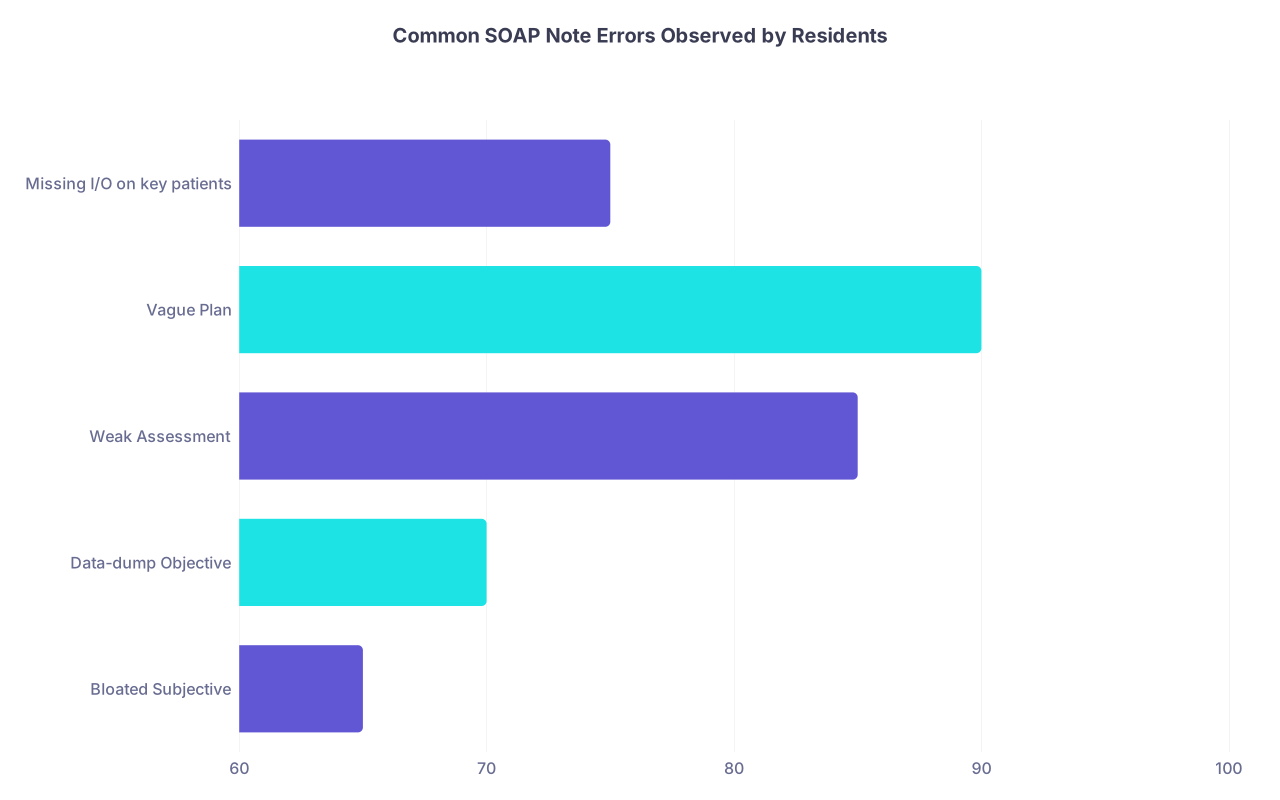
| Category | Value |
|---|---|
| Bloated Subjective | 65 |
| Data-dump Objective | 70 |
| Weak Assessment | 85 |
| Vague Plan | 90 |
| Missing I/O on key patients | 75 |


| Component | Medicine Focus | Surgery Focus |
|---|---|---|
| Subjective | Symptoms, ROS by organ system | Pain, diet, flatus/BM, ambulation, wound issues |
| Objective | Vitals trends, I/O, detailed exam | Vitals, I/O, post-op exam, drains, wounds |
| Assessment | Pathophysiology, diagnosis refinement | Post-op day, complications risk, trajectory |
| Plan | Med management, diagnostics, comorbidities | Pain control, bowel function, mobilization, discharge milestones |
FAQ (Exactly 6 Questions)
1. How long should a daily SOAP note be on wards?
For a typical inpatient, 1–2 well-structured screens in the EHR is plenty. If your note routinely scrolls for days, you are including too much raw data and not enough synthesis. Complex ICU cases can be longer, but on standard medicine and surgery services, concise and sharp wins every time.
2. Should I rewrite all the labs and vitals in my Objective section?
No. Summarize trends and abnormalities that affect today’s plan. “Cr up from 1.0 to 1.5, lactate down from 3.6 to 2.4, WBC stable” is far more valuable than pages of numbers. Anyone can click the labs tab. Your job is interpretation and prioritization.
3. How do I handle patients with 15+ chronic problems in the Assessment/Plan?
You do not list every chronic issue daily. Focus on 3–7 active problems that are changing hospital care: acute issue(s), key comorbidities affecting management, and disposition. Stable, irrelevant problems can live in the H&P or a “Chronic problems (stable)” line if needed, without individual daily plans.
4. Is it acceptable to copy yesterday’s note and “update” it?
Every service has norms, but blindly copying is dangerous and lazy. If you use yesterday’s note as a skeleton, you still must re-examine, re-interpret, and rewrite what changed. Copy-pasted incorrect facts (“Foley in place” when it was removed yesterday) are a fast way to lose trust.
5. How can I practice SOAP notes before or between rotations?
Take de-identified patients from prior cases, online vignettes, or UWorld stems and force yourself to write a real SOAP note: S, O (what you’d expect to find), then a structured A/P. Ask a resident or mentor to critique one or two. Focus on tightening your Assessment/Plan; that is where your clinical thinking shows.
6. What is the single biggest “upgrade” I can make to my SOAP notes tomorrow?
Stop writing vague plans. For every key problem, write a plan that could be carried out without you present: specific meds (with doses if appropriate), monitoring, next tests, and what would make you escalate care. “Continue management” is useless. “Continue IV furosemide 40 mg BID; goal net –1 to –1.5 L; hold if SBP <90 or Cr >2.0” sounds like someone who understands medicine.
Key takeaways:
- SOAP is a thinking structure, not a formatting chore; your Assessment/Plan is the core.
- Medicine and surgery notes share the same skeleton but emphasize different milestones and risks.
- Precise, prioritized, and actionable notes make you look like a junior resident, not a tagalong student.