Your attending knows you’re pre-rounding wrong within 10 seconds of your presentation.
Not 30. Ten.
They know before you’ve finished the first sentence of “Mr. Smith is a 64-year-old male with a history of…” and they’ve already decided—consciously or not—whether you’re “the sharp student” or “the one we have to babysit.”
Let me tell you what really happens in their head.
What Attendings Actually Expect From Pre-Rounding
Here’s the first truth nobody tells you: most attendings do not care how early you woke up. They care whether your data are accurate, relevant, and usable.
On medicine services in particular, pre-rounding is not about “showing effort.” It’s a competence test disguised as morning busywork. It answers one question:
“Can I trust this person’s information and judgment?”
If the answer is no, you’re mentally filed under liability.
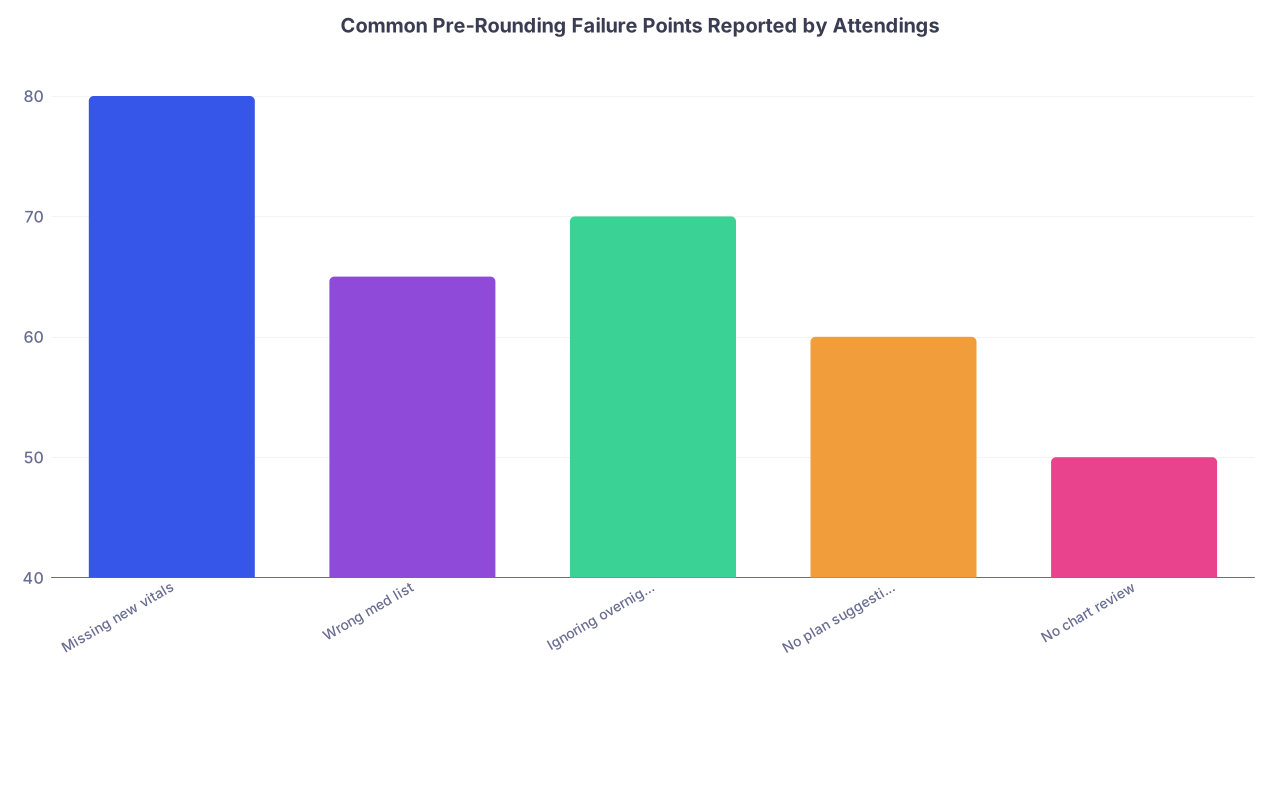
| Category | Value |
|---|---|
| Missing new vitals | 80 |
| Wrong med list | 65 |
| Ignoring overnight events | 70 |
| No plan suggestions | 60 |
| No chart review | 50 |
These percentages are roughly what I hear in resident rooms and workrooms when people vent about students. The patterns repeat at every teaching hospital.
What your attending thinks when you pre-round incorrectly comes down to a few categories.
The Instant Red Flags: What Attendings Notice First
1. You Clearly Haven’t Looked at the Chart Today
This is the cardinal sin.
You walk into the room, you ask the patient, “How are you feeling?” You chat for three minutes. Then you leave and jot down “no complaints, feels okay, wants to go home.”
On rounds, you say that. The resident asks, “Did you see the vitals?”
Turns out the patient spiked a fever to 39.2°C at 3 a.m. and had a blood pressure of 85/50.
What your attending is thinking:
- “You are documenting a false sense of security.”
- “You’re relying on the patient for data instead of the system.”
- “I cannot trust you to see sick from not sick.”
They won’t say all that out loud, but the label is now: does not know how to read a chart.
You just went from “maybe honors” to “maybe pass” in one presentation.
The internal monologue is usually something like:
“Okay, this student is pleasant but doesn’t know where the danger lives. I need to watch every number myself.”
Translation: they stop listening to your “story” and start silently re-rounding behind you.
2. Your Data Are Sloppy or Incomplete
You rattled off “vitals are stable” but didn’t know the actual numbers. You said “labs are unremarkable” and then the attending pulls up a creatinine that went from 0.9 to 1.7. Or a potassium of 2.9.
That “unremarkable” line? That’s where they lose patience.
What they’re really thinking:
- “You don’t know what matters yet.”
- “You’re trying to bluff.”
- “I have to double-check everything you say.”
Most attendings would rather you say: “I looked through the labs. I want to highlight these three changes; I may be missing something—could we review them together?” than pretend everything is fine.
No one fails you for not knowing. They fail you for being confidently wrong.
3. You Did “Social Rounds,” Not Medical Rounds
A classic med student mistake: you spend 8 minutes on a patient learning about their grandkids, their dog, their job. You document every detail of their social history and “how they feel,” but you never look at the incision, the IV sites, the Foley, the edema, the drain outputs, the oxygen source, or the actual objective data.
Attendings see this constantly on surgery and medicine:
- “He’s doing okay, says pain is a little better.”
No mention of the Jackson-Pratt drain that’s suddenly more sanguineous.
No mention of the new 3L nasal cannula this morning.
What your attending thinks:
- “You’re playing ‘medical student’ instead of being a real junior clinician.”
- “You’re missing the entire point of why we pre-round.”
- “You like talking to patients but you have not yet learned how to examine a patient.”
They might smile and say, “Okay, let’s go see him together,” which is code for: “I don’t believe your assessment at all.”
4. You Don’t Know the Overnight Events
Attendings absolutely hate this one.
The resident: “Any issues overnight?”
You: “No issues.”
The EMR: Rapid response at 2 a.m., new oxygen requirement, one-time IV Lasix, troponin ordered, repeat EKG.
What they’re thinking:
- “You didn’t even scroll through the nursing notes.”
- “You have no idea who wrote orders on your own patient.”
- “If I leave you alone for 2 minutes, I might miss something dangerous.”
The hidden test of pre-rounding is this:
Did you read all the new information since yesterday?
If the answer is no, they assume you’re skimming or guessing your way through.
The Quiet Calculations: How Attendings Re-Label You
Let me be blunt: attendings and residents categorize students faster than you think. And that categorization is sticky.
When you pre-round badly, they start putting you into buckets.
| Student Type | What They See on Pre-Rounds | Resulting Label |
|---|---|---|
| Reliable | Accurate, concise, catches overnight changes | "Safe, can trust" |
| Well-Meaning | Friendly, incomplete data, misses key labs | "Nice but green" |
| Dangerous | Confidently wrong, misses fevers/hypotension | "Liability" |
| Ghost | Clearly didn’t see patient or chart today | "Non-existent" |
| Workhorse | Data solid but no synthesis | "Useful, needs guidance" |
Most of you end up in “Well-Meaning” or “Workhorse.” That’s fine. You can grow from there.
When you’re in “Dangerous” or “Ghost” territory because your pre-rounds are wrong, it takes a lot to climb out. People start scripting around you instead of with you.
Meaning: they’ll let you “present,” but they’re not actually using your information to treat anybody. They’re quietly ignoring you.
The Specific Ways You’re Pre-Rounding Incorrectly (That No One Explained)
Let me walk through what “wrong” really looks like from the other side of the table. Because most students never get this spelled out.
Error #1: You Start With the Wrong Question
Students think pre-rounding means:
“Go talk to the patient and see how they’re feeling.”
Attendings think pre-rounding means:
“Find out what changed in the last 24 hours and whether our plan is still safe and appropriate.”
If you start with “How are you?” instead of “What’s new?”—in the chart—your entire workflow is backwards.
A safe sequence is:
- Chart first.
- Then bedside.
- Then quick re-check in chart if needed.
Not bedside → chart (or worse, bedside only).

| Step | Description |
|---|---|
| Step 1 | Start Pre-Rounds |
| Step 2 | Open Chart |
| Step 3 | Review Vitals & I/O |
| Step 4 | Check Labs & Imaging |
| Step 5 | Scan Notes & Overnight Events |
| Step 6 | Form Hypothesis & Questions |
| Step 7 | See Patient at Bedside |
| Step 8 | Focused Exam & Clarify Symptoms |
| Step 9 | Update Brief Note or To-Do List |
| Step 10 | Prepare Oral Presentation |
If you invert that flowchart, your attending can feel it. Your presentation sounds like vibes, not medicine.
Error #2: You Don’t Have a Mental Template
When students wander, it’s almost always because they never built a pre-rounding checklist. They’re improvising at 5 a.m.
Attendings pick this up immediately:
- You forget to mention urine output on the septic patient.
- You forget to mention drain output on the post-op.
- You forget to mention bowel function on the abdominal surgery.
- You forget to check telemetry on the new afib with RVR.
What they’re thinking:
“This student doesn’t know what variables define this patient’s trajectory.”
They don’t care if it's written on paper, in your brain, or tattooed on your forearm. But they expect you to have a pattern.
Error #3: You Have No Filter
On the other end, some of you check everything but report it all unfiltered.
“Vitals: HR 78, 82, 90, 84. BP 135/80, 140/70, 138/75, 142/85. Temps 36.8, 36.7, 36.9, 37.0. O2 saturations 98, 98, 97, 99 on room air. I/Os are…”
By minute two, your attending is already done. You’re clearly working hard. You’re just not thinking.
Their silent conclusion:
- “This student doesn’t understand significance.”
- “They’re doing data dumps instead of clinical reasoning.”
- “I can’t let them write real notes yet.”
Filtering is a huge part of pre-rounding correctly. Knowing what not to say is as important as knowing what to say.
Error #4: You Don’t Tie Anything to Yesterday’s Plan
This is a big one.
Students pre-round as if each day is independent. They list today’s facts with no connection to yesterday’s goals.
For example, yesterday the plan was:
- Diurese 1–2 L net negative
- Wean O2
- Advance diet if passing flatus
Today, your pre-round is:
- “He’s feeling okay. Vitals stable. Labs look okay. He’s on 3L O2. No BM yet.”
What the attending wishes you’d say:
- “Net -1.5 L over last 24 hours, creatinine stable at 1.0, O2 weaned from 4L to 2L this morning with sats >94%, still no flatus or BM, abdomen soft, so I’d hold off advancing diet yet.”
Do you feel the difference? One is observation. The other is continuity.
Your attending thinks:
“First one is just reading the chart. Second one is acting like an intern.”
And yes, that’s exactly the mental shift you want them to have about you.
What “Correct” Pre-Rounding Looks Like From Their Side
Let me flip this. When you pre-round well, what’s actually happening in your attending’s head?
They hear:
“Overnight, no acute events documented. Tmax 37.8, blood pressures 110–125 systolic, still tachycardic 100–110. Net positive 1 L. Creatinine up slightly from 1.0 to 1.3, WBC up from 9 to 13, lactate down from 3.1 to 2.0. He reports feeling more short of breath walking to the bathroom; on exam he has new mild crackles at the bases and 1+ edema. I’m wondering if he’s getting a little overloaded while still septic, and whether we should adjust his fluids and maybe start diuresis.”
Their internal reaction is something like:
- “Okay, this student gets trajectory and risk.”
- “They saw the conflicting signals and tried to reconcile them.”
- “I can strengthen this thinking rather than rebuild it from scratch.”
On evaluations, those students get language like:
- “Functions at or near intern level.”
- “Able to synthesize relevant data.”
- “Safe with appropriate supervision.”
And when they’re thinking who to let do procedures, who to involve in family meetings, who to write drafts of discharge summaries? They’re picking that student.
Because they trust them. And that trust started at 6 a.m. with pre-rounding.
How to Fix Your Pre-Rounding Starting Tomorrow Morning
Let’s be practical. You want to know what to do when you’re back in the hospital in 8 hours.
Build a Speed-Checklist per Patient
Before you leave for the day, write down the 6–8 things that define whether that patient is getting better, worse, or stuck.
For a typical medicine patient with pneumonia and sepsis, that might be:
- Vitals: fever curve, HR, BP, O2 needs
- I/Os: net balance, urine output
- Labs: WBC, lactate, creatinine, cultures
- Respiratory: O2 mode and sat, RR, dyspnea
- Antibiotics: which, when started, any changes
- Functional: eating, walking, mental status
Next morning, you’re not randomly scrolling. You’re hunting for those datapoints first, then scanning the rest for “surprises” (overnight notes, new orders, imaging).
For a post-op surgery patient:
- Vitals and pain scores
- I/Os with specific attention to drains, Foley
- Labs: Hgb/Hct, WBC, creatinine, electrolytes
- Wound/incision status
- Return of bowel function
- Mobility and PO intake
Most students never do this intentionally. The ones who do stand out.
Time-Box Your Pre-Round Per Patient
What your attending hates: the student who spends 30 minutes chatting with one stable patient and then hasn’t seen the rest of the list.
Reasonable target: 5–7 minutes per stable patient. Maybe 10–12 for a complex ICU-level case as a student.
A simple split that actually works:
- 3 minutes chart
- 2 minutes bedside
- 1–2 minutes to clarify and update your own notes
If you’re blowing 15–20 minutes per patient, you’re not “thorough.” You’re inefficient.
Attendings notice who’s always “still pre-rounding” at 7:30 when everyone else is ready.
Speak in Changes, Not Static Snapshots
When you present, frame everything as:
- “Compared to yesterday…”
- “From yesterday to today…”
- “Over the last 24 hours…”
Attendings think in trends. They cannot care less that the sodium is “138.” They care that it was:
- 131 → 134 → 138 on hypertonic? Good.
- 148 → 144 → 138 on aggressive fluids? Maybe too fast.
When you orient them to changes, they relax. You’re speaking their language.
Admit What You Don’t Know (Fast)
Here’s the secret: attendings are not angry you don’t know everything. They’re angry when you pretend you do.
If they ask, “What was his urine output overnight?” and you don’t know, the worst answer is: “Umm… I think it was fine.”
The best answer is: “I didn’t write down the exact number—give me 10 seconds to pull it up.” Then actually pull it up. Right there.
They think:
- “Trainable.”
- “Honest.”
- “Teachable.”
Students tank themselves trying to bluff or soft-shoe missing information. Do not do that.
The Hidden Consequences: How Bad Pre-Rounding Hurts You
This isn’t just about one awkward moment on rounds. There are downstream effects.
You get fewer opportunities.
Attendings are not going to hand the LP, central line, or family meeting to the student who misses fevers and hypotension.Your grade narrative tanks.
Even with “objective” evaluations, the comment box is king.
Comments like “needs close supervision with data gathering” or “often missed key changes overnight” are poison on a clerkship eval.Residents stop teaching you at a high level.
When they think you cannot handle basics, residents default to spoon-feeding instead of pushing you to reason. That’s how you stagnate.You’re remembered for the wrong things.
Asking good questions doesn’t fix unreliable data. I’ve seen brilliant students intellectually who were dismissed because nobody could trust their pre-round information.
You’re in a game you did not design. But you are playing it whether you like it or not.
Learn the rules.
Quick Reality Check: What Attendings Actually Want You to Do
Let me boil down what goes through an attending’s mind when they’re evaluating your pre-rounding, even if they never articulate it.
They’re silently asking:
- Did you see every patient you’re assigned?
- Did you review the chart today, not just remember yesterday?
- Did you catch the big changes (vitals, labs, imaging, events)?
- Can I use your information to actually manage this patient?
- Did you try—honestly try—to synthesize and suggest next steps?
If the answer is yes to most of those, you’re already in the top half of students.
If the answer is yes and you’re concise and organized?
You’re in the top 10–15%. That’s the “this student is basically an intern” tier.
And that tier is very memorable when grades, awards, and letters of recommendation come up behind closed doors.
FAQs: The Stuff You’re Afraid to Ask Out Loud
1. How early should I actually pre-round?
Early enough that you’ve:
- Checked the chart thoroughly
- Seen the patient
- Organized your thoughts
…and you’re not sprinting into rounds half-prepared. For many medicine services, that means 60–90 minutes before formal rounds. On surgery, 90–120 minutes is common. Ask the interns what time they expect you ready with data, then back-calculate.
If you’re consistently cutting it close, you’re over-talking at the bedside or under-preparing the night before.
2. Is it better to skip seeing a patient or to see them but not review the chart?
Skipping the chart is worse. By far.
If you had to pick (you shouldn’t, but hypothetically), it is safer to review chart-only than it is to see the patient without context and then proclaim “no issues.” Obviously, the actual expectation is both: chart then bedside.
But if you present without knowing overnight events, new labs, or new imaging? That’s how you get labeled unsafe.
3. What if I can’t get to all my patients before rounds?
Tell the intern or resident early. Do not hide it.
“Hey, I spent extra time on our new admission with sepsis and didn’t get to fully see Mr. X yet—would you rather I quickly chart-check him or focus on presenting the new patient well?”
Residents and attendings will respect your honesty and help you prioritize. What they hate is being surprised on rounds when you pretend you’re fully prepared and clearly aren’t.
4. How much of the physical exam am I expected to repeat every morning?
Not a full admission-level exam. Targeted exam aligned with the patient’s problem list and yesterday’s plan.
Pneumonia with hypoxia? Lungs, work of breathing, O2 needs, maybe heart and peripheral edema.
Post-op lap chole? Abdomen, incisions, tenderness, bowel sounds, distension, pain with movement.
Heart failure? JVP, lungs, edema, weight, orthopnea.
Doing a big, unfocused exam then reporting everything is not impressive. It’s a sign you don’t know what matters.
5. Can I use notes or a printed template on rounds, or will that look weak?
Use them. Quietly and professionally.
The student who comes with a small, organized list or printed template with key data wins over the one who “wings it” and forgets half the story. Attendings know interns carry sign-out sheets and printouts. Nobody expects your brain to hold 20 patients worth of data perfectly.
What looks weak isn’t the template. It’s pretending you don’t need one and then presenting garbage.
With this, you know what your attending is actually thinking, not the sanitized version you hear in orientation. You know the mental categories, the red flags, and the fixes.
Now you’ve got the framework. Next step in your evolution is learning how to present that pre-round data like a near-intern—tight, focused, and persuasive. But that’s a story for another day.