The fastest way to lose an attending’s trust is sloppy documentation.
On rotations, your note is the only part of you that lives past 5 p.m. If it is inaccurate, lazy, or dangerous, people will stop letting you near real responsibility. And they will be right.
Let me walk you through the seven documentation errors that reliably scare attendings. Not annoy. Scare. As in: “I cannot trust this person with patient care.”
1. Copy-Paste Lies (a.k.a. “Chart Fiction”)
This is the classic student disaster: unchecked copy-forward.
You take yesterday’s resident note, copy it into your student note, “edit a bit,” and move on. By day three, your note says the patient is on 4L NC, comfortable, no pain, ambulatory… while the nurse is calling a rapid response because the patient is hypotensive on pressors.
That disconnect? It tells me one thing: you are documenting a fantasy, not a patient.
The dangerous patterns:
- Vitals and exam that do not match the current day
- “No chest pain / no SOB” when the overnight note clearly documents both
- “No edema” in a patient with 3+ pitting edema that any intern can see from the door
- Copying consultant impressions from three days ago as if they are current
Why this scares attendings:
Because copy-paste errors are how patients end up with missed diagnoses, wrong meds continued, or critical changes ignored. Malpractice attorneys love finding a trail of cloned notes with increasing contradictions. Juries do too.
What you must do instead:
- Treat every line as a statement you are personally vouching for. If it is in your note, you are saying, “I checked this today.”
- Rewrite the HPI and assessment from scratch each day, in your own words.
- If you must reference prior notes, explicitly time-stamp it: “Per cardiology note 1/3: EF 25%. No new TTE since.”
- In the physical exam, only document what you actually examined. If you did not check reflexes, do not write “2+ symmetric.”
Red flag sentence that makes attendings nervous:
“Patient denies chest pain, shortness of breath, palpitations, dizziness, nausea, vomiting, diarrhea, constipation…”
If your review of systems reads like a template was vomited onto the chart, I assume you barely asked any of it.
2. The Fake Exam: Documenting What You Never Did
This one is worse than copy-paste. It is essentially lying.
I have seen student notes on a post-op patient that include:
- “No murmurs, rubs, or gallops” when the chest was never auscultated because the student “did not want to wake them”
- “No focal neurologic deficits” when there was zero neuro exam, not even grip strength
- “Abdomen soft, non-tender” written from the hallway
Let me be blunt: documenting an exam you did not perform is falsification of the medical record. That is an integrity problem, not a knowledge problem.
The most common student “fake exam” pitfalls:
- Full neurologic exams on every patient, every day, in detail, yet the student cannot perform half of what they documented when asked
- “No lower extremity edema” in a fully dressed patient whose socks were never removed
- GU or breast exam findings documented with no chaperone, no mention of chaperone, and clearly never done
- Writing a complete lung exam on a patient on BiPAP you never touched
How to avoid this:
- If you did not assess it, leave it out or write “Not assessed today.”
- Use focused exams. It is fine to not do a full 14-system neuro exam on a stable cellulitis patient.
- When the attending asks, “What did you actually examine?” you should be able to describe exactly how.
And if you are ever tempted to “fill in the blanks” to make the note look complete—do not. An incomplete but honest exam is infinitely safer than a polished lie.
3. Dangerous Medication Documentation
If there is one area where documentation errors can literally kill someone by morning rounds, it is meds.
I have watched students document medication lists that were fantasy-level wrong:
- Home meds copied from an ancient clinic note instead of current MAR or reconciliation
- PRN meds showing up as “scheduled”
- Anticoagulation status unclear or contradictory data (one note says “on apixaban,” the other “held for procedure,” your note says nothing)
- Insulin regimens butchered
The scariest patterns:
- Writing “Restart home meds” in the plan with no list of what those actually are
- Vague nonsense like “Continue antibiotics” when there are 4 orders: vanc, cefepime, azithro, flagyl
- Not documenting anticoagulation decisions on post-op or high-risk patients
- Failing to mention high-risk meds at all (warfarin, DOACs, insulin, opioids, steroids, antiarrhythmics)
Here is why this freaks out attendings:
Medication lists are the backbone of safe care. Bad med documentation tells me you are not tracking what is going into the patient’s body. That is unacceptable.
Non-negotiable habits:
- Always check three places: MAR, “Orders,” and med reconciliation / admission note
- In your plan, be explicit: “Continue ceftriaxone 2 g IV q24h (day 3/7). Stop azithromycin—course complete.”
- For anticoagulation, write it out: “On apixaban 5 mg BID for Afib—held for upcoming colonoscopy; last dose 1/4 evening.”
- If you do not understand a med, look it up before you present or document around it
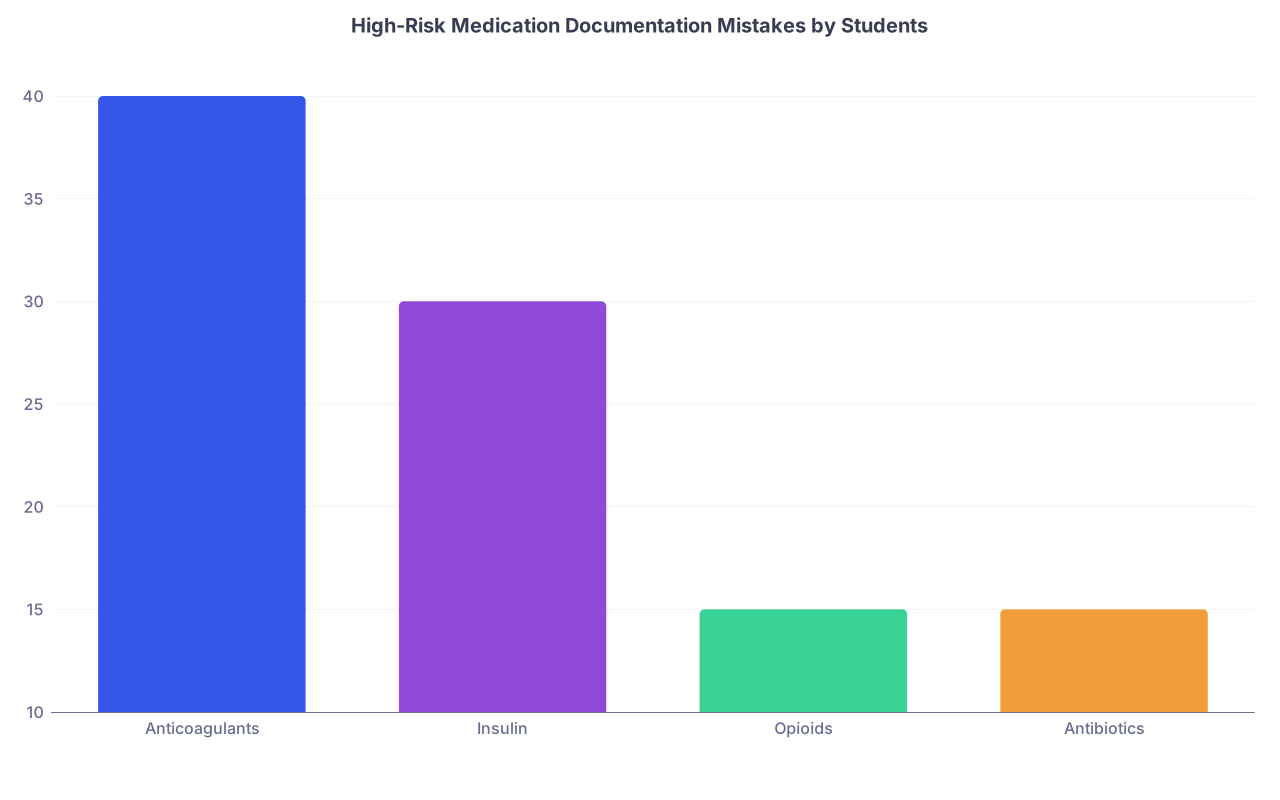
| Category | Value |
|---|---|
| Anticoagulants | 40 |
| Insulin | 30 |
| Opioids | 15 |
| Antibiotics | 15 |
You are not expected to be a pharmacist. You are expected to not be careless.
4. Time-Travel Notes: Inconsistent, Backdated, or Chronologically Impossible
Attendings read the chart like a timeline. When your documentation breaks the timeline, alarms go off.
Examples I have actually seen:
- A 7 a.m. student note saying “Pain controlled, comfortable” when there was a rapid response at 6:30 a.m. for uncontrolled chest pain
- A note saying “No overnight events” when there was a new fever, STAT CT, and broad-spectrum antibiotics started
- Writing that a central line was placed “this morning” when the procedure note is timestamped yesterday afternoon
- Documenting your exam as if it happened before a lab/imaging result, but referencing that result as if you already knew it
This is not just sloppiness. It confuses anyone trying to understand what actually happened when. In emergencies, that matters.
Common student missteps:
- Pre-writing notes the night before and not updating them
- Copying “No overnight events” from an old template without checking nursing notes
- Editing yesterday’s note and accidentally leaving yesterday’s date or time
- Writing in present tense about conditions that changed hours ago
How to avoid time-travel documentation:
- Check overnight events before touching your note: vitals trends, nursing notes, orders, new labs/imaging, rapid responses
- If your note is late, time-stamp your knowledge: “As of 10:15 a.m., patient afebrile since 4 a.m.; T max 38.5 at 2 a.m.”
- Be honest about sequence: “CT chest ordered after morning exam due to new dyspnea”
- Never assume “nothing happened overnight” until you confirm it

| Step | Description |
|---|---|
| Step 1 | Arrive on floor |
| Step 2 | Check overnight nursing notes |
| Step 3 | Review new labs and imaging |
| Step 4 | Check vitals and I/Os |
| Step 5 | See patient and perform exam |
| Step 6 | Update note with todays findings |
If the story in your note does not match the story in the rest of the chart, you look unreliable. Even if your exam was good.
5. Overconfident Assessments With No Support
There is a special kind of fear that comes from reading a student’s note that declares strong conclusions with absolutely no backing.
For example:
- “Sepsis resolved” when the patient is still on pressors and febrile
- “Acute kidney injury improving” when creatinine went from 2.1 to 2.0
- “Low suspicion for PE” in a hypoxic tachycardic patient, with no Wells score, no d-dimer, no reasoning
- “Rule out ACS completed” because troponin trended down once
The real problem here is not being wrong. Everybody is wrong sometimes. The problem is being confidently wrong with no evidence trail. That terrifies attendings because it means you do not know what you do not know.
Scary documentation habits:
- Bold statements: “No evidence of X,” “Resolved,” “Stable,” with no data
- Using consultant language without understanding it: “Demand ischemia only” or “clinically euvolemic” because cardiology wrote it once
- Declaring discharge readiness based on vibes, not criteria
How to fix this:
Think like this: “If a stranger read only my note, could they follow my thinking and see how I got from complaint to assessment?”
Better patterns:
- “Suspect CHF exacerbation: orthopnea, PND, weight gain 5 lb, bilateral crackles, JVD, CXR with pulmonary congestion.”
- “AKI slightly improved: Cr 2.0 from 2.2 yesterday; urine output increased to 0.7 mL/kg/hr.”
- “Still concerned for PE: persistent hypoxia on 4L, HR 110–120, no alternative explanation identified—consider d-dimer vs imaging based on attending preference.”
| Situation | Scary Phrase | Safer, Supportive Phrase |
|---|---|---|
| Suspected sepsis | "Sepsis resolved" | "Improving sepsis; lactate down, still on low-dose NE." |
| AKI with marginal change | "AKI resolving" | "AKI with slight improvement in Cr, trend still needed." |
| Possible PE | "Low suspicion for PE" | "PE remains in differential; HR 110, new O2 need." |
| Chest pain overnight | "ACS ruled out" | "Troponins flat x2, pain resolved; low concern for ACS." |
You earn trust not by being right, but by showing real clinical reasoning on the page.
6. Ignoring Red Flags from Other Team Members
One of the most disturbing documentation patterns is when a student writes a calm, reassuring note while nurses, RTs, or consultants are clearly worried.
The story is all over the hospital, except in your documentation.
You will see this as:
- “Patient resting comfortably” on the same morning the nurse documented “patient states worst pain of life, tearful, 10/10”
- No mention of repeated pages for hypotension, mental status changes, or arrhythmias
- Ignoring consultant recommendations in your plan entirely
- Notes that could have been written without talking to a single other human on the care team
Why this is dangerous:
Good medicine is a team sport. When your note acts like the rest of the team does not exist, it signals that you are practicing in a bubble. That bubble is where errors grow.
Common student mistakes:
- Not reading nursing notes or RT notes at all
- Not integrating consultant impressions into the assessment/plan
- Leaving out family or patient concerns that were voiced to other staff
- Minimizing or omitting events that “someone else already documented”
How to avoid this:
Before finishing your note:
- Scan overnight nursing notes and flowsheets for pain scores, unusual events, PRN use
- Look at new consultant notes and summarize relevant parts in your A/P
- If there was a rapid response, fall, new agitation, or family meeting, mention it
Example of safe integration:
“Overnight, patient had 10/10 chest pain per nursing note; EKG and troponin x2 negative, pain improved with morphine. Today denies chest pain but anxious about recurrence.”

If your note consistently ignores the concerns of others, attendings will stop trusting it—and you.
7. Vague, Legal-Landmine Language
The last category is more subtle but just as alarming: documentation that is either dangerously vague or invites medico-legal trouble.
Red-flag phrases that make attendings wince:
- “Noncompliant patient” with no context or explanation
- “Patient refused care” without describing what was explained, what risks were discussed, or why they refused
- “Stable” in critically ill patients (ICU, high-dose pressors, active MI)
- “Will follow” with no actual plan, time frame, or criteria
- “Pain likely psychological” slapped onto complex patients without supporting discussion
Why this is scary:
These phrases can be used as weapons later—in court, in complaints, in QA reviews. They also often signal that the student does not fully grasp the clinical or psychosocial complexity of the situation.
Examples of better documentation:
Instead of “Noncompliant”: “Patient has not been taking insulin for the past week due to cost and difficulty getting to pharmacy; discussed importance of adherence and explored resources for assistance.”
Instead of “Patient refused care”: “Offered blood transfusion for Hgb 6.8; explained risks (TRALI, TACO, reactions) and benefits (reduced ischemia risk, symptom improvement). Patient verbalized understanding and declined, citing religious beliefs. Will reassess if symptoms worsen.”
Instead of “Stable”: “Hemodynamically stable on NE 0.1 mcg/kg/min with MAP 65–70; no dose change past 4 hours.”
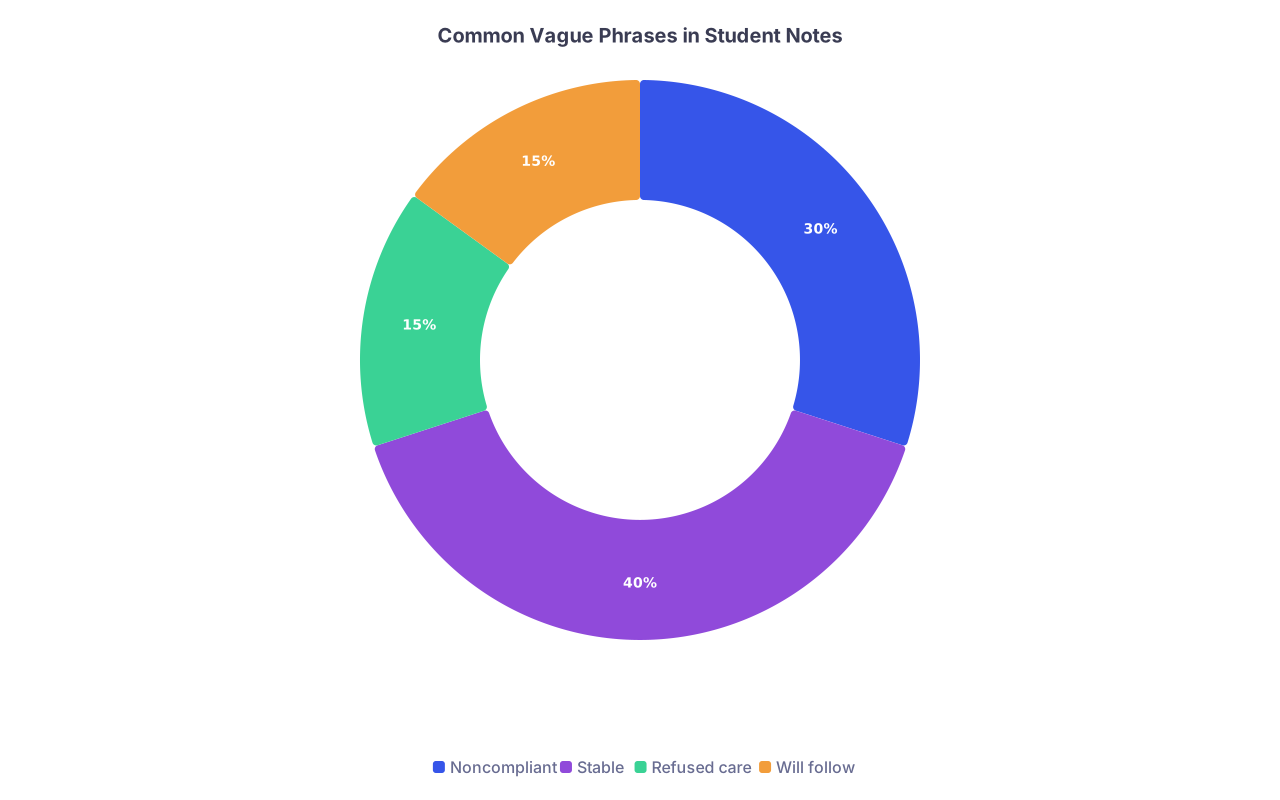
| Category | Value |
|---|---|
| Noncompliant | 30 |
| Stable | 40 |
| Refused care | 15 |
| Will follow | 15 |
You are early in training. No one expects perfect legal phrasing. What they do expect is that you do not take lazy shortcuts with loaded words.
How to Make Attendings Relax When They Read Your Notes
Let me flip this around. There are a few habits that immediately lower my blood pressure when I read a student note:
- The subjective and objective clearly happened today
- The exam is focused but obviously real
- Abnormalities are highlighted, not buried in normal text
- The assessment shows actual thinking, including uncertainty and differential
- Medication lists and plans are specific, not vague
A short, honest, precise note is infinitely better than a long, impressive-sounding mess.
If you are not sure whether to include something, ask yourself: “Could a reasonable person misinterpret this in a way that harms the patient or looks dishonest later?” If yes, fix it.

FAQs
1. How long should my notes be on rotations?
Shorter than you think. A student progress note usually does not need to exceed 1–2 concise pages. The danger is not in being brief; it is in being incomplete or inaccurate. Focus on today’s story: key overnight events, targeted exam, pertinent labs/imaging, and a thoughtful assessment/plan. If a section is just template noise, cut it.
2. Is it ever OK to use templates or copy-forward?
Yes, with discipline. Templates are fine for structure; copy-forward is dangerous when unchecked. You can use templates for ROS, exam headers, or standard phrasing, but you must edit aggressively. Every line that remains in your note should reflect what you personally confirmed today. If you cannot stand by it in front of the patient and your attending, delete it.
3. What should I do if I realize I documented something wrong?
Fix it promptly and transparently. Add an addendum or corrected note depending on your system. Do not quietly overwrite without a timestamp. Briefly state the error and the corrected information. If the error could affect care (wrong med, vital, exam finding, or plan), tell your resident or attending directly. People get far more concerned about hidden or ignored errors than honest, quickly corrected ones.
Key points to keep:
- Never document what you did not do or do not know; your note is a legal, permanent claim.
- Copy-paste, vague language, and sloppy med or timeline documentation are the fastest ways to lose trust.
- A careful, honest, well-reasoned short note will protect your patient—and your reputation—far better than any templated masterpiece.