
It is week 3 of your internal medicine rotation. You open MedHub/New Innovations/whatever your school uses and see it: a mid-rotation evaluation that stings.
“Below expectations” on professionalism.
“Needs improvement” on clinical reasoning.
Comments that feel half-true and half-unfair.
Your stomach drops. You start doing the math:
Mid-rotation eval → final eval → clerkship grade → MSPE → residency.
You are wondering if you just tanked your entire application.
You did not. But you can tank the rest of the rotation if you react badly.
Here is the recovery plan. Step-by-step. No fluff. No pep-talk platitudes. Just what to do next, what to say, and how to give yourself a real shot at turning this around.
Step 1: Triage Your Situation (Within 24–48 Hours)
First move: stop spiraling and figure out exactly how bad this is.
1. Read the eval like a consultant, not a defendant
Print it or screenshot it and go line by line. Separate what hurts from what is actually actionable.
Mark each point as:
A. Fact-based (concrete, behavioral):
- “Arrived late to rounds twice.”
- “Notes frequently turned in after requested deadline.”
- “Does not pre-read before OR cases.”
B. Interpretation-based (attitude, personality, vague):
- “Does not seem enthusiastic.”
- “Appears disinterested on rounds.”
- “Quiet and not engaged.”
C. Questionable / unclear:
- Comments that do not match your memory.
- Comments from someone who barely worked with you.
- Vague criticism with no examples.
You are going to approach A, B, and C differently. But you need the map first.
2. Identify who actually matters for your final grade
On most rotations, one of these holds the power:
- Clerkship director
- Site director
- Your primary attending
- Composite of several attending and resident evals
Find out:
Is this mid-rotation eval from:
- The main attending?
- A random resident for a 3-day stretch?
- A formal mid-rotation feedback session?
Will this directly influence your final grade or is it “formative only”?
If you do not know, ask the clerkship coordinator in one short, professional email:
Dear [Coordinator Name],
I recently received my mid-rotation evaluation for [Rotation, Site]. I want to make sure I use it constructively. Could you please clarify how much weight the mid-rotation evaluation carries in the final clerkship grade, and whether there will be another formal evaluation closer to the end of the rotation?
Thank you for your help,
[Your Name], MS3
You are not complaining. You are gathering intel.
3. Check your gut reaction at the door
You will feel:
- Defensive (“My resident was impossible to please.”)
- Embarrassed (“Everyone probably thinks I am incompetent.”)
- Hopeless (“There is no way to fix this.”)
You cannot act from that emotional place and expect this to go well.
Quick reset protocol:
- Give yourself 24 hours before you respond to anyone.
- Rant to a friend or co-student outside the hospital, not to anyone on the team.
- Do not send emotional emails. Draft it, then read it the next day cold.
Once you have done that, move to the next step.
Step 2: Get Clarifying Feedback – The Right Way
The number one mistake I see: students avoid the attending after a bad eval. They quietly try to “work harder” and hope the grade magically improves.
The recovery plan requires the opposite. You go toward the feedback.
1. Request a brief meeting (script included)
You are not scheduling a trial. You are asking for coaching.
For an attending:
Dr. [Name],
I reviewed my mid-rotation evaluation and would really appreciate the chance to get more specific feedback so I can improve during the rest of the rotation. Would you have 10 minutes sometime in the next day or two to discuss what you are seeing and how I can best work on it?
Thank you,
[Your Name]
For a resident who wrote it:
Hi [Dr. / Name],
I saw your feedback on my mid-rotation evaluation. I want to make sure I understand it so I can improve. Could we talk for 5–10 minutes today or tomorrow about specific things I can adjust?
Thanks,
[Your Name]
Short. Respectful. Clear that you are not arguing.
2. Go into that meeting with a structure
Do not just say, “How can I improve?” That gets you vague answers.
Use this 3-part question set:
Clarification:
- “When the eval mentions [X], can you give me one or two specific examples where you saw that? I want to be sure I understand exactly what you mean.”
Priority:
- “If I focus on just one or two things in the next week, what would make the biggest difference in how I am performing?”
Verification:
- “In 1 week, would you be willing to let me know if you are seeing improvement in these areas?”
During the meeting:
- Do not explain away every example.
- Do not blame the system, EPIC, the night float, or “the culture.”
- Write down what they say. Literally. Pen and paper or notes on your phone.
You want the attending to walk away thinking: This student is taking this seriously and is coachable.
3. Translate vague criticism into behaviors
Take each comment and convert into concrete actions.
Examples:
“Quiet on rounds” →
- Volunteer to present at least 1–2 patients per day.
- Ask 1–2 thoughtful questions per half-day on rounds.
- Verbalize at least one plan item per presented patient (e.g., “For her hyponatremia, I was thinking….”).
“Not prepared” →
- Pre-round on your patients and write key problem list on index card before rounds.
- Look up at least one guideline or UpToDate article on your patients’ main problem daily.
- Have vitals, labs, and imaging pulled up before your attending asks.
Write your new “behavior targets” in a short list you can review each morning before you walk in.
Step 3: Build a 7–10 Day Performance Sprint
You do not have time for a slow, vague “I’ll just be better.” You need a focused sprint.
Here is the framework.
1. Decide on 3–5 concrete changes only
Too many goals = no change. Pick 3–5 from this menu based on your feedback.
If the problem is work ethic / reliability:
- Arrive 15–20 minutes earlier than you think you need to. Every day.
- Be the first to volunteer for scut that actually matters (calling consults, following up imaging, calling families).
- Turn in every note before the deadline the senior gives you. No exceptions.
If the problem is knowledge / reasoning:
- For each patient, write out:
- 2–3 key problems
- 2–3 diagnoses in your differential for the main problem
- 1–2 diagnostic steps you would do next
- 1–2 management steps you think are appropriate
- Do 10–20 targeted questions per day (UWorld/AMBOSS/AnKing, depending on rotation).
- When you present, explicitly say your differential and plan.
If the problem is “attitude” / “engagement”:
- Greet everyone on the team each morning. Yes, actually say, “Good morning.”
- Do not sit on your phone. If there is downtime, ask, “Anything I can help with?” or pull up a patient’s chart and update your knowledge.
- Show visible enthusiasm for learning:
- “I have not seen a case of [X] before—would it be ok if I looked up Y and presented it briefly tomorrow?”
2. Use a daily checklist
Make a short daily checklist that fits on your phone lock screen or a sticky note.
Example for a student with “quiet on rounds” + “needs to be more proactive”:
- Arrived 15–20 minutes early
- Pre-rounded on all patients, notes started
- Presented at least 2 patients
- Asked 1–2 substantive questions
- Offered to help with 1 thing not assigned to me
- Looked up 1 topic from my patients
At the end of the day, spend 2 minutes and check it off. If you missed something, adjust the next day.
3. Get a mid-course re-check (you ask for it)
After 7–10 days of actually doing this, you go back to the attending or senior resident:
Dr. [Name],
Thank you again for the feedback last week. I have been working specifically on [3–4 items: e.g., being more proactive on rounds, tightening up my presentations, and improving my problem lists].
Have you noticed any improvement in those areas? And is there one thing I should focus on even more for the remainder of the rotation?
This does several things:
- Forces them to reflect on whether you improved.
- Signals maturity and accountability.
- Gives you one more feedback loop before the final eval.
Step 4: Handle Different Types of “Bad” Evaluations
Not all bad evals are the same. Let’s break down the big four.
A. The “You Have Weak Clinical Skills” Eval
Typical language:
- “Struggles to generate differentials.”
- “Needs to work on clinical reasoning.”
- “Relies heavily on others for assessment and plan.”
This is fixable. Quickly. If you are willing to think out loud and prepare.
Concrete plan:
Adopt the SOAP framework and stick to it
- Before you see your attending, write a mini-assessment:
- “This is a [age]-year-old [gender] with [1-liner], most likely [X] given [Y], but [Z] also possible.”
- For each problem, write:
- Top 2–3 diagnoses and why.
- What tests you would order and why.
- What treatments you recommend and why.
- Before you see your attending, write a mini-assessment:
Say your reasoning, even if you are wrong
- On rounds: “For her chest pain, my top concern is ACS because of [A, B, C], but I am also considering PE because of [D]. I would like to get [E] test next.”
- You being wrong + open to correction looks far better than being silent and “safe.”
Targeted questions, not shotgun study
- That night, do 10–20 questions specifically on your patients’ main issues:
- Pneumonia
- AKI
- CHF exacerbation
- DKA
- Quickly review the UWorld/AMBOSS explanations and jot down 2–3 “clinical pearls” per topic.
- That night, do 10–20 questions specifically on your patients’ main issues:
Within a week, most attendings will notice:
“Your assessments have been much stronger. Keep that up.”
B. The “You Look Disengaged / Low Energy” Eval
Common phrases:
- “Seems uninterested.”
- “Lacks enthusiasm.”
- “Not engaged with the team.”
This one is dangerous because it bleeds into professionalism and attitude. But 50% of the time, these students are just quiet, tired, or anxious. Not actually lazy.
Fix involves optics:
- Stand, do not slump in chairs while others are working.
- Close your laptop/phone when someone is talking to you.
- Look at the speaker. Nod occasionally. Basic human communication.
- Volunteer comments: even simple ones.
- “I read about [X] last night; it mentioned [Y]. Is that something we should be considering here?”
If you are introverted, you do not need to become a cheerleader. You need to signal interest in visible ways.
C. The “Professionalism Concern” Eval
This is the one that can haunt you if not addressed.
Red flags include:
- “Late to rounds multiple times.”
- “Did not follow through on tasks.”
- “Made inappropriate comment.”
- “Did not respond to pages in a timely manner.”
There is no sugarcoating: this category is serious. But you still have a path.
Own it explicitly in your meeting
- “I understand the concerns about [being late/not following through]. You are right, and I am not ok with that being how I showed up. Here is what I am changing: [concrete system].”
Build a fail-safe system
- Alarms: 2 alarms, 5 minutes apart. Phone across the room.
- Tasks: Keep a running to-do list (paper or app). When someone says, “Can you call X?” you write it down and check it off.
- Pages: If paging culture is used, confirm receipt: “Got it, I am on my way.”
Ask for specific re-evaluation
- “If you notice improvement in my reliability and timeliness over the rest of the rotation, would you be willing to reflect that in your final evaluation? I want my grade to be based on the full picture, not just my bad start.”
Most reasonable attendings will do exactly that if you truly change.
D. The “Unfair / Biased / Plain Wrong” Eval
Sometimes you are right: the eval is garbage.
Maybe:
- The evaluator barely worked with you.
- They confused you with another student.
- They wrote something obviously factually wrong.
Here is how you handle it without looking like a complainer.
- Document your version privately
Write down:
- Dates you worked with that person.
- Specific cases or days that contradict what they said.
- Any emails/feedback from other team members during that time.
Do not share this yet. Just document while your memory is fresh.
- Seek a neutral opinion first
Talk to:
- Site director, or
- Clerkship director, or
- Trusted faculty mentor (not a co-student).
Example email to clerkship director:
Dear Dr. [Name],
I wanted to ask for your guidance regarding my mid-rotation evaluation on [Service / Site]. Some of the feedback does not seem to match my interactions with that evaluator, and I am concerned about the impact on my final grade.
Would you be available for a brief meeting to review the evaluation and discuss how best to address it professionally? My goal is to improve and also ensure the evaluation reflects my actual performance.
Sincerely,
[Your Name]
During the meeting, your tone:
- Non-accusatory.
- Focused on accuracy, not revenge.
- Open to the possibility you missed something.
- Let leadership decide if and how to correct
Sometimes they will:
- Discount that eval.
- Ask another attending for additional input.
- Add a note to your file.
Do not email the evaluator a long rebuttal. That almost never helps and often confirms their impression of you as defensive.
Step 5: Protecting the Final Grade and The Narrative
You are not just salvaging this rotation. You are protecting your larger story for your MSPE and residency apps.
1. Make sure someone sees your improved version
Ideal: the same attending who wrote the bad mid-rotation eval.
If that is not possible (rotating services, leaving early, etc.):
- Ask the clerkship director if another attending can provide a late-rotation evaluation.
- Ask to be assigned more directly to an attending for the last 1–2 weeks.
Phrase it as:
I would really appreciate the opportunity to work more closely with an attending who can observe my performance after I have implemented the feedback from my mid-rotation evaluation. I want to show improvement with direct observation.
You are not asking for a handout. You are asking for a fair shot.
2. End-of-rotation conversation: close the loop
If you have any chance to talk to your attending at the end:
Dr. [Name],
Thank you for the feedback you gave me mid-rotation. I have tried to work on [specific items]. Do you feel you have seen improvement? Is there anything else you think I should carry forward to future rotations?
You are subtly prompting them to notice the change—and hopefully reflect that in your final written comments.
Step 6: Rotate-Level Damage Control and Future Planning
Sometimes, despite your best efforts, the rotation grade is not great. Maybe:
- You end up with a Pass where you wanted an Honors.
- Comments in your evaluation are lukewarm.
This is not the end of anything. But you do need to be strategic.
1. Put this rotation in context
Ask yourself:
Is this your only “bad” eval?
Then it can easily be framed as a growth point.Is this a recurring theme across rotations?
Then you need more serious remediation (and you should want it).
Clerkship directors and deans are far more worried about patterns than isolated blips.
2. Use other rotations to explicitly show the opposite
If this rotation dinged you for:
- “Disengaged” → Then on the next rotation, you aim for comments like “exceptionally enthusiastic” and “integral part of the team.”
- “Weak reasoning” → Next rotation: “strong clinical reasoning,” “independent thinker,” “excellent differentials.”
Share your goals with your next team:
I got feedback on a prior rotation that I needed to work on [X]. I am focusing this month on [specific behavior]. If you see anything I can improve along the way, I would appreciate feedback.
This is how you shift from “student with a problem” to “student who takes feedback and improves.”
3. Plan how you will discuss this if asked in interviews
If this mid-rotation eval ends up coloring your final grade or a clerkship comment, programs might ask.
Your template answer:
Brief issue:
- “On my internal medicine rotation, my mid-rotation evaluation noted that I was not speaking up enough on rounds and that my assessments needed work.”
What you did:
- “I met with my attending to clarify the concerns, asked for specific examples, and then built a daily checklist: present at least two patients, state my differential and plan out loud, and ask at least one question tied to my patients.”
What changed:
- “By the end of the rotation, my attending specifically commented that my reasoning and engagement had improved substantially. On subsequent rotations, I continued those habits, and my evaluations reflect much stronger comments about my participation and clinical reasoning.”
Short, concrete, no whining. That is the grown-up version.
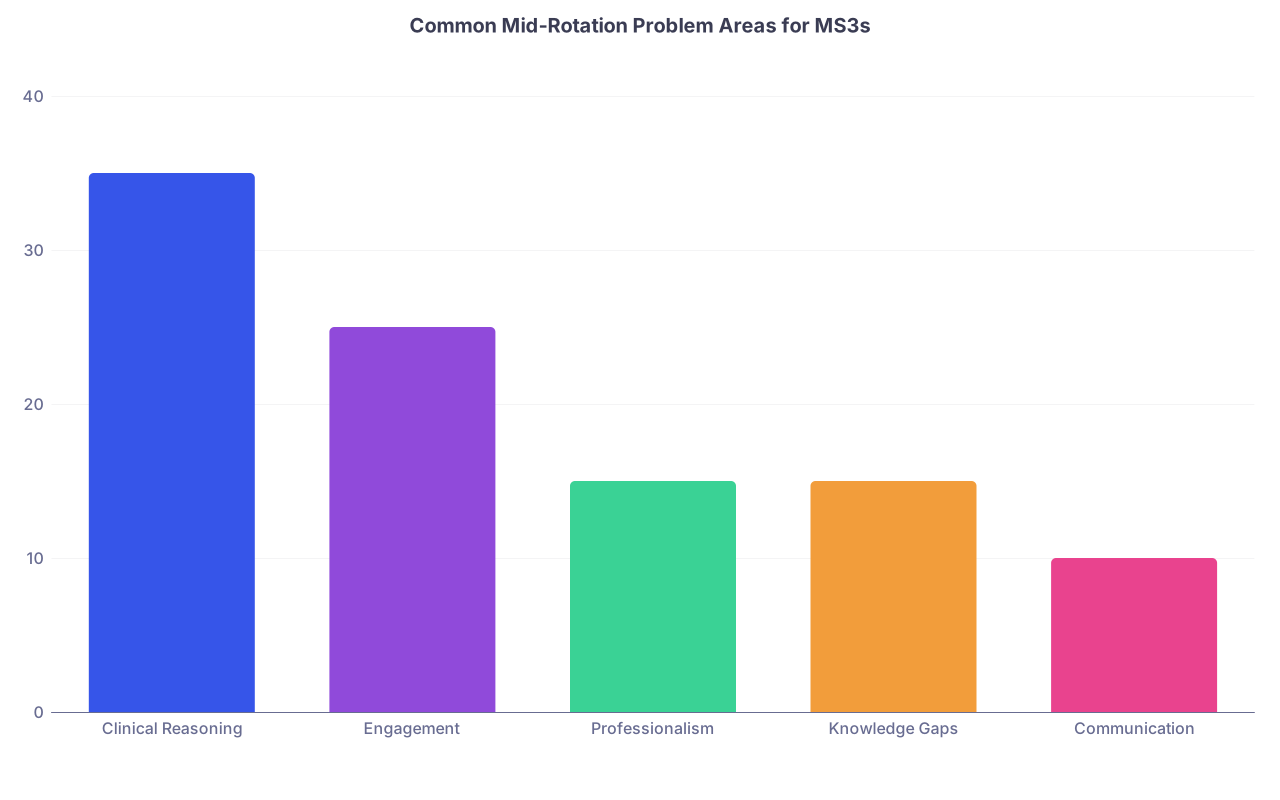
| Category | Value |
|---|---|
| Clinical Reasoning | 35 |
| Engagement | 25 |
| Professionalism | 15 |
| Knowledge Gaps | 15 |
| Communication | 10 |
Quick Comparison: Reacting vs. Recovering
| Situation | Emotional Reaction | Strategic Recovery Action |
|---|---|---|
| See bad mid-rotation eval | Vent to classmates, avoid attending | Request brief feedback meeting with clear agenda |
| Vague criticism (“disengaged”) | Argue internally, feel misunderstood | Translate into 3–5 visible engagement behaviors |
| Professionalism concern | Defend, blame schedule or system | Own it, build concrete systems, ask for re-check |
| Unfair eval | Write long rebuttal email | Document privately, discuss with clerkship director |
| Fear of final grade impact | Freeze, hope it improves | 7–10 day performance sprint + ask for re-eval |

| Step | Description |
|---|---|
| Step 1 | Bad Mid-Rotation Eval |
| Step 2 | Read and Categorize Feedback |
| Step 3 | Request Feedback Meeting |
| Step 4 | Define 3-5 Behavior Targets |
| Step 5 | 7-10 Day Performance Sprint |
| Step 6 | Ask for Reassessment |
| Step 7 | Document Improvement & Plan Next Rotation |

Final Reality Check
You are in the messy part of medical training. Third year is designed to expose your weaknesses. Sometimes sharply. On a public stage.
A bad mid-rotation evaluation feels catastrophic. It is not. What actually matters:
- Whether you hide from feedback or run toward it.
- Whether you convert vague criticism into concrete, visible changes.
- Whether your pattern over time is “same problems repeated” or “got hit once, adjusted, and got better.”
Most faculty care far more about your trajectory than your day 1 performance. If they see you take a hit, adjust course, and level up, they will say that in your evaluations. And that story plays very well in residency applications.
You are not trying to be flawless. You are trying to be coachable, reliable, and clearly improving.

FAQ (Exactly 3 Questions)
1. Should I ask to change teams or sites after a bad mid-rotation evaluation?
Usually no. Changing teams mid-stream often looks like you are running away from feedback or conflict. The better move is to stay, show visible improvement, and let that same team see your growth. The exception is if there is clear unprofessional behavior or mistreatment from the evaluator; in that case, speak with the clerkship director or your dean’s office and let them suggest or arrange any changes.
2. Can one bad clerkship grade really hurt my residency chances?
One isolated “Pass” or one lukewarm evaluation rarely kills an application by itself. Programs look at patterns: do you repeatedly struggle with professionalism, engagement, or clinical reasoning? If you have mostly strong evaluations and one “rough” rotation with a clear improvement story afterward, you are fine. Use subsequent rotations to generate strong comments that directly counter whatever you struggled with here.
3. Should I write a formal rebuttal or response to the evaluation for my file?
In most cases, no. Formal rebuttals tend to come across as defensive and rarely change grades. They also risk locking in a narrative that you are difficult to coach. A better strategy is to address concerns directly with the evaluator and clerkship director, demonstrate improvement, and let later evaluations and letters show the full picture. Save official written statements for extreme cases involving factual inaccuracies, discrimination, or serious professionalism allegations—and even then, only after discussing with your dean or advisor.