You are on week three of your medicine clerkship. It is 8:02 a.m. You are trailing behind the team as they move from room to room. Your vitals sheet is half folded in your white coat pocket, your notes app is open on your phone, and you are praying they do not ask you about that creatinine bump from yesterday.
The attending glances at you when you start presenting. Expression flat. You see it: a tiny eyebrow raise when you gloss over a missing lab. A pause when you say, “Everything else is stable.” The presentation ends. The attending turns to the resident and asks the question they expected you to know. And then another. To them. Not to you.
You are still on the team. You are still “nice” and “hard‑working.” But you are no longer trusted.
Not because of one catastrophic event. Because of a collection of small, subtle behaviors that quietly told them: “This student is not safe to rely on.”
Let me walk you through the big ones—because I have watched these sink otherwise strong students again and again.
1. The “Vague and Comfortable” Presentation
You think you are being efficient. The attending thinks you are hiding what you do not know.
The classic version:
“Overnight was unremarkable. Vitals stable. Labs are overall similar. Plan is to continue current management.”
Sounds harmless. It is not.
This triggers alarms in a good attending’s head, because it usually means one of three things:
- You did not actually look at all the data.
- You saw something you did not understand and just skipped it.
- You do not recognize what matters for this patient.
All three are trust killers.
Concrete examples of how this shows up:
- “Labs are fine” instead of: “Na 134 from 136, K 3.6 from 4.0, Cr 1.3 from 1.1 yesterday.”
- “No complaints” when the patient told you, “I still feel kind of short of breath when I walk.”
- “No events overnight” when the nurse note clearly documents a 3 a.m. desat to 86% on room air.
The attending hears “vague plus confident” and assumes—correctly, most of the time—that you are out over your skis.
How to avoid this:
Replace vague summaries with specific facts.
Not: “Vitals stable.”
Say: “BP ranged 110–130/70–80, HR 80–95, afebrile, no desats documented.”Explicitly say what you did not get.
“I could not find the EKG from yesterday afternoon; I looked in media and results. I asked the nurse and she thought it might not have been uploaded yet.”When you are uncertain, label it.
“I saw that the bicarb dropped from 24 to 18; I am not sure if this is from diarrhea versus another cause. I was planning to review the ABG and talk through the differential with you.”
Attendings do not lose trust when you are appropriately uncertain. They lose trust when you are confidently vague.
2. The Quiet Data Fabricator
You may think you would never “make up” data. Yet I have seen versions of this every single block.
It does not start with, “Let me fabricate a potassium level.” It starts with:
- “He probably didn’t have a fever.”
- “I am pretty sure he is still on 2L.”
- “I think he denied chest pain.”
Said quickly. As if you checked. You did not.
An attending hears:
- “Probably” + said as fact = this student does not respect the difference between data and assumption.
- “Pretty sure” + no pause to verify = this student is comfortable guessing about clinical facts.
Red flag.
Here is the line you cannot cross: representing something as checked when you have not checked it.
This includes:
- Reporting I/O when you have not looked at the flowsheet.
- Saying “no new imaging” because you did not scroll past “Today.”
- Claiming “meds unchanged” when you never opened the MAR.
You will be caught. Not always in the moment. But you will.
And once they see it once, the attending starts quietly re‑checking everything you say. You stop being a learner and become an extra verification step. That is not where you want to live.
How to avoid this:
Ban “probably” and “I think” when talking about objective data.
Either you know, or you say, “I do not know yet.”Use explicit language:
“I did not confirm overnight I/O yet; I can get that now.”
“I forgot to check his home med reconciliation; I will look it up after rounds.”If you realize on the spot you were wrong, correct it yourself.
“I just said he was on 2L; I am looking at the monitor now and he is actually on room air. I apologize—I should have confirmed before speaking.”
Correction builds more trust than pretending you were never wrong.
3. The Phone‑Distracted, “Multitasking” Student
You are on rounds. You are scrolling and typing on your phone. You feel productive: updating your list, checking labs, pre‑charting.
Your attending sees one thing: You look disengaged.
There is a brutal reality: attendings have watched years of students pretend they were “looking up the patient” while texting. So the default assumption is skepticism.
Even if you are doing something “for the team,” this kills trust in several ways:
- They doubt your attentiveness. If you are looking down when they are teaching or discussing a plan, they assume you missed half of it.
- They worry you will miss subtle safety issues. That small phrase from a patient. The nurse saying, “He looked more short of breath last night.”
- It signals priority: your device > your patient.
How to avoid looking like “that student”:
Make your device use explicit.
“I am pulling up the latest labs on my phone now.”
“I am going to add that med to my to‑do list so I do not forget.”When the team enters a room, your device should be away unless your role is clearly to check something.
If you are documenting during bedside rounds because your team expects it, tell the attending early in the rotation:
“I may be on Epic on my phone during rounds to keep live notes on my patients; if that is distracting or not how you run things, I can change.”
Transparency fixes 80% of the suspicion.
4. The “Nodder” Who Never Clarifies
Another subtle trust killer: pretending you understand when you do not.
You know this one:
- The attending says, “We will broaden to zosyn, stop the ACE, and switch to a heparin drip—make sure to get a baseline PTT first.”
- You nod. You write nothing down.
- You have not ordered a heparin drip before. You are not sure which baseline labs are needed. You are hoping the intern will magically fix it.
The attending is not dumb. They notice the lack of notes. The absent questions. They know what you can and cannot reasonably be expected to know at your level.
So when you do not ask:
- They assume you overestimate yourself.
- Or worse, that you do not care enough to get it right.
That is how they end up re‑stating instructions to the resident instead of you. Trust shifted.
How to avoid this:
When you are given action items that you are not fully comfortable with, say so.
“I understand the plan; I have not placed a heparin drip order before. I can draft the orders and then review them with the intern before signing?”Ask precise clarifying questions:
“For baseline labs, do you prefer just PTT or PTT and anti‑Xa here?”
“Should I document the rationale for stopping the ACE in the note, or is that implied in the AKI assessment?”Write down tasks in front of them. Visibly. It signals seriousness.
The honest “I am not sure, but I will find out and confirm” voice earns trust. The blank nod does not.
5. The Blame‑Shifter and Excuse‑Maker
Nothing destroys trust on rounds faster than the student who reflexively points the finger away from themselves.
You will recognize the pattern:
- “I thought the intern was going to follow up on that.”
- “The nurse never told me the glucose was that high.”
- “The system was slow so I could not finish reading that note.”
Some of those may even be true. They still sound bad. Because what the attending hears underneath is: “My first instinct is to protect myself, not the patient.”
They do not trust people who dodge responsibility.
Two critical distinctions here:
Explaining vs. excusing.
“I missed the new troponin because I only checked the morning labs, not the evening set; I will start reviewing the 24‑hour range from now on.”
That is explanation plus ownership. Trust‑building.Versus:
“No one told me there was an evening troponin.”
That is excuse. Trust‑destroying.Safety vs. blame.
You absolutely should escalate true system problems or unsafe handoffs. But not as knee‑jerk deflection.
A trusted student does this instead:
Owns their piece immediately.
“I should have rechecked the imaging today; I only looked at yesterday’s CT. I will fix that now.”Then describes context if needed.
“I was covering two new admissions this morning, so I prioritized getting their H&Ps done and missed that update. Next time I will set a reminder in the chart for interval imaging.”Explicitly states the change in behavior.
“From now on, I am going to….”
That last part is what convinces attendings this was a one‑time miss, not your baseline.
6. The “Too Casual” Professionalism Problem
You do not swear at the bedside. You show up on time. You think you are fine on professionalism.
Meanwhile the attending is quietly docking you in their head because of the little things:
- You sit on the patient’s bed in front of the team uninvited.
- You lean on the wall, arms crossed, looking bored while the attending explains something to a family.
- You whisper side comments to another student while the resident is presenting.
Each of these may seem minor to you. Attendings see them as proxies for how you will act when no one is watching.
And some truly subtle signals:
- You never introduce yourself to patients. “Hi, I’m with the team” does not count.
- You consistently forget to wash or gel your hands when entering the room until someone prompts you.
- You keep your white coat messy: old food wrappers, loose papers, stethoscope buried.
What that says to an attending: This student cuts corners on the small stuff. Will they cut corners on the big stuff?
How to avoid the “sloppy” impression:
- Create a pre‑room ritual: gel in, knock, introduce, eye contact with patient before screen. Every time.
- Stand like you are engaged: shoulders forward, eyes on speaker, arms not crossed, minimal fidgeting.
- If you are exhausted and zoning out, do one concrete thing: start writing the key point from what is being discussed. It forces you to stay with it.
Professionalism is judged in seconds. You rarely get explicit feedback when you slip. You just get less trust.
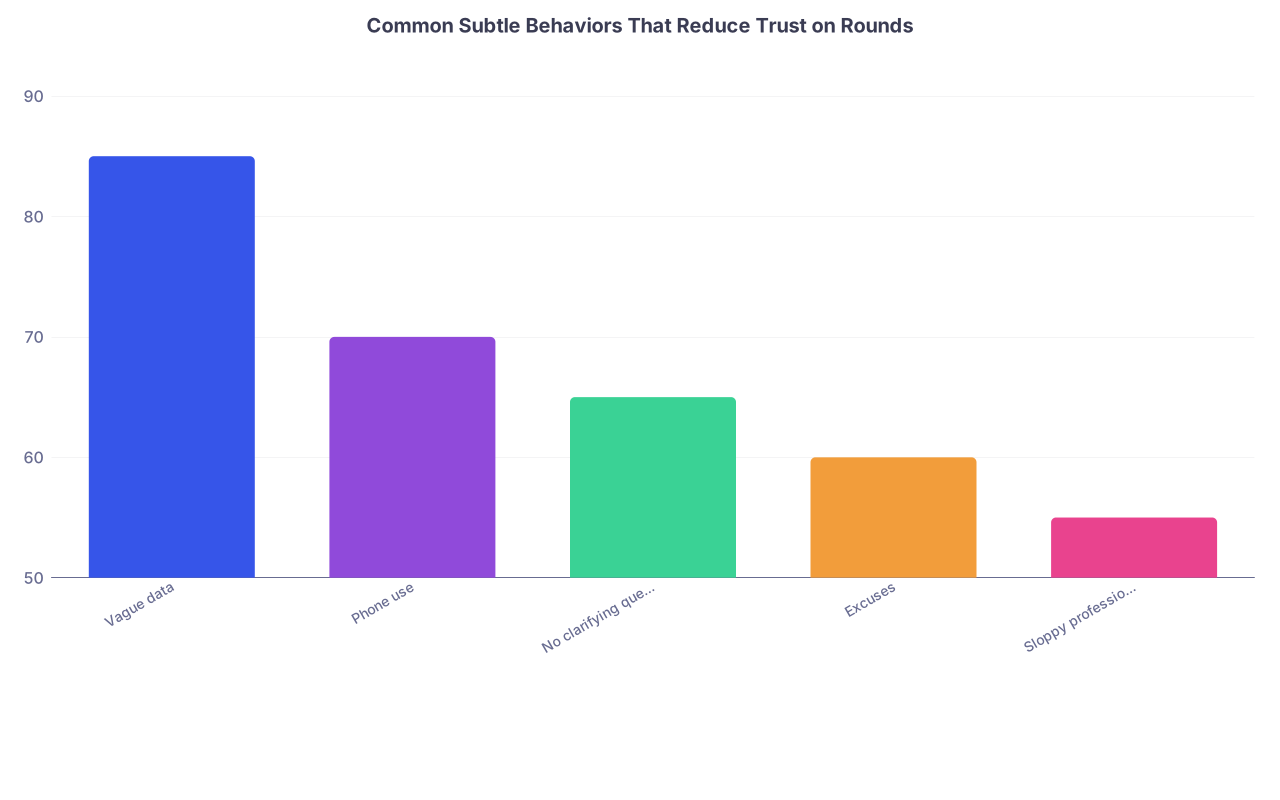
| Category | Value |
|---|---|
| Vague data | 85 |
| Phone use | 70 |
| No clarifying questions | 65 |
| Excuses | 60 |
| Sloppy professionalism | 55 |
7. The Non‑Closer: Failing to “Complete the Loop”
Trust is not just about knowledge. It is about follow‑through.
One of the quickest ways to erode confidence: you agree to do something on rounds, then never close the loop.
Examples:
- You say, “I will call radiology to clarify whether they saw any small PE.” Nobody hears back from you that afternoon.
- You are told, “Update the son about the plan before we change code status.” At the end of the day, the note is in, the orders are placed, but the son has not heard from anyone—you never made the call.
Attendings remember that. Not only because it is annoying, but because it is unsafe.
What is subtle is how this surfaces. They rarely confront you directly. Instead you see:
- They stop giving you independent tasks.
- They route everything through the intern.
- They use phrases like, “Let’s have the resident handle that.”
You think they “don’t like you.” More often, they do not trust you to finish.
How to avoid this:
Repeat back the task in concrete form when it is assigned.
“So I will call the son this afternoon, explain that we are changing to DNR/DNI based on his mother’s wishes, and then document the conversation in a brief note. I will let you know when it is done.”Put time‑sensitive tasks in writing immediately: checklist, list, sticky note on your folded census—whatever system you will actually look at.
Close the loop proactively.
“Quick update: I called the son at 2 p.m., explained the plan, and he was in agreement. I documented the conversation in a note titled ‘Goals of care discussion.’”
That last sentence can literally change an attending’s narrative about you from “forgetful” to “reliable.”
8. The “I’m Only a Student” Mentality
One of the most damaging patterns is subtle and internal: you act as if your role does not matter.
You hint at it with lines like:
- “I am just the student, but…”
- “I did not want to bother anyone about the blood pressure; the nurse was already on it.”
- “I figured the resident was watching the labs.”
Attendings pick up on this quickly. It frightens them. Because the people who catch bad things early are often the ones “lowest” on the hierarchy—the nurse, the MS3, the intern.
If you mentally step out of responsibility, you signal you are not a future colleague. You are a passenger.
Examples of how this shows up behaviorally:
- You notice the patient looks more confused but do not mention it because “I’m not writing the orders.”
- You see a strange medication dose and assume, “They must have meant to do that.”
- You discover in the chart that a test the attending wanted never happened, but you sit on it until next morning rounds.
Trustworthy students do the opposite: they over‑communicate safety concerns.
How to avoid the “passenger” trap:
Treat your patient panel as your responsibility, even if you have limited power.
Your thought process: “I personally am responsible for knowing what is happening with this patient and alerting the team to anything concerning.”Use respectful escalation language.
“I may be overcalling this, but I am worried his mental status has changed from this morning. Can we reassess him together?”
“I saw that the CT angiogram we ordered still is not done; do you want me to call radiology to check on timing?”Never assume “someone else” saw the thing you are looking at. State it out loud.
That is how attendings start thinking, “I would feel safe if this person was watching my patient overnight.”

| Step | Description |
|---|---|
| Step 1 | Subtle behavior |
| Step 2 | Vague or incomplete data |
| Step 3 | Disengaged body language |
| Step 4 | Poor follow-through |
| Step 5 | Attending stops relying on student |
| Step 6 | Fewer questions, fewer tasks |
| Step 7 | Less opportunity to improve |
9. The Anti‑Feedback Shield
Final subtlety: how you respond when corrected.
Every student gets things wrong on rounds. Often. That is expected. What attendings watch very closely is your reaction when that happens.
Red‑flag behaviors:
Immediately arguing instead of listening.
“Well, actually the UWorld question said…” before the attending has finished explaining.Freezing, getting visibly offended, or going silent for the rest of rounds.
Blaming lack of teaching:
“No one told me we do that here.”
“My last team said not to worry about that.”
When attendings sense that giving you feedback is emotionally expensive, they pull back. They teach you less. They stop correcting small errors. Why? Because it feels like a fight every time.
And underneath that, they start to wonder:
“If they react like this when I gently correct them in daylight with backup, what will they do when a nurse questions them at 3 a.m.?”
The trusted student does something different:
Listens fully. No interruptions.
Reflects back the point once.
“So for CHF patients, I should always present weight trends, I/O, and diuretic doses explicitly, not just say ‘breathing better.’ Got it.”Shows change within 24 hours. That is what really matters.
One of the highest trust‑building moves you can make: deliberately apply a piece of feedback the very next day and say, “I’m doing this differently based on what you said yesterday.” That tells them their investment works with you.

Your Next Move: One Concrete Fix Today
This can feel like a long list. It is. But you do not need to overhaul everything at once. You need to stop making the quiet, trust‑killing mistakes that are 100% fixable.
Do this today:
Before your next set of rounds, take your patient list and add a tiny column on the right called “VERIFY.” Under each patient, write 1–2 items you will not guess about:
- Last 24 hours vitals trend
- New labs or imaging
- Overnight events from nursing notes
Then, actually verify them before you present. Out loud, say:
“Overnight there were no acute events documented in the nursing notes, and no new imaging was performed.”
Make that your baseline. Precise, verified data instead of vague comfort.
Once you have that habit, layer in the next: ask one clarifying question per patient where you are even slightly unsure, instead of nodding and hoping.
Open your patient list right now, draw that “VERIFY” column, and pick the three data points that you refuse to be vague about tomorrow. That small, deliberate change is how attendings start to think, often silently:
“I can trust this one.”