

What do you do when the team walks into a patient room, the patient speaks a language you barely understand, and your entire role shrinks to “stand in the corner and smile politely”?
If you’re honest, you know the feeling. You’re on IM or OB or Surgery, you’re supposed to “own your patients,” but half your list speaks Spanish, Mandarin, Arabic, Vietnamese—something you do not. The resident runs the whole encounter with an interpreter or in a language you do not speak, the note’s already done, and you’re left wondering: Am I actually learning anything? And are you going to get evaluated as “disengaged” because you literally can’t talk to your own patients?
Let’s fix that. Here’s how to handle this situation like someone who actually deserves to be on the team.
First: Be Honest About the Problem (Not Just Guilty)
You’re up against three separate issues here:
- Patient care risk: Miscommunication can hurt people.
- Educational loss: You’re missing chances to take histories, build rapport, and practice counseling.
- Evaluation optics: You look passive even when you’re trying.
So you can’t just “be a good person” and smile more. You need tactics.
Let me be blunt: just standing there, not understanding anything, and hoping your grade doesn’t tank is not a strategy. It’s how you end up with “below expectations in patient ownership” on your eval.
Your job is to:
- Protect patient safety.
- Extract as much learning as possible.
- Show the team you’re engaged despite the barrier.
You won’t solve language inequity during week 3 of your Internal Medicine rotation. But you can absolutely change how much you contribute and how you’re perceived.
Step 1: Fix the Basics – Interpreters, Not Guessing
If your team is casually “getting by” with family members or broken English, you’re in dangerous territory. And you, even as a student, can nudge it in the right direction.
You need to know exactly what tools your hospital has:
- In-person interpreters (often limited to Spanish and a few high-volume languages).
- Phone interpreter service.
- Video remote interpreting tablets/carts.
- Bilingual staff with documented proficiency and approved to interpret.
If your patient’s language isn’t English and you’re about to see them, your default should be: “We need a professional interpreter.”
That means you get comfortable with a sentence like:
“Should we grab the interpreter phone/tablet before we go in so we can be sure the patient understands everything?”
Said once? You’re just “curious.”
Said consistently? You become the person on the team who actually cares about doing this correctly.
And if someone says, “Oh, the daughter can translate,” you don’t have to pick a fight. You can say:
“We might still want the interpreter for the more complex parts, like discussing the plan or consent.”
You’re a student, not the hero of a policy drama. But your suggestion often nudges people to do the right thing.
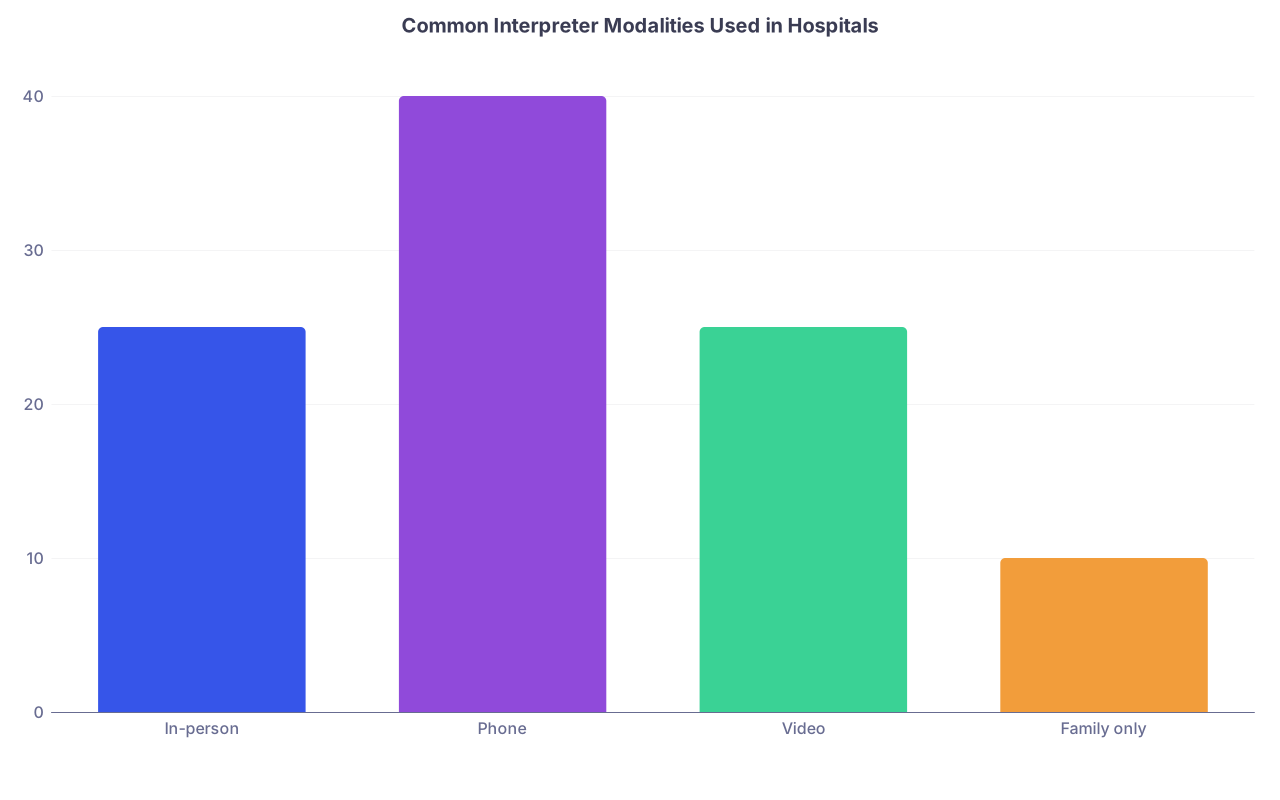
| Category | Value |
|---|---|
| In-person | 25 |
| Phone | 40 |
| Video | 25 |
| Family only | 10 |
Step 2: Before Rounds – Prepare Smarter for Language-Mismatched Patients
The worst time to feel useless is at the bedside, with six people watching. The fix starts before you walk into the room.
For each patient where you don’t share a language:
Read the chart more deeply. Not just “HPI and A/P.” Read:
- Prior consult notes, especially social work and case management.
- Nursing notes (“Patient appears anxious when family leaves,” etc.).
- Any prior interpreter notes indicating what the patient seems to value or fear.
Build a short written “script” for yourself. Write down in English:
- 1–2 key questions you’d ask if you could.
- The one thing you most need to clarify (e.g., “Why are they refusing the CT?”).
- One empathetic statement you want to make.
Learn 3–5 phrases in the patient’s language—correctly. Not a whole conversation. Just:
- Hello / Good morning.
- My name is [Name], I’m a medical student.
- Thank you. Use hospital-provided phrase sheets or a vetted resource—not Google Translate off your phone while walking into the room.
You’re not going to “suddenly be bilingual,” so don’t play that game. You’re signaling respect and effort, then doing the real work through an interpreter.
Step 3: During Rounds – How to Not Be a Statue in the Corner
Here’s the core problem: the attending and resident start using the interpreter, the conversation is flowing, people are talking fast, and by the time you figure out what’s happening, it’s over.
You need a role. That doesn’t happen accidentally.
Take a Clear, Defined Role
Try this structure:
- At the start of the encounter, position yourself where you can see and hear the interpreter device and the patient clearly. Not behind the attending. You are allowed to move.
- Watch the patient more than the team. Their facial expressions, body language, confusion—this is where you can add value.
Then, deliberately do at least one of these things each encounter:
Ask 1–2 patient-centered questions using the interpreter. Example (when there’s a pause):
“Can I ask a quick question?”
Then, to the patient via interpreter:
“What worries you the most right now about your illness or the hospital stay?”Clarify one specific point.
“I’d like to ask if they had any side effects from yesterday’s new medication.”
Close the encounter with empathy.
“Thank you for talking with us. We know this is a lot. We’ll keep you updated each day.”
This takes 15–30 seconds. If you do this consistently, attendings notice. You go from “background figure” to “student who engages even in hard situations.”
Manage the Interpreter Flow Without Being Awkward
Do not talk over the interpreter.
Do not ask long, paragraph-length questions.
Use short, clean, interpreter-friendly chunks:
Bad:
“Can you ask the patient if the abdominal pain is worse when he eats, and if he’s been having any nausea, vomiting, diarrhea, or constipation, because I’m trying to figure out whether this is more likely to be something like ischemic colitis or something else.”
Good:
“Can you please ask:
- Is the pain worse after eating?
- Any nausea or vomiting?
- Any diarrhea or constipation?”
You’re learning a core skill here: how to think and speak in discrete, translatable pieces. This will matter for the rest of your career.

| Step | Description |
|---|---|
| Step 1 | Pre-round prep |
| Step 2 | Enter room with team |
| Step 3 | Brief intro to patient |
| Step 4 | Resident/attending leads main discussion |
| Step 5 | Student asks 1-2 focused questions |
| Step 6 | Student offers closing thanks/summary |
| Step 7 | Post-encounter chart review and reflection |
Step 4: After Rounds – Turn That Encounter Into Credit (and Learning)
You’re still being graded on “patient care,” “communication,” and “professionalism.” If you only see language barriers as “bad luck,” you’ll get steamrolled.
Debrief Briefly With the Resident
On the way out of the room, or at the computer later, ask a fast, focused question:
- “What did I miss in that conversation that was most important?”
- “If I had more time with the interpreter, what else would you have asked?”
- “Can I follow up later with the interpreter about X and then add an addendum?”
Then actually do the follow-up.
Use Interpreters on Your Own Time
If you’re pre-rounding or checking in on a patient in the afternoon:
- Grab the interpreter phone or tablet yourself.
- Do a small, defined task:
- Ask about symptoms since morning.
- Clarify home meds.
- Review tomorrow’s plan.
This is where you stop being passive.
When you staff this with your resident:
“I called the interpreter this afternoon and checked in with Mr. Tran. He reports his pain is better (3/10 vs 6/10 this morning), and he understands that we’re planning for discharge tomorrow if his labs stay stable.”
That’s ownership. Nobody cares that you don’t speak Vietnamese. They care that you cared enough to close the loop.
Step 5: Make Sure Your Evaluation Reflects the Reality
If half your patients spoke a language you don’t, and your eval just says “did not independently interview many patients,” that’s a failure of documentation on your part too.
You want to lightly pre-load your evaluators with the right frame before they sit down to fill forms.
Around the midpoint or last week, with your resident or attending:
“I’ve been trying to stay engaged with our non-English-speaking patients by using the interpreter, especially for afternoon check-ins and clarifying plans. If you have any feedback on how I can improve with interpreter use or communication in those encounters, I’d really appreciate it.”
That one sentence does three things:
- Reminds them you have been working with language-barrier patients.
- Frames you as someone who actively uses interpreters, not someone who disappears.
- Invites specific feedback they may then reflect in your written eval.
If your school has a self-reflection or mid-rotation feedback form, you can also write explicitly:
“Several of the patients I followed primarily spoke Spanish/Mandarin/Arabic. I used the hospital interpreter service to conduct focused check-ins and clarify the care plan, and I’m working on asking more concise, interpreter-friendly questions.”
You’re basically handing them the language they can use in your evaluation.
Step 6: Learn Enough Cultural Medicine to Not Sound Clueless
Language barriers are rarely only about the language. Culture is wrapped into this.
You’ll see patterns:
- Families who insist on “protecting” elders from bad news.
- Patients who will not openly disagree with the doctor in the room but tell the nurse later they’re not taking the meds.
- Religious or cultural practices around diet, modesty, gender of examiner.
Spend one or two nights on that rotation doing targeted reading about the main language groups on your service, from a reputable source (your institution, UpToDate, or similar—not random blogs).
Then on rounds, you might say:
“Given his fasting for religious reasons, should we adjust the timing of his meds or labs?”
Or:
“She seemed hesitant when we mentioned rehab placement. Should we clarify with the interpreter whether there are cultural or family concerns about that setting?”
That’s not performative “cultural competence.” It’s you showing that you know real humans with different backgrounds react differently to the same medical plan.
Step 7: Safeguards – What Not to Do (Seriously)
Some things will sink you. Fast.
Do not:
“Wing it” with your high-school Spanish/Chinese/whatever for complex discussions. If it’s symptom check like “more pain or less pain?” and you’re truly fluent, fine. But consent, prognosis, meds, new diagnoses? Interpreter. Period.
Use family members for sensitive or high-stakes information unless there is no alternative and the team has made that call. You’re a student; you don’t override, but you also don’t initiate family-interpreter setups for serious topics.
Pretend you understood everything in the room when you did not. If you missed a key part of the conversation, ask your resident afterward:
“I lost part of that explanation—can you walk me through the main points you covered with the patient?”
Document as if you personally obtained a history you did not. If the entire HPI came from attending via interpreter while you stood in the back, do not write “I spoke with the patient and they endorsed…” Say, “Per discussion with patient via interpreter with attending present…” or similar.
Misrepresenting your role in the encounter is how you go from “student learning in tough circumstances” to “dishonest.”

Step 8: Building Long-Term Skills (So This Stops Feeling Awful)
If you’re in the U.S., certain languages dominate: Spanish, Mandarin, Vietnamese, Arabic, etc. Your hospital’s census will tell the story.
Without turning this into a fantasy of “I’ll be fluent by residency,” you can:
Learn a functional medical-intro script in the most common language you encounter. You want to say, comfortably:
- Hello, my name is X.
- I’m a medical student on your team.
- I’m going to call an interpreter so we can talk clearly.
- Thank you for your patience.
Learn how to order interpreters in the EMR and how to get devices yourself. Don’t depend on the nurse or resident every time.
Keep a personal crib sheet. A small folded page in your coat with:
- Your most-used phrases (printed from an approved source).
- The number for phone interpreter.
- Quick reminders on structuring questions for interpreters.
None of this wins awards. But it adds up into you becoming the person who is never completely helpless in these encounters.
Quick Comparison: Passive vs. Active Student With Language Barriers
| Situation | Passive Student | Active Student |
|---|---|---|
| Before rounds | Skims chart, shrugs at language mismatch | Reads interpreter notes, social work notes, prepares 1–2 questions |
| During encounter | Stands in back, says nothing | Asks 1 focused question via interpreter, watches patient closely |
| After encounter | Moves on to the next room | Clarifies key points with resident, plans afternoon interpreter check-in |
| Documentation | Writes generic note implying personal history | Accurately documents that information came via interpreter with team |
| On evals | “Quiet, limited independent patient interaction” | “Engaged, used interpreters effectively to care for non-English speakers” |
You pick which column you want.
FAQs
1. What if my attending or resident clearly does not want to use an interpreter?
You’re not going to fix a whole culture during one rotation, but you can tactfully push. Try:
“Would it be helpful to bring in the interpreter for a few minutes to make sure they understand the plan?”
If they shut it down, don’t escalate in front of the patient. Later, ask a genuine question:
“I was wondering how you decide when to use interpreters versus not—can you talk me through your thought process?”
Sometimes that alone reminds them there is a standard, and they’ll adjust next time. If what you’re seeing is clearly unsafe or unethical, bring it quietly to a chief resident, clerkship director, or trusted faculty member.
2. I feel useless during these encounters. How do I handle the frustration?
You’re allowed to be frustrated. It feels like someone slammed a door on all the skills you finally got comfortable with. The antidote is movement: give yourself 1–2 specific, achievable goals per day with language-barrier patients—ask one question, do one afternoon check-in, clarify one cultural concern. Tiny wins add up fast. And remind yourself: this is not “extra”; this is real-world medicine.
3. Can I practice my own second language with patients during rotations?
Yes—with limits. If you’re truly fluent and can handle full medical conversations, talk to your attending:
“I’m fluent in Spanish. Are you comfortable with me taking a first pass at the history, and we can bring in an interpreter for key decisions or if anything is unclear?”
If you’re conversational but not medically fluent, use your language for rapport (greetings, small talk, basic comfort questions) and still use a professional interpreter for any clinical content. When in doubt, err on the side of the interpreter.
4. How do I document encounters that rely heavily on interpreters?
State clearly how information was obtained and who was present. For example:
“History obtained from patient via certified Spanish interpreter (phone) with resident present.”
Then write the HPI as usual. If you didn’t personally ask the questions but were present, don’t claim “I interviewed the patient.” You can say “During team discussion with patient via interpreter, patient reported…” That’s accurate and safe.
5. Will language barriers hurt my clinical evaluations?
They can—if you disappear in those encounters. But you can flip it. If you consistently:
- Suggest appropriate interpreter use.
- Ask at least 1–2 thoughtful questions via interpreter.
- Do solo check-ins with interpreters in the afternoon.
- Talk explicitly with your evaluators about your efforts.
Then language barriers become a chance to shine, not a handicap. Many faculty will respect that you stayed engaged when things got harder, not easier.
Key points:
- You cannot control what language your patients speak; you can control how actively you use interpreters and how visible your effort is.
- Define a clear role for yourself in every language-mismatched encounter—before, during, and after rounds.
- Protect patient safety, own your learning, and make sure your evaluations reflect the reality that you showed up even when communication was hard.


