
Your resident’s chaos is not an excuse for your mediocrity. It’s your chance to stand out.
If you’re on a rotation where your resident is disorganized, scattered, constantly behind, or just straight-up flaky, you’re in one of the most common and most frustrating situations in clinical training. I’ve watched students sink with the ship. I’ve also watched smart ones use that mess to look like absolute rockstars to the attending.
Let’s talk about how to be in the second group.
1. First, Diagnose the Kind of “Disorganized” You’re Dealing With
Not all chaos is the same. If you get this wrong, you’ll respond wrong.
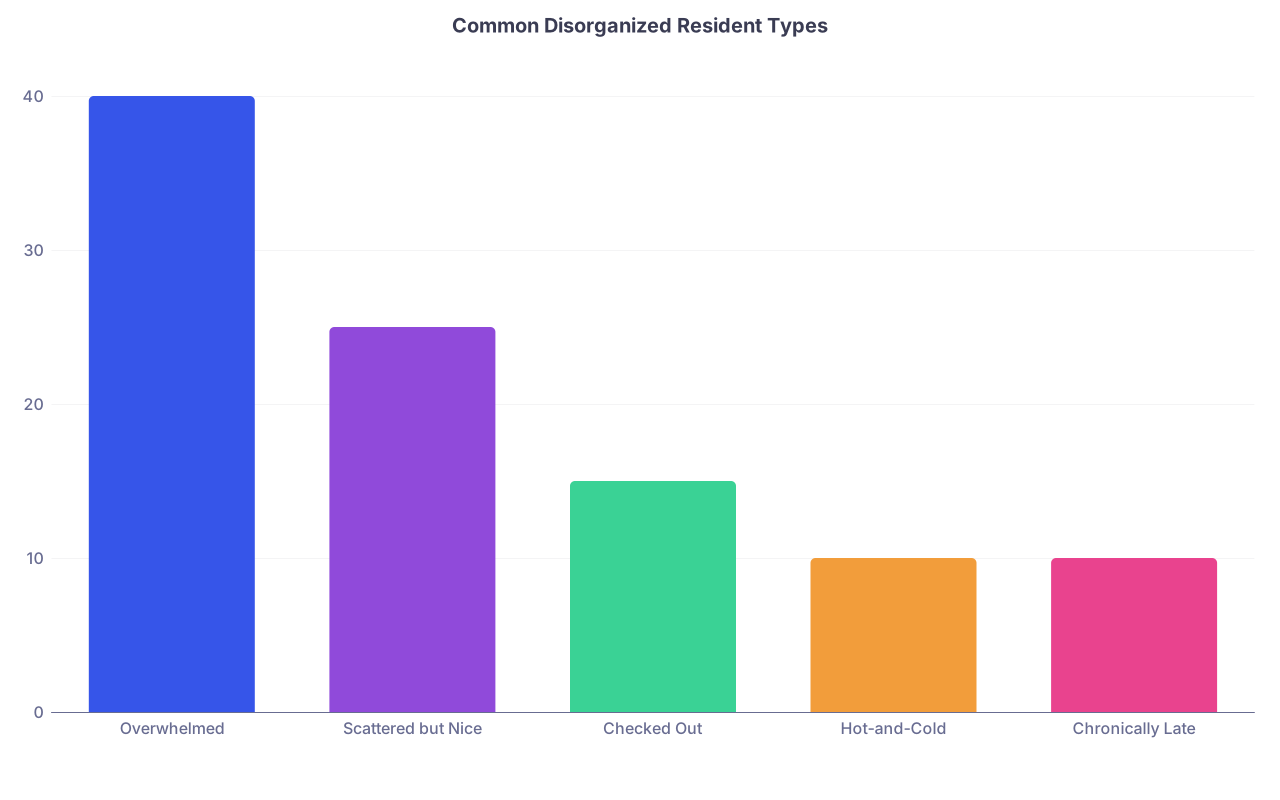
| Category | Value |
|---|---|
| Overwhelmed | 40 |
| Scattered but Nice | 25 |
| Checked Out | 15 |
| Hot-and-Cold | 10 |
| Chronically Late | 10 |
Broadly, I see five patterns:
Overwhelmed workhorse
Runs nonstop, always behind, tons of patients, constantly apologizing. Good intent, bad systems.Scattered but nice
Forgets to see you, loses track of times, but is kind and wants to help when reminded.Checked out / disengaged
Does the bare minimum, doesn’t teach, doesn’t care if you learn. Might be burned out hard.Hot-and-cold
Some days they’re great, other days they vanish, forget to staff things, or contradict themselves.Chronically late / time-blind
Always 20–40 minutes late to everything. Notes behind. Rounds start whenever they show up.
You handle each a bit differently, but the core principle is the same:
You create your own structure. You do not wait for theirs.
Before you assume bad intentions, give it 2–3 days of observation. Write down what actually happens:
- What time do they really show up?
- How often do they forget to check on your patients or your tasks?
- Do they respond to texts/pages reasonably?
- Are they nice but chaotic, or indifferent and chaotic?
You can’t fix their personality. You can absolutely work around their systems.
2. Build Your Own Structure So You Aren’t Dependent on Them
Your resident may be your “official” supervisor. But you answer to the attending, the nurses, and the chart too. You need a system that works even if your resident is all over the place.
Make a “rotation operating system” for yourself
This is not complicated. It’s just deliberate.
Use one sheet of paper or one note on your phone (HIPAA-safe, no PHI if on your phone):

Break it into:
Patient list section
- Name/room
- Diagnosis
- Your responsibility (note, presentation, follow-up lab, imaging, consult, discharge summary)
Daily timeline section (rough skeleton):
- 6:30–7:30: Pre-rounds
- 7:30–9: Rounds
- 9–11: Notes and orders review
- 11–12: Follow-up tasks, teaching points
- Afternoon: Updates, sign-out prep
Then you adapt to that specific team’s real rhythm over the first week.
Your resident might not give you a clear schedule. So you infer it:
- Ask the intern or another student: “What time do people actually start pre-rounding?”
- Ask the nurse: “What time does this team usually round?”
- Ask the attending (if needed): “I want to be prepared—what time do you usually like to start table or bedside rounds?”
You’re collecting data because your resident isn’t giving you reliable structure. Fine. You build it yourself.
Get your own patient ownership early
Day 1 or 2, ask:
“Could I take primary responsibility for 2–3 patients? I’ll pre-round, write notes, and present them on rounds.”
Do not let their disorganization turn into your passivity.
If they’re overwhelmed, they’ll usually hand you more than you expect. If they’re checked out, they’ll also hand you more—because it’s less work for them. Either way, you win as long as you do it well.
3. Make the Attending See You (Without Throwing the Resident Under the Bus)
The biggest fear I hear: “My resident is a mess; the attending is only going to see me through that lens.” Wrong—if you learn to bypass quietly.
You’re not going around them. You’re just being visible.
Be prepared on rounds like your grade depends on the attending. Because it does.
When the team gets to your patient:
- Have a tight, structured presentation ready, even if your resident never heard it first.
- Message your resident before rounds:
“I’m ready to present Mr. Smith and Ms. Lopez this morning. I’ll be outside their rooms by 8.” - On rounds, if there’s confusion about the plan because your resident is flailing, you calmly anchor:
“I checked the morning labs – creatinine improved from 2.1 to 1.8, no new electrolyte issues. I spoke with the nurse; pain is well controlled, but he’s still not ambulating much. I’d suggest a more aggressive PT plan today.”
You’re not showing off. You’re stabilizing the situation. Attendings notice that.
Talk to the attending 1-on-1—about your learning, not your resident
At some point in week 1–2, when there’s a quiet moment, say:
“I really want to get the most out of this rotation. I’ve taken primary responsibility for [X patients/tasks]. Is there anything specific you’d like me to focus on or improve in how I present and follow patients?”
That tells the attending:
- You care.
- You’re trying to build structure.
- You’re not just floating along with the chaos.
Notice what you didn’t say: “My resident is disorganized.” You don’t need to. The attending probably already knows. They might even be part of the problem. You stay neutral and competent.
4. Act as the “Anchor” for the Team Without Acting Like You Run It
If your resident is chronically behind, you can quietly become the person who keeps things from falling apart.
There’s a way to do this without being insufferable.
You become the checklist
Before rounds, go through your patients:
- New labs?
- New imaging?
- New consult notes?
- Overnight events?
- Discharge planning steps?
| Item | When to Check |
|---|---|
| Overnight events | Before pre-rounds |
| Labs/Imaging | Just before rounds |
| Consult notes | Mid-morning |
| Discharge steps | Early afternoon |
| Follow-up tasks done | Before sign-out |
When your resident shows up scattered:
Instead of: “What should we do today?”
Try: “For Ms. Lee, CT results are back, creatinine is stable, and PT saw her this morning. Ready when you are to see her and discuss the plan.”
You’ve done the mental lifting. They just have to say yes/no. They’ll be grateful, even if they don’t say it.
Protect the basics: pages, nursing concerns, orders
Disorganized residents often:
- Forget to respond to nurses promptly
- Lose track of urgent issues
- Place incomplete or delayed orders
You can’t enter orders. You can absolutely be the memory.
Nurse: “Can you tell the resident we need new pain meds for Mr. X?”
You: Write it down. If resident is around, tell them immediately. If not, text or page:
“Hi, just relaying from RN: Mr. X’s pain is still 8/10, current regimen not effective. They’re asking about new pain meds.”
Then, if it’s crickets after a reasonable time, you follow up again. Calmly, not nagging:
“Just bumping this—RN is asking again about Mr. X’s pain meds.”
You’re not responsible for the final action. You are absolutely responsible for not forgetting.
That’s how attendings later say in evals: “Student was reliable, aware of patient needs, and helped keep the team on track.”
5. When Your Resident’s Chaos Is Hurting Your Learning
There’s a line between “annoying” and “this is sabotaging my education.”
Here’s where that line usually is:
- You’re consistently left out of rounds or procedures you should be at
- You’re getting minimal to no feedback on your notes or presentations
- You’re being used purely as a scribe/secretary with zero teaching or integration
- You miss mandatory teaching sessions because your resident forgets or “doesn’t believe in them”
When that happens, you escalate—but smartly.
Step 1: Try a direct, low-friction ask
You:
“I’m trying to improve how I write notes and present. Could you give me feedback on one of my notes or watch a presentation and tell me 1–2 things to fix?”
If they’re just overwhelmed, they might respond well when you make it small and specific.
If they’re checked out, you’ll get vague answers like “You’re fine” or “Looks good” without even looking. Make a mental note. That tells you what you’re up against.
Step 2: Use other teachers on the team
If your resident is a dead end, you don’t stop learning. You just move sideways.
- Ask the intern: “Can I run a presentation by you and get feedback?”
- Ask another resident on the team: “Would you mind if I present one of my patients to you quickly sometime this week for feedback?”
- Use NP/PA, pharmacist, or senior nurse as content teachers (for meds, flows, etc.).
You’re building a coalition of people who can honestly say, “This student is engaged and improving,” even if your primary resident is useless.
Step 3: Quietly loop in the attending or clerkship director—only if necessary
If your education is truly suffering and you’ve tried the above, then you move up a level. The key: you talk about your learning, not your resident’s personality.
You might say to the attending after rounds:
“I’m hoping to get more structured feedback this rotation and chances to present. I’ve had a little trouble getting consistent opportunities on that front. Is there a way I could present to you once a day / get feedback on one note a week?”
Or, if it’s truly bad and affecting mandatory requirements, you contact the clerkship coordinator or director:
“I’m on [service] with [team]. I want to make sure I meet the rotation objectives. I’ve had difficulty getting consistent teaching, feedback, and chances to participate in care. Could I get your advice on how to approach this? I don’t want to complain; I just want to make sure I’m doing what I need to learn and be evaluated fairly.”
Reasonable clerkship directors have heard this exact story many times. You’re not the first.
6. Protect Your Evaluation When the Resident Is a Wild Card
Sometimes the scariest part isn’t the lack of structure. It’s the fear that this disorganized person is going to write your eval.
Here’s how you reduce the randomness.

| Step | Description |
|---|---|
| Step 1 | Week 1: Clarify Expectations |
| Step 2 | Week 2: Ask for Feedback |
| Step 3 | Week 3: Show Improvement on Specific Points |
| Step 4 | Week 4: Ask Resident for Summary Feedback |
| Step 5 | Politely Remind to Submit Evaluation |
Get feedback mid-rotation. Specifically.
Mid-rotation, you say:
“I really value your feedback. Is there one thing I could do better with my notes or my presentations the rest of the rotation?”
Then you write down whatever they say. Then you actually fix it. And later, you point it out:
“Thanks for that feedback about tightening my assessments. I’ve been focusing on that this week—please let me know if you notice anything else to improve.”
Two reasons:
- They’re now subconsciously invested in seeing you improve.
- When they fill out the eval, they’ll remember that you listened and adapted.
Make your work impossible to ignore
Disorganized residents forget vague contributions. They remember:
- The student who always had vitals/labs ready on rounds
- The student who wrote actual usable notes
- The student nurses trusted to relay messages and follow-up
You can even ask at the end:
“Would you be comfortable commenting in my evaluation on how I handled [patient ownership / communication / dependability]? That’s something I’ve been working on this month.”
You are handing them the narrative. Politely.
7. When the Resident’s Disorganization Crosses Into Unsafe
There’s one more layer: patient safety. Disorganized doesn’t always mean unsafe. But sometimes it does, and then things change.
Warning signs:
- Repeatedly forgetting to follow up critical labs or imaging
- Ignoring urgent nursing concerns
- Writing or co-signing clearly wrong orders and refusing to reconsider
- Repeated, obvious communication breakdowns that put patients at real risk
You are still a student. You are not the captain of the ship. But you are not helpless.
Here’s the quiet escalation ladder:
Clarify with the resident (once more, clearly).
“I’m concerned about X. The nurse mentioned Y. Are we OK with the current plan, or should we reconsider?”If dismissed and still concerned, loop in someone lateral, not nuclear:
- Another resident on the team
- The intern
- The fellow (on subspecialty services)
If it’s truly immediate risk and nobody else responds:
- You go to the attending directly:
“I might be overreacting, but I’m worried about [concrete, specific issue]. I wanted to make sure you were aware.”
- You go to the attending directly:
Do not dramatize, do not speculate about your resident’s competence, do not blame. Just state facts and your concern.
8. Take the Lesson Forward: How Not to Become That Resident
One uncomfortable truth. Some of the most disorganized residents were extremely “high-achieving” students who never built systems, only hustle. Don’t repeat that.
Use this rotation to practice the habits you wish your resident had:
- A consistent way you track patients and tasks
- A morning routine that gets you clinically ready before anyone else
- A simple way to respond quickly to nursing needs
- A rhythm for teaching junior learners or classmates even when busy

| Category | Value |
|---|---|
| Pre-rounding/Charting | 20 |
| Rounds | 25 |
| Notes/Orders Review | 30 |
| Follow-up Tasks | 15 |
| Teaching/Studying | 10 |
You’re not just surviving this rotation. You’re test-driving the version of yourself you’ll be as a resident. And if you can stay organized under a disorganized senior, you’re already ahead of the game.
FAQ (Exactly 3 Questions)
1. Should I ever directly tell my resident that they’re disorganized or that their chaos is affecting me?
Usually, no. That conversation almost never goes well from a student to a resident. What you can say instead is framed around your needs, not their flaws:
“I learn best with a bit more structure. Could we set a consistent time for me to present my patients to you each morning before rounds?”
You’re asking for a system, not criticizing their personality. Big difference.
2. What if my resident never lets me do anything because they’re so anxious and disorganized?
You’ll see this on surgery and some high-acuity services. The resident is so tightly wound and behind that they hoard all the tasks and procedures.
Your move: ask for very specific, small responsibilities.
“Could I place one or two orders under your supervision?”
“Could I close one of the smaller incisions?”
“Could I call one consult and then you can review how I did it?”
If they still block you, go sideways: ask another resident or the attending for targeted involvement. Always framed as, “I’d really like to learn X—would it be possible for me to do [specific thing] tomorrow?”
3. Will attendings actually notice my effort if the resident barely mentions me in sign-out or feedback?
Often, yes—if you make sure they have something concrete to see. That means:
- Consistently strong presentations on at least a few patients
- Thoughtful questions that show you’re actually thinking, not just collecting trivia
- Visible ownership: following up on labs, knowing the overnight events, reporting back updates on your patients
If you’re worried they’re not seeing it, ask late in the rotation:
“Could I get a few minutes of feedback from you before I finish this block? I’ve been focusing on [X, Y, Z] and would love your perspective on how I’m doing.”
Now they’re forced—nicely—to reflect on you as an individual, not just “one of the students.”
Key points:
- Your resident’s disorganization is not your destiny; build your own structure and make yourself the anchor.
- Make the attending see your preparation and ownership without openly criticizing your resident.
- If your learning or patient safety is truly compromised, escalate calmly and specifically—focus on your needs and the facts, not personalities.