
It’s week two of your rotation. The shine has worn off. You’re on a team where the senior rolls their eyes when you answer a question. The attending openly criticizes people on rounds. Residents snap at each other. Jokes are cutting, not funny. You feel your chest tighten every morning on the way to the hospital.
And in the middle of all that, you still need a decent evaluation. Maybe even an honors.
You can’t just “rise above” and pretend it’s all fine. But you also cannot blow up the bridge while you’re still standing on it. This is the line you have to walk: protect your sanity, protect your eval, and not sell your soul in the process.
Here’s how to handle that, step by step, like someone who has been on bad teams and still walked away with good comments.
First 24–48 Hours: Stop the Bleeding
You’re already in it. Things feel off. Before you decide “this whole team is garbage,” do a quick, ruthless reality check.

| Step | Description |
|---|---|
| Step 1 | Notice toxicity |
| Step 2 | Adjust behavior and expectations |
| Step 3 | Focus on self-protection and boundaries |
| Step 4 | Clarify expectations with resident |
| Step 5 | Document incidents and adapt strategy |
| Step 6 | Is it targeted at you? |
Step 1: Diagnose the type of toxicity
You’re looking for pattern and target.
Common patterns I see:
- “Yeller” attending or senior – humiliates people on rounds, likes “pimping as blood sport.”
- Passive-aggressive resident – sighs, ignores questions, vague about expectations, dumps work on you.
- Fragmented team – people openly talk behind each other’s backs, no one communicates, you get blamed.
- Checked-out leadership – attending barely present, senior runs everything, culture is “sink or swim.”
Ask yourself bluntly:
- Is this aimed at everyone or specifically at me?
- Is this about personality (they’re just mean), structure (system is chaotic), or me actually missing the mark?
If you’re unsure, watch how they interact with:
- Other students.
- Interns.
- Each other.
If the attending eviscerates the senior the same way they eviscerate you? That’s culture, not just you. Still toxic, still dangerous, but different strategy.
Step 2: Establish a private “sanity check” person
You need one grounded person who sees you in action:
- A different resident who seems reasonable.
- Chief resident.
- Clerkship director or site director.
- Another student who has been with you from the start.
You’re not filing a complaint yet. You’re reality-checking.
What to say (keep it simple, not dramatic):
“Can I run something by you? I want to make sure I’m understanding expectations on this team. I’m trying to do a good job, but I’m getting a lot of negative feedback and I want to know if I’m missing something specific I can fix.”
This is non-accusatory. It frames you as coachable and conscientious. You’ll often get one of three responses:
- “Yeah, that team is tough. They’re like that with everyone. Just hang in there.”
- “They expect a lot of independence. Here’s what they typically want…”
- “Honestly, that doesn’t sound okay. If it continues, you should loop in the clerkship director.”
All three change how you play the game.
Locking Down Your Eval: Performance Under Fire
You can’t fix the team. You can absolutely control how clearly you show value in a hostile environment.
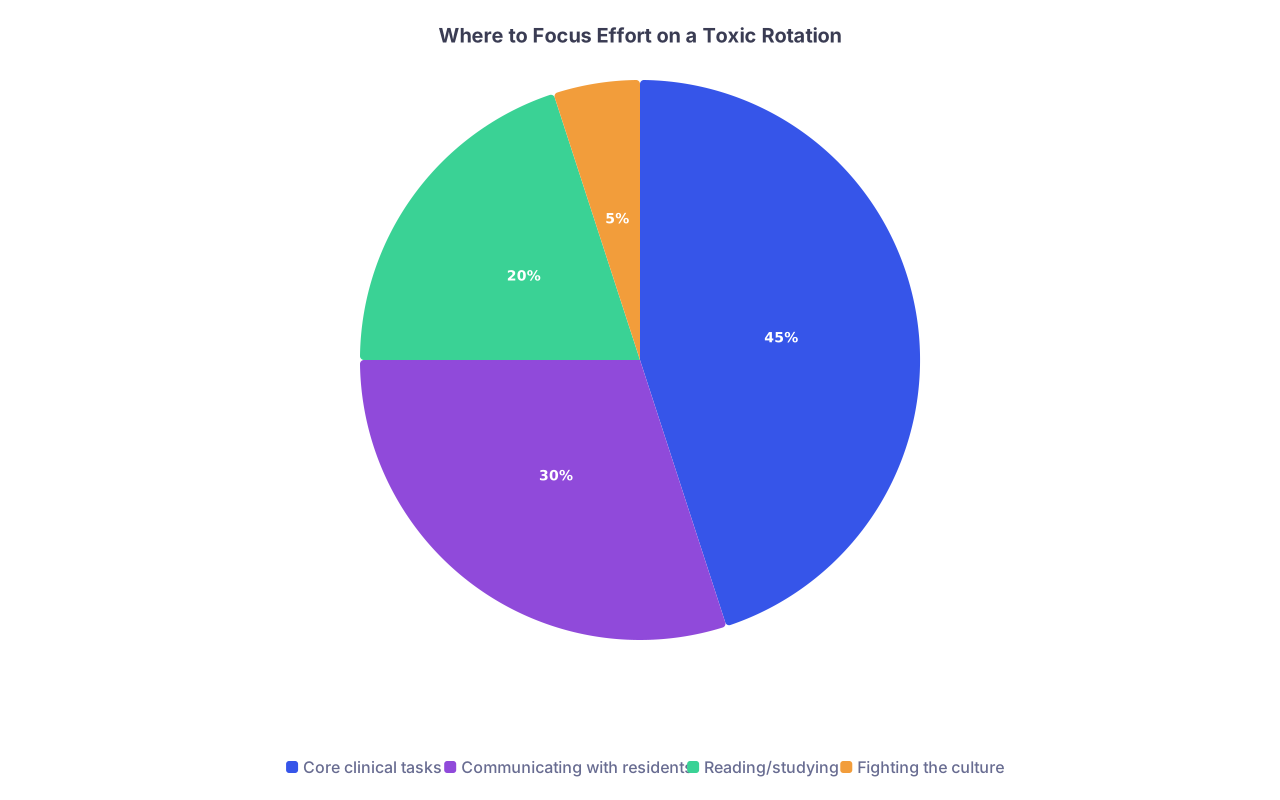
| Category | Value |
|---|---|
| Core clinical tasks | 45 |
| Communicating with residents | 30 |
| Reading/studying | 20 |
| Fighting the culture | 5 |
Know whose eval actually matters
Most schools weight:
- Attending eval heavily.
- Senior/resident eval second.
- Interns often informal but can influence narrative comments.
If your attending is toxic but your senior is fair, your main job: make that senior your primary audience. If the senior is the problem but the attending is reasonable, you work to shine in front of the attending, while keeping your head down with the senior.
Ask early, one-on-one:
“What does a strong student evaluation look like on this rotation from your perspective? Are there specific things you like students to take ownership of?”
Write down what they say. Then use their own words in your self-assessment later.
Simplify your goals to three visible things
On a toxic team, you don’t have the luxury of vague goals like “be helpful.” You need tight, concrete deliverables that even a hostile resident has to admit you did.
Pick 3–4 that fit the rotation:
- Own your patients’ data: be the person who always knows overnight events, labs, imaging, and plans.
- Notes done early and clean, using the team’s preferred format.
- Follow through on tasks: when someone says “Can you call X?” they never have to ask twice.
- Anticipate basic needs: pre-chart, pull up images, have forms ready.
Specific example for inpatient medicine:
- Your rule: by 6:30–6:45 am, you’ve:
- Seen your patients.
- Checked vitals, I/Os, labs, new notes.
- Drafted notes.
- Written a one-liner and bullet plan for every problem.
Then on rounds, even a jerky attending will notice:
- When they say, “What were the overnight events?” you answer clearly.
- When they say, “What were the last three creatinines?” you have them.
- When they throw a snarky question, you at least have the main clinical data straight.
Toxic people are still constrained by reality. If you’re prepared, they can’t honestly call you “lazy” or “disengaged” without looking a little ridiculous.
Reduce surface area for attack
You’re not there to win them over as friends. You’re there to get through clean.
Concretely:
- Be on time or early, always. This team will weaponize “lateness.”
- Ask direct, short questions rather than vague ones:
- Bad: “What else can I do?”
- Better: “Would it be more helpful if I prioritize discharge summaries or following up consults this afternoon?”
- Confirm expectations out loud:
- “Just to be clear, you’d like me to pre-round on 3 patients, write notes on all of them, and be ready to present by 8, correct?”
- After being criticized, extract something you can use:
- “I hear you that my plan wasn’t specific enough. Next time, would it be better if I focus more on medication changes and concrete follow-up steps?”
You’re forcing them into giving you actionable feedback instead of pure character assassination.
Dealing With Open Hostility or Bullying
Now we’re past “this team is grumpy” and into “this is damaging.”
Script for handling a dressing down in public
Scenario: Attending humiliates you on rounds for “not knowing anything” in front of the whole team.
In the moment:
- Do not fight back there. You won’t win, and they’ll remember you as “defensive.”
- Keep your face neutral. Take notes. Short answer: “Okay.”
After rounds, 1-on-1 if safe:
“Dr. X, I wanted to follow up about rounds earlier. I’m really trying to improve, and I felt overwhelmed. Could you tell me one or two specific areas I should focus my studying on for tomorrow so I can better meet your expectations?”
One of two things usually happens:
- They calm down and give actual guidance.
- They double down with vague cruelty (“You just need to be better.”)
If they calm down, exploit that. Anchor your future work to what they named.
If they stay vague and cruel, now you have a pattern and a documented attempt to address it professionally. That matters if this escalates.
Document — quietly, every day
When a team is toxic, your memory won’t be trusted. You need a quiet log.
Use a note on your phone or a private doc:
- Date.
- Who was present.
- What was said/done.
- Your response.
- Whether patient care was impacted.
Short entries, like:
1/9 – AM rounds. Attending Smith: “You’re clearly not cut out for this field” after I didn’t know mechanism of Drug X. On call, saw 3 new admits, notes submitted on time. No prior negative feedback.
1/11 – Senior Jones told intern in front of me and another student: “Just dump all scut on the students, that’s what they’re for.” Repeated multiple times this week. All patient tasks completed; no feedback about clinical performance.
This is not a complaint diary. It’s evidence if you need to talk to the clerkship director or if your eval is wildly inconsistent with your actual performance.
When and How to Escalate Without Nuking Your Eval
You do not run to the clerkship director every time someone is curt. You do speak up when:
- There are repeated personal attacks unrelated to performance.
- You’re being asked to do unsafe things or things beyond your scope and blamed if you push back.
- You’re experiencing harassment or discrimination (sexist/racist remarks, etc.).
- Your educational needs are being fully sidelined (e.g., they refuse to let you see patients or present, but then say you’re “disengaged”).

How to talk to the clerkship director like an adult, not a complainer
Email something like:
“Hi Dr. [Name],
I’m on the [X] team this block and was hoping to get brief guidance. I’m committed to doing well on this rotation, but I’m running into some challenges with the team dynamics and expectations that I’m not sure how to handle. Would you have 10–15 minutes for a quick check-in this week?
Best,
[Name], MS3”
In the meeting:
- Lead with your efforts, not their sins.
- Use facts, not adjectives.
Example framing:
“I want to be sure I’m meeting expectations. I’m pre-rounding on 3–4 patients, getting notes in before rounds, and I always ask for feedback. I’ve been getting comments like ‘you’re clearly not cut out for this’ and ‘students are just here for scut,’ often in front of the whole team, without specific guidance on what to improve. I’ve tried to ask for concrete feedback but usually get general criticism instead.
I’m concerned both about my learning and my evaluation. I’d appreciate advice on how to proceed and what you’d recommend in situations like this.”
You’re not saying “this team is toxic.” You’re saying: here is my performance, here are the behaviors I’m experiencing, here are my attempts to fix it, here’s the impact.
Good directors will:
- Check in quietly with the team.
- Tell you how they weight feedback from known-problem attendings.
- Sometimes move you to another team.
- Document that you raised a concern early.
If your school has a specific mistreatment policy, know it. For clear harassment or discrimination, jump straight to that process instead of trying to “tough it out.”
Protecting Your Mental Health in the Middle of the Fire
You’re not weak for being affected. Toxic teams chew up residents and attendings too. You’re a student with less power and less control over your schedule.
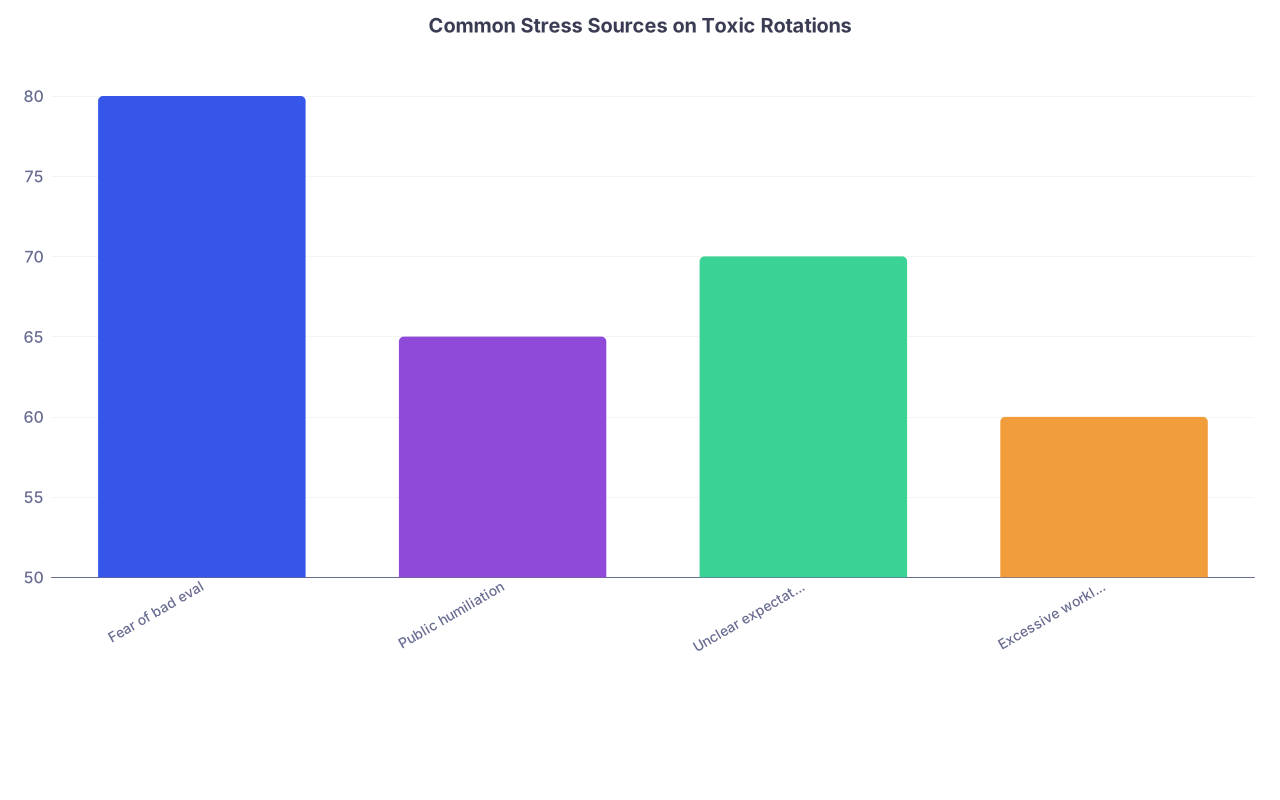
| Category | Value |
|---|---|
| Fear of bad eval | 80 |
| Public humiliation | 65 |
| Unclear expectations | 70 |
| Excessive workload | 60 |
A few things that actually work (not wellness poster nonsense):
Shrink the horizon.
Stop thinking about “this 4-week rotation.” Think about the next 24 hours. What 3 things do I have to get right today? Sleep, core tasks, one small bit of studying. That’s it.Offload the emotional sludge to someone safe.
Friend in another rotation, partner, sibling, therapist, or school counseling. Say exactly what happened, unfiltered. Then stop replaying it in your head. You already exported it.Guard sleep like your life depends on it.
On bad teams, everything feels worse if you’re chronically sleep-deprived. If you have 5 hours, get 5 actual hours. Not 3 hours plus 2 hours doom-scrolling.Keep one thing outside medicine stable.
20-minute walk after sign-out. Dinner with a non-med friend once a week. Lifting twice a week. No, it won’t “fix” the rotation. It reminds your brain you have a life beyond this clown show.Name the game.
Sometimes literally telling yourself: “This is a dysfunctional team, not a judgment on my worth. My job is to collect data, protect my eval, and get out” helps separate their behavior from your identity.
Salvaging and Framing the Evaluation at the End
You survived. Now you need to salvage what you can on paper.
Use the final feedback meeting strategically
If there’s a formal sit-down:
- Go in with a short list of what you worked on.
- Ask for specific examples they can put in the eval.
You can say:
“At the start of the rotation, you mentioned you value students who own their patients and follow through. I tried to do that by [concrete examples]. Are there particular strengths or areas for improvement you’d want to highlight in my written evaluation?”
You’re nudging them toward narrative comments that at least acknowledge your effort. Even difficult attendings will often say something like:
- “Shows good ownership of patients.”
- “Comes prepared to rounds.”
- “Hardworking, reliable.”
If they blindside you with unexpected criticism:
“I appreciate that feedback. I wasn’t aware that was a concern. For my own growth, could you give me a specific example or two so I can better understand?”
Sometimes they can’t. That’s useful to know when you see the eval.
Your self-evaluation/write-up
Many schools ask for a self-eval or reflection. Use it to:
- Emphasize concrete responsibilities you took on.
- Reflect (briefly) on handling challenging team dynamics without naming names.
Example:
“This rotation involved working with a high-acuity and fast-paced team. I took primary responsibility for 3–4 patients daily, pre-rounding, writing notes, and following up on consults and labs. I sought feedback from residents and attendings to align with expectations.
I also learned how to maintain professionalism and patient-centered care in the context of challenging communication styles within the team, which required resilience and clear prioritization of patient needs.”
That last sentence is code most clerkship directors can read between the lines.
If the Eval Comes Back Unfair
Sometimes, despite all of this, you still get burned.
Step 1: Compare reality vs eval
Read it line by line and ask:
- Does this match the feedback I was given during the rotation?
- Is it consistent with my prior and subsequent rotation evals?
- Are there specific, factual inaccuracies?
If it says “frequently late” and you documented consistently being there early, that’s an inaccuracy you can challenge.
If it says “knowledge base below level” but every other rotation says “strong knowledge base,” that’s pattern vs outlier.
Step 2: Decide whether to challenge — and how
You usually have two levers:
- Clarification request to clerkship director.
- Formal grade appeal (heavier artillery, use sparingly).
For a clarification conversation, you can say:
“I wanted to discuss my evaluation for [rotation]. I fully accept that I have areas to improve, and I’m working on X and Y. I’m concerned about [specific statement], because it doesn’t align with the feedback I received during the rotation or my performance on other services. I did [concrete efforts]. I’m wondering how this is being weighed, and whether there’s any additional context that can be added to my file.”
You’re not demanding a grade change (yet). You’re asking for context. Many directors will add an internal note or adjust narrative comments.
Formal grade appeal is for:
- Clear factual errors.
- Documented bias or mistreatment.
- Completely out-of-line eval compared to all others, especially if you have prior documentation and you raised concerns during the rotation.
If you go that route, bring:
- Your incident log.
- Any emails to the clerkship director during the rotation.
- Specific lines from the eval that are inaccurate or unsupported.
FAQ (Exactly 4 Questions)
1. How do I tell the difference between a “high expectations” team and a truly toxic one?
High expectations teams are tough but consistent. They give specific feedback, push you to read, and may be blunt—but they’ll acknowledge when you improve and don’t attack your character. Toxic teams are chaotic and personal: vague criticism, public shaming, eye-rolling, sarcasm, and no clear way to “win.” If you cannot identify concrete expectations after 3–4 days and your attempts to get clarity are brushed off or mocked, you’re probably dealing with toxicity, not just rigor.
2. Won’t speaking to the clerkship director about my team automatically tank my eval?
Usually, no—if you do it early, calmly, and focused on performance and learning, not revenge. Directors already know which attendings and teams are “difficult.” If you come in saying, “I want to do well on this rotation and here’s what I’m running into,” they’re more likely to protect you than punish you. The real risk is going at the very end, after the eval is in, with a purely emotional complaint and no documentation.
3. What if the toxic person is a resident, but the attending seems decent?
Then you aim your performance and visibility at the attending. Make sure you present to them, ask them for mid-rotation feedback, and document any egregious behavior from the resident. Many attendings don’t see how their seniors talk to students. A quiet, factual comment to the attending near the end (“I appreciate your teaching; I sometimes struggled with communication on the team and tried to address it by…”) can prompt them to weigh your performance more heavily than the resident’s gripes.
4. Is it ever worth directly confronting a toxic attending or senior about their behavior?
Direct confrontation is high risk as a student. You can and should ask for clearer expectations and specific feedback. You can set small boundaries (“I’m not comfortable discussing this patient in the hallway; can we step into a room?”). But calling someone out as “toxic” or “unprofessional” to their face during your rotation almost never helps you. If the behavior crosses the line into harassment, discrimination, or serious mistreatment, escalate through official channels rather than trying to reform them yourself.
Key points to keep in your head:
- You’re not crazy—some teams really are toxic. Your job is to perform visibly well, reduce attack surfaces, and document what happens.
- Use your clerkship structure: residents, chiefs, and directors exist partly to buffer students from exactly this. Loop them in early and professionally if needed.
- This rotation ends. Your reputation will be shaped far more by the consistent pattern across many rotations than by one dysfunctional team. Protect your eval, protect your sanity, and move on.