
The biggest mistake students make after witnessing unprofessional behavior on rotation is doing nothing and then venting in the group chat. That helps exactly no one—and it can burn you later.
If you’re on the floor, you see something wrong, and your stomach drops, you need a plan. Not vibes. Not “I’ll just figure it out.” An actual stepwise plan.
This is that plan.
Step 1: Freeze the Scene in Your Mind (While Staying Safe)
You don’t start by “confronting” anyone. You start by making sure you’re safe and mentally screenshotting what happened.
You’re in the room when a resident screams at a nurse and calls her “stupid” in front of the patient. Or you watch an attending mock a patient’s weight as soon as they leave. Or a team overrides a patient’s clear refusal and “nudges” the consent.
First, safety and self-preservation:
- If the behavior is just toxic/unprofessional (yelling, belittling, gossiping): stay quiet in the moment. Do not visibly roll your eyes, sigh, or argue in front of the team. Not your battlefield. Not yet.
- If there is immediate risk of harm to a patient (wrong-site, ignoring critical allergy, clear impairment like a drunk provider): you’re allowed to interrupt. Brief, specific, respectful.
“Dr. Smith, I just want to confirm—this is the left leg, but the consent says right.”
If they shut you down, you’ve still flagged it. That matters.
Then, capture details mentally as soon as you can:
- Who: names, roles (attending, PGY-2, nurse, tech, clerk, etc.)
- What: specific words/actions, not “they were mean”
- Where: unit, room number, clinic, OR, hallway
- When: date, approximate time, which part of the day (pre-rounds, noon, sign-out)
- Who else: witnesses (other students, nurses, residents)
Write this down privately ASAP after the event—notes app, email draft to yourself, paper in your pocket. Factual, time-stamped, no dramatizing. This is not for gossip. It’s for clarity.
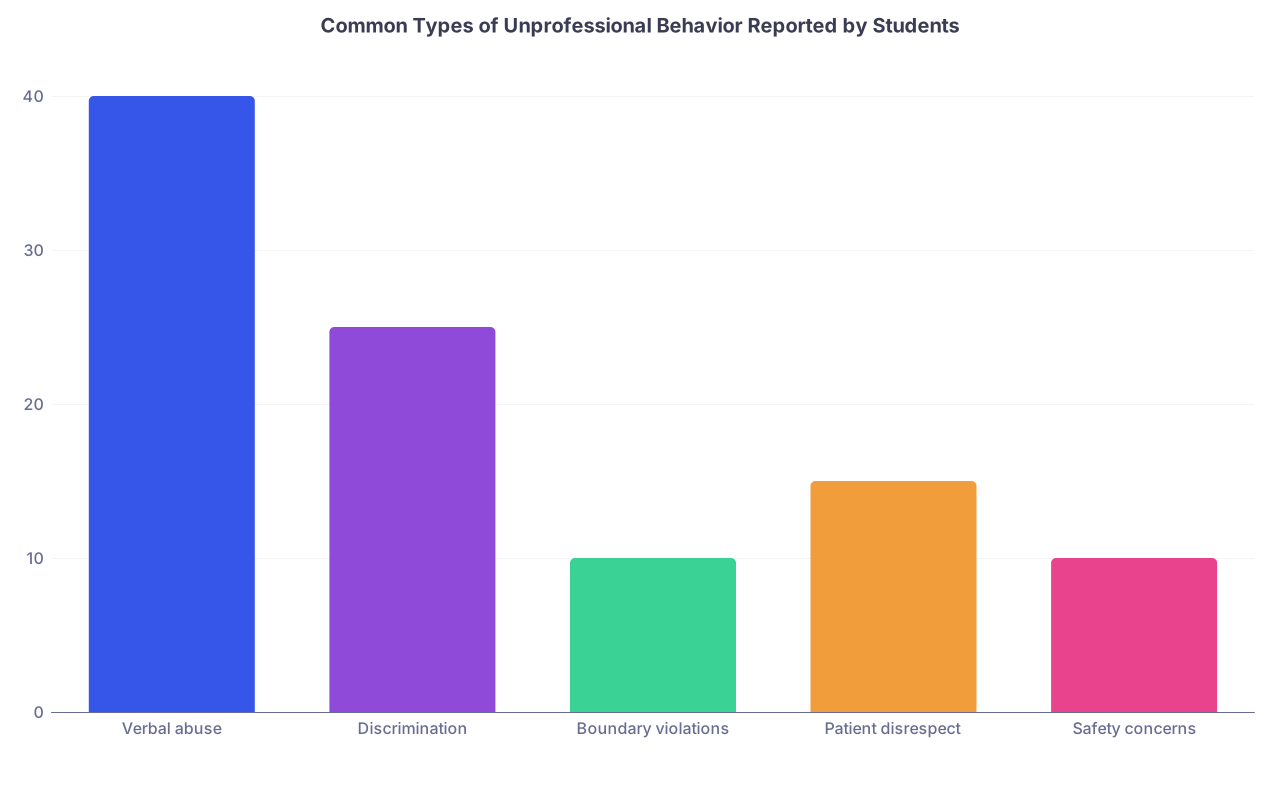
| Category | Value |
|---|---|
| Verbal abuse | 40 |
| Discrimination | 25 |
| Boundary violations | 10 |
| Patient disrespect | 15 |
| Safety concerns | 10 |
Step 2: Classify What You Saw: Annoying vs Reportable vs Emergency
You can’t treat every bad vibe like a Title IX case. You also can’t dismiss serious issues as “just how medicine is.” You need a triage system.
Category A: Toxic but Not Dangerous
Stuff like:
- Snapping at staff or students
- Mildly demeaning comments (“You’re useless on rounds”)
- Rolled eyes at patient questions
- Gossiping about colleagues
- Passive-aggressive comments about other specialties
These are usually professionalism or culture problems. They matter, but they’re often best handled with:
- Local conversations (trusted resident, faculty)
- End-of-rotation evaluations
- Pattern documentation over time
Category B: Serious Professionalism / Boundary / Bias Issues
Examples:
- Racist, sexist, homophobic, transphobic comments or actions
- Mocking a patient’s identity, religion, disability
- Sexual comments, unwanted touching, creepy “jokes”
- Retaliatory behavior (“If you complain, I’ll tank your eval”)
- Deliberate shaming of patients or students in a harmful way
- Bullying a staff member in front of patients repeatedly
These generally require actual reporting, especially if they’re repeated or directed at vulnerable people. This is where Title IX, student affairs, or professionalism committees come in.
Category C: Immediate Patient Safety / Abuse / Impairment
This is the red zone:
- Performing procedures without consent or clearly against patient wishes
- Ignoring a known serious allergy or contraindication
- Impaired provider (intoxication, altered, falling asleep in the OR repeatedly)
- Covering up errors that put patients at risk
- Physical abuse or threats toward patients or staff
These are not “maybe I should say something.” These are “I must act” situations. That doesn’t always mean confrontation in the moment, but it absolutely means urgent escalation to someone with authority.
Step 3: Do Not Crowdsource Your Conscience (Be Strategic About Talking)
Your instinct will be to text your classmates, “OMG you won’t believe what Dr. X just did.” Resist that urge.
Why?
- Group chats get screenshotted.
- Rumors spread faster than facts and can blow back on you.
- It muddies the record if everyone is swapping half-remembered details.
Instead:
Talk to exactly one or two people, chosen carefully:
- A trusted upperclassman who rotated there before and isn’t on your team now.
- A faculty mentor not connected to this rotation.
- Your college advisor or learning community leader.
You’re not asking them to fix it yet. You’re reality-testing:
“Here’s what happened. Here are the exact words used. Am I overreacting, or is this as bad as it feels?”
If they’re experienced, they’ll help you:
- Classify the behavior (A/B/C from above)
- Gauge local culture (is this a known issue? repeat offender?)
- Point you to the right formal channel if needed
Do not:
- Vent loudly at the nurses’ station.
- Confront the person in front of patients or staff.
- Post about it anywhere online.
You’re building a clean, calm record. Not a drama.
Step 4: Decide: Address Directly, Report, or Both
This is the fork in the road. There isn’t one right answer for every scenario, but I’ll give you the framework I use when coaching students.
Option 1: Quiet Direct Feedback (Lower-Risk Situations)
For Category A stuff or one-off minor B issues, sometimes a soft, one-on-one nudge works. Especially with residents who are usually decent but had a bad moment.
Timing: Not immediately after the incident when emotions are hot. Catch them later that day or the next, away from patients.
Example script to a resident:
“Hey, can I ask you something about earlier?
When you said to Ms. Lopez, ‘You probably wouldn’t understand the risks,’ she looked pretty uncomfortable. I wondered if there might be a different way to phrase it next time so she feels more included.”
Or:
“On rounds this morning, when you called the nurse ‘incompetent’ in front of the patient, it felt rough from where I was standing. I know you’re under a ton of pressure, but I worried it might undercut how the patient trusts the team.”
You’re not their therapist. You’re just holding up a mirror. If they react badly or threaten you? That’s more evidence this needs formal attention.
Skip direct feedback if:
- The power gap is huge (e.g., toxic attending, PD, chair).
- You feel unsafe, intimidated, or at risk of retaliation.
- It’s clearly serious discrimination, harassment, or safety risk.
Option 2: Formal Reporting / Escalation
For Category B and C, especially repeated behavior, you escalate. Period.
Channels that usually exist (names vary by school):
| Option | When to Use |
|---|---|
| Clerkship Director | Rotations issues, professionalism |
| Site Director / Course Director | Specific hospital/clinic incidents |
| Student Affairs / Dean’s Office | Patterns, retaliation, big concerns |
| Title IX / Equity Office | Harassment, discrimination, assault |
| Anonymous Reporting Tool | If you fear personal retaliation |
You can combine them. For example: talk to clerkship director AND file an online report.
How to structure a report:
- Start with: “I’m a third-year student on [rotation], at [site], and I’d like to report a professionalism concern I witnessed.”
- Then describe one clear incident at a time: who, what was said/done, setting, date/time, who else was present.
- Avoid adjectives. Stick to observable facts. “Dr. X said, ‘…’” not “Dr. X was a jerk.”
- State your main concerns: patient safety, discrimination, hostile learning environment, etc.
- Say how safe you feel: “I’d prefer this be handled without directly involving me with Dr. X, if possible, because I’m still being evaluated by them.”
You’re not the judge or the executioner. You’re a witness creating a record and activating the system that allegedly exists to address this stuff.
Step 5: Protect Yourself Academically While Doing the Right Thing
You’re not paranoid for worrying about retaliation. It happens. I’ve seen students get mysteriously mediocre evaluations after raising valid concerns.
Here’s how you lower that risk:
Document your performance:
- Keep a running list of positive feedback (emails, casual “great job,” thanks from attendings, etc.).
- After a good interaction or teaching moment, send a short thank-you email: “Thanks for letting me present on Mr. Y today; I learned a lot about X.” That email becomes a time-stamp that you were engaged and performing.
- Ask multiple people for mid-rotation feedback. If they say you’re doing well, that’s useful data if an outlier eval appears later.
Separate the person you’re reporting from your primary evaluator, if possible:
- If the offender is a random attending, but your primary evaluator is the clerkship director, good. Keep showing up, performing, and getting face time with others.
- If the offender IS your primary attending, loop in the clerkship director or course director early and explicitly ask:
“I’m concerned about how this might affect my evaluation. Is there a way to ensure my grade doesn’t depend solely on this individual?”
If you sense retaliation:
- Save every weird comment or email.
- Ask for a meeting with student affairs or the clerkship director.
- Bring your earlier documentation of your performance.
You’re not being dramatic. You’re controlling the narrative so it’s not just your word vs. theirs.

| Step | Description |
|---|---|
| Step 1 | Witness Unprofessional Behavior |
| Step 2 | Ensure Safety |
| Step 3 | Document Facts Privately |
| Step 4 | Consider direct feedback |
| Step 5 | Formal escalation |
| Step 6 | Urgent escalation to authority |
| Step 7 | Monitor for patterns |
| Step 8 | Contact clerkship/Title IX/etc. |
| Step 9 | Protect yourself & track evaluation |
| Step 10 | Type of Issue? |
Step 6: Handle Your Own Emotional Fallout
Watching people treat patients or colleagues badly screws with your head. Especially when you’re new and idealistic.
Common reactions I’ve seen students quietly carry:
- Guilt: “I should’ve done something in the moment.”
- Disillusionment: “If this is medicine, did I pick the wrong career?”
- Fear: “If I speak up, they’ll crush me.”
- Isolation: “Everyone else acts like this is normal. Is it just me?”
Here’s what you do with that:
Find one space where you can be totally honest. This might be:
- A therapist (many med schools cover visits; use them)
- A trusted mentor outside the department where this happened
- A student support group / wellness group that actually has teeth
Say the quiet part out loud: “I felt sick watching that attending mock our patient.” Naming it keeps you from normalizing it.
Then separate three things:
- What you wish you had done in the moment.
- What you realistically could have done safely.
- What you are doing now (reporting, documenting, learning from it).
You’re not going to fix the culture of medicine alone as an MS3. Your responsibility is to act within your lane, protect patients when you can, create a record when patterns exist, and not let yourself become numb.
Step 7: Use This to Decide the Physician You Refuse to Become
Quietly, rotations are not just about learning medicine. They’re about seeing dozens of role models—good and bad—and deciding whose habits you’re going to steal and whose you’re going to reject.
When you witness unprofessional behavior, do this:
- Write down exactly what bothered you—not just “they were rude,” but “they dismissed the patient’s pain as drug seeking without asking a single follow-up question.”
- Then write the opposite behavior you want to practice someday: “I will ask more questions before assuming. I will validate pain even if I’m skeptical.”
- If you see an attending or resident handle something beautifully (calming a conflict, apologizing after snapping), write that down too. You need positive templates, not just red flags.
Unprofessional behavior is data. On your colleagues. On the system. On the kind of physician you don’t want to be.
It’s ugly, but it’s also information. Use it.
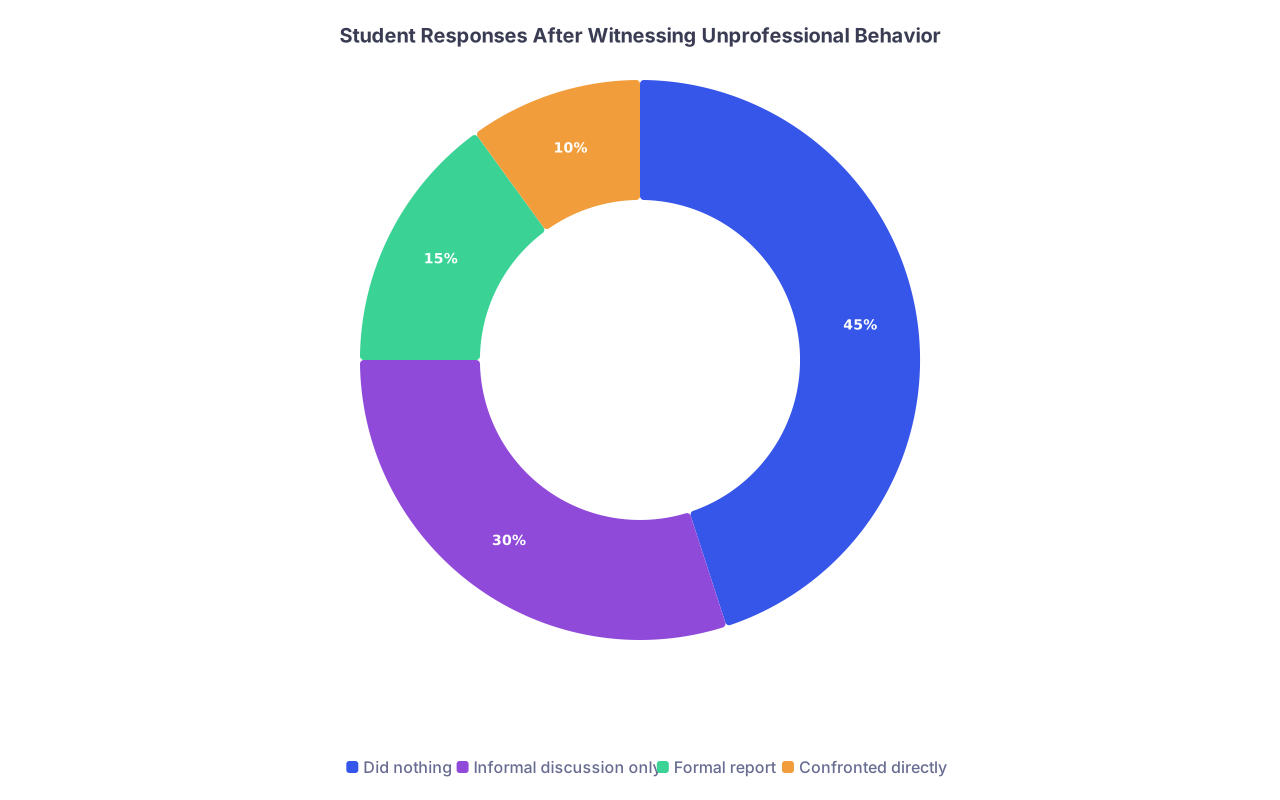
| Category | Value |
|---|---|
| Did nothing | 45 |
| Informal discussion only | 30 |
| Formal report | 15 |
| Confronted directly | 10 |
Concrete Scripts for Common Scenarios
A few plug-and-play lines you can adapt.
1. When someone is blatantly disrespectful to a patient
In the moment (if safe and discreet):
“Ms. K, I’m sorry—that sounded dismissive. Your concerns are important, and we do take them seriously.”
Later, to a mentor or clerkship director:
“During rounds, Dr. X said, ‘You people never follow instructions anyway’ to a Black patient. It made me uncomfortable and I felt it was racially charged. I’d like to document this.”
2. When a resident screams at a nurse in front of you and the patient
You don’t need to jump in mid-scream. After the room:
To the nurse, quietly:
“I’m sorry you were spoken to that way.” (You don’t need to pick a side. Just be human.)
To your trusted faculty later:
“I saw Dr. Y shouting at Nurse Z in front of Mr. A. He called her ‘incompetent’ and ‘useless’ while the patient watched. It seemed to undermine the team and the patient’s trust. I want to report this.”
3. When you suspect something unsafe
In the moment:
“Just to clarify—this patient has a penicillin allergy listed. Are we definitely okay with starting this antibiotic?”
If ignored and you’re still worried: go to the nurse or charge nurse afterward:
“I’m a student, so I might be misunderstanding, but I’m worried about X. Can you double-check this with someone senior?”
Then document and consider reporting if this is a pattern, not a one-off.

How to Actually File a Report (Step-by-Step)
Let’s be painfully practical. A generic but realistic sequence:
- Check your school’s website for:
- “Mistreatment policy”
- “Professionalism concerns”
- “Title IX / discrimination reporting”
- Decide whether you want:
- Named report with follow-up
- Anonymous report (less powerful, but safer if you’re scared)
- Draft your report in a separate document first.
- Include:
- Your role and rotation
- Clear description of the incident, with quotes if possible
- Why you see it as unprofessional or unsafe
- Whether you feel safe interacting with that person now
- Whether others witnessed it
- Submit through:
- The online professionalism/mistreatment form, OR
- Direct email to clerkship director / student affairs, OR
- A meeting where someone else types the report with you
Then, crucially: follow up.
- If you hear nothing in 2–3 weeks, send a polite email:
“I wanted to follow up on the professionalism concern I reported on [date]. I’m not asking for specific outcomes, but I’d like to confirm it was received and is being addressed.”
You’re not a bystander anymore. You’re a participant in the system.

FAQs
1. Won’t reporting unprofessional behavior ruin my career if they’re powerful?
It can feel that way, but no—if you’re smart about it. You mitigate risk by documenting your good performance, involving student affairs or a clerkship director early, and avoiding solo wars with a single attending. Use formal channels, not hallway confrontations. And if several students report the same person over time (which is often what happens), it’s much harder for them to target one student as “the problem.”
2. What if I’m not 100% sure it was “bad enough” to report?
You rarely will be 100% sure in the moment. That’s normal. When in doubt, start with a confidential conversation with a mentor, student affairs, or your college advisor: “Here’s exactly what happened. What do you think?” They can help you calibrate. If your gut keeps nagging you days later, that’s usually your answer—you at least document it with someone.
3. Should I confront the person directly first before reporting?
Not always. For minor issues with a resident you know well and generally trust, a private conversation might actually help them and prevent future problems. For anything involving discrimination, harassment, clear abuse of power, or patient harm, you don’t owe them an attempt at rehab before you report. Your safety and the patient’s safety outrank their comfort.
4. Can I be punished for reporting something in good faith if it turns out I misinterpreted?
If you genuinely report in good faith—meaning you honestly believed what you saw was unprofessional or unsafe—schools and hospitals are supposed to protect you. They’re often clumsy about it, but that’s the policy almost everywhere. Malicious or knowingly false reports are a different story; don’t do that. If your perception was off, the worst realistic outcome is usually some awkwardness, not career destruction.
5. What if the culture is so bad that everyone says, “That’s just how it is here”?
Then you’ve learned something critical: that place is not your long-term home. Still, you log what you see, protect patients where you can, and use whatever reporting channels exist so there’s a record. You also quietly decide that when you have power—as a resident, attending, or leader—you will not run your team that way. Survive the rotation, don’t become them, and remember: this is one hospital, not the whole profession.
Key points:
- Treat unprofessional behavior like any clinical problem: assess risk, document facts, and escalate appropriately.
- Protect yourself while doing the right thing—track your performance, choose your channels carefully, and avoid impulsive confrontations.
- Use what you witness, good and bad, to shape the kind of physician you refuse to become.