
The real reason some students never get strong rotation letters is simple: nobody with real power ever decided to care enough about them.
Not that they were bad. Not that they did not “honors” the shelf. Not that they lacked “passion for patient care.” The machine just never clicked into place around them. And behind closed doors, that’s exactly how attendings talk about it.
Let me show you how that machine actually works.
How Rotation Letters Really Get Written
Here’s the part your school never explains: most rotation letters are not written carefully, thoughtfully, or with any real depth.
They’re written:
- Fast
- From memory
- When someone is already tired
- With far less detail than you think your 8 weeks “deserve”
Nobody is sitting there with an itemized list of all your H&Ps, the one time you caught the murmur, or the 2 a.m. note you stayed late to write. They’re thinking in impressions.
“I liked her.”
“He was solid but not special.”
“She was quiet; I barely noticed her.”
“Great kid – I’d take him as a resident.”
That’s the mental file your letter comes from. Not your evaluations page. Not your NBME score. The emotional thumbnail they carry of you when your name pops up in their inbox.
And if there isn’t a mental file?
You get what I see all the time: generic, lukewarm letters that are technically positive but functionally useless.
“Pleasure to work with.”
“Will be a fine resident in any program.”
“Met expectations for a third-year student.”
Those are death sentences in competitive fields. Program directors can smell the absence of conviction in three lines.
The Unspoken Categories Attendings Use
Let me be blunt: most attendings don’t start rotations thinking, “Who can I write letters for?” They start thinking, “Let me survive this month.”
Over time, they triage students into mental buckets. They won’t tell you this. I will.
| Category | How They Talk About You |
|---|---|
| Letter-Worthy | "I’d take them as a resident." |
| Solid but Forgettable | "Yeah, they were fine." |
| Liability | "Please do not send them here." |
If you’re not in the first bucket by week 3, you’re in trouble for a strong letter.
The “Letter-Worthy” group shares a pattern, and it’s not just being smart:
They’re known. As a person. As a presence. The attending can tell a story about them without thinking too hard.
“I watched her take ownership of this patient with DKA. She checked labs on her own, communicated the plan, and stayed late to see it through.”
“I saw him take feedback about his presentations and transform them in 48 hours. That kind of responsiveness is rare.”
The key word there? Saw. If nobody truly sees you in a rotation, you do not get a letter that moves the needle.
Why “Working Hard and Being Nice” Isn’t Enough
This is where many good students get blindsided. They try to win rotations with generic virtue.
They show up early. They pre-round. They read. They never complain. They help the team.
Faculty love them… in the moment. But try this experiment: pull up any given attending in your mind and ask yourself:
“How many students from last year’s rotations could they name, unprompted?”
Most can name:
- The outstanding one
- The problematic one
- Maybe one random student who did something very memorable
Everyone else? Blended into the “good kids” fog.
The tragedy is: a lot of strong students live and die in that fog. They think:
“I didn’t mess up, I worked hard, I was respectful – they’ll write a great letter.”
No. They’ll write a safe letter. A “good but weak” letter. And program directors would often rather have no letter than three of those.
The Gatekeeper Problem: Who Actually Writes Your Letter
Here’s the dirty little secret almost nobody tells you in med school:
The person who knows you best is rarely the one with the letterhead that matters most.
- Senior resident loves you
- Chief thinks you’re fantastic
- Fellow sees your growth every day
But who writes the real letter? The attending you presented to once daily and maybe scrubbed with twice.
Behind the scenes, this is what happens more often than students realize:
Attending: “Hey, can you send me a few bullets about this student?”
Resident: types 5-10 bullet points, usually pretty generous
Attending: turns that into formal-ish prose in 15 minutes between notes
If nobody on the team is strongly invested in you—or if you never gave them anything specific to work with—those bullets are bland. Then your letter is bland. Then your application feels bland.
The pipeline to a strong letter is not “impress the attending once.” It’s: make someone on the team quietly decide, “I want to help this kid.” Then give them material.
The Real Reasons Students Stay Forgettable
Let me walk you through the actual, consistent patterns I’ve seen in the students whose letters are always… fine, but never strong.
1. They never force a clear narrative
Faculty remember stories, not adjectives.
“Hardworking” means nothing. “Improved dramatically over the month” is fluff. But:
“She arrived underconfident with presentations, asked explicitly for feedback, and by the end of the rotation was delivering concise, well-structured updates even on complex patients” – that’s a story.
The students who get weak letters usually drift through the rotation in “competent autopilot” mode. They never name a goal. They never say:
“Dr. Smith, one thing I really want to get better at this month is X. If you notice opportunities to help me with that, I’d appreciate it.”
That sentence forces the attending to see you across time, not as a static blur. That’s the foundation of a narrative: “This student intentionally worked on X and grew.”
2. They hide in the middle of the pack
On every team there’s an informal hierarchy:
- One or two students who speak up, own tasks, ask questions
- A middle group who politely follow
- One student partly disengaged or struggling
The “never get strong letters” group lives in the middle. They’re afraid:
“If I ask too many questions, I’ll be annoying. If I volunteer, I might fail. If I say I’m interested in this specialty, they’ll think I’m kissing up.”
So they wait. And wait. And wait. They do whatever the resident tells them and hope “quietly reliable” will be noticed.
It isn’t. Not in the way you need.
3. They never trigger the “future colleague” switch
This one matters more than any grade or score. At some point, a faculty member has to cross an internal line:
“I could see this person as my resident.”
When that switch flips, everything changes. They invest. They teach more. They pay attention. And when evaluation time comes, they advocate hard.
The problem: many students behave like guests on a tour, not like junior colleagues.
They say, “What should I do?” instead of “Here’s what I think we should do; can I run it by you?”
They stand at the edge of the group instead of stepping into the work.
They wait for orders instead of anticipating needs.
You don’t flip the “future colleague” switch by being polite. You flip it by acting like you’re already half a resident—curious, proactive, accountable—without being arrogant or unsafe.
That line is thin. But attendings know it when they see it.
How Strong Letters Actually Get Sparked
Let me tell you how the best letters I’ve seen actually started behind the scenes.
Not with, “I need a letter; can you write one?”
They start weeks before that.
I watched a surgery attending at a big university hospital tell the chief: “If she needs a letter, I’ll write her a good one.” It was week 2. Why?
Not because she was a surgical prodigy. She was a third-year fumbling with knots like everyone else.
It was because:
- She volunteered for every case she reasonably could without pestering
- She asked specific, targeted questions that showed she’d read the night before
- She took feedback about her presentations and visibly improved in 48 hours
- She spoke to the intern and senior like a respectful peer, not a scared shadow
By week 3, everyone on the team knew her name. Not in a loud, “look at me” way. In an, “Oh yeah, she’s on it” way.
So when she eventually said, near the end:
“I’m strongly considering applying in surgery; if you feel you know me well enough, I’d be honored to have a letter from you” – the decision had been made weeks earlier.
That’s the part students miss. The ask is the last 5% of the process. The substance happens on Day 3, 7, 12, 19.
Where Students Sabotage Themselves (Quietly)
There are a few recurring landmines that kill strong letters before they’re even an option.
Looking “directionless” about specialty
No, you do not have to know your specialty in third year. But the students who never get strong letters sound like this all year:
“I’m keeping an open mind.”
“I’m not sure yet; I like everything.”
“I’m just trying to learn as much as I can.”
That’s fine once. Maybe twice. But if you say that 5 times on 5 services, here’s what attendings think:
“I’m not going to go to bat for someone who might never even apply in my field.”
You want a stronger approach:
“I’m between internal medicine and anesthesia right now, but I want to perform on this rotation like I’m going into this field. Could I get your feedback on what I’d need to work on if I did choose it?”
Now you’ve given them a reason to invest.
Never explicitly asking for feedback
The students who get strong letters force feedback moments.
They say, halfway through:
“Dr. Patel, we’re at the midpoint of the rotation. Could I get 2–3 minutes of direct feedback on what I’m doing well and what I should change for the rest of the block?”
That triggers a shift. You’re now a person trying to improve, not just existing on the service.
Then, crucially, they actually change something. Tangibly. Within days.
Later, that becomes a sentence in your letter:
“They actively sought feedback and implemented it quickly, which is a hallmark of high-functioning residents.”
Acting like you’re only there for a grade
Attendings can sense when a student’s interest ends at “getting honors.”
They hear it in the way you ask: “Is this on the shelf?” after every discussion.
They see it when you disappear the moment official hours end, every single day.
They feel it when all of your questions are about eval forms, point systems, and grade thresholds.
Nobody wants to write a passionate letter for someone whose entire rotation energy is transactional.
Ironically, students who stop playing the grade game so obviously, who actually care about becoming good at the work, end up with the letters that matter more than a meaningless “honors” box.
What Program Directors Read Between the Lines
You need to understand how residency leadership reads your letters, because their reading is different from how you imagine it.
Here’s what they’re scanning for:
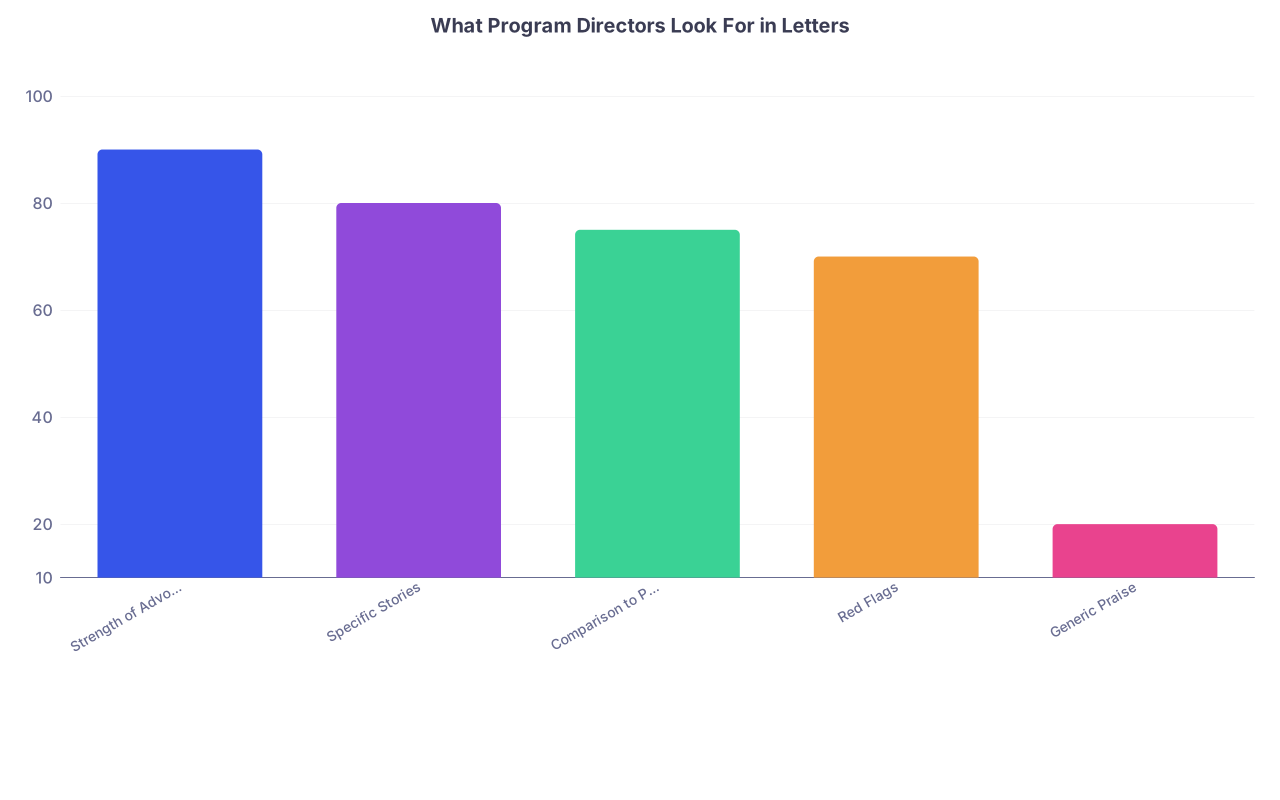
| Category | Value |
|---|---|
| Strength of Advocacy | 90 |
| Specific Stories | 80 |
| Comparison to Peers | 75 |
| Red Flags | 70 |
| Generic Praise | 20 |
They care about:
- Strength of advocacy: Does this writer want this student in their program, or are they just politely describing them?
- Specific stories: Does the letter have 1–2 concrete examples, or is it all adjectives?
- Comparison to peers: Are you “above the level of a typical third-year” or just “meets expectations”?
- Subtext: Are they carefully avoiding enthusiasm? That’s a red flag.
Generic praise is almost noise. “Hardworking, compassionate, team player” is the background radiation of every letter.
If your letters are full of nice-sounding but interchangeable praise, PDs know: nobody stuck their neck out for you.
And that’s the real reason some students never get strong rotation letters: they never succeeded in making anyone feel like you were worth staking a reputation on.
How to Become “Letter-Worthy” on Day 1 of a Rotation
Let me give you a simple, concrete sequence that I’ve seen work repeatedly, when students actually use it.

| Step | Description |
|---|---|
| Step 1 | Day 1 Intro |
| Step 2 | State 1-2 Clear Goals |
| Step 3 | Ask for Midpoint Feedback |
| Step 4 | Visibly Implement Feedback |
| Step 5 | Take Ownership of Something |
| Step 6 | Clarify Specialty Interest |
| Step 7 | End-of-Rotation Ask |
On Day 1–2, do a brief, direct introduction with your main attending or senior:
“Dr. Lee, I’m [Name], MS3. I’m especially hoping to improve my [presentations/clinical reasoning/procedural comfort] this month. If you see opportunities where I could push myself on that, I’d really appreciate it.”
Midpoint, ask for short feedback and implement one visible change.
In the last week, tell them clearly where you’re leaning specialty-wise, even if you’re not 100%:
“I’m leaning strongly toward pediatrics, though I haven’t officially decided. This rotation has been important for me in clarifying that. If you feel you know me well enough, I would be very grateful to have you as a letter writer.”
Notice the wording: “if you feel you know me well enough.” That gives them an out. Which protects you from a lukewarm letter.
Students who do this on several rotations accumulate 2–3 genuinely strong letters. Students who never do this accumulate 5–6 mediocre ones that all say the same thing.
Guess which pile program directors prefer.
FAQs
1. How can I tell if a potential letter writer actually likes me enough?
Listen to how they talk about you and to you. If all you’ve gotten is vague praise like “You’re doing fine” or “Keep it up,” that’s not enough. Strong signals include:
- They invite you to do more: procedures, presentations, digging into a complex patient.
- They tell you some version of “You’re functioning at the level of an intern.”
- They mention you unsolicited to others on the team in a positive way.
You can also test lightly:
“I’ve really enjoyed working with you, and your feedback has helped me a lot.”
See if they respond with something like, “We’ve enjoyed having you; you’d be great in this field.” That’s green light territory.
2. Is it better to have a big-name letter writer who barely knows me or a less famous one who knows me well?
Take the less famous one who truly knows you. Every. Single. Time.
Program directors can smell a branded but empty letter from a mile away: “I had brief contact with this student who rotated on my service…” That’s code for “I barely know them.” A detailed, story-filled letter from a community physician who supervised you closely carries more actual weight than a dean-level name who met you twice.
3. What if I realized too late in the rotation that I need a letter from that specialty?
You’re not completely sunk, but you’re playing from behind. You have to compress the whole arc:
- In the last week or two, explicitly say you’re now seriously considering the specialty and why.
- Ask for direct feedback on what you’ve shown so far and what you wish you’d done earlier.
- If you get even a glimmer of strong enthusiasm, you can still ask for a letter, but phrase it honestly:
“I know we’ve only worked together for a short time, but your perspective would be incredibly valuable to me. If you feel you know me well enough, I’d be honored to have a letter from you.”
If they hesitate, don’t push. A short rotation plus a lukewarm writer is a bad combo.
4. Can a single bad or mediocre letter sink my application?
One truly negative, coded-red-flag letter can, yes. A single bland letter in a stack of strong ones won’t kill you, but three bland letters and zero strong ones will. Most PDs look for at least one letter that reads like: “I would absolutely take this student into my program.” Without that, you’re just another safe, unremarkable file in a very tall pile.
Years from now, you won’t remember every SOAP note you wrote or every pimp question you missed. You’ll remember the few people who saw you clearly, who decided you were worth investing in—and whether you gave anyone the chance to feel that way about you.