
Last year on internal medicine, a student pulled me aside after rounds, eyes glued to his phone. He’d just gotten his NBME shelf score back—96th percentile—and he was furious. His rotation eval? “High pass.” No honor. No explanation.
He did what most students do: assumed the clerkship was unfair and that the attending “didn’t like him.” What he did not realize is this: he and the clerkship director were not playing the same game. Shelf scores and rotation grades are not valued the way students think they are. Not by faculty. Not by committees. And definitely not by residency program directors.
Let me walk you through how this actually works behind closed doors.
The Quiet Truth: Faculty Do Not Care About Your Shelf Score the Way You Think
Here’s the uncomfortable reality: most individual faculty on the wards neither know nor care what you scored on the shelf.
Not out of malice. Out of workflow.
They see you for a few days, maybe two weeks. They get an email or a form asking them to rate you on things like medical knowledge, professionalism, communication, initiative. That form is usually due before your shelf exam even happens. So the person who wrote “meets expectations” on your evaluation? They had no idea you were going to crush a 90th percentile shelf.
They’re grading you—the human—based on:
- How you presented Ms. Johnson in 5N this morning
- Whether you showed up on time to pre-round
- Whether nurses rolled their eyes when your name came up
- Whether you read about your patients and came back with something useful
The shelf is a separate world, owned by the clerkship office and the NBME.
What’s actually happening behind the scenes is this:
- Faculty give narrative comments and Likert-scale ratings.
- Clerkship coordinators and directors combine that with your shelf score using some secret-ish formula.
- Out pops “Honors / High Pass / Pass.”
The formula is where the shelf matters. But individual faculty impressions? Those are driven almost entirely by behavior and day-to-day performance, not your exam score.
How Clerkships Really Weight Shelf Scores vs Rotation Performance
You’ll never see the real weighting clearly spelled out in big bold letters. There’s a reason for that. Once students see the math, they start to game it.
But I’ve sat in those grading meetings and seen the spreadsheets. The pattern is pretty consistent across schools.
| Component | Weight Range |
|---|---|
| Shelf / NBME Exam | 25–40% |
| Faculty Clinical Evals | 40–60% |
| OSCE / Practical | 0–20% |
| Assignments / Attendance | 0–15% |
At many schools, the shelf is around one-third of the final grade. Some make it 40%. Very few go below 25%.
Here’s the insider part students usually miss:
There’s usually a cutoff shelf score to even be eligible for honors.
That might be “≥ 75th percentile” or “≥ 1 standard deviation above the mean” or some raw score threshold. If you don’t hit it, I don’t care how much the team loved you—you’re capped at High Pass. This isn’t in neon lights, but it’s in the policy document nobody reads.Above the cutoff, shelf points have diminishing returns.
Once you clear that eligibility threshold, the difference between 80th and 95th percentile helps much less than you think. A stellar eval plus a solid-but-not-spectacular shelf can beat a sky-high shelf with lukewarm evals.Below a certain shelf line, your grade auto-drops or triggers remediation.
If you bomb the shelf, clinical performance can’t fully rescue you. That’s where you see “Pass with Remediation” or get forced to retake the exam despite decent comments.
So shelf = gatekeeper. Not king. It opens or closes doors to certain grades, but what happens inside that range is driven heavily by clinical evaluations.
And yes, clerkship directors do adjust things at the margins. If the team raves about you but your shelf is a hair below the cutoff, I’ve seen directors quietly nudge your grade up. It happens. They won’t advertise it, but they do it.
What Faculty Actually Value on Rotations (That You’re Not Tested on)
Here’s the part students consistently underestimate: faculty rate you on invisible checkboxes you’ll never see, and none of them are “Got 90th percentile on NBME.”
They care about three broad domains. And they are not equal.
1. Professionalism and Reliability
This is non-negotiable. You can’t shelf-score your way out of being unreliable.
Faculty notice:
- Are you on time? Every day. Not just when you’re on with the PD.
- Do notes get done without your residents chasing you?
- Do you disappear when work shows up? Or do you lean in?
- Do nurses trust you enough to call you directly?
A student who’s clinically average but rock-solid reliable will get better evaluations than the genius who always seems to “be in the bathroom” when discharges need to be written.
I’ve literally heard an attending say in the eval meeting:
“Her knowledge is fine, shelf will be what it is. But I’d work with her again any day. She shows up and owns her patients.” That comment carries more weight than “knows obscure esoterica.”
2. Clinical Reasoning in Real Time
The shelf loves minutiae. Faculty love watching how you think.
When I’m evaluating a student, I’m not trying to see if they can recite treatment for every vasculitis. I’m listening to things like:
- Can you form a focused problem list, or is everything just word salad?
- When I ask, “What’s your top two in the differential?” do you freeze or give me a coherent answer?
- When labs come back weird, do you just shrug and move on, or do you ask, “Why?”
Students think “I don’t know” kills them. It doesn’t. What kills them is, “I don’t know” followed by silence. The students who get honors say, “I don’t know, but if I had to guess, I’d consider X vs Y because…” That exposes reasoning. Faculty love that.
3. How You Fit into the Team
Faculty are blunt about this when they’re alone:
“No one wants to work with a brilliant jerk.”
They care about:
- Do residents roll their eyes when your name comes up?
- Do you help your co-students or sabotage them? (Yes, we hear about both.)
- Do you step up to tasks that aren’t glamorous—calling families, sitting with a scared patient, doing the scut without complaint?
I watched one student with an average shelf get honors because three separate residents wrote some version of:
“Best student I’ve worked with in three years. Made my life easier. Great with patients and staff.”
You will never see those resident comments. But they decide your fate more than your scaled NBME score.
Behind Closed Doors: How Program Directors Read Your Transcript
Now let’s move to the higher level—the part that actually affects your future: residency selection.
Program directors are not sitting there parsing, “Did this student get 78th vs 88th percentile on the psych shelf?” They don’t even see that level of detail at most schools.
Here’s what they do see:
- The final clerkship grade (Honors / High Pass / Pass)
- Sometimes a note like “Honors in the clinical component; High Pass overall due to exam score”
- MSPE (“Dean’s letter”) summary of how you performed relative to classmates
And here’s the hierarchy in their heads—though they’ll rarely say it out loud.
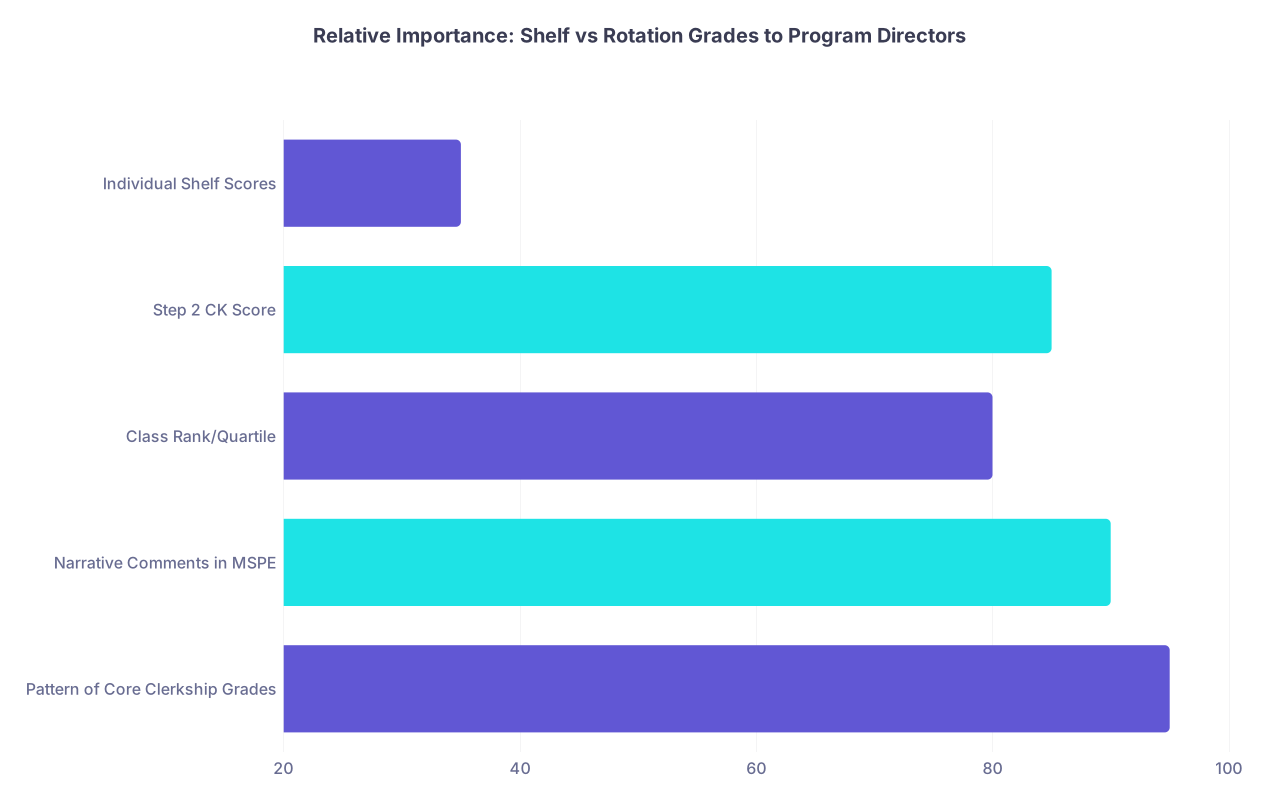
| Category | Value |
|---|---|
| Pattern of Core Clerkship Grades | 95 |
| Narrative Comments in MSPE | 90 |
| Class Rank/Quartile | 80 |
| Step 2 CK Score | 85 |
| Individual Shelf Scores | 35 |
They care about patterns and consistency:
- Multiple honors in core rotations in their specialty or adjacent fields? Strong signal.
- Consistently “Pass” in core rotations? That hurts more than one mediocre shelf.
- Glowing comments about teamwork, work ethic, ownership? Gold.
What they almost never do is micromanage your raw shelf history. Unless something stands out, like:
- One terrible outlier exam with an otherwise stellar record
- A comment in the MSPE that shelf failure required remediation
- A pattern of just barely passing shelves that suggests test-taking weakness
But line-by-line: “Hmm, this student got 83rd percentile in surgery shelf vs 74th percentile in IM shelf”? No. They don’t have the time, patience, or data access for that.
They default to:
“How did this student perform compared to their peers overall?”
Rotation grades tell that story much more clearly than exam percentiles.
Where Shelf Scores Do Quietly Matter a Lot
I’m not saying shelf exams are irrelevant. They’re not. They quietly drive several key things.
1. Your Class Rank / Quartile
At many schools, shelf-heavy clerkships (IM, surgery, peds, OB/GYN) have a big chunk of your third-year GPA baked into them. Your performance there can nudge you into a higher or lower quartile, and quartile shows up in your MSPE.
Program directors actually look at that.
If you’re trying for something competitive—derm, ortho, ENT, plastics, rad onc—being in the top quartile helps, a lot. Shelf scores are one of the main levers that move that number.
2. Predictive Signal for Step 2 CK
Whether schools admit it or not, shelf exams are basically Step 2 CK practice runs. Clerkship directors and advisors absolutely use them as a barometer.
- Strong shelves across the year → “You’re on track; you can aim high on Step 2.”
- Mixed shelves → “You’re okay, but don’t be complacent.”
- Struggling repeatedly → “We need to adjust your strategy now.”
I’ve sat in meetings where we debated letting a borderline student take an away rotation at a prestigious site. One of the questions was, “What do their shelves look like?” Because that was the best clue we had about whether they were reading and retaining.
3. Minimum Standards and Red Flags
A single failed shelf with a good rotation record can be explained. Two or three starts to look like a pattern of poor test performance. This makes committees nervous in the Step 2, board pass-rate era.
So no, faculty don’t worship shelf scores. But shelves are a quiet safety check to reassure everyone you’re not going to crash on licensing exams.
When There’s a Mismatch: Great Shelf, Mediocre Eval (or Vice Versa)
Here’s where students really get burned: when the shelf story and the rotation story don’t match.
Scenario 1: You Crush the Shelf but Only Get High Pass
I’ve seen this dozens of times:
- Top 5–10% on exam
- Clinical comments: “Quiet,” “Needed prompting,” “Knowledge good but didn’t seem engaged,” “Minimal initiative”
- Final grade: High Pass
The student is outraged. The faculty are not. Their view is:
“Yes, you’re book smart. But we’re not going to call you ‘Honors’ if you were functionally invisible on the team.”
Behind-the-scenes view:
Clerkship directors actually like students like this more than the student realizes. Because you’re not a risk for Step 2. But they are also not going to override multiple lukewarm evaluations just for a high score. They would rather give honors to the student with slightly lower shelf but fantastic teamwork and ownership.
Scenario 2: You Are Loved on the Team but Shelf is Mediocre
Opposite case:
- Residents rave: “Great to work with, excellent with patients, always prepared.”
- Attendings score you high on all behavioral metrics.
- Shelf: 40–60th percentile.
If your school’s policy isn’t too rigid, a director will sometimes pull you up. You might get honors or at least not be penalized as hard as the formula suggests.
But if you’re below the honors eligibility cutoff, even a sympathetic director has their hands tied. This is the part students don’t like to hear: sometimes the policy really is the villain.
Still, those glowing comments feed directly into your MSPE. Program directors read phrases like “top 10% of students I’ve worked with” and they notice. That can blunt the impact of a few less-than-stellar shelves.
What You Should Actually Optimize For (If You Want Faculty On Your Side)
Let me be blunt. You are not going to out-game the math better than the people who designed it. Instead, you aim where faculty really care.
Here’s the hierarchy I give my own mentees:
Don’t fail shelves.
Sounds obvious, but this is baseline. Your first job is to stay out of the “red flag” zone. If you’re consistently below class mean, you don’t have a rotation problem, you have a study systems problem.Target “solidly above average” shelves, not perfect.
Once you’re safely above your school’s eligibility threshold for honors, pouring extra energy to move from 75th to 90th percentile gives you a smaller return than using that energy to be outstanding on the wards.Be impossible not to honor clinically.
You want attendings saying in meetings: “If this student doesn’t get honors, what are we even doing?” That doesn’t come from pimp-question brilliance. It comes from:- Owning your patients
- Anticipating next steps
- Being teachable and responsive to feedback
- Making the team’s day smoother
Guard your reputation. Seriously.
Residents talk. Nurses talk. Your name comes up more than you think. One story about being lazy, dismissive, or unprofessional can sour three otherwise decent rotations. And those stories will find their way, one way or another, into how people score you.Use your shelves as feedback, not identity.
A mediocre shelf in a subject you felt great in? That’s data. It means your question strategy, not your knowledge, might be off. A stellar shelf when you felt lost on the wards? That’s also data—you’re good on tests, but maybe not translating knowledge into action.
How This All Feeds Into Your MSPE and Letters
The real referee in this fight between shelf and rotations is the MSPE and your letters. That’s what residency actually reads.
And here’s the insider secret: your MSPE is built almost entirely off rotation evaluations, not your shelf scores.
The MSPE pulls language like:
- “Among the best students I have worked with.”
- “Performed at or above the level expected of an intern.”
- “Required significant supervision and prompting.”
Shelf scores mostly appear as part of your clerkship grade, folded into “Honors / High Pass / Pass.” They’re not narrated one by one. If you’re hoping residency PDs will see that one 99th percentile psych shelf and forgive every “Pass,” that’s not how the document is structured.
Letters of recommendation? Even more clinically weighted. Your letter writers will remember:
- The complicated patient you took ownership of
- The way you handled a bad outcome or family conversation
- How you responded when you were wrong in front of the team
Not what you bubbled in on NBME form 3A.
Visualizing the Tradeoff: Time on Shelf vs Time on the Wards
You only have so many hours in a day. Students always ask, “How much should I study for shelves vs how much should I focus on the team?”
Think about it like this:
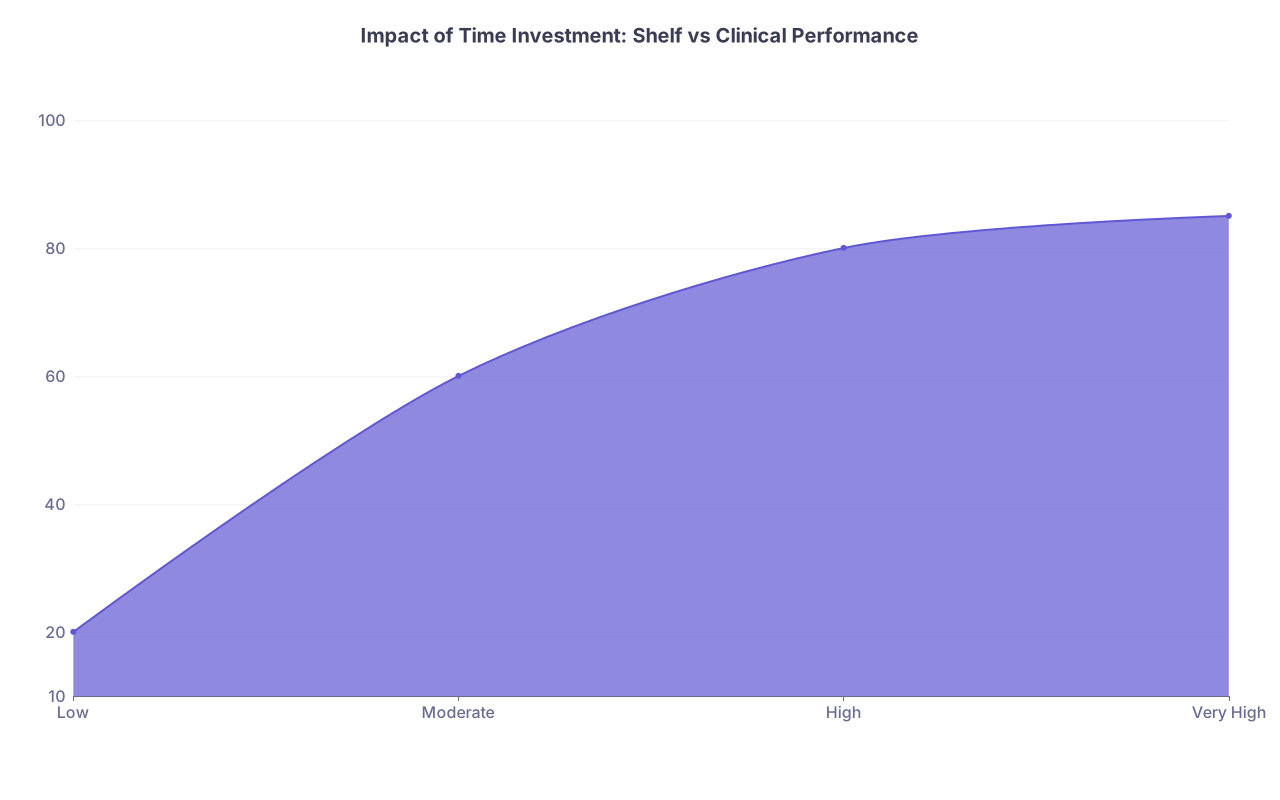
| Category | Value |
|---|---|
| Low | 20 |
| Moderate | 60 |
| High | 80 |
| Very High | 85 |
If “Low to Moderate” investment in shelf studying gets you into the eligibility zone, the extra effort from “High” to “Very High” might net you only a marginal bump in your total perceived value, especially once you consider the opportunity cost of not being present/engaged on the wards.
The point isn’t that shelves don’t matter. The point is diminishing returns. Once you’re safe and eligible, the fastest way to increase your value in faculty eyes is to behave like a junior resident, not a professional test-taker.
FAQ: Shelf Scores vs. Rotation Grades
1. If I have to choose due to time, should I prioritize studying for the shelf or impressing the team?
If you’re at risk of failing the shelf, you prioritize the exam. A failure follows you around on transcripts and MSPE. But once you’re in “likely pass and near eligibility” range, you lean hard into being outstanding on the wards. That’s what generates honors, comments, and letters.
2. Can amazing clinical evaluations make up for a low shelf score?
They can soften the blow, but only within the rules. If your school has a hard cutoff for honors eligibility based on shelves, even rave reviews can’t override that. What they can do is make your MSPE and letters strong enough that residency directors overlook a few mediocre exam signals.
3. Do residency programs ever see my specific shelf percentiles?
Most of the time, no. They see final clerkship grades and narrative summaries. Some schools include brief notes like “strong exam performance” or “shelf performance below expectations,” but they usually don’t list raw percentiles for each shelf. Exceptions exist, but they’re uncommon.
4. Which specialties care most about shelves and exams?
Highly competitive, cognitively heavy fields—derm, radiology, some IM subspecialties—pay closer attention to any sign of strong standardized test performance, usually via Step 2 CK, not shelves directly. But shelves matter indirectly by correlating with Step 2 and helping you get honors in core rotations that strengthen your application.
5. I honored most rotations but had one bad shelf and got only High Pass. Will that sink me?
No, not by itself. A single outlier shelf leading to one High Pass in a sea of honors is basically background noise. In committees, we notice patterns—consistently mediocre or failing, not a single stumble. If your narrative comments are strong and your overall pattern is solid, that one rotation won’t define you.
If you remember nothing else, remember this: shelves are the gatekeepers; your day-to-day behavior is the story. Faculty, clerkship directors, and program directors read that story much more closely than they read your percentiles. Aim to be the student they want back on their team—then use shelves to stay out of trouble and in the running, not as your entire identity.