You are on morning rounds. You barely slept. The senior presents a patient with chest pain, and the attending turns to you:
“Alright, student. Give me your differential for pleuritic chest pain. Top five. Go.”
Your brain: total static. You know you have seen this a dozen times. Somewhere between UWorld, Anki, and that one shelf review book. But in the moment? Nothing.
You mumble something about PE and pericarditis, stall out on number three, and feel the team’s patience thinning. You spend the rest of the day replaying it in your head and thinking, “I am actually not this dumb. Why can I not answer simple pimping questions?”
Here is the problem: pimping is not just about knowledge. It is about recall speed, structure, and pattern recognition under mild (or not so mild) pressure. The good news: you can train those skills. Quickly. With a simple daily drill.
I am going to walk you through a concrete, repeatable system that, if you run it for 2–3 weeks, will noticeably change how you perform on rounds.
What You Are Actually Up Against With Pimping
Before I give you the drill, you need to be clear what you are trying to fix. It is rarely “I know nothing.” It is usually one of these:
- You cannot retrieve what you know fast enough.
- You do not have pre-built frameworks for common questions.
- You panic as soon as eyes turn toward you.
- You study in a way that is great for exams but terrible for on-the-fly questioning.
Pimping questions in clinical rotations fall into a few predictable buckets:
| Type | Example |
|---|---|
| Definition | "Define sepsis." |
| Differential | "Differential for jaundice?" |
| Workup | "Next three tests for GI bleed?" |
| Management | "Initial management of DKA?" |
| Mechanism/Path | "Why does COPD cause polycythemia?" |
If you build fast-response frameworks for these buckets, your performance on rounds improves dramatically. You stop trying to “remember everything” and start plugging into patterns.
The Core Fix: A 30–40 Minute Daily Pimping Drill
This is the system. If you actually run this, you will get sharper in 7–10 days.
You will do this every day you are on rotation, ideally:
- 15–20 minutes before you leave for the hospital
- 15–20 minutes after you get home / before bed
Step 1: Build a “Pimp Bank” for Your Rotation (One-Time, 30–60 Minutes)
On day 1–2 of a new rotation, you build your pimp bank: a short list of high-yield topics and “classic” questions for that specialty.
Use:
- Your shelf prep book’s table of contents (e.g., Case Files, Emma Holliday outlines, OnlineMedEd topics)
- Last year’s students’ notes or shared pimp sheets
- Things you got asked and missed in the first couple of days
Organize it by question type, not just topic. For example, for Internal Medicine:
Definitions
- Sepsis / septic shock
- AKI vs CKD
- SIRS criteria (even if outdated, they still ask)
Differentials
- Chest pain
- Dyspnea
- Hyponatremia
- Anemia
Initial workup
- Upper vs lower GI bleed
- Syncope
- Altered mental status
Management
- DKA initial management
- STEMI vs NSTEMI
- New-onset A-fib with RVR
You do not need a 20-page document. A 1–3 page outline is enough.
The pimp bank is the raw material for your daily drills.
Step 2: Morning Drill – “5 Questions, 5 Frameworks” (15–20 Minutes)
Morning is about speed and structure.
Goal: Warm up your brain so the first time you are “on the spot” is not when the attending calls your name.
How to Run It
Pick 5 questions from your pimp bank, across types
Example for surgery:- Differential for post-op fever
- Initial workup of suspected DVT
- Causes of ileus
- Management of open fracture in ED
- Mechanism of warfarin
Ask them out loud to yourself
Yes, out loud. That is the whole point: simulate the situation. Sit at your desk, look at the wall, and say:
“What is the differential diagnosis for post-op fever on POD#1?”Answer in 30–60 seconds, in a structured format
This is where most students fail. They ramble. You need tight frameworks.Example answer structure for “Post-op fever”:
- “I break post-op fever down by POD timing.”
- “POD 1–2: atelectasis, pneumonia, early infection, transfusion reaction.”
- “POD 3–5: UTI, pneumonia, line infection.”
- “POD 5+: wound infection, abscess, DVT/PE.”
You do not aim for perfection. You aim for clean structure, even if a detail or two is off.
Immediate check + micro-correction (30–60 seconds)
Look at your source (note, book, UpToDate screenshot). Quickly correct:- What did you miss?
- What extra did you say that is wrong or outdated?
- How can you tighten your wording?
Repeat for all 5 questions
That is it. You are not reviewing 40 pages. You are sharpening 5 high-yield frameworks in a way that maps directly to rounds.
Step 3: Throughout the Day – Capture “Got Pimped” Moments (2–3 Minutes Each)
If you do not harvest your daily embarrassment, you waste a goldmine.
Any time during the day:
- You get asked something and blow it.
- You give a shaky answer and the attending “teaches around” your gaps.
- You hear another student get grilled on something you sort-of know.
You capture it. Immediately. Not “later when I get home.”
Use:
- Notes app on your phone
- Small pocket notebook
- Back of your signout sheet
Simple format:
- Question asked
- Your answer (if any)
- Correct / key points to remember
Example:
Post-call note, 10:30 AM
Q: “What are the criteria for ARDS?”
A: I mumbled “hypoxia, infiltrates, not volume overload.”
Fix: Berlin criteria – timing within 1 week, bilateral opacities, not cardiac, PaO2/FiO2 thresholds for mild/moderate/severe.
That 20-second note becomes tomorrow’s drill question.
Step 4: Evening Drill – “Fix Today’s Weak Spots” (15–20 Minutes)
Evening is for repair and consolidation. You take what went wrong today and hardwire the fix.
How to Run It
Pull out your “got pimped” notes from the day
If you had a brutal attending, this might be 8–10 questions. If it was calm, maybe just 2–3.Pick 3–7 of the highest-yield or most embarrassing misses
Prioritize:- Things your attendings clearly care about
- Things that show up everywhere (ARDS, sepsis, chest pain, DKA, etc.)
- Anything you “sort of know” but cannot say cleanly
For each, run this 3-part micro-drill (2–3 minutes per question)
a) Look it up properly (2–3 minutes)
- Quick check in a trusted source (UpToDate, AMBOSS, your shelf book)
- Capture the framework, not just raw facts.
Example for ARDS:
- “Berlin criteria: timing, imaging, origin of edema, oxygenation.”
- “Management: underlying cause + lung protective ventilation.”
b) Write a 2–4 sentence “pimp answer”
You are scripting your future response.Example:
- “ARDS is an acute inflammatory lung injury. Berlin criteria: onset within 1 week of a known insult, bilateral opacities on chest imaging, not fully explained by cardiac failure or fluid overload, and hypoxemia defined by PaO2/FiO2 thresholds for mild, moderate, or severe disease on PEEP ≥5.”
c) Say it out loud once, eyes closed
Seriously. Close your eyes, imagine the attending, say the answer. It feels silly. It works.Optional: Turn the question into a flashcard
If you use Anki, make a cloze or Q/A card with your structured answer. That way it starts spacing itself out.
You are done in 15–20 minutes. You did not “study everything.” You upgraded a handful of specific weak points, with direct clinical relevance.
The Key Skill: Learning Frameworks, Not Trivia
Pimping goes badly when you try to memorize scattered facts.
Attendings love frameworks. They want to see that you:
- Organize information
- Prioritize
- Can at least think like a clinician, not like First Aid on legs
So your daily drill should always push you toward patterns.
Here are some extremely useful frameworks you should deliberately practice in your drills:
1. The 3–5 Item Differential
Used for:
- Chief complaints (chest pain, abdominal pain, SOB)
- Lab abnormalities (hyponatremia, anemia, hypercalcemia)
Template:
- “Top three life threats are X, Y, Z. Then common benign causes A, B.”
Example – Dyspnea differential:
- “I split dyspnea into cardiac, pulmonary, and other.
Cardiac: CHF exacerbation, ACS.
Pulmonary: COPD/asthma exacerbation, PE, pneumonia, pneumothorax.
Other: anemia and metabolic acidosis.”
2. Initial Workup in 3 Steps
Used for:
- Any new symptom or acute problem
Template:
- “Stabilize, basic labs/imaging, targeted tests.”
Example – Syncope workup:
- “First, stabilize: vitals, airway, IV access, fingerstick glucose.
Then initial workup: ECG, orthostatic vitals, CBC, BMP.
Then targeted testing based on suspicion: echo for structural disease, telemetry, possibly Holter or tilt table testing.”
3. Initial Management in 3 Moves
Used for:
- Common emergencies (DKA, sepsis, CHF exacerbation, asthma flare, GI bleed)
Template:
- “Stabilize ABCs, specific first-line treatment, monitoring/disposition.”
Example – DKA management:
- “ABCs first and check glucose.
Start fluid resuscitation with isotonic saline, correct potassium as needed, then start insulin infusion once potassium is safe.
Monitor BMP, anion gap, and blood glucose closely, and transition to subcutaneous insulin when gap closes and the patient can take PO.”
Your drill should force you to speak in frameworks. Over time, this becomes automatic. That is when pimping becomes tolerable, even fun.
A Simple Weekly Plan to Compound the Gains
You do not need a complicated scheduler. Just a simple weekly rhythm that compounds.
| Day | Focus |
|---|---|
| Mon–Thu | Normal morning + evening drills |
| Fri | Add 10-minute “week review” block |
| Weekend | 30–45 min bigger concept sessions |
Monday–Thursday: Standard Daily Drills
- Morning: 5 questions from the pimp bank
- Daytime: capture missed questions
- Evening: 3–7 “fixes” from the day
Friday: Short Weekly Review (Extra 10 Minutes)
On Friday evening, add:
- Skim all the questions you missed that week
- Pick the 5–10 most important
- Run a rapid-fire out-loud session:
- Ask the question
- Answer in 30 seconds
- Quick check
No detailed studying. Just tightening recall.
Weekend: Deepen 2–3 Big Topics (30–45 Minutes)
Pick a couple of core shelf exam topics from the week that kept showing up in pimping:
- On IM: chest pain, shortness of breath, AKI, hyponatremia
- On Surgery: post-op complications, acute abdomen, shock
- On OB: third-trimester bleeding, fetal heart tracings
- On Peds: fever in neonate, asthma, dehydration
Do a deeper dive:
- Watch one good 10–20 minute high-yield video
- Skim a solid review page
- Integrate what you learn back into your spoken frameworks (the ones your attendings will actually hear)
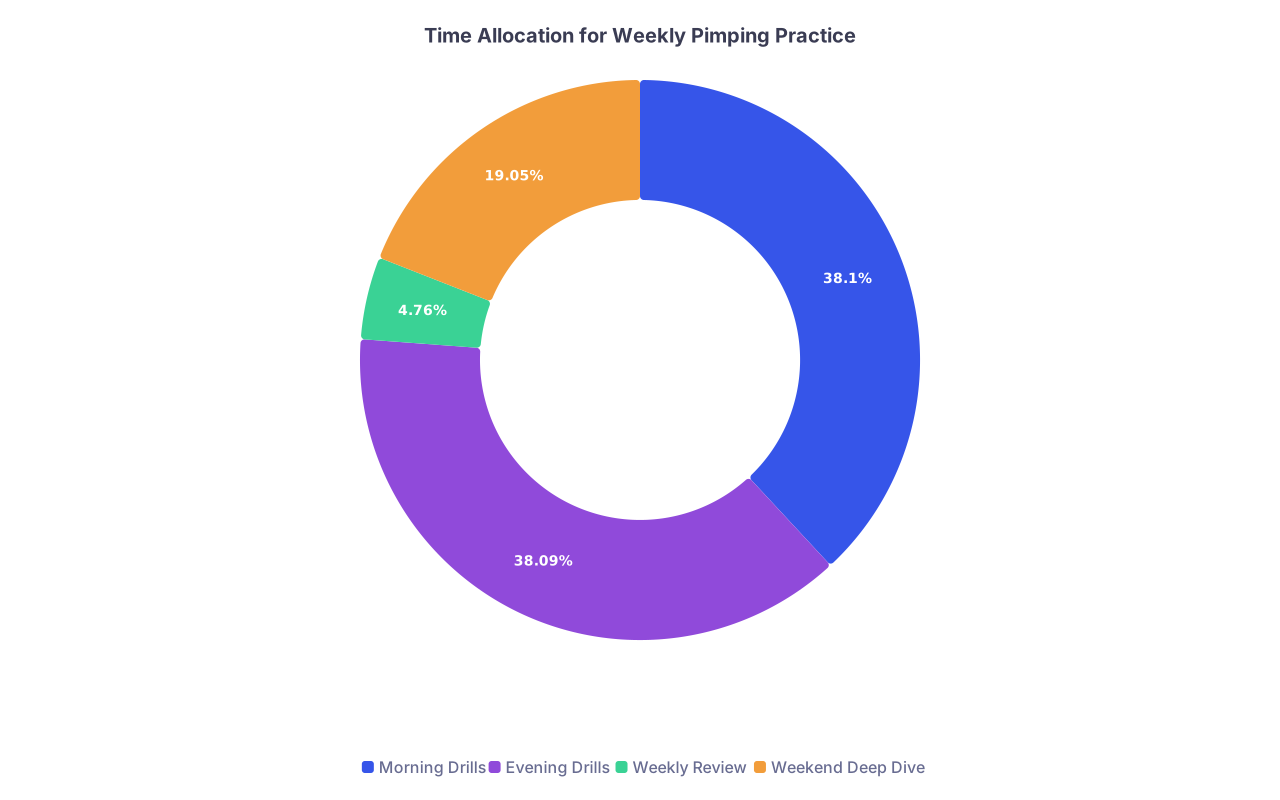
| Category | Value |
|---|---|
| Morning Drills | 80 |
| Evening Drills | 80 |
| Weekly Review | 10 |
| Weekend Deep Dive | 40 |
Fixing the Performance Anxiety Side
Some of you do not have a knowledge problem. You have a panic problem. Your mind goes blank the second an attending looks at you.
You handle this in parallel with the drill.
1. Use “Buy Time” Phrases
You are allowed to think. You just need to sound like you are thinking, not like you are drowning.
Phrases to practice:
- “Let me think through that out loud.”
- “First, I consider…”
- “I would break that into X and Y.”
You start your framework even while your brain is assembling the rest.
2. Stop Aiming for Perfection
Students freeze because they think they need the USMLE answer key.
Attendings want:
- A reasonable structure
- No dangerous nonsense
- Evidence you are trying
If they ask you for 5 causes, and you know 3 solid ones, say:
- “I am certain about these three: X, Y, Z. I am less confident about the others, but I would also consider A and B.”
That is much better than sweating in silence.
3. Pre-Commit to One “Ask for Help” Line
You are human. Some questions will be way over your level.
Have a single sentence you use every time instead of babbling:
- “I am not sure about the full answer, but here is how I would start to approach it…”
- Or, if you are totally lost:
“I do not know that yet. I would like to read about it and get back to you tomorrow.”
Then you actually read it and bring it up the next day. That move alone earns you points.

Tools That Make This Much Easier
You do not need fancy software, but a few things help.
1. A Single Source for Each Rotation
Pick one main clinical resource for each rotation. Not five.
- IM: AMBOSS, OnlineMedEd, or Step-Up
- Surgery: Pestana + OnlineMedEd
- OB: UWise, Blueprints
- Peds: BRS Peds / OnlineMedEd
When you look up a pimp question in your evening drill, always use the same source. Your brain will start knowing “where” the answer lives.
2. Lean, Clean Notes
Overbuilt notes kill you. You will not review them.
Instead, keep a running “pimp notes” document per rotation with only:
- The question
- The skeleton of your spoken answer (framework bullets, not paragraphs)
Example entry:
ARDS – definition/criteria
- Acute onset within 1 week
- Bilateral opacities on CXR/CT
- Not fully explained by cardiac failure or overload
- PaO2/FiO2 thresholds for mild/moderate/severe with PEEP ≥5
- Mgmt: treat cause + low tidal volume ventilation
You can scroll this on your phone for 3 minutes before rounds. That alone will win you questions.
3. Optional: Anki for High-Yield Frameworks Only
If you are already an Anki person, make cards like:
Q: “What are the Berlin criteria for ARDS?”
A:
- Acute onset within 1 week of known insult
- Bilateral opacities on imaging
- Not explained by cardiac failure or fluid overload
- Hypoxemia defined by PaO2/FiO2 thresholds on PEEP ≥5
But stay strict: only truly high-yield pimp items go into this deck. You are not rebuilding UWorld.
How This Looks After 2–3 Weeks
You run this system for a couple of weeks on a busy rotation. What changes?
- You start answering in clean, organized chunks instead of scattered fragments.
- You are no longer blindsided by >50% of questions because you have heard them in your drills.
- When you do not know, you recover faster and ask better follow-ups.
- Your shelf studying feels more connected to the real wards.
I have watched consistently mediocre-on-rounds students become “one of the stronger students this month” just by doing this for 3 weeks on medicine and then repeating the same pattern on surgery.
No genius. Just a tight feedback loop and daily reps in the exact skill you are being graded on: thinking and talking medicine under pressure.

| Step | Description |
|---|---|
| Step 1 | Start of Rotation |
| Step 2 | Build Pimp Bank |
| Step 3 | Morning Drill: 5 Questions |
| Step 4 | Daytime: Capture Missed Questions |
| Step 5 | Evening Drill: Fix Weak Spots |
| Step 6 | Weekly Review + Weekend Deep Dives |
| Step 7 | End of Week? |
FAQs
1. How many questions should I expect to improve on each week with this method?
Realistically, you can meaningfully sharpen 20–40 questions per week:
- 5 per morning x 4–5 weekdays = 20–25
- 3–7 evening fixes per day = some overlap, but another 10–15 unique ones
By the end of a 4-week rotation, you have drilled 80–120 high-yield questions multiple times, out loud, in context. That is a huge chunk of what most attendings actually ask.
2. What if my team does not pimp much – is this still worth doing?
Yes. The skill you are building is structured clinical thinking and rapid recall, which:
- Helps you present patients succinctly
- Improves your answers during case discussions
- Boosts your shelf performance, because you learn in organized patterns
If your team is low-pimp, you just do not get the real-time “testing.” But your future rotations will still benefit.
3. How do I handle an attending who seems to use pimping to humiliate students?
You cannot fix their personality, but you can:
- Take their questions as a curriculum – whatever they obsess over goes straight into your evening drill.
- Set a mental boundary: their tone is about them, not your worth.
- Use one calm line when you truly do not know: “I do not know the answer to that. I will read about it tonight and follow up tomorrow.” Then actually close that loop.
The drill gives you some control back. You stop feeling like a permanent target and more like you are running your own training program alongside theirs.
4. I am already overwhelmed. How do I fit this in time-wise?
You are not adding two hours of studying. You are replacing low-yield, unfocused scrolling with 30–40 targeted minutes:
- 15–20 in the morning – often you can steal this from aimless phone time.
- 15–20 in the evening – instead of pretending you will “read for 2 hours” and then not doing it, commit to a short, tight block.
If you truly cannot manage both, start with just the evening drill (3–7 fixes from the day) for one week. Once you see the payoff, it is much easier to justify adding the morning session.
Key takeaways:
- Pimping is a trainable skill: you are fixing recall speed, structure, and pressure tolerance, not just memorizing more facts.
- A simple daily system – morning frameworks, daytime capture, evening fixes – compounds fast over a 2–3 week block.
- Speak in frameworks, not trivia. That is how you sound like a clinician on rounds, even while you are still a student.