
It’s 5:45 a.m. on day one. You’re in a half-empty workroom, staring at a list of patients whose names you don’t recognize, trying to figure out where the vitals are in a charting system you barely know. The night intern is wrapping up sign-out. The chief wanders in with coffee, scrolls through the census once, glances around the room, and in about 90 seconds has already decided who on this rotation is “solid,” who is “high maintenance,” and who is going to be invisible.
You think you’re a blank slate.
You’re not.
Let me walk you through what’s actually happening behind the curtain.
How Chiefs Really Form Their First Impression
Here’s the part students never quite believe until they become residents: most chiefs can peg you within the first 48 hours. Not your exact grade, but your tier. Are you a “would trust with my sickest patient one day” student, a “safe but forgettable,” or a “please do not let this person write anything important alone”?
We are not waiting for your big presentation on day 7. We’re watching you from the second you walk into the workroom and say your first word.
The invisible whisper network
Before you even show up, there’s often background noise about you. Chiefs hear things. They’re not supposed to matter. They still do.
- The outgoing team might say during sign-out: “You’re getting two new students; one is super motivated but anxious, the other is really chill, sometimes too chill.”
- A chief from a prior rotation might mention casually at sign-out: “Oh, you’re getting Alex? Good kid. Reads. Doesn’t complain.”
- Or worse: “Heads up, Sam needs a lot of guidance. Double-check their notes.”
No one writes this down. It’s not official. But it colors how your chief watches you in those first 48 hours.
That said, here’s the good news: your chief’s direct experience with you in those first two days will overwrite almost any rumor. Strong early behavior can erase a weak reputation. Weak early behavior will absolutely confirm a bad one.
The First 10 Minutes: What You Don’t Realize You’re Broadcasting
The awkward introductions. That’s where more damage is done than in any H&P.
Your entrance and basic presence
You think you’re just walking into a room. Everyone else is making micro-judgments.
We notice:
- Did you show up 10–15 minutes before the stated time, or are you strolling in right on time with wet hair and a half-open backpack?
- Do you introduce yourself clearly and audibly, or mumble from the corner?
- Do you look like you’re there to work, or like you’re dropping in for a tour?
A student who walks in, finds a spot, opens their laptop or pulls out a small notebook, logs into the EMR, quietly asks “Who are we following today?” with clear eye contact—immediately reads as prepared and engaged.
The one who stands with their backpack still on, clutching a coffee, awkwardly laughing, bumping into chairs while looking for plugs? That’s the student we already know will need more hand-holding.
How you respond to chaos
Interns are finishing notes, nurses are calling, someone’s crashing in another room, and the chief is trying to orient you in between pages. Day 1 is not a neat orientation packet. It’s messy.
What we watch for:
- Do you stay calm and observant when everyone else is moving quickly?
- Do you jump into the way, or do you find a useful corner and listen?
- Do you ask thoughtful questions, or interrupt with something that clearly could wait?
A very specific example: you ask, “Where should I sit?” once. Good. You ask it three times while people are trying to start sign-out? That reads as low situational awareness.
The First Pre-Rounds: Your Work Tells on You
By the time we hear your first patient presentation, we already have a sense of how you think, just from how you’ve moved in the chart and on the wards.
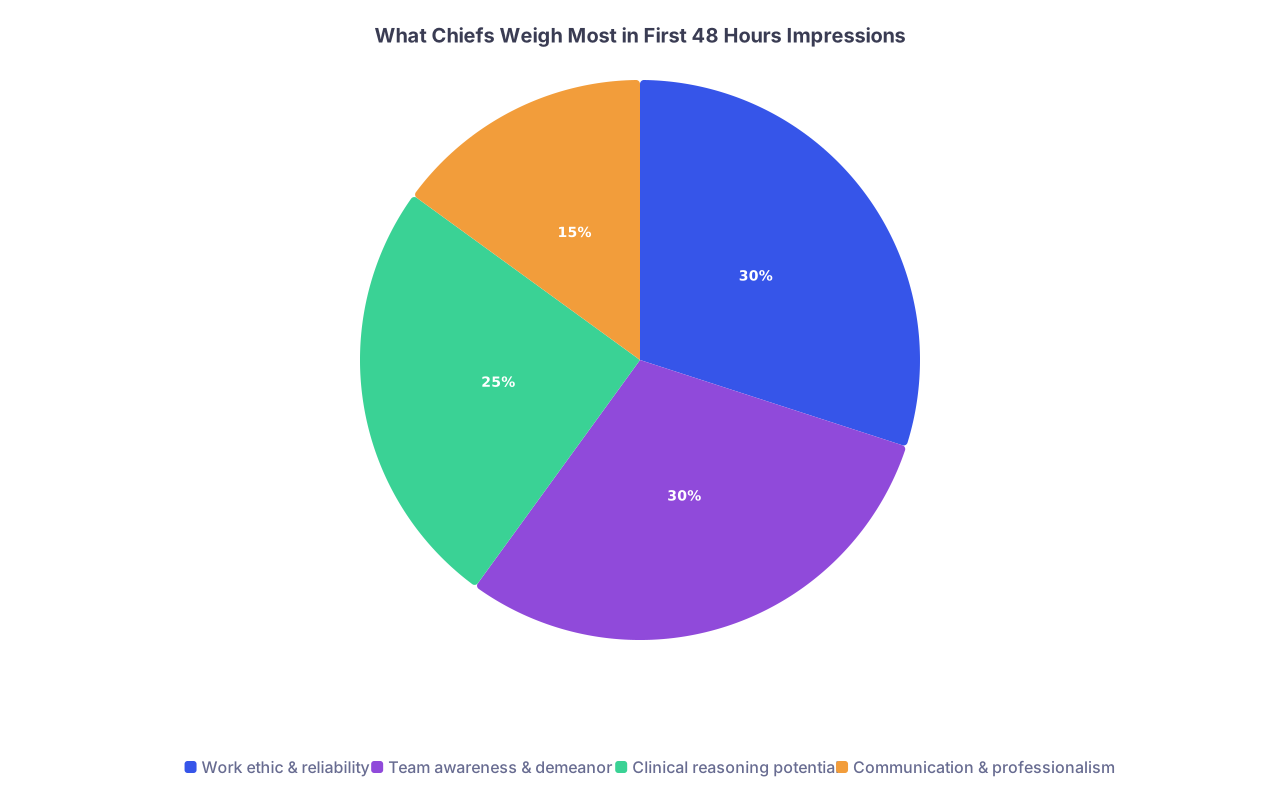
| Category | Value |
|---|---|
| Work ethic & reliability | 30 |
| Team awareness & demeanor | 30 |
| Clinical reasoning potential | 25 |
| Communication & professionalism | 15 |
Those percentages aren’t from a journal article. They’re from years of watching chiefs talk about students.
How you “pre-round” tells us if we can trust you
You get assigned 1–3 patients. We tell you: “Pre-round on them, check vitals, overnight events, labs, talk to them if you can.”
Translation: “Show me you can pull together coherent information and that you care enough to be thorough.”
Here’s what we’re looking for when we glance at your screen while you’re “working”:
- Are you actually in your patient’s chart, scanning the overnight note, MAR, vitals, labs?
- Or are you in UpToDate, rabbit-holing on ‘hyponatremia’ before you even know why they’re here?
The strong early student has a scrap sheet or note structure, jots key vitals and events, quickly talks to the nurse if something looks off. The weaker one spends 25 minutes rewriting the HPI from admission into their own words and never notices the 3 a.m. hypotension.
If I have to ask, “Did you check this morning’s labs?” and you say, “Oh, I don’t think they’re back yet,” and I click and they’ve been back for an hour—that’s a major early ding. Not because you’re evil. Because it screams: “This person doesn’t yet understand what’s important.”
Your first presentation: we’re listening for specific things
No med student nails their first presentation of the rotation. We know that. We are not grading you on being polished. We are grading you on:
- Did you understand the basic story?
- Do you actually know why the patient is in the hospital?
- Can you say a one-sentence summary without reading?
I cannot tell you how many times I’ve heard: “This is a 65-year-old male with a past medical history of hypertension, hyperlipidemia, and diabetes who presented with shortness of breath and chest pain for three days, he was found to have a troponin of…” and by the time they finish the HPI, they still have not said the words “NSTEMI” or “CHF exacerbation” or anything resembling a diagnosis.
The sharp student, even on day one, will say somewhere early: “He’s here with an NSTEMI with mildly reduced EF, on day two of heparin gtt.” Or, “She’s here with a COPD exacerbation likely triggered by pneumonia.”
We don’t care if you’re right about everything. We care that you’re trying to synthesize.
The Unforgiving Metric: Reliability in the Little Things
You want to know the fastest way to drop from “honors possible” to “barely pass”? It’s not missing a rare diagnosis. It’s being unreliable.
Pages, tasks, and the vanishing student
Chiefs keep a mental log:
- “Texted Alex to get an EKG copy at 9:15. Never heard back.”
- “Asked Maya to call the lab for that missing K. It got done and she reported back without prompting.”
- “Told Jordan to check on Mrs. X’s discharge meds. Heard nothing until I asked hours later.”
You think those are tiny things. They’re not. That’s your trust score.
If on day one I ask, “Can you go talk with the nurse about the patient’s pain and see what’s been given?” and you:
- Say “Yes,” immediately.
- Actually go within 5–10 minutes.
- Come back and say, “I talked to her. She’s been getting PRN morphine but it’s only ordered q4h and she’s having pain at hour 3. The nurse asked if we could switch to q3h. I checked her blood pressure—stable.”
That one interaction puts you in the “this student might actually be useful” category from the start.
If instead you half-nod, go back to your laptop, get distracted writing your note, and 30 minutes later I realize you never went? You just bought yourself a narrative: “Smart on paper, not reliable clinically.”

| Step | Description |
|---|---|
| Step 1 | First Interaction |
| Step 2 | Flag: Reliability Concern |
| Step 3 | Needs Close Supervision |
| Step 4 | Hardworking but Green |
| Step 5 | High Potential / Trustworthy |
| Step 6 | On Time & Prepared? |
| Step 7 | Handles Simple Tasks? |
| Step 8 | Synthesizes Info? |
That’s more or less how it runs in our heads.
Your Demeanor: How You Treat the Team (and How They Talk About You)
Students underestimate this so badly it almost becomes predictable.
How you interact with interns
You think your eval comes from the attending. It doesn’t. Not primarily.
On most rotations, the chief and interns essentially write the first draft of your evaluation. The attending signs it. If the interns say, “This student is fantastic,” you’re starting on third base.
Interns are not dumb. They know exactly how you talk to them vs. how you talk to the attending.
We notice:
- Are you respectful of the intern’s time, or are you constantly asking them things that you could find yourself with 20 seconds of EMR exploration?
- When they correct you, do you say “Oh, that makes sense,” or do you go quiet and sulk?
- When the attending walks in, do you suddenly become wildly enthusiastic and talkative, after being low-energy all morning?
Nothing tanks a student faster than being two-faced—obviously deferential to attendings, dismissive or “buddy-buddy boundaryless” with interns and nurses. Chiefs have very little patience for that.
How you handle feedback in the first 48 hours
There’s almost always a moment on day 1 or 2 where we give you early course correction.
Classic example: your first SOAP note is a wall of text. The chief or intern says, “This is too long; tomorrow aim for this structure instead.”
What we watch for is not whether you magically fix it overnight. We watch your reaction in the room:
- Do your eyes glaze and your posture slump like you’ve been personally insulted?
- Do you immediately say, “Okay, that’s helpful. Can I ask—do you want problem-based or system-based in the Assessment?”
- Or do you start defending: “Well, at my last rotation they wanted more detail….”
You want to signal that you can course-correct fast. Chiefs are drawn to students who treat feedback like a normal part of growth, not a trauma.
Clinical Brain vs. Trivia Brain
In the first 48 hours, we’re not testing whether you’ve memorized UpToDate. We’re looking for signs of how your clinical brain is developing.

The questions you ask say everything
The student leaning into clinical reasoning early will ask things like:
- “She’s hypotensive and tachycardic—do you think this is more sepsis versus hemorrhage in this context?”
- “He’s on both a beta-blocker and diltiazem and is bradycardic—should we consider stopping one?”
- “For this COPD exacerbation, is there a specific threshold for when you start BiPAP versus just nasal cannula?”
Those tell me your brain is lining up data and wondering what to do.
The student still stuck in trivia world asks:
- “What’s the exact mechanism of action of this antibiotic again?”
- “How many points on the Wells score do you need before you get a CT?”
- “Is hyponatremia in this case hypotonic or isotonic?”
Those aren’t bad questions. But if that’s all you’re asking while you miss big-picture issues—hypotension, delirium, missed labs—it signals you’re not yet operating at the right level.
Risk awareness
We also listen very carefully for whether you recognize danger.
If I ask, “Anything concerning about your patient this morning?” and you say, “No, everything’s fine,” but I later see a blood pressure of 80/40 and escalating oxygen requirements in the chart… I know you’re not ready to be trusted yet.
A better answer on day one, even if you’re not sure, is: “She was more short of breath, and I saw that her O2 went from 2L to 5L overnight. I don’t fully know what that means yet, but it worried me.”
That line—“I don’t fully know what that means yet, but it worried me”—is gold. It shows judgment and honesty.
How You Fit (or Don’t) Into the Workflow
This is the piece almost no one spells out: chiefs are under pressure. They’re dealing with bed flow, consults, late discharges, angry families, staff shortages. A student who either lightens that load or adds to it makes an outsized impact in 48 hours.

Situational awareness on rounds
Chiefs watch:
- Do you naturally gravitate to the side or back on rounds, or keep ending up shoulder-to-shoulder blocking the door?
- Do you step out of the doorway if a nurse needs to pass?
- When the attending is talking to a patient, are you scrolling your phone in the doorway, or are you watching the patient’s face, picking up nonverbal cues?
All those little movements tell us how aware you are that this is a workplace, not a classroom.
The fastest way to read as “clueless” is to stand in the middle of a narrow hallway with your back to the code cart while three nurses are trying to get around you. I have literally seen chiefs dock students for that kind of thing, because it suggests a complete lack of clinical awareness.
Documentation and not becoming a liability
In the first 48 hours, we’re also deciding:
“Can I let this student write notes that actually carry weight, or will I have to rewrite everything?”
If your day-one note is wordy but factually correct, we’re encouraged. If your note has wrong vitals, wrong exam, wrong plan? We mentally flag you as someone whose work must be verified line by line. That’s brutal. That stigma is hard to shake.
| Student Behavior (First 48h) | Typical Chief Interpretation |
|---|---|
| Arrives 10–15 min early, logged in, already looking at the list | Reliable, engaged, low-drama |
| Needs repeated reminding about simple tasks | High supervision required, limits trust |
| Asks one or two focused clinical questions per patient | Strong reasoning potential |
| Overly quiet, never asks anything, just nods | Hard to read, often graded lower |
| Blames prior rotation/others when corrected | Poor insight, risky to invest in |
The Subtle Stuff: What Chiefs Notice That You Don’t Think About
There are a few things that come up over and over in chief discussions on students.
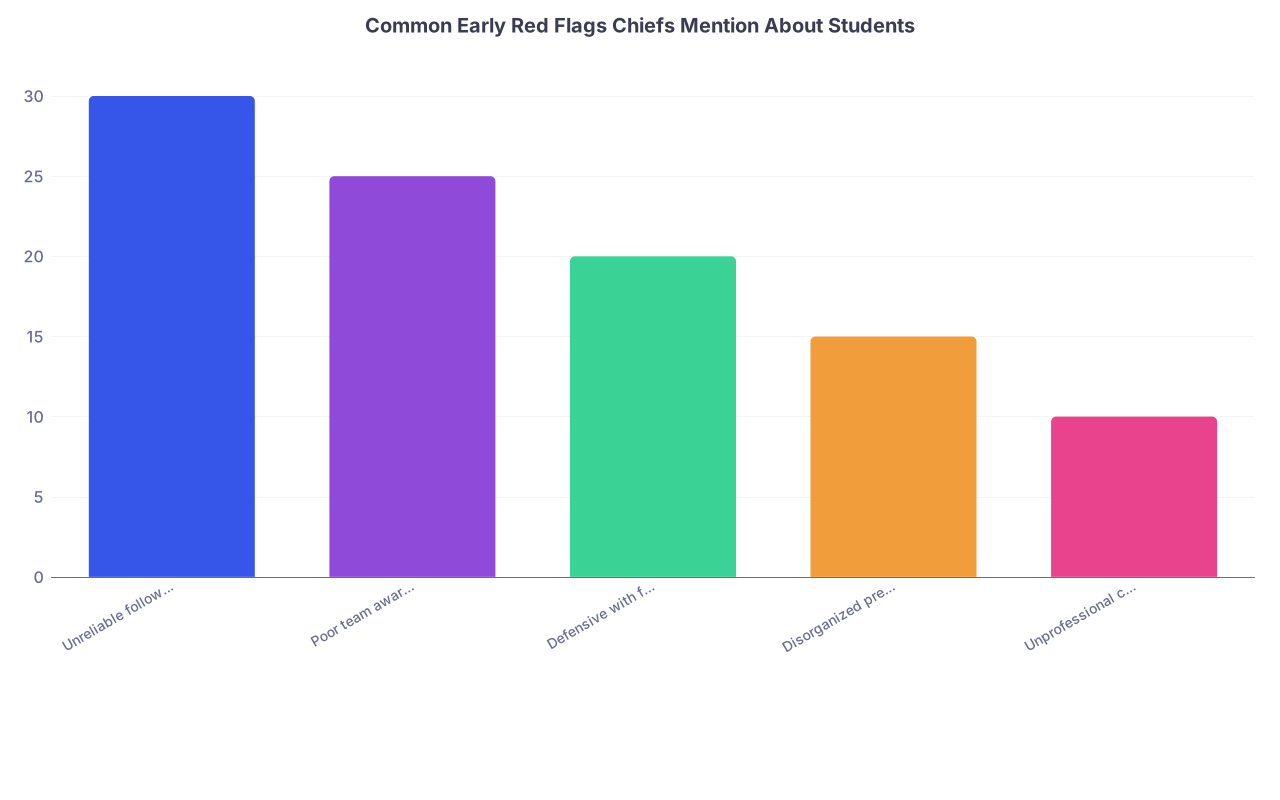
| Category | Value |
|---|---|
| Unreliable follow-through | 30 |
| Poor team awareness | 25 |
| Defensive with feedback | 20 |
| Disorganized presentations | 15 |
| Unprofessional comments | 10 |
How you talk about patients when you think it’s “just us”
When the doors close and it’s “just the team,” some students loosen up. That’s when we hear who you actually are.
Examples that absolutely come back to bite people:
- Calling a patient “crazy” instead of “psychotic” or “severely anxious.”
- Making jokes about BMI, hygiene, or “frequent flyer” status.
- Rolling your eyes about a “drug seeker.”
You may think you’re bonding with the team with dark humor. More often, you’re telling the chief: “I don’t see these people as fully human.” The better chiefs will call it out. Some won’t. But it will show up later when they choose adjectives for your evaluation.
Your energy when you’re not being watched
This is the part many students miss. Chiefs don’t only see you when you’re next to them.
People talk. The night intern mentions, “Hey, your student was actually here late finishing up a note and asked me how to better structure it.” Or, “Your student left right at 4 even when we were still scrubbing on that case.”
Nurses tell us, “Your student was really helpful with repositioning that patient,” or “Your student seemed annoyed when I asked them to help.”
You are never as invisible as you think.

How to Recover if You Stumble Early
Let me be honest: messing up in the first 48 hours is not the end. Chiefs know you’re adjusting. What kills students is not the mistake, but the pattern.
If you:
- Miss an important lab on day one. Own it immediately: “I missed that; I’ll build a checklist so it doesn’t happen again.”
- Show up exactly on time and realize everyone’s been here 15 minutes already. Fix it: be early from then on. No explanation, no over-apologizing. Just quietly change behavior.
- Botch your first presentation. Ask your intern or chief that day, “Can you show me how you’d present this same patient? I want to model my structure on yours.”
We notice quick improvement. Chiefs talk about it. I’ve written evaluations that literally said: “Initially struggled with X, but within days made marked changes and ended as one of the stronger students.”
That “growth arc” is almost as valuable as being polished from day one.