
You are not “shy.” You are being structurally ignored. And there is a system for fixing that.
Most students who feel invisible on rotations think the problem is their personality. Wrong. The problem is that clinical teams run on habits, hierarchy, and momentum. If you are not deliberately integrated into those systems from day one, you get left on the sidelines. Smiling more will not fix it. Hoping someone “notices your work ethic” will not fix it.
There is a repeatable way to go from ghost on the team to known, trusted, and included. It is not about being loud or fake. It is about running a specific playbook—early, consistently, and professionally.
Let me walk you through it.
Step 1: Diagnose Why You Are Invisible (There Are Only a Few Real Reasons)
Before you fix anything, you need a clear working diagnosis. “They hate me” is not a diagnosis. It is a feeling. You need to identify what system you are currently not plugged into.
In almost every rotation, invisibility comes from one or more of these:
Role not defined
No one clearly told you:- What you own
- What you are expected to do daily
- How your work feeds into the team’s work
Result: people do not page you, ask you, or assign you anything because they do not know what you are “for.”
Information flow bypasses you
You are not:- On group texts / group chats
- On the EMR patient list the team actually uses
- Included on handoff or sign-out
Result: you hear about cases and plans after they happen.
You appear low-yield to the team
This one stings, but you need to face it. If the team subconsciously thinks:- It is faster to just do it themselves
- You will not know the answer anyway
- You seem disinterested or timid
They stop trying to involve you.
You are physically in the wrong place at the wrong time
Classic:- You are at the nursing station while they are rounding in rooms
- You are charting while the attending teaches in the conference room
- You arrive exactly at start time while everyone else starts 20 minutes earlier for pre-rounds
Toxic or chaotic team culture
Occasionally, the problem is not you. It is:- A malignant resident or attending
- A chronically understaffed, drowning service
- A team that genuinely does not care about teaching
You cannot control #5, but you can still improve your situation within it. For #1–4, the fix is absolutely within your reach.
Quick self-audit. Ask yourself:
- Do I know exactly which patients I “own”?
- Do I know what the resident expects me to pre-round and present?
- Do I know where the team meets at each point in the day, and am I already there 5 minutes early?
- Am I on their main communication channel (group chat, WhatsApp, GroupMe, etc.)?
If the answer to any of those is “no” or “I think so?”, that is your first problem.
Step 2: Reset the Rotation – Script for Clarifying Your Role
If you are early in the rotation, you do this on Day 1. If you are mid-rotation and already feel invisible, you do this tomorrow. Do not wait.
The 5-minute “role reset” conversation
You are going to have a brief, focused conversation with your senior resident. Not a therapy session. A strategy meeting.
When:
- End of the day, or a natural pause (post-call, after rounds)
- In person, not by text, ideally when they are not drowning
Script (adapt as needed):
“Hey [Name], do you have 3 minutes for quick feedback and expectations? I want to make sure I am contributing as much as possible.”
Once they say yes:
“I really want to be useful to the team and also keep improving.
Right now, I am not fully sure which tasks you want me to own versus just observe.
Can we clarify:
- Which patients you want me to follow and present?
- What you expect me to do before rounds?
- How I can best help during the day so I am not just standing around?”
Then shut up and listen. Take notes. Even if they say vague things like “Just help out where you can,” push gently:
“That makes sense. Could we make it more concrete for tomorrow? For example, would you like me to:
- Pre-round on 2–3 specific patients?
- Put in draft notes or orders for you to review?
- Call consults or follow up labs for certain patients?”
The goal is to walk away with something you clearly own.
If they still stay vague, you conclude with:
“Okay, here is what I will plan for tomorrow unless you tell me otherwise:
- I will pre-round on [X] and [Y] and be ready to present.
- I will check overnight events, vitals, labs, and update the team list for those patients.
- During the day, I will focus on [task A and B]. I will run changes by you before I act.
Does that work for you?”
Now they have implicitly agreed to your role. That makes including you their plan, not just your wish.
Step 3: Get Plugged into the Information Stream
You cannot be included if you are not reachable or in the loop. Fix that next.
1. Join whatever channel they actually use
Most teams have one of these:
- GroupMe / WhatsApp / Signal / iMessage group
- EMR-based messaging thread
- Old-school: a shared patient list printed every morning
You say, early:
“Is there a team group chat or preferred way to communicate quick updates? I would like to be on that so I do not miss important info.”
If they say, “It is just residents”, respond:
“Totally understand. In that case, what is the best way for me to know about room changes, new admits, or timing for rounds and conferences?”
Then:
- Ask to see the patient list they use
- Make sure your patients are on it and clearly labeled as yours
- Offer to help update the list once they trust you
2. Know the daily rhythm better than anyone
You should know, by memory:
- Pre-round start time
- Rounds start time
- When teaching usually happens
- When sign-out/handoff occurs
- Any recurring conferences (M&M, noon conference, teaching rounds)
Write it down on Day 1 and plan backwards.
If rounds start at 8:00, and it takes you 8 minutes per patient to pre-round on 3 patients, you cannot roll in at 7:30. You show up at 7:00, so you are ready and calm.
Step 4: Make Yourself Useful in Highly Visible Ways
You are not on service to be a spectator. You are on service to practice being a functional member of a team.
In practice, you become visible when you:
- Own specific tasks
- Follow through consistently
- Communicate clearly
Here are the highest-yield, low-risk ways to do that.
A. Own a small set of patients like a hawk
On almost any inpatient service, you should:
- Start with 1–2 patients on Day 1–2
- Build up to 3–5 as you get comfortable
For each patient you “own”:
Pre-round thoroughly
- Check vitals trends, overnight events, new notes
- Read new labs and imaging; know what changed
- Talk to the patient briefly:
- “How are you feeling compared to yesterday?”
- “Any new pain, shortness of breath, concerns?”
- Check new consult notes if relevant
Have a plan ready, not just facts For example (internal medicine):
- “Her BP improved after increasing lisinopril; I would continue current dose and recheck PM BMP for potassium and creatinine.”
- “He is still short of breath walking to the bathroom; I would increase diuresis slightly with IV Lasix 40 mg x1 and monitor I/O and weight.”
Residents notice students who talk in “plan language,” not just “He is on 2 liters oxygen.”
B. Volunteer for predictable, discrete tasks
These are gold because they are:
- Visible
- Useful
- Not too high-risk
Examples:
- Track and report on that one lab everyone is waiting for:
- “I can keep an eye on Mr. X’s 4 pm troponin and let you know as soon as it results.”
- Gather collateral information:
- “I can call the nursing home to get his exact medication list and functional baseline.”
- Draft simple notes:
- Progress notes for your patients
- Brief post-op notes dictated by your resident
Say:
“I am happy to help with [X]. Would you like me to draft [note/lab follow-up/consult call] and then run it by you before finalizing?”
You always include “run it by you” to make it clear you respect supervision.
C. Learn to self-assign without being annoying
You do not want to ask every ten minutes, “Anything I can do?” That is exhausting for residents.
Instead, use 3 questions, spaced out logically:
Morning, before rounds:
“For today, aside from my patients, are there any specific tasks you know I can help with? I have capacity for [X, Y].”
Late morning, after rounds:
“I am going to work on my notes for [patients]. Also happy to help with follow-ups or consults—anything you would like to hand off?”
Mid-afternoon:
“I have finished my notes and follow-ups on [patients]. Is there one more thing I can do to help before I head out around [time]?”
Notice the phrasing: specific, time-bound, and respectful of their bandwidth.
Step 5: Speak Up Strategically (Without Becoming “That Student”)
Being visible does not mean talking constantly. It means speaking at the right times with something useful to say.
Situations where you should speak:
When the team is discussing one of your patients and you have relevant data
- “His creatinine is up from 1.0 to 1.5 today; urine output dropped overnight.”
- “He mentioned his chest pain worsens with deep inspiration and improves when sitting up.”
When something is off or unsafe
- “I may be mistaken, but Ms. Y’s chart lists a penicillin allergy and we just ordered piperacillin-tazobactam. Should we double-check that?”
- Always frame as “I might be wrong but…” if you are junior. It decreases defensiveness.
When asked a question, answer like you belong there
- Use a concise structure:
- Start with your answer.
- Then give 1–2 key supporting points.
- Not: “Well, I am not sure but I think maybe…”
- Better: “I think this is most consistent with pre-renal AKI, because [A, B].”
- Use a concise structure:
Situations where you should not speak much:
- When the team is clearly drowning in pages / admits
- While the resident or attending is giving critical news in a room
- During rapid responses or codes unless directly asked
There is a time to prove you know the Krebs cycle. Code blue is not that time.
Step 6: Use Feedback as a Visibility Accelerator
The worst-performing students avoid feedback. The best students hunt it down and weaponize it.
How to ask for real feedback (not the “You’re doing fine” nonsense)
Pick a specific person:
- Senior resident
- Attending you work with closely
- Fellow on a subspecialty service
Ask near the midpoint of your time with them, not the last day.
Script:
“Can I ask for some brief, specific feedback?
I want to make sure I am improving on this rotation.
Two questions:
- What is one thing I am doing that is helpful to the team that I should continue?
- What is one thing I should change or work on over the next week?”
Then stop talking. Write down what they say.
You do not defend yourself. You do not explain. Just:
“Thank you, that is very helpful. I will work on that.”
Then you actually change your behavior in a visible way.
Example:
- Feedback: “You are a bit quiet on rounds. I think you know more than you are saying.”
- Your change:
- The next day, you speak up on each of your patients with one concise, thought-out point or question.
- After 2–3 days, you can even say:
“Thanks again for that feedback about speaking up more; I have been trying to do that on rounds. Please let me know if I am hitting the right balance.”
Now they see you as coachable and engaged. That alone will bump you a grade.
Step 7: Handling a Truly Bad or Neglectful Team
Sometimes you do everything right and still feel invisible. That usually means:
- The team is overwhelmed.
- The culture is malignant.
- Someone above you does not value students at all.
You still have options, but the goal shifts from “Make this rotation amazing” to “Salvage your learning and protect your evaluation.”
A. Secure your evaluation
Your main priorities:
Document your effort and involvement
- Keep a brief log:
- Patients you followed
- Notes you wrote
- Calls or tasks you handled
- Teaching you attended
- This is for you and for your clerkship director if needed.
- Keep a brief log:
Find at least one person to know your work
- Maybe the attending ignores you, but the senior resident sees you.
- Or the fellow on consults who has watched you on 5 cases.
Ask them near the end:
“Would you be comfortable providing feedback or input on my evaluation? I have really appreciated working with you, and you have seen my day-to-day work more closely than many others.”
B. Use the clerkship director strategically
Do not run to them with vague complaints. Go with clear, factual observations and a request for guidance.
Email or speak with them:
“I wanted to ask for advice about getting more involved on [Service]. I have tried to clarify my role and volunteer for tasks, but I am still often left out of patient care and teaching.
So far I have:
- Asked the senior for specific responsibilities.
- Taken ownership of [X patients, Y tasks].
- Asked for feedback on how to improve.
I would appreciate any suggestions on how I can better engage on this service, or whether you recommend I speak with someone else.”
You are not complaining. You are demonstrating effort and asking for direction. That plays very differently when grades are discussed.
Step 8: Daily Micro-Checklist to Stay Included
This is the rotation survival protocol. You run it every day until it is automatic.
| Time | Action |
|---|---|
| Pre-7 AM | Review patients & pre-round |
| Before 8AM | Confirm rounds location/time |
| Post-round | Clarify your tasks for the day |
| Midday | Update team on key follow-ups |
| Late day | Close the loop on all tasks |
Use this as a simple mental script:
Morning (Before Rounds)
- Do a focused chart check on your patients.
- See them briefly in person.
- Prepare a structured, concise update and plan.
- Be at the meeting point 5–10 minutes early.
After Rounds
- Confirm your tasks:
- “So I am following up on [labs/consults/imaging] for [patients], and drafting notes on [X, Y]. Anything I missed?”
- Map your work into time blocks (e.g., 10–12 notes and orders, 1–2 follow-ups).
Midday
- Send or say brief updates:
- “FYI, Mr. A’s CT showed [result]; I put a draft note in and flagged it for you.”
- “Cardiology called back for Ms. B; they recommend [plan]. I documented their rec.”
End of Day
- Close the loop:
- “I finished my notes on [patients], checked their 4 pm labs, and followed up with [consult]. Anything else you would like me to do before I head out?”
- If you are leaving earlier than residents (you usually should), say when:
- “I was planning to leave around 5:30 if there is nothing urgent; is that okay?”
You will not be the student who disappears at 3 pm with no warning. That student gets crushed on evaluations.
Visual: The “Invisibility to Inclusion” Process

| Step | Description |
|---|---|
| Step 1 | Feeling Invisible |
| Step 2 | Clarify Role with Senior |
| Step 3 | Join Info Channels |
| Step 4 | Own Specific Patients/Tasks |
| Step 5 | Speak Up Strategically |
| Step 6 | Seek and Use Feedback |
| Step 7 | Known, Trusted, Included |
Step 9: Adjust for Specific Rotations (Medicine vs Surgery vs Outpatient)
The core strategy is the same, but the details shift with the service.
Inpatient Medicine
- Priority: pre-rounding, daily plans, notes
- Visibility moves:
- High-quality, succinct oral presentations
- Anticipating “next steps”:
- “We should probably start DVT prophylaxis.”
- “He has been here >48 hours with a Foley; we should reassess.”
Surgery
- Priority: pre-op, OR presence, post-op checks
- Visibility moves:
- Know your patients’ indication for surgery cold.
- See them pre-op, present them concisely to the attending.
- Be in the OR before the surgeon, help with positioning, know the basic steps.
- Post-op: check on them, know their pain control, urine output, vitals trends.
Outpatient / Clinic
- Priority: seeing patients independently (as allowed), presenting efficiently
- Visibility moves:
- Volunteer to see new patients:
- “I can see room 3 and get a focused H&P, if that helps.”
- Present in 2–3 minutes:
- Chief complaint, 3–4 key points, your differential and plan.
- Help with patient education or discharge instructions.
- Volunteer to see new patients:
On every rotation, the formula is the same: clear role + visible ownership + reliable follow-through.
Simple Chart: Where Students Lose Visibility Most
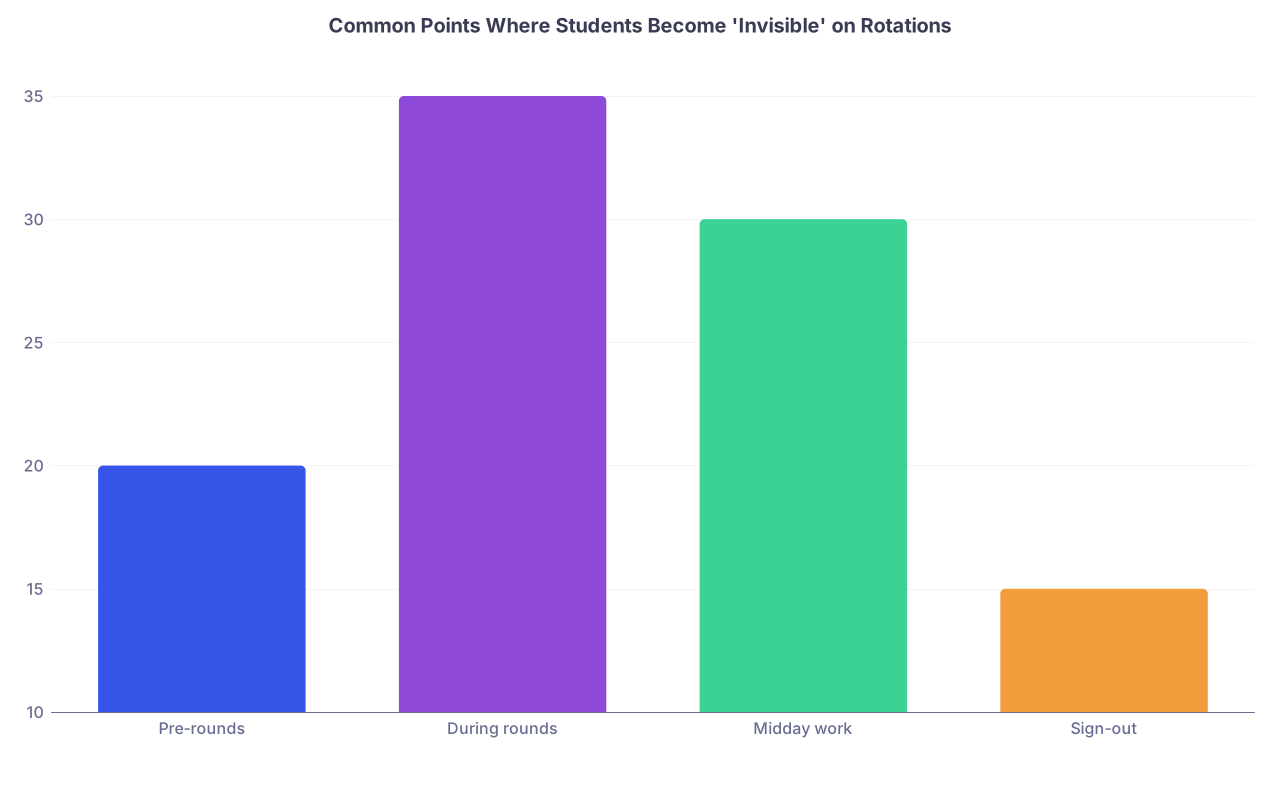
| Category | Value |
|---|---|
| Pre-rounds | 20 |
| During rounds | 35 |
| Midday work | 30 |
| Sign-out | 15 |
This is where you focus your strategy: the middle of the day is where most students quietly vanish into the computer. You will not.
FAQs
1. What if I am introverted and hate “putting myself out there”?
Being included on service is not about being an extrovert. It is about being reliable and visible where it matters. You do not need to be the loudest voice. You need to:
- Show up early and prepared.
- Own a small number of patients or tasks completely.
- Speak briefly but clearly when it is your turn.
- Ask for feedback once or twice, not constantly.
Introverts often excel at this because they listen well, notice details, and follow through. If small talk drains you, skip it. Focus on being the student who always knows their patients and closes the loop on tasks. That earns more respect than forced enthusiasm.
2. How do I recover if I have already spent 1–2 weeks being invisible?
You do a mid-rotation reset. Tomorrow. No drama, no apologies tour, just a pivot:
- Have the 3-minute expectations talk with your senior resident:
- “I want to step up my contribution for the rest of the rotation. Can we clarify what I can own from here on out?”
- Take on 2–3 patients and treat them like your job depends on it.
- Ask one attending or senior for specific feedback:
- “What is one thing I can change this week to finish stronger?”
- Start giving concise updates and closing the loop daily.
Will it erase a weak first week? Maybe not entirely. But clinical evaluations are heavily weighted toward what you do in the second half of a rotation. People remember the most recent version of you. Give them a better one.
Key points to remember: clarify your role early, own something concrete every day, and make your effort visible through reliable follow-through and brief, focused communication.