
You will absolutely screw up socially with an attending at some point. The difference between students who recover and students who get quietly blacklisted is how they repair it.
This is fixable. Almost always. But you have to stop doing what most students do: pretending it did not happen, spiraling internally, and hoping the evaluation will somehow be fair anyway.
I am going to walk you through exactly how to repair things after an awkward misstep with your attending — whether you misspoke, overstepped, contradicted them in front of the team, or just had a weird, tense moment that will not leave your brain.
Step 1: Diagnose What Actually Went Wrong (Not What You Fear Went Wrong)
Most students confuse three things:
- What objectively happened
- What the attending likely perceived
- The catastrophic version running in their head at 2:00 a.m.
You cannot fix number 3. You fix number 1 and number 2.
Start with a brutally concrete replay of the event. Write it down if you have to. One paragraph. No drama.
- Where were you? (rounds, OR, clinic, hallway)
- Who was present? (just you and attending vs entire team vs patient)
- Exact words or actions you did that felt off
- Immediate visible response from the attending (face, voice, body, what they did next)
Then classify the misstep. Most “disasters” fall into one of these buckets:
| Misstep Type | Typical Risk Level |
|---|---|
| Professional boundary | High |
| Patient safety / error | High |
| Public contradiction | Medium–High |
| Tone / attitude issue | Medium |
| Overstepping role | Medium |
| Socially awkward comment | Low–Medium |
Reality check:
- High risk: needs rapid, direct repair and sometimes faculty involvement
- Medium: repairable with a thoughtful conversation
- Low: usually solvable with one clean, concise apology and consistent good behavior
Do not treat a slightly blunt answer the same way you would treat violating patient confidentiality. If you pathologize everything, you will paralyze yourself and then actually perform worse.
Ask yourself three questions:
- Did I undermine the attending’s authority in front of others?
- Did I in any way compromise patient safety, privacy, or trust?
- Did I show disrespect (even unintentionally) toward anyone: attending, staff, patient, or team?
If you hit “yes” on 2 → that is the priority problem.
If you hit “yes” on 1 or 3 → still serious for your relationship and evals, but fixable with communication.
Step 2: Stabilize the Situation in the Moment
You usually have a tiny window right after the misstep to prevent it from metastasizing.
You do not need a TED Talk apology on rounds. You need one or two sane sentences.
If it happens in front of the team or patient
Use a short, clean response right away:
- “You are right, I misspoke there.”
- “Sorry, I should not have said it that way.”
- “Let me correct that — I was mistaken.”
Notice what is not there: long explanations, excuses, blaming “nerves” or the EMR.
Your goal in the moment:
- Acknowledge the error
- Stop the damage (clinical, social, or professional)
- Signal that you are not defensive
Once the moment passes, do not keep revisiting it in front of everyone. You will make it bigger.
If it involves potential patient harm
Different category. You deal with it now.
- Speak up: “I realize I might have contributed to [X] — should we recheck [lab/order/med]?”
- If the attending brushes it off but you are still concerned, loop in the resident or senior. Quietly, but clearly.
This is not about your ego. This is about safety. Most attendings will forgive almost anything if you are honest and prioritize the patient.
Step 3: Decide: Do You Need a Private Repair Conversation?
Here is the rule:
- If the misstep was minor and handled quickly in the moment (e.g., awkward phrasing, small knowledge error you corrected), you do not need a separate formal “meeting.”
- If it involved disrespect, contradiction in front of others, major awkwardness, or unresolved tension, you do.
Err slightly on the side of having the conversation. I have seen more students punished for silence than for owning something.
Look for these signs you need a 1:1 repair:
- Attending’s tone with you abruptly changed afterward
- You notice them excluding you from teaching, eye contact, or questions
- They made a comment like, “We can talk about this later,” and you never followed up
- You cannot stop replaying it because it feels unfinished
If two or more of those are true, schedule a brief check-in.
Step 4: The Repair Conversation – Script and Structure
Most students botch this conversation in one of two ways:
- They never have it.
- They turn it into a dramatic confession, over-share, and make the attending uncomfortable.
You want something in between: direct, short, respectful, and focused.
Timing and setup
Ask for a quick moment outside the chaos of rounds:
- Right after rounds: “Dr. Smith, do you have two minutes later today or now for a quick check-in about something from this morning?”
- In clinic between patients: “Dr. Lee, could I grab you for a quick moment before we finish today?”
Do not ambush them on the way to the bathroom. Ask, then wait for them to pick the time. That small act of respect already starts repairing power dynamics.
Use a 4-part structure
Keep it under three minutes unless they choose to extend it.
1. Name the event concretely
“Yesterday on rounds when I contradicted your plan in front of the team…”
2. Own your part without qualification
“I realize that came across as disrespectful and out of line for my role.”
3. State what you are changing
“I am working on pausing, asking clarifying questions, and sharing concerns one-on-one instead of during presentations.”
4. Invite brief feedback, then stop talking
“I value learning from you on this rotation, and I do not want this to get in the way. Is there anything specific you would like me to do differently?”
Then shut up. Let the silence hang. They will fill it.
Here is the key:
- Do not cry if you can possibly help it. If you do, stay. Regulate. Finish the conversation.
- Do not over-confess your entire impostor syndrome history.
- Do not blame others: the resident, another attending, Epic, “stress,” your upbringing.
You will be judged on how you handle this conversation at least as much as on the original mistake.
Step 5: Tailor Your Repair to the Type of Misstep
Different problems require different fixes. Let us get specific.
1. You contradicted or corrected your attending publicly
Example: On rounds, you said, “Actually, that is not what UpToDate says,” in front of the whole team.
Problem: You challenged their authority in a public setting. Even if you were clinically correct, the way you did it created friction.
Repair:
- Immediate: “I should have asked that more respectfully, sorry.”
- Later 1:1: “I realize my tone this morning when I brought up the guideline may have sounded like I was challenging you instead of asking a question. That was not my intent, and I am working on how I phrase things on rounds.”
Then adjust your future behavior:
- Convert “Actually, that is wrong” to “Can I ask a clarifying question about [X]? I thought [guideline] suggested [Y]; I might be misunderstanding.”
- Defer to the attending’s clinical judgment after asking the question. Once. Not three times.
Most attendings are fine being questioned. They hate being publicly undermined by someone they are supposed to be evaluating.
2. You sounded dismissive, annoyed, or checked-out
Example: They ask you to read on something and you say, “Yeah, I know,” or you roll your eyes, sigh, or answer with one-word grunt responses.
Problem: You are signaling disrespect and low teachability.
Repair:
- 1:1: “I realized after rounds that my responses to your questions were coming across as short and probably disinterested. That is not how I feel about the rotation, and I apologize. I am working on being more deliberate about how I respond even when I am stressed.”
Future behavior change:
- Make eye contact when they teach.
- Ask one genuine follow-up question per teaching moment. Not fake, not forced, just one.
- If you are exhausted, say it once, before you act out: “I am a bit fried today, but I am glad to be here and will do my best.”
Most attendings will give you a lot of grace if they see insight and effort.
3. You overstepped your role (orders, procedures, patient discussions)
Example: You adjusted medications in the EMR under a cosign without explicitly discussing, or you consented a patient without understanding the procedure.
This is where you absolutely must be direct.
Repair steps:
- Immediately inform the responsible resident/attending about what you did.
- Spell out exactly where your knowledge/procedural gap was.
- Own it: “I crossed a line in terms of my role as a medical student. I am sorry and I understand why that was not appropriate.”
Then request structure:
- “Can we clarify which tasks you are comfortable with me doing independently, what should always be run by you, and what is off limits for students?”
Attendings care deeply about role boundaries. They do not want to feel like they have to babysit someone reckless. Showing that you understand this — and will be conservative from here on — is how you rebuild trust.
4. You made a socially awkward or inappropriate comment
This ranges from a clumsy joke that landed wrong to something that brushed against gender, race, culture, or politics.
Do not gaslight yourself here. If it felt off and the room went quiet, you probably need to fix it.
Repair formula:
- “During [situation], I made a comment about [X].
I realized afterward that it could have come across as [insensitive / inappropriate].
I am sorry for that. I am working on being more thoughtful about my wording.
I appreciate you letting me know if something I say is off.”
Do not say, “I did not mean it that way.” That line is poison. They do not care if you meant it. They care that you realized it, own it, and change.
If the comment was truly over the line (sexual, racist, etc.), you may need to:
- Apologize to anyone present who was directly affected
- Accept that this will be documented
- Show consistent, humble behavior improvement for the rest of the rotation
You can still recover professionally. But not if you minimize it.
5. You had a tense disagreement about a clinical plan
Sometimes the attending is just… wrong. Or doing something you think is outdated.
You tried to point it out, it got tense, and now the air feels heavy.
Repair strategy:
- 1:1: “About our discussion on [X] earlier — I appreciate you walking through your reasoning. I realize I came in a bit strong with my viewpoint. Thanks for letting me engage in that discussion; I am here to learn how you think through these decisions.”
Then change your stance from “debate opponent” to “apprentice”:
- Less: “But guideline Y says…”
- More: “I read guideline Y that suggests [option]. How do you think about that versus your approach in practice?”
Most attendings will love that question. You are validating their experience while still being evidence-based. That is how grown-ups debate.
Step 6: Fix the Pattern, Not Just the Incident
One apology does not mean anything if your behavior does not change. Attendings watch patterns. They are used to seeing students be perfect for 48 hours after a feedback session, then slip back.
Think in terms of a 1–2 week consistency window.
Pick one or two target behaviors based on your misstep type:
- If you were disrespectful → focus on tone, eye contact, and response style
- If you overstepped → focus on asking before acting, double-checking with the team
- If you seemed disinterested → focus on showing visible engagement and follow-through
Track yourself:
- At the end of each day, write down one moment you handled better than you would have a week ago.
- If you are unsure whether the attending sees the change, you can ask after a few days:
“You gave me feedback last week about [X]. I have been working on [specific behavior]. Does that feel different on your end?”
Yes, this is uncomfortable. It also signals maturity and self-directed learning. Faculty remember that.
Step 7: Know When to Escalate or Get Backup
Sometimes you did your part correctly — and the attending is still cold, punitive, or vindictive. Or the situation involved something serious where you want a record of your attempt to fix it.
That is when you stop suffering alone and get help.
Who you can talk to
- Clerkship director
- Site director
- Trusted faculty mentor not on this rotation
- Dean of students / student affairs
- Chief resident (if the issue is triangular with residents and attendings)
When you reach out, use a calm, factual summary:
- “I wanted your guidance about a situation on my current rotation. I made [specific misstep], I did [specific repair actions], but the relationship still feels strained and I am concerned about my evaluation and the learning environment.”
Bring:
- Timeline of events
- What you said and did to repair
- Any written feedback or emails that show the pattern
You are not asking them to “fix” the attending. You are asking for guidance, documentation, and sometimes mediation.
Do not wait until the last week of the rotation to do this. By then, your eval is probably already written.
Step 8: Protect Your Future Evals After a Rough Start
You can absolutely salvage a rotation that started badly. I have seen students go from “Probably will fail” week 1 to “High Pass” or even “Honors” by week 4 because they handled the repair process like an adult.
Tactics:
Over-communicate your learning goals
“I know we had that rough moment earlier this week. My goals for the rest of the rotation are to [X, Y, Z]. If there are opportunities for me to demonstrate improvement, I would appreciate it.”
Request mid-rotation feedback explicitly
Not the vague, “How am I doing?”
Use: “Are there one or two specific things I can focus on over the next week to improve my final evaluation?”Then do those things. Visibly.
Ask for written feedback early
Some schools have formal mid-rotation forms. If yours does not, you can ask for a short email.
“Would you mind putting a brief comment in writing so I can track my progress? It helps me know what to focus on.”
A surprising number of attendings will soften during this process. They see you taking responsibility, they see growth, and it actually becomes a positive narrative in their minds: “This student took feedback seriously and improved significantly over the rotation.”
To them, that is better than the student who was “perfect” and never challenged.
Step 9: Learn How to Avoid the Most Common Missteps
You will not avoid all awkwardness. But you can stop stepping on the same landmines over and over.
Here are the recurring patterns I see on rotations:
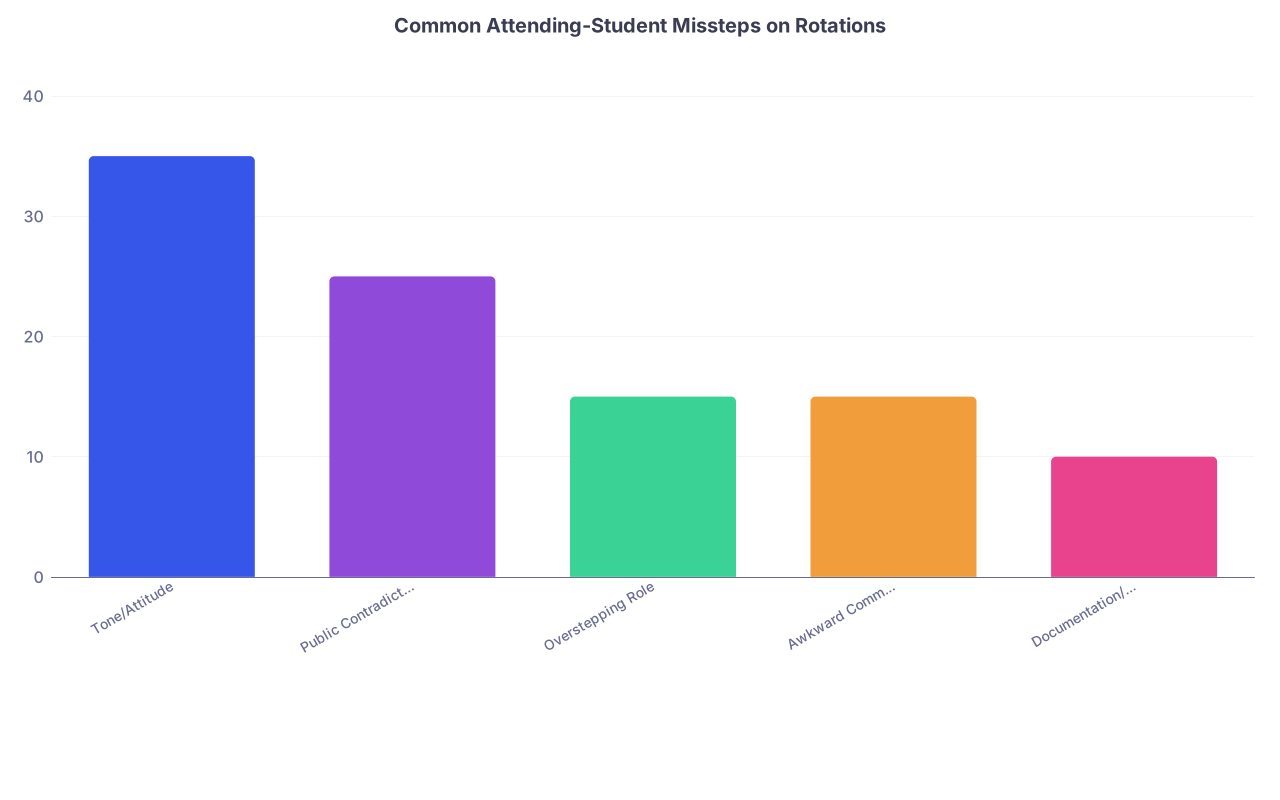
| Category | Value |
|---|---|
| Tone/Attitude | 35 |
| Public Contradiction | 25 |
| Overstepping Role | 15 |
| Awkward Comment | 15 |
| Documentation/Orders | 10 |
Brief prevention rules:
Never correct an attending in front of a patient.
If you are worried they are missing something dangerous, ask for a private word:
“Dr. X, could I ask you something quickly outside the room?”Do not touch the order button without explicit permission.
I do not care what your last rotation allowed. Ask:
“For orders and notes, what are you comfortable with me entering independently, and what should I always run by you first?”Assume everything you say on rounds is professional speech.
Jokes, sarcasm, complaints about other services — skip them. It is not worth it.Treat nurses, staff, and residents with visible respect.
Attendings watch how you treat people with less power than them. It weighs heavily on evals.Use “I” statements sparingly around strong emotion.
“I feel like surgery hates us” is not helpful.
“I am struggling to balance getting my notes done and reading on my patients; could we talk about priorities?” is.
Step 10: Accept That Discomfort Is Part of Growing Up Clinically
Here is the harsh truth: you cannot become a competent physician without occasionally deeply embarrassing yourself in front of someone more senior.
You will:
- Present a plan that is wildly off base
- Make a joke that lands like a rock
- Misread an attending’s personality and overshare
- Freeze during pimping and say something incoherent
What makes you a professional is not perfect performance. It is how you handle repair.
Let yourself feel the discomfort. Then translate it into action:
- Name the misstep accurately
- Own what is yours
- Have the uncomfortable conversation
- Change your behavior consistently
- Get help if the environment turns toxic or punitive
That is the whole game.

| Step | Description |
|---|---|
| Step 1 | Misstep with Attending |
| Step 2 | Assess Severity |
| Step 3 | Brief in-the-moment acknowledgment |
| Step 4 | Plan 1:1 repair conversation |
| Step 5 | Behavior change next 1-2 weeks |
| Step 6 | Use 4-part repair script |
| Step 7 | Request targeted feedback |
| Step 8 | Maintain pattern & finish rotation strong |
| Step 9 | Escalate to clerkship director/mentor |
| Step 10 | Relationship improving? |

What Actually Matters Most
If you remember nothing else:
- Silence kills relationships faster than mistakes do. A short, direct repair conversation beats months of awkwardness and a terrible eval.
- Attendings judge you more on your response to conflict than on the conflict itself. Ownership + visible improvement is the winning formula.
- You are allowed to ask for help. When you have tried to repair and it is still bad, bring in the clerkship director or a mentor early, not after the rotation ends.
You will misstep. Repair it cleanly, learn the pattern, move on.