
The way you present a case on rounds is being used to decide if they would ever trust you with their patients.
Not your grade. Not your “participation.” Your residency potential.
Let me walk you through how this really works, because nobody is honest with students about it.
What Attendings Really Hear When You Present
Everyone tells you case presentations are about “organizing information” and “communicating clearly.” That’s the brochure version.
On the other side of the table, here’s what’s actually going through a program director’s or seasoned attending’s head while you talk:
- Can this person think like a PGY‑1 in six months?
- Will I feel safe when this person calls me at 2 a.m.?
- Will this person embarrass my program on rounds, consults, or in the ED?
They’re not consciously scoring every sentence, but they are making fast, global judgments about your future reliability based on a 3–5 minute performance repeated over a few weeks.
And they absolutely talk about it when they write your MSPE and letters.
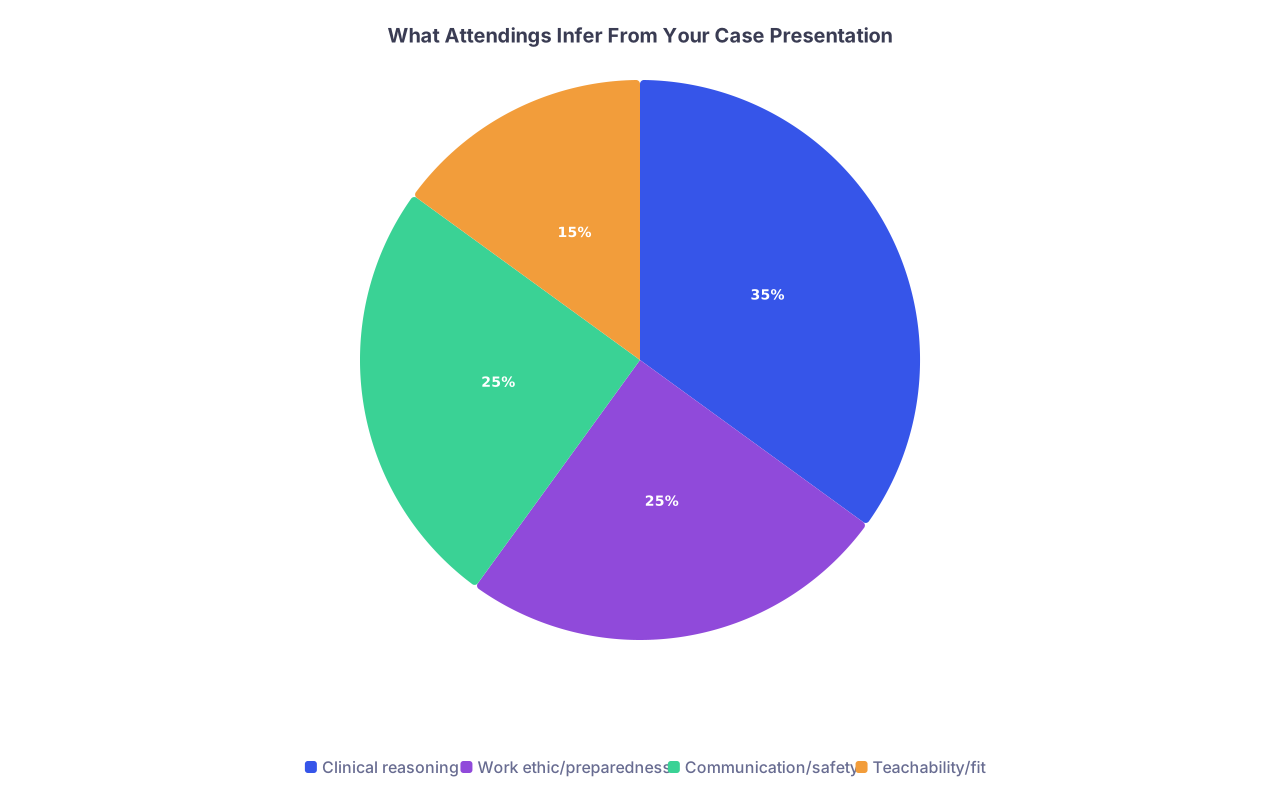
| Category | Value |
|---|---|
| Clinical reasoning | 35 |
| Work ethic/preparedness | 25 |
| Communication/safety | 25 |
| Teachability/fit | 15 |
Notice what’s missing? “Raw intelligence.” No one cares how smart you say you are if your presentation doesn’t show it where it counts.
Let me translate how your presentation style maps, in their minds, to residency potential.
The Hidden Rubric: How Your Presentation Becomes a Residency Prediction
No one hands this to you, but most academic clinicians are running some version of this quiet rubric during your rotation.
| What You Do In Presentation | What They Conclude About You As Resident |
|---|---|
| Clear, prioritized HPI | Can triage and recognize sick vs stable |
| Focused, problem-based A/P | Has an intern-level reasoning framework |
| Knows overnight events cold | Reliable, does pre-round work, prepared |
| Admits uncertainty + plan | Safe, knows limits, teachable |
| Disorganized, rambles | Will struggle on call, poor time use |
You think you’re “just presenting.” They think they’re seeing a preview of you on July 1 of your intern year.
1. Structure = Can This Person Handle Intern-Level Work?
If your presentation is:
- Meandering
- Chronologic without prioritization
- Full of trivia but missing the actual problem
they don’t just think “this student doesn’t present well.” They think “this student will drown on medicine wards as an intern.”
I’ve watched this very explicitly. At a big academic IM program, one attending said after rounds (about a student thinking of applying to IM):
“He’s bright, but if that’s his best structured presentation at the end of the rotation, he’s going to need a very supportive program. I wouldn’t rank him high here.”
Translation: Presentations were the proxy for how he’d function when he had to see 8–10 patients before 8 a.m.
By contrast, a student who gives:
- One-line summary that actually captures acuity and key problems
- Focused HPI tailored to the active issues
- Problem-based assessment and plan
gets tagged mentally as: “functions above level,” “could be an intern soon,” “safe to give more autonomy.”
Those phrases show up in your evaluations. Program directors read them. Carefully.
2. Level of Detail = Are You Safe With Real Patients?
Here’s a dirty little secret: attendings are constantly looking for safety signals during your presentations.
They listen for:
- Do you mention vitals that actually matter for the problem?
- Do you casually breeze past red flags?
- Do you notice a new oxygen requirement or mental status change?
When you present a COPD patient and you say:
“Overnight was fine, no acute events. Vitals were stable.”
and then they go look and see the patient was on 2L yesterday and is now on 4L with RR 24, that’s not just “sloppy.” That’s a safety concern in their mind.
I’ve heard comments like:
“If she doesn’t catch that as a student when she only has two patients, what happens with ten as an intern?”
Your attention to key trends (vitals, I/Os, weight, labs) is them testing: “Will I be woken up for the right reasons, or not woken when I should be?”
What Different People on the Team Are Really Judging
You’re not being evaluated by a single brain. You’re being triangulated.

| Step | Description |
|---|---|
| Step 1 | Student Presents Case |
| Step 2 | Attending |
| Step 3 | Senior Resident |
| Step 4 | Intern |
| Step 5 | Writes Formal Eval |
| Step 6 | Informal Feedback to Attending |
| Step 7 | Backchannel Comments |
Each of them cares about something slightly different, but together they build your “residency potential” profile.
Attendings: “Would I hire this person as my intern?”
Attendings tend to judge:
- Clinical reasoning: Can you explain why you think it’s CHF exacerbation and not pneumonia?
- Big-picture organization: Does your assessment and plan show that you can prioritize problems?
- Professionalism: Are you prepared, on time, not making excuses?
One cardiology attending I know keeps a notebook where he literally writes one summary line about each student at the end of the rotation. I’ve seen entries like:
- “Presents like a rising intern already. Good.”
- “Pleasant but shallow reasoning, would not want on a heavy service.”
- “Slow but careful, will be fine with time, good attitude.”
Those one-liners end up in MSPE language or letters. Things like “ready to function as an intern” or the more damning “will benefit from close supervision early in residency.”
Residents: “Will this person make my life easier or harder?”
Seniors and interns are blunt. They’re listening for:
- Can you get to the point, because they have six more notes to write?
- Do you understand the plan, or will they have to explain it twice daily?
- Do you catch overnight events, or will they get blindsided by the attending’s questions?
Behind closed doors, I’ve heard residents say:
“She presents like she’s already a sub‑I. I’d be happy to have her as my intern next year.”
versus
“He’s nice, but he doesn’t seem to have any filter of what’s important. If he matches here, he’s going to struggle hard.”
Those comments often get relayed when attendings ask: “So what do you think of the student? How are they on presentations and follow-through?”
You’re not in the room for that part.
The Three Presentations That Quietly Make or Break You
Not all presentations are weighted equally. Some are watched much more closely and absolutely color how they see your residency potential.
, Mid-rotation complex case, Last week summary, Random daily updates](https://cdn.residencyadvisor.com/images/articles_svg/chart-relative-weight-of-different-presentation-moments-4155.svg "Relative Weight of Different Presentation Moments")
| Category | Value |
|---|---|
| [First full case](https://residencyadvisor.com/resources/clinical-rotations-success/what-chiefs-notice-about-you-in-the-first-48-hours-of-a-rotation) | 30 |
| Mid-rotation complex case | 35 |
| Last week summary | 25 |
| Random daily updates | 10 |
1. Your First Real Full Case: “What’s their baseline?”
That first time you present a full new patient, people are calibrating.
They’re not expecting perfection. They’re asking:
- How much polishing will this person need?
- Is this raw but promising, or fundamentally disorganized?
- Do they understand the language of medicine yet?
If you walk in with a printout and read the HPI line-by-line, they’ll mentally put you in the “immature, needs heavy coaching” bucket. Not fatal, but that’s your starting point.
If you walk in, give a clean one-liner, then a focused story, then a problem-based A/P, they start thinking “potential rising star.”
2. The First Time You Present a Complex or “Sick” Patient
This is the big one.
The first septic, crashing, or diagnostically messy patient you present? That’s when they really lean in.
Here they’re judging:
- Can you separate noise from signal?
- Do you understand severity and urgency?
- Do you have a provisional diagnosis and differential that makes sense?
If you present a GI bleeder like:
“This is a 68-year-old male with a history of CAD, HTN, and diabetes who presents with three days of melena and…”
and you drone on for three minutes before mentioning the hemoglobin is 5.8 and he’s tachycardic, that’s a problem.
They’ll think: “This student does not feel acuity. Dangerous if that persists.”
Contrast that with:
“This is a 68-year-old male with CAD and HTN who presented last night with an upper GI bleed, now hemodynamically stable after 2 units PRBC, Hgb up from 5.8 to 8.2, and scoped this morning with confirmed bleeding duodenal ulcer. The main issues today are monitoring for re-bleed, optimizing secondary prevention, and reassessing his anticoagulation strategy.”
Suddenly, they see: “This person thinks in structure. That’s intern-level framing.”
3. Your Last-Week Presentations: “Trajectory check”
They absolutely notice whether you improved.
A student who starts rough but shows:
- Cleaner one-liners
- More focused HPIs
- Stronger, prioritized A/P
gets labeled as “teachable, steep learning curve.” Programs love that. Everyone would rather have a teachable grinder than a “naturally good” student who doesn’t evolve.
But if your last-week presentation sounds almost identical to week one? That often becomes:
“Limited insight, doesn’t incorporate feedback.”
And that is death in competitive specialties.
Subtle Presentation Habits That Scream “Future Intern” (Or Don’t)
Let’s get specific. Here’s what faculty and residents quietly love—and what makes them nervous.

Habits that make them think “I’d trust this person in July”
You lead with the right one-liner.
Not “69-year-old female with PMH of everything presenting with multiple complaints.”
But: “69-year-old woman with poorly controlled CHF and CKD, admitted with acute decompensated heart failure now improving on IV diuresis.”You know the overnight story cold without being prompted.
You walk in: “Overnight she had one episode of chest discomfort, troponin was checked and stable, EKG unchanged. Vitals otherwise stable, net negative 1.5L.”
That’s intern energy. It signals you prepped like you were responsible, not just observing.You anticipate the obvious questions.
When you present a pneumonia patient and already have answers to “What’s their CURB‑65?” or “Have cultures grown yet?” you’re showing you’re already learning to think the way they need you to as a resident.You say “I’m not sure, but I thought about X vs Y.”
That phrase tells them you have a framework, you’re honest about limits, and you’re not going to hide ignorance on call. That matters more than being right on every detail.Your A/P reads like a real intern note.
Doesn’t have to be perfect. But: problem list, assessment with reasoning, then explicit plan. Not just “continue to monitor” for everything.
Habits that quietly kill your residency credibility
You sound like you copy-pasted the chart.
If your HPI is just the ED note with some filler, they’ll assume you didn’t actually synthesize anything. Interns can’t function like that.You never commit to a primary diagnosis.
Saying “could be a lot of things” every time doesn’t make you thoughtful. It makes you look unready to decide. Residents must decide.You’re always “surprised” by new info.
If the attending says, “You know the potassium is 2.9 today, right?” and you don’t—more than once—that’s a pattern. Their conclusion: “I cannot trust this person to own their patients.”Your plan is generic and passive.
If your answer to every problem is “monitor” or “continue current management,” you look like a scribe, not a budding physician.You crumble the moment you’re questioned.
Being wrong is fine. Falling apart, getting defensive, or completely losing the thread tells them you will not cope well under real residency pressure.
How This Shows Up In Your Letters and MSPE
You won’t see “case presentations” written in giant letters on your dean’s letter. But the code language is there.
Here’s how faculty often translate your presentation performance into formal comments:
| How You Actually Performed | What Ends Up Written |
|---|---|
| Strong, intern-level structuring | "Ready to function at the level of an intern" |
| Solid but inconsistent | "Performs at or above level, benefits from guidance" |
| Disorganized, never improved | "Will require close supervision early on" |
| Good reasoning, asks for help appropriately | "Demonstrates sound judgment and insight" |
| Misses key safety issues | "Needs continued development in clinical prioritization" |
Program directors know these phrases. They can smell the subtext. A letter that says:
“By the end of the rotation, she presented cases with the clarity and structure of a strong intern.”
is a massive plus.
A letter that says:
“He is pleasant to work with and grateful for feedback.”
with nothing about clinical reasoning or presentation evolution? That’s code for: “Nice kid, not clinically impressive.”
What You Should Actually Be Practicing (That No One Assigns You)
No one builds a curriculum around this, but they should. So let me give you what I’ve seen work for students who later crushed residency.

Rehearse like you’re already a PGY‑1
You shouldn’t be reading your presentation off the paper. Interns don’t have time for that. Use notes, sure—but practice delivering in sense units, not sentences.
The strongest students I’ve seen:
- Jot a one-liner at the top of their sign-out or note.
- List problems and 2–3 bullets per problem.
- Then practice presenting out loud in the workroom, once, before rounds.
They sound like interns because they prepare like interns.
After rounds, debrief one thing, not everything
Instead of “How can I improve?” ask your resident:
“Can I run my last presentation by you—how would you reframe the one-liner and the plan?”
You’ll get concrete feedback like:
- “Shorten the PMH, emphasize why they’re here today.”
- “Group all the vascular risk factors, then jump straight to the stroke workup and plan.”
- “Move the EKG and imaging into your assessment instead of the HPI.”
Then apply that the next day. The attendings and residents will absolutely notice you adjusted. That’s the teachability they want in a resident.
What This Looks Like Over a Career
You’re not just learning how to talk in front of a team. You’re building the skill you’ll use:
- Presenting to consulting services who will judge whether to take your patient seriously.
- Presenting to ICU attendings who decide if they’ll accept your transfer.
- Presenting on tumor board where subspecialists decide on a care plan based partly on your clarity.
The evaluation does not stop after third year. It just gets less explicit.
Right now, during rotations, you actually get a chance to grow with supervision and relative safety. If you choose to treat presentations as a box-checking exercise, you’ll still learn medicine. But you’ll miss the fastest lever you have to shape how faculty picture you in a white coat with an MD and pager.
Years from now, you won’t remember the exact wording of your HPI on that GI bleeder. You will remember which attendings started talking to you like a future colleague instead of a student. That shift often starts with one thing:
The day your case presentation finally sounded like a resident’s.