Your presentations are hurting you more than your missing facts.
On clinical rotations, students get this backwards all the time. They obsess over memorizing differentials and drug doses, then casually wing the one thing attendings actually use to judge them day after day: how they present a patient.
I have seen strong test-takers get “average” or even “below expectations” evals not because they were clueless, but because their presentations screamed:
- Disorganized
- Unprepared
- Not safe to trust
And yes, attendings will write that between cases while you are in the next room seeing your third “chest pain” of the morning.
Let me walk through the quiet presentation habits that are sabotaging you—and exactly what to do instead.
1. The “Data Dump” Presentation
This is the classic early-clerkship mistake: you think more information equals better presentation. It does not. It just shows you do not understand what matters.
What it looks like:
- Reading the chart out loud in chronological order
- Listing every lab and every imaging finding from the last 5 years
- Reciting the entire medication list including multivitamins and PRN Tylenol in the same tone as vasopressors
The red flag phrases I hear:
- “Umm, then they had… and before that… and also back in 2019…”
- “Labs… there are a lot of them…”
- “Imaging… the CT showed… I am just going to read the impression…”
This kills your evaluation because:
- It signals poor clinical reasoning.
- It wastes everyone’s time on rounds.
- It forces the attending to dig for what matters, which makes you look like dead weight for the team.
Fix it fast:
- Decide the “story” first: Why is this patient in the hospital today? Anchor everything around that.
- Prioritize problems: CKD and mild anemia are background, acute GI bleed is foreground. Present like you know the difference.
- Summarize nonessential history:
- Right: “Significant PMH: T2DM, HTN, CKD3, prior NSTEMI 2019, no known strokes or malignancy.”
- Wrong: “In 2019 they had an NSTEMI and were hospitalized for 6 days, then in 2020 their A1c was 8.2 and…”
If your attending has to mentally filter your presentation to find the single important issue, you are already losing points.
2. Presenting Like You Are Reading a Script
Some students sound like an EMR note came to life. Same order. Same phrasing. Zero judgment.
You know you are doing this when:
- You never look up from your notes
- You say everything with the same flat importance
- You get visibly lost if someone interrupts or asks a question mid-presentation
Here is how that lands with evaluators:
- “Does not seem to understand what they are saying”
- “Relies on notes, cannot adapt”
- “Limited clinical reasoning”
That is harsh, but fair. Because in real clinical work, no one is going to let you read a monologue. You will be interrupted constantly—by questions, by pages, by the patient coding.
Do not make this mistake:
- Writing your entire presentation word-for-word
- Trying to memorize it exactly and panicking if you lose your place
- Hiding behind your iPad or folded paper like a shield
Better habit:
- Use skeletal notes: headings + key numbers, not sentences
- Practice out loud before rounds—twice if you are new or anxious
- Know your opening, your problem list, and your plan cold; the details you can glance down for
That small shift—from script to structured outline—changes how your attending perceives you: from passive reporter to thinking trainee.
3. Burying the Lead (aka Hiding Critical Information)
Nothing tanks trust faster than this one.
Scenario I have seen too many times:
- Student: “24-year-old female with history of asthma admitted for shortness of breath…”
- Long, meandering HPI
- At the very end: “Oh, and overnight she desaturated to 80% on room air, was placed on 4L, and needed one dose of duoneb.”
You buried the lead. You hid the most important clinical event in a pile of trivia.
To an attending, this reads as unsafe. Not “inexperienced.” Unsafe.
Other common “buried lead” disasters:
- Mentioning a new fever halfway through your ROS
- Slipping an “Oh, her troponin is now 5.2” into your labs after the CBC
- Mentioning suicidal ideation after presenting depression, like it is an afterthought
You must front-load:
- New vitals instability
- New chest pain, SOB, neuro deficits, mental status changes
- Any suicidal/homicidal ideation
- Any major abnormal lab/imaging change from prior day
When presenting a follow-up:
- Start with overnight events: “Overnight, the patient developed X; now they are Y.”
- Then updated vitals.
- Then targeted HPI for the problem.
If you are sitting on a bombshell piece of clinical information while calmly reading through the allergy list, you are telling everyone you do not understand acuity.
4. Ignoring the One Person You Are Talking To
You are presenting to the attending. Not the wall. Not the computer. Not your notebook.
One of the fastest ways to quietly damage your eval is terrible audience awareness.
How it shows up:
- You stand with your back half-turned to the attending, talking to the EMR
- You never check if they are following or need clarification
- You just plow through while they are clearly scanning the labs or answering a text
The attending is subconsciously grading:
- Can this person communicate with colleagues?
- Do they read the room?
- Would I want them presenting in front of patients and consultants?
Here is what not to do:
- Deliver your rehearsed monologue at full speed no matter what happens
- Ignore mid-presentation cues like “hold on, what were the vitals?”
- Talk to the computer as if the computer will write your eval
Better pattern:
- Start facing the attending, not the monitor
- Have brief, confident eye contact during your summary and assessment
- Pause after key sections: “Vitals were… Labs showed… [Pause 1 second]”
You are not on stage. You are in a conversation. Your presentation should sound like the start of a team discussion, not like you are defending your thesis.
5. Being Vague, Hand-Wavy, or “I Think It Was Okay-ish”
Attendings hate guessing. Vague language forces them to do exactly that.
The vague-presentation habits that quietly wreck you:
- “Vitals were stable overnight” (What does that mean? Numbers.)
- “Labs were unremarkable” (Which labs? What did you check?)
- “Neuro exam was non-focal” (What did you actually examine?)
- “The CT was fine” (Normal? Stable? No acute process?)
This makes you sound lazy or out of your depth—even if you are not.
Instead, precision:
- Vitals: “Afebrile, BP ranged 120–140/70–85, HR 80–95, sat 96–99% on 2L.”
- Labs: “No leukocytosis, WBC 7.2 from 7.5, Hgb stable at 9.8 from 9.7, Cr 1.4 from 1.2.”
- Imaging: “CXR this morning: no new consolidation, mild pulmonary vascular congestion unchanged from prior.”
You do not need to read every number, but you must prove you looked and understood trends.
Another quiet killer: “I think” used as a crutch for not knowing.
- “I think the echo was okay.”
- “I think his A1c was around 9.”
- “I think the creatinine was better.”
If you do not know, say you do not know—and that you checked or will check:
- “I do not recall the exact A1c, but I looked and it was elevated in the poorly-controlled range; I will pull the exact value now.”
That is honest and fixable. “I think it was okay” is neither.
6. Presenting Without a Clear Assessment and Plan
This one is brutal because it guarantees mediocre comments like “needs to work on clinical reasoning,” even if your factual knowledge is fine.
What it looks like:
- Strong HPI, solid exam, complete data
- Then… a shrug.
- “So… that is the patient.”
Or a half-hearted: “Assessment is shortness of breath, plan to continue current management.”
On a core rotation, a student who never attempts an assessment and plan looks uninterested or incapable of thinking like a physician.
Common mental trap: “I do not want to be wrong.”
Reality: Not attempting is worse than being wrong with a good thought process.
You must:
- Commit to a prioritized problem list (not a regurgitated PMH)
- For each active problem, give:
- What you think is going on (1–2 sentences)
- What you would do next (dx + tx steps)
Example difference:
- Weak: “Assessment: 65-year-old male with CHF exacerbation. Plan is to continue diuresis.”
- Strong: “Assessment: CHF exacerbation, likely from dietary indiscretion + medication non-adherence. Euvolemic clinically now but still requiring 2L. Plan: transition to oral furosemide at X mg, daily weights, strict I/Os, arrange heart failure follow-up before discharge, and re-educate on sodium and fluid restriction.”
Even if details are off, you are showing:
- You can synthesize
- You are thinking ahead
- You understand the goals of care
That is what attendings are grading.
7. Over- or Under-Shooting Detail by Context
Presentations are not one-size-fits-all. Another quiet killer is using the same style for:
- New patient vs. follow-up
- ICU vs. outpatient clinic
- Surgical vs. medicine rotation
The student mistake: not adjusting depth to context.
Signs you are doing this:
- Giving a full H&P on day 7 of a stable floor admission
- Spending 2 minutes on social history in the ED trauma bay
- Giving only a 10-second update on a crashing ICU patient
Think of it as a dial:
- New admit on medicine: longer HPI, full problem list, relevant deep dive
- POD#3 stable surgery patient: succinct overnight events, focused surgical issues, early discharge plan
- ICU: focused on hemodynamics, ventilation, active lines/drips, and major organ systems

If every presentation you do is 8 minutes long regardless of context, people will start cutting you off. Once they start cutting you off regularly, their eval language becomes predictable:
- “Needs to be more concise”
- “Presentations often too detailed and miss the main point”
You want: “Concise and focused.” So practice trimming your presentation differently for:
- New vs. follow-up
- Stable vs. unstable
- Clinic vs. inpatient
8. Failing to Track Trends and Trajectories
Clinical medicine is obsessed with trajectories, not snapshots.
Weak students present like this:
- “Creatinine is 2.0.”
- “Weight is 90 kg.”
- “Troponin is 0.4.”
Strong students present like this:
- “Creatinine 2.0, up from 1.2 on admission and 0.9 baseline last month.”
- “Weight 90 kg, up 3 kg from admission, with net positive 2L in last 24 hours.”
- “Troponin 0.4, down from a peak of 1.2, chest pain resolved.”
The mistake? Treating each number as free-floating.
Attendings listen for:
- Are you following the trend?
- Do you know if the patient is improving or worsening?
- Do you recognize early warning signs?
If you only report today’s values with no frame, you sound like the EMR, not a clinician.
Quick mental habit:
- For any lab or vital you mention, ask: “Compared to what?”
- Mention:
- Direction (up/down/stable)
- From what (yesterday, admission, baseline)
- Why it matters for your assessment
That shows deeper understanding with almost no extra time.
9. Not Owning Your Gaps (and Hiding Behind “I Didn’t See That”)
Almost every student will miss a piece of data or forget to ask something on exam. That is not what hurts your eval.
What hurts is:
- Getting defensive when asked
- Making excuses
- Pretending you know when you do not
Classic mistakes:
- “The nurse did not tell me that.”
- “It was not in the note.”
- “Nobody told me to check that.”
This makes you sound unreliable and immature. It shifts attention from “incomplete data” to “poor professionalism.”
Better response when you get called on something you missed:
- “I did not ask that specifically / I did not check that result. I will look it up now and update you after rounds.”
Then actually do it. Same day. Told back to the attending.

Attendings know you are still learning. They do not expect perfection. They do expect:
- Accountability
- Curiosity
- Follow-through
If instead they see deflection and excuses in your presentations, that absolutely bleeds into comments on your evaluations.
10. Sounding Disengaged, Disorganized, or Rushed
The last category is less about content and more about how you present. This is where many “average” evals are born.
Behaviors that silently drag your grade down:
- Talking too fast, mumbling, or trailing off
- Shuffling papers, scrolling endlessly while speaking
- Constant “um, like, uh, so yeah…” every 4 words
- Laughing nervously while discussing serious issues
- Showing up obviously underprepared and trying to wing it
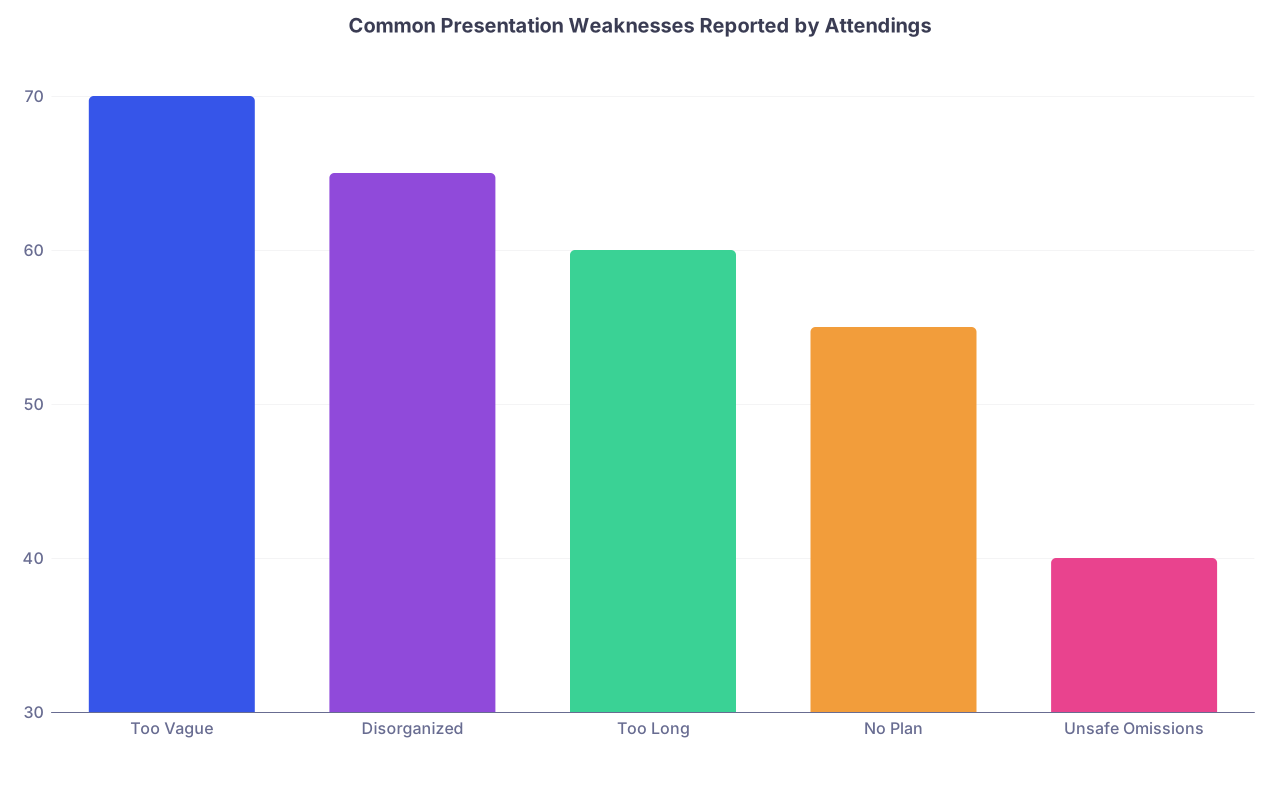
| Category | Value |
|---|---|
| Too Vague | 70 |
| Disorganized | 65 |
| Too Long | 60 |
| No Plan | 55 |
| Unsafe Omissions | 40 |
You do not need to be a charismatic public speaker. But you do need:
- Clear, audible speech
- Reasonable pacing
- Basic preparedness
Because the attending is using your presentation as a proxy for:
- Would I trust this person with my patients at 2 a.m.?
If you sound rushed and scattered at 9 a.m. with a full night’s sleep and notes in your hand, the answer becomes “no.”
Low-effort but high-yield fixes:
- Arrive 10–15 minutes earlier to organize your notes and mentally rehearse
- Write a simple structure at the top of your page: CC → HPI → Key PMH/meds → Overnight events → Vitals → Labs/Imaging → Assessment/Plan
- Time yourself once or twice; most follow-ups should be 2–3 minutes, not 7
Tiny preparation changes your entire vibe from “flailing” to “competent but junior.”
Quick Reference: Presentation Habits That Hurt vs Help
| Habit Type | Hurts You When It Looks Like… | Helps You When It Looks Like… |
|---|---|---|
| Information Volume | Long, unfocused data dumps | Prioritized, problem-focused details |
| Use of Notes | Reading word-for-word | Brief outline with confident eye contact |
| Critical Events | Mentioned late or casually | Front-loaded, clearly emphasized |
| Language Precision | “Stable”, “fine”, “unremarkable” only | Concrete numbers and clear trends |
| Assessment & Plan | Vague or missing entirely | Prioritized problems with specific next steps |
How to Practice Without Wasting Clinical Time
If you are serious about not making these mistakes, you cannot “practice” only on real rounds.
Use deliberate reps:
Solo practice with a timer
- Take 1 real patient from your day
- Time a full presentation: new admit (4–5 min), follow-up (2–3 min)
- Record yourself once a week; the filler words will horrify you—but you will improve
Peer practice after hours
- Swap a case with a classmate
- One presents, one interrupts with attending-style questions
- Force each other to front-load critical issues and state an assessment/plan
Template repetition
- Make one structure that you reuse on every rotation, adjusting depth
- Feedback from one attending gets built into your “default” shape

| Step | Description |
|---|---|
| Step 1 | Overnight Events |
| Step 2 | Vitals & I/Os |
| Step 3 | Focused Subjective |
| Step 4 | Focused Exam |
| Step 5 | Key Labs & Imaging Trends |
| Step 6 | Problem-based Assessment |
| Step 7 | Plan for Each Problem |
This is how you build reliable habits instead of reinventing your style every week.
Frequently Asked Questions
1. How long should my inpatient follow-up presentations be?
For most medicine or surgery floor patients, 2–3 minutes is ideal. If you consistently go beyond 4–5 minutes for stable follow-ups, you are almost certainly including extraneous details. New admissions may justifiably take 5–7 minutes, but even there, clarity and prioritization matter more than raw length.
2. What if my attending has a totally different preferred style?
They will. Many do. The mistake is resisting those preferences. Early in the rotation—or explicitly on day 1—ask, “How do you like presentations structured?” Then adapt. You can keep your core framework but reorder or emphasize sections to match their style. Flexibility actually boosts your evaluation; it shows you can adjust to team needs.
3. How do I handle being interrupted or corrected mid-presentation?
Do not fight it. Stop, listen, answer the question briefly, then smoothly resume at a logical point. The worst move is getting flustered and restarting from the top or arguing. If you are corrected, respond with a simple “Got it” or “Thank you,” adjust your understanding, and keep going. Attendings are usually testing whether you can think on your feet, not whether your monologue survives untouched.
The bottom line:
- Your presentations are not a recital of facts; they are a real-time demonstration of judgment, safety, and professionalism.
- Most students tank their evaluations not by ignorance, but by being disorganized, vague, or passive.
- Fix the habits above and your evals will quietly rise—even if your fund of knowledge has not changed much.