
Trying too hard on clinical rotations will quietly sink you faster than not trying hard enough.
Yes, you read that correctly.
The students who get destroyed on evaluations are not always the lazy ones. Often it is the visibly “gung-ho,” constantly-talking, over-prepared-for-the-wrong-things student who walks away with “Meets Expectations” and a stack of lukewarm comments. Or worse: the dreaded “would not want as intern.”
You think you are showing drive. Your team thinks you are exhausting.
Let me walk you through the traps I see over and over—and how to avoid blowing up your evals in the name of “enthusiasm.”
The Ugly Truth: What Residents Actually Penalize
You are graded on two things far more than anything else:
- How easy you are to work with.
- How safe and trustworthy you seem with patients.
Everything else—knowledge, pimp questions, your 40-page summary of CHF—comes after that.
The overeager trap is simple:
- You try to show how hard you are working.
- Instead of just doing the work, calmly, competently, and quietly.
Here is how this goes wrong in real life.
Red flags residents complain about behind your back
I have heard versions of these exact phrases in resident workrooms:
- “He is always talking. I cannot think.”
- “She keeps volunteering for everything but forgets basics on her own patients.”
- “He is trying to impress the attending, not help the team.”
- “She presents way too much irrelevant stuff. Feels like a performance.”
- “I would not trust him alone with a cross-cover list.”
You do not want to be the subject of those sentences. They show up on your written evals as:
- “Enthusiastic but sometimes lacks insight about team needs.”
- “Very eager, occasionally oversteps role.”
- “Hard-working, but should improve conciseness and prioritization.”
Translated? You were annoying. You did not read the room. Your grade drops.
Mistake #1: Performing Instead of Working
This is the core error: you treat rotation like a stage, not a job.
You start doing “visible effort” moves:
- Asking an extra question every round to look engaged.
- Volunteering for every task in front of the attending.
- Rattling off obscure facts from UpToDate during presentations.
- Over-documenting in the note to showcase all you read.
Here is the problem: the people grading you see through this in 30 minutes.
They do not want a performer. They want a future intern.
Signs you are performing, not helping
If you recognize yourself in more than two of these, you are in the overeager danger zone:
- You ask questions while the team is clearly behind, hungry, or stressed.
- You give long-winded presentations despite subtle (or not-so-subtle) attempts to cut you off.
- You feel anxious when you do “invisible” work (calling records, walking a patient, reviewing meds) because no one “saw” you do it.
- You angle yourself physically closer to the attending on rounds.
- You speak up even when you have nothing particularly new or useful to add—just to show you are paying attention.
The irony: the truly impressive students are the ones who make life easier for the team, not the ones who demonstrate how much they care.
How to avoid this mistake
Shift your internal question from:
- “How do I show them I am working hard?”
to - “How do I reduce someone’s workload or mental load right now?”
Concrete replacements:
- Instead of asking a “big picture” question in the middle of a time crunch, write it down and ask after rounds.
- Instead of re-summarizing recent RCTs during your one-minute SOAP presentation, give a focused plan and add “I read about X trial last night—happy to share if there is time later.”
- Instead of chiming in to agree with the resident in front of the attending, stay quiet unless you have something additive and brief.
You get credit for results and judgment, not for visible effort.
Mistake #2: Talking Too Much, Saying Too Little
Overeager students almost always share the same bad habit: they fill silence.
Rounds are not a podcast. They are a clinical decision-making meeting.
When you talk too much:
- You slow the team down.
- You irritate the resident trying to keep track of labs, imaging, and discharges.
- You look disorganized, even if you have studied for hours.
The classic over-talker patterns
Overloaded presentations
- Every random lab.
- Every ROS line.
- Every problem listed with equal priority.
Unfocused questions
- “So I was wondering about the pathophysiology of…” (while the team is moving to the next room).
- “I read three papers and they said slightly different things…” (nobody cares right now).
Narrating simple tasks
- “I will put in the order now. I am clicking. It is pending. I will let you know when it’s done.”
- Just do it. Tell them when it is actually completed.
Residents associate excessive talking with:
- Poor clinical reasoning.
- Poor time awareness.
- Higher risk of missing something important.
Tightening up: what “concise” actually looks like
Here is what residents value:
- Prioritization.
- Clarity.
- Relevance.
Example of an overeager MS3 presenting a medicine patient:
“So overnight I checked on him three times, we talked a lot about his diet, and he said he likes salty foods, so that may have contributed to the CHF exacerbation. The nurse said his urine was kind of darker than before and he was a bit short of breath around 3 AM but then it improved. He also mentioned mild ankle pain, which could be related to his gout, though he was not exactly sure, and…”
Stop.
A competent, non-overeager version:
“Overnight: mild SOB at 3 AM, resolved without intervention. Otherwise stable. Today he feels back to baseline, no chest pain, no orthopnea.”
You do not impress anyone by narrating every conversation you had.
How to fix this quickly:
- Before speaking, ask yourself: “What does the team actually need to know to make decisions?”
- Aim to cut your usual length by 30–40%. If you think you need 4 minutes, target 2–3.
- Watch your resident. If they step closer, look at the attending, or glance at their watch, land the plane.
Mistake #3: Overstepping Your Role (This One Gets You Burned)
Nothing scares residents more than a student who does too much, too independently, and then advertises it later.
This is the overeager trap that triggers harsh comments, even if you “meant well.”
Examples I have seen:
- Student “adjusts” insulin dose without confirming with resident because “the sugar was high.”
- Student tells a patient, “You will probably go home tomorrow,” before dispo is finalized.
- Student calls consults directly without the resident asking them to.
- Student changes the plan in the chart (“start heparin drip”) after reading UpToDate.
Every one of those can cause real harm. Or at least real chaos.
The invisible line you cannot cross
Your actual job as a student:
- Gather information.
- Communicate clearly.
- Suggest plans.
- Execute tasks that have been explicitly delegated to you.
You do not:
- Independently change the medical plan.
- Make promises or guarantees to patients.
- Call other services without explicit permission.
- Order anything that changes hemodynamics / serious meds unless told to, and then confirm.
Residents talk a lot about “students who do not know their limits.” That comment is poison in an evaluation.
How to look proactive without overstepping
Use phrases that show initiative but also deference:
- “I noticed his blood pressure has been running low. I drafted a note and flagged it. Do you want to consider adjusting his meds?”
- “I prepped a heparin order set based on what I saw yesterday; can you review it before I sign anything?”
- “He asked about discharge timing; I told him it depends on how labs look and that we will update him after rounds.”
You appear thoughtful, observant, and safe. That is what gets you Honors, not cowboy moves.
Mistake #4: Competing With, Instead of Supporting, Your Co-Students
Another ugly truth: your residents can tell when you are competing.
And they hate it.
The overeager, competitive student:
- Interrupts classmates during presentations.
- Rushes to answer every pimp question first.
- Volunteers for every “interesting” case and leaves scut to others.
- Publicly corrects or “adds onto” another student’s answer.
Residents do not sit there deciding which student is the smartest. They are deciding who they trust to join a team.
If you make the team feel worse, you lose, even if you get every question right.
Competitive behaviors that backfire
Watch yourself for these:
- You feel annoyed if someone else gets positive feedback.
- You raise your hand before the attending finishes the question.
- You say “Actually, I think…” to another student in front of the team, instead of gently discussing it afterward.
- You “accidentally” take over the more complex patient when both of you are MS3s.
This reads as insecure. And self-centered.
How to win by being a good teammate
I have seen residents bump students up a full grade for being quietly supportive. Things like:
- “I can grab vitals on both our patients while you finish your progress note.”
- “Do you want to take this pimp question? I know you read that article yesterday.”
- “We both saw this patient—do you want to present today and I will present tomorrow?”
That is the person residents write about as:
- “Excellent team player.”
- “Would absolutely want as intern.”
No one writes “Honors: answered the most questions.” They write “Honors: made our lives easier and took good care of patients.”
Mistake #5: Confusing Obsession With Presence
Another flavor of the overeager trap is mistaking constant physical presence for dedication.
You stay endlessly:
- Always last to leave.
- Showing up earlier than anyone else.
- Hanging around the workroom after sign-out just to be “available.”
Here is the secret: residents are not impressed by your 14-hour shadowing marathon if you were only actually useful for 5 of those hours.
Sometimes they just feel guilty watching you sit there, which makes them irritated.
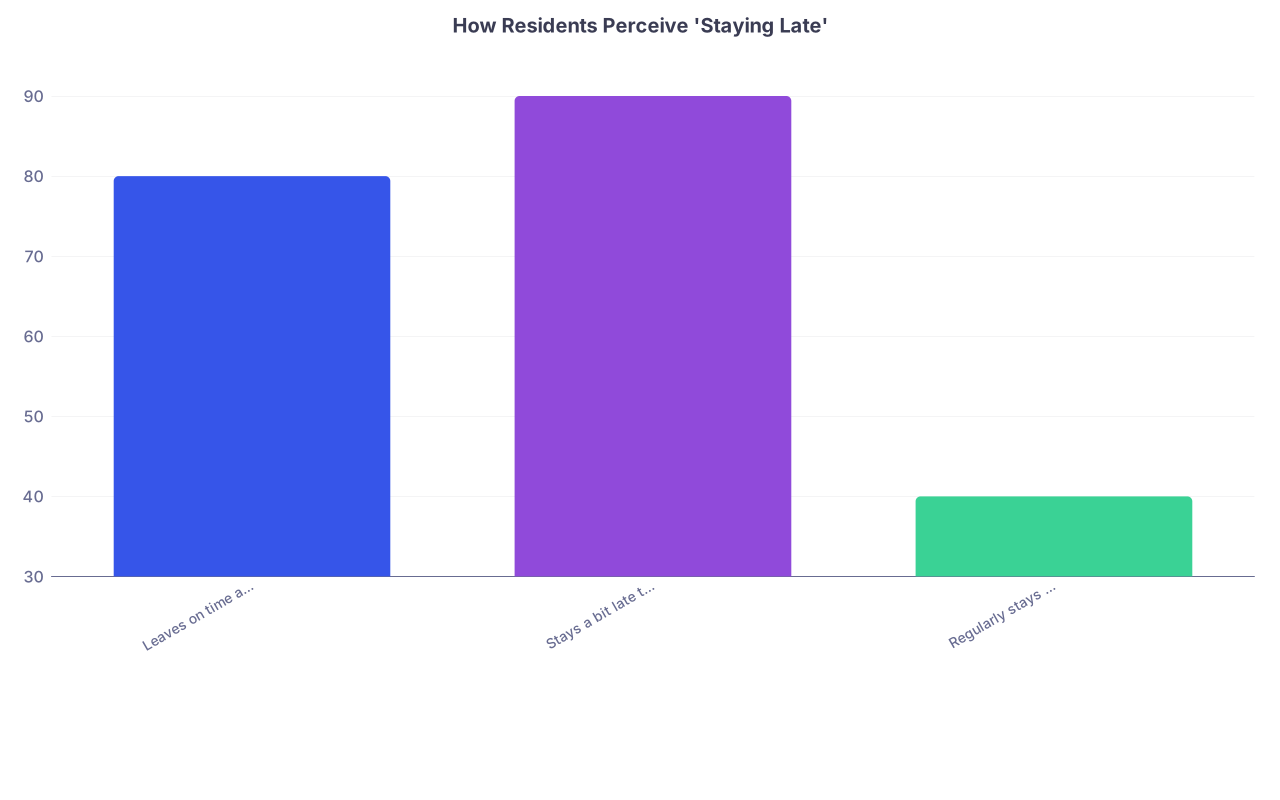
| Category | Value |
|---|---|
| Leaves on time after work done | 80 |
| Stays a bit late to finish real tasks | 90 |
| Regularly stays much later than team | 40 |
That last number reflects perceived positivity of the behavior. Notice how it drops.
Healthy vs unhealthy “eagerness”
Healthy:
- You ask: “Is there anything else I can help with before I head out?”
- You stay 15–30 minutes late to finish your note properly or complete a real task.
- You go home when your work is done and the resident says you can go.
Unhealthy:
- You linger until 8 PM on a day when nobody asked you to.
- You insist on staying for every admission even when the team is clearly trying to send you home.
- You look disappointed or push back when they tell you to leave.
Residents see over-staying as:
- Poor boundary setting.
- Potential burnout risk.
- Inefficient use of time.
- Sometimes, an implicit criticism of their own boundaries.
You want to look reliable, not desperate.
Ask once: “Is it OK if I stay to see this admission? If not, I am happy to go home.”
Then respect the answer, even if it is “No, go home.”
Mistake #6: Studying For Pimp Questions, Ignoring Your Patients
Overeager students often pour hours into reading for questions they hope to be asked, while their actual patients are half-understood.
They can recite:
- The mechanism of action of a 4th-line drug they will never see.
- Every step of the clotting cascade.
- The inclusion criteria of a landmark trial.
But they fumble when:
- Asked for a patient’s social situation.
- Clarifying a timeline of symptoms.
- Explaining, in plain language, what is actually going on with their patient.
Residents do not care how many pages you read about myocarditis if:
- Your note is sloppy.
- Your HPI misses key details.
- You cannot give a clear, three-sentence summary of the patient at the bedside.
The study pattern that backfires
Overeager pattern:
- Spend 2–3 hours a night reading random chapters “just in case.”
- Try to memorize everything for shelf questions.
- Prioritize high-yield facts over understanding your own patients deeply.
Your evaluations, however, are based heavily on:
- Your performance with your actual patients.
- Your presentations.
- Your reliability with daily tasks.
Not how many cardiology facts you can recite when bored attendings decide to quiz someone.
Shift your studying to be rotation-anchored
Safer, smarter approach:
- Each day, pick 1–2 key problems from your own patients.
- Read specifically on:
- Pathophysiology
- First-line management
- Hospital course and major complications
- Apply it the next morning in one sentence:
- “Given his new reduced EF and persistent volume overload, guideline-directed therapy would suggest adding X if blood pressure allows. I looked up the starting doses last night.”
That is how you show effort without being over-the-top. Calm, relevant, and directly helpful.
Mistake #7: Ignoring The Hidden Curriculum: “Read the Room”
The overeager student is often blind to context.
They push the same level of energy and questions at 11 AM on a calm day and at 5:30 PM when three discharges are delayed and a new septic patient just rolled in.
This is not about faking anything. It is about situational awareness.

| Step | Description |
|---|---|
| Step 1 | Notice Team Energy |
| Step 2 | Ask Brief Questions |
| Step 3 | Prioritize Tasks |
| Step 4 | Finish Work First |
| Step 5 | Offer Specific Help |
| Step 6 | Then Step Back |
| Step 7 | Is Team Calm? |
| Step 8 | Is Your Task Done? |
Signs you are not reading the room
- You ask for feedback at exactly the wrong times (e.g., right after a patient dies, during a code, just before sign-out).
- You start a teaching conversation while your resident is frantically typing discharge summaries.
- You keep standing near an attending who is clearly trying to slip away between commitments.
Residents remember this. They comment on “situational awareness” more than you think.
Simple rules to protect yourself
- If the team is moving fast, save your questions.
- If people are short or abrupt, do not take it personally—just lower your verbal output and increase your work output.
- Ask: “When would be a good time for me to ask some questions about X?” instead of launching into them.
You look mature when you adapt your behavior to the environment. You look overeager when you act the same regardless of what is happening.
What Residents Actually Reward
Let me flip this. Here is what consistently correlates with top evaluations—and it is not frenetic energy.
| Behavior Type | Resident Reaction |
|---|---|
| Calm, prepared, concise | Strongly positive |
| Respectful questions at good times | Positive |
| Quietly doing unglamorous tasks | Very positive |
| Over-talking, over-answering | Negative |
| Overstepping orders or promises | Strongly negative |
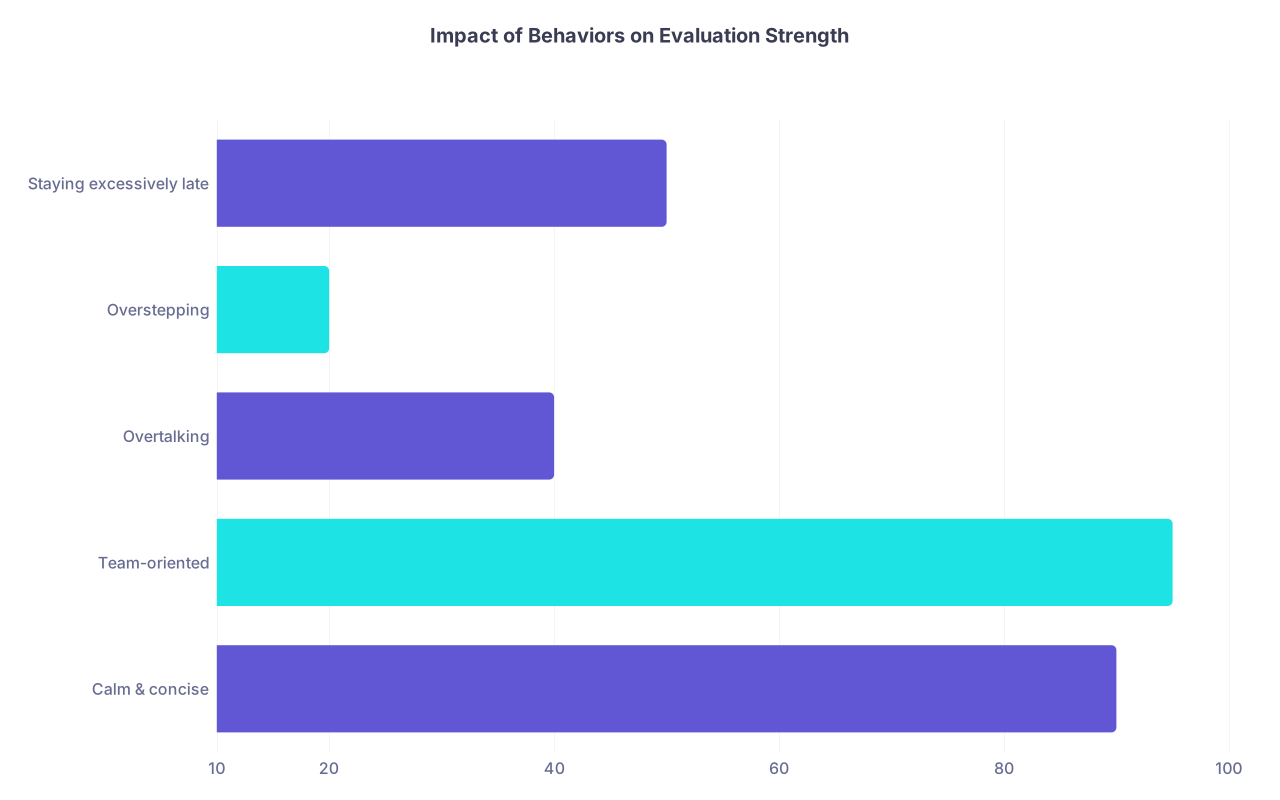
| Category | Value |
|---|---|
| Calm & concise | 90 |
| Team-oriented | 95 |
| Overtalking | 40 |
| Overstepping | 20 |
| Staying excessively late | 50 |
Numbers here are approximate “helpfulness” scores from resident perspectives I have collected over the years. Notice what actually matters.
The student who does best is usually:
- Prepared but not performative.
- Helpful but not intrusive.
- Curious but not clingy.
- Confident but not competitive.
You do not need to be a genius. You do need to avoid the overeager traps.
How To Self-Correct Mid-Rotation
If you are reading this halfway through a rotation and recognizing yourself, good. You can still fix it.
Try this 3-step reset over the next 48 hours:
Ask for targeted feedback
- Say to your senior:
- “I want to make sure I am supporting the team well. Is there anything I am doing that is too much, or anything I should dial back?”
- Then stop talking. Listen. Do not defend.
- Say to your senior:
Cut your spoken words by ~30%
- Shorter presentations.
- Fewer comments unless necessary.
- Questions clustered at one appropriate time in the day.
Increase invisible but real work
- Volunteer for:
- Discharge paperwork help
- Calling pharmacies
- Checking on families
- Following up on imaging reports
- Then just report back briefly: “X is done.”
- Volunteer for:
You will feel like you are doing less. From the team’s perspective, you will seem dramatically more competent and pleasant.
The Core Warnings, In Plain Language
Keep these straight:
- Do not confuse visibility with value. The best students make the team’s day smoother, not louder.
- Do not cross the line from proactive to unsafe. Always stay within your role, especially with orders and promises to patients.
- Do not turn rotations into a competition. Residents are not picking a “winner”; they are deciding who they trust not to make life harder.
Avoid those three mistakes and you will not just survive clinical rotations. You will actually be the person everyone hopes will match into their program.