
The clinical rotation system is not built for quiet people.
You can still win in it—but only if you stop trying to become the loudest voice on the team.
You’re not losing points because you’re introverted. You’re losing points because no one can see what you’re doing well. That’s a fixable problem.
Let’s go rotation by rotation, moment by moment, and turn “quiet” from a liability into something that actually works for you.
Step 1: Stop Trying to Be Someone You’re Not
If you’re introverted, you’ve probably already tried the “just speak up more” advice. It usually ends the same way: you force some comments on rounds, feel fake, then shut down even more.
You do not need to become the talkative, performative student. You do need to become visible and predictable in how you contribute.
Here’s the reframe that helps most quiet students:
- Your value is not your volume.
- Attendings need three things from you: reliability, insight, and teachability.
- You can show all three without turning into a nonstop talker.
So the real strategy is:
Use structure, not personality, to make your contributions unavoidable.
That means you’re going to:
- Script specific phrases you’ll say every day
- Pick predictable “windows” where you’ll speak
- Use written/typed work to amplify your thinking
- Ask for feedback in a way that does not feel like begging for praise
We’ll get concrete.
Step 2: Survive (and Stand Out) on Rounds Without Being Loud
Rounds are where quiet students feel most exposed. Too many people. Too much performance. Not enough time to think.
The trick is to front-load your contribution and standardize what you say.
1. Use a simple, repeatable speaking script
If your brain freezes when you’re put on the spot, you need scripts. Not word-for-word memorization. Just repeatable structures.
For a typical medicine or surgery patient, your minimum “I spoke today” contribution can be:
- A structured assessment and plan for 1–2 problems
- One focused question or learning point
Example mini-script for your presentation:
- “For Mr. X, the main active issue is [problem]. I think he’s [stable/improving/worsening] because [1–2 objective data points].
My assessment is [short statement]. I’d like to [plan step 1], and consider [plan step 2] because [brief rationale].”
Then end with something like:
- “I looked up [specific narrow question] and found that [1–2 sentence answer].”
That last part is your built-in speaking moment. Every. Single. Day.
You’re no longer hoping you’ll “find a time” to talk. You’ve baked it into your role.
2. Pre-round with a purpose
Quiet students often think they’re doing the work, but no one sees the hours.
You fix that by making your pre-rounding visible:
- Before rounds, quickly tell your resident:
“I checked on Ms. Y—BP 110s/70s, pain 3/10, no overnight issues. I’ll present her today and looked up [relevant topic].”
Short, clean, proactive. Now when you present on rounds, your resident already knows you’re prepared.
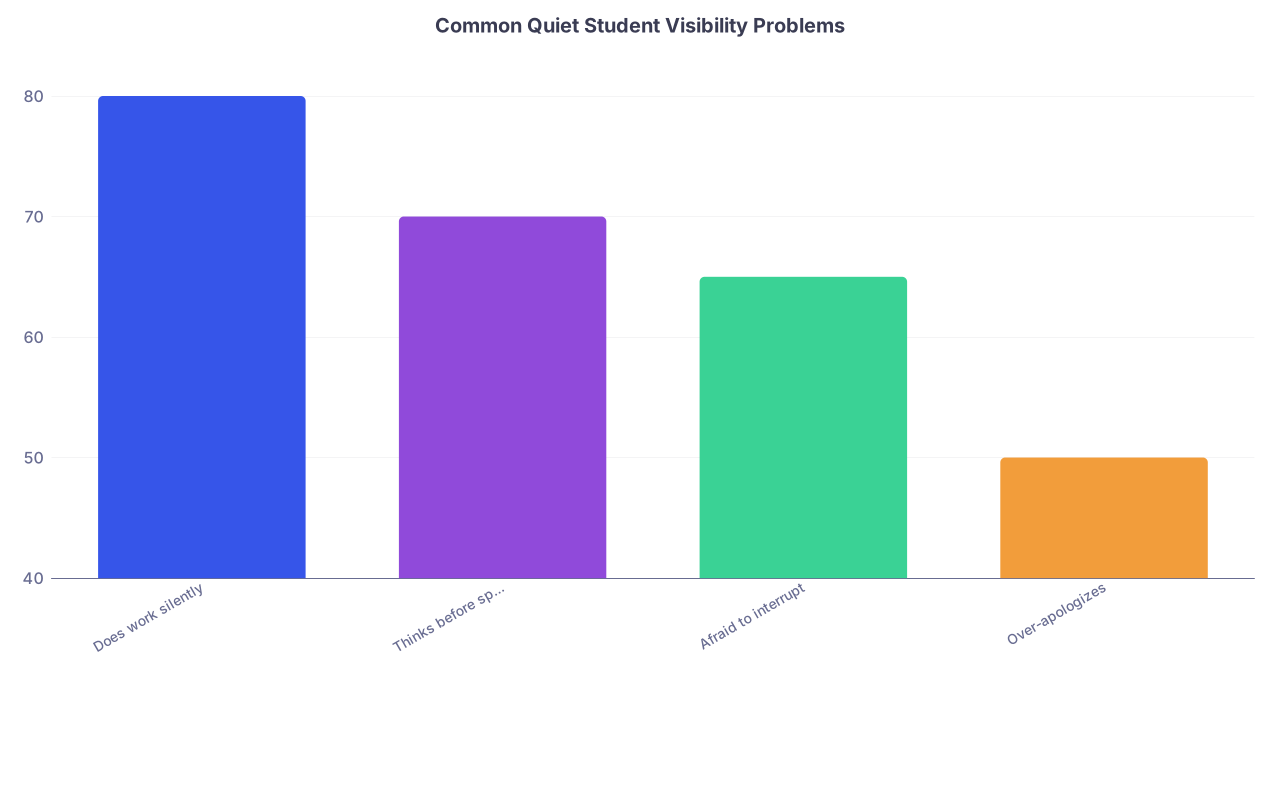
| Category | Value |
|---|---|
| Does work silently | 80 |
| Thinks before speaking | 70 |
| Afraid to interrupt | 65 |
| Over-apologizes | 50 |
3. Build one daily question that doesn’t feel fake
You don’t need to ask 10 questions. You need one good one that proves you’re engaged.
Keep a running list on your phone or small notebook during the day. If something confuses you, write it down. Then, before rounds end or during a lull, choose one:
- “Can I ask a quick question about Ms. Z’s case? I was wondering how you decided between [option A] and [option B] for her [condition].”
Not open-ended philosophy. Not “what’s the most important thing to know about CHF?”
A narrow, decision-based question is safer and shows actual thinking.
If you’re terrified of speaking in front of the whole team, ask right after rounds to the resident or attending:
- “Do you have a minute for a quick question about [patient]?”
That still counts. They remember that.
Step 3: Use Your Written Work as a Force Multiplier
Introverts usually think well in writing. Good. Exploit that.
On many services, your notes, orders, and sign-outs are more visible than your voice.
Here’s how you make them work for you:
1. Turn your notes into quiet flexes
You don’t get extra points for long notes. You do get credit for clean thinking.
Focus on:
- A concise one-liner that actually shows you understand the patient
- Problem-based A/P with clear bullets and rationale
- Adding 1–2 lines from a guideline or resource when relevant
Example:
“ID: 65M with hx of COPD, HTN admitted for acute hypoxic resp failure likely 2/2 COPD exacerbation.”
In your A/P:
“COPD exacerbation – improving
- Cont. duonebs q4h while awake, wean as tolerated
- Prednisone day 3/5
- Reviewed GOLD guidelines: consider adding LAMA on discharge; he’s had ≥2 exacerbations this year”
That little “reviewed guidelines” line is you quietly yelling: I read and I care.
Then say, very simply to your resident once:
“I’ve been trying to add guideline-based notes in the A/P—let me know if that’s helpful or if I should change it.”
Translation: Please notice I’m working hard. Without whining for attention.
2. Volunteer for one “grunt” thing early
Quiet students sometimes get accidentally sidelined: “Oh, they’re chill, I’ll let them just observe.” That’s death for your eval.
Day 1 or 2, say:
- “I’m happy to take ownership of writing notes for [x patients] or helping with [discharge summaries / consult calls / updating sign-out] if that would be useful.”
You’re not just helpful. You’re giving them a way to see your work product.
Step 4: Handle Pimping Without Melting Down
Being quiet + being wrong in public = nightmare combo for introverts.
You cannot avoid being pimped. You can change how you respond so you don’t look timid or disengaged.
1. Use a standard “I don’t know” that doesn’t tank you
Stop with the soft, apologetic “I’m not sure, sorry.” It reads as lack of confidence, not humility.
Use this instead:
- “I don’t know the exact answer. If I had to guess, I’d say [short guess]. I can look it up and get back to you.”
Now you’ve shown:
- You’re willing to commit to a guess
- You’re open about your limits
- You’re oriented toward follow-up
Then—this part matters—later that day, you follow up:
- “I looked up your question about [topic]—the answer is [1–2 lines].”
That small loop closure is disproportionately impressive.
2. Prepare a short “study log” for yourself
Introverts often study a lot but don’t connect it to patient care out loud.
Fix it with a simple 5-minute routine at the end of the day:
Write:
- 1 patient name + main problem
- 1 thing you looked up for them
- 1 line summary of what you learned
Next day on rounds, you have built-in material:
- “Yesterday I read about [topic] for Mr. X; the main takeaway is [short line].”
That’s your safe way to initiate speaking without improvising.
Step 5: How to Talk to Residents and Attendings When You’re Quiet
Here’s the brutal truth: a lot of evaluations are based less on raw performance and more on vibes.
If they perceive you as “quiet but hard-working and engaged,” you’re fine.
If they perceive you as “quiet and checked out,” you’re in trouble.
You need to actively shape that narrative, gently.
1. Day 1 script that sets expectations (and buys you grace)
Use a version of this with your senior resident or attending:
- “I tend to be more on the quiet side at first, but I really care about doing good work and I’m eager to learn. If you ever feel like I’m not asking enough questions or not speaking up when I should, I’d appreciate you telling me so I can adjust.”
You just did three powerful things:
- Named the elephant (“I’m quiet”)
- Avoided sounding defensive
- Invited feedback in a very adult way
Now when you’re quiet, they’re more likely to think, “That’s just their style” instead of “They don’t care.”
2. Mid-rotation check-in: non-cringey version
Do not wait until the last week for feedback. That’s too late to fix anything.
Middle of the block, say:
- “We’re about halfway through—would you mind giving me 1–2 things I could improve on for the rest of the rotation? I’ve been working on [specific thing, e.g., ‘being more concise on presentations’].”
Notice: you name something you already know you’re trying to do. That shows self-awareness.

3. End-of-rotation memory anchor
Attendings write your evals days or weeks later. Quiet students get forgotten.
Near the end, create a small anchor in their mind:
- “I just wanted to say thanks for letting me take on more responsibility with [patients/tasks]. I learned a lot about [specific clinical or professional thing].”
Short. Genuine. Not fake enthusiasm.
It reminds them: you were there, you worked, you appreciated it.
Step 6: Rotation-Specific Tactics for Introverts
Different rotations punish quiet students differently. You have to adjust.
Internal Medicine
Medicine likes thoughtfulness, which is good news for you.
Lean into:
- Crisp, structured presentations
- Strong notes with clear assessment and plan
- Looking up 1 question per patient each day
Quiet-student landmine: never volunteering.
Fix: early in the rotation, say, “I’m happy to take full ownership of 2–3 patients, including calling consults with supervision.”
That gives you a defined lane.
Surgery
Surgery is less tolerant of silence. Not because they hate introverts, but because they equate quiet with low initiative.
Your moves:
In the OR, ask short, concrete questions between critical steps, not during them:
“Can I ask a quick question about why you chose [tool/approach] for this part?”Before a case:
“I read the Op Note from the last similar case and anatomy for [procedure]. Is there anything you’d like me to focus on watching today?”After a case (scrubbed out, calm moment):
“Thanks for letting me scrub. I’d like to get better at [x small thing – e.g., holding retractors / knowing instruments]. Anything specific you’d suggest I work on?”
You’re showing interest without monologuing.
Pediatrics / Family Med
These rotations often value communication style highly.
You might be quieter with staff, but you can shine with patients and families:
- Take an extra 5 minutes to explain things simply to a parent
- Document clearly that you did patient education
- Tell your resident:
“I spent time explaining [diagnosis] with the family and making sure they understood the plan.”
This translates directly into “good with patients” on evals.
EM / Fast-paced rotations
These are tough for introverts because there’s less time to think.
Your lifeline: micro-briefings.
Before jumping into a patient:
- “I’ll go see the chest pain in room 8—plan to get focused history, targeted exam, start thinking HEART score.”
After:
- “Quick summary on room 8: [1-liner]. I’m thinking [2–3 differential diagnoses] and would start with [basic workup].”
Short bursts. Not essays.
| Rotation | Low-Volume, High-Impact Actions |
|---|---|
| Medicine | Guideline-based A/P, daily “I looked up…” |
| Surgery | Pre-case prep + 1 targeted OR question |
| Pediatrics | Patient/family education + document it |
| EM | Brief pre- and post-patient huddles |
| Psych | Detailed interview notes + 1 formulation point in rounds |
Step 7: Managing Your Energy So You Don’t Burn Out
Being introverted doesn’t just mean “quiet.” It usually means social interaction drains you.
Clinical rotations are 8–14 hours of constant people. If you don’t manage your energy, you’ll default to total shutdown.
1. Build micro-recovery into your day
You’re not getting a two-hour break. You can get 3–5 minute resets.
Examples:
- Bathroom break where you literally just sit, breathe, and don’t talk
- Walk one set of labs or paperwork yourself and decompress on the walk
- Eat part of your lunch alone in a stairwell or quiet corner before rejoining
You don’t need to explain this to anyone. Just do it.
2. Decide your “speaking windows” in advance
If you try to be “on” all day, you’ll fail.
Designate:
- Rounds: I will speak on every patient I follow + 1 question total
- Afternoon: I will ask my resident 1 focused clinical or career question
- End of day: I will do 1 follow-up on something I looked up
That’s it. If more happens, great. If not, you still hit your baseline.
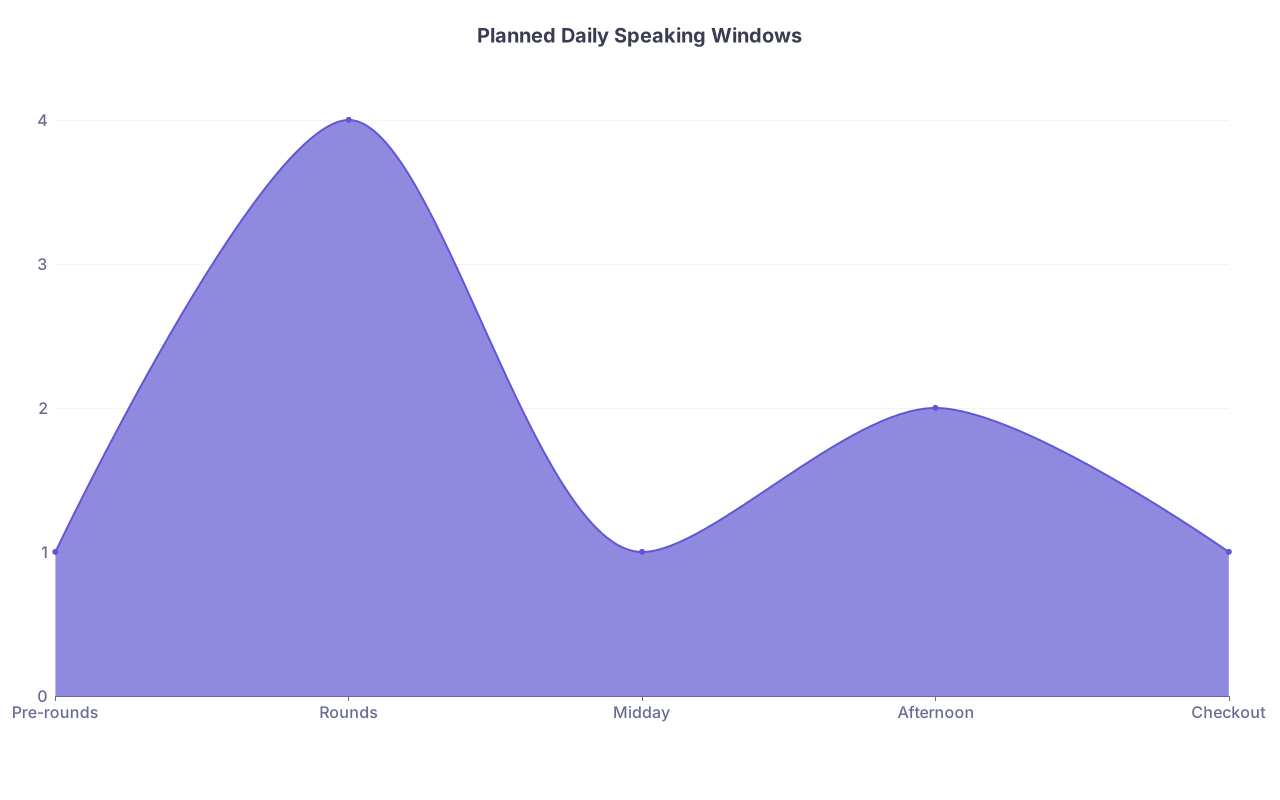
| Category | Value |
|---|---|
| Pre-rounds | 1 |
| Rounds | 4 |
| Midday | 1 |
| Afternoon | 2 |
| Checkout | 1 |
3. Protect one non-medicine thing daily
Rotations will swallow you. Quiet people need a place where they’re not “on.”
Pick something small but consistent:
- 20-minute walk with music
- One episode of a show
- Reading non-medical fiction before bed
If everything you do is medicine + guilt, your brain will shut down on rotations 4–5.
Step 8: Turning “Quiet” into a Strength, Not an Apology
There are things introverted students do better than many extroverts. You just have to lean into them.
Good quiet students often:
- Listen more than they talk
- Notice patient emotions others miss
- Write cleaner, more thoughtful notes
- Remember small but important details
So highlight those.
Examples:
When a patient is anxious and you spent time with them, tell your team:
“Ms. X was really worried about [issue], so I spent some time explaining [concept] and she seemed relieved.”When you pick up subtle social info:
“He mentioned he’s worried about affording meds; might be good to loop in social work.”When your attention to detail prevents a problem:
“Pharmacy flagged a dose discrepancy—I double-checked the chart and fixed it.”
You’re quietly pointing out: I’m paying attention. I’m useful. I care.

Step 9: What to Do if You Already Got a Bad Evaluation for Being Quiet
If you’re reading this because you already got hit with “too quiet” or “not engaged enough,” you’re not sunk.
But you do need to be intentional.
1. Decode the eval honestly
“Quiet” on an eval can mean several different things:
- Literally soft-spoken / rarely spoke
- Seemed disinterested or disengaged
- Lacked initiative
- Didn’t ask for tasks or responsibilities
If you can, ask a resident you trust:
- “I got feedback that I came off as quiet or not engaged on [rotation]. From your perspective, was it more that I didn’t speak much on rounds, or that I wasn’t taking enough initiative, or something else?”
You’re not arguing. You’re clarifying what to fix.
2. Overcorrect specifically, not globally
Do not swing from “quiet” to “trying to talk constantly.” That just makes you anxious and weird.
If the issue was:
- “Didn’t ask enough questions” → Commit to 1 question/day, written in your notebook beforehand.
- “Didn’t take initiative” → On Day 1 of next rotation, say: “I’d like to take ownership of [small set of patients/tasks].”
- “Seemed disengaged” → Use your face and body. Eye contact. Slight nodding. Put your phone away completely.

| Step | Description |
|---|---|
| Step 1 | Get feedback: too quiet |
| Step 2 | Clarify what that meant |
| Step 3 | Pick 1-2 specific behaviors to change |
| Step 4 | Script phrases & speaking windows |
| Step 5 | Ask mid-rotation: is this better? |
| Step 6 | Adjust & repeat |
3. Document your growth for yourself
Quiet students sometimes internalize one bad eval as “I’m just bad at rotations.”
Keep a simple record:
- Rotation
- Main feedback
- What you changed
- Evidence it improved (comments, grades, your own sense)
This helps when you write personal statements or talk in future interviews about “an area I improved on.” You have real, concrete stories.
Final Thoughts: How You Win as a Quiet Student
You don’t need to become loud. You need to become legible.
Three things to keep front and center:
- Build predictable, low-drama ways to speak every day: a structured presentation, one narrow question, one follow-up on something you looked up.
- Let your written work and small actions showcase your effort: strong notes, helpful tasks, closing the loop on questions and issues.
- Name your quietness early, invite feedback, and shape their narrative: “quiet but engaged, thoughtful, reliable”—not “quiet and absent.”
You’re not broken. The system is just noisy. Learn its rules, then play it your way.