

What actually makes you look like a stronger medical student on rotations: quietly reading UpToDate, or jumping in to help with scut when the team is drowning?
Let me be direct: 90% of students misplay this.
They either hide in a corner “reading about my patients” while the team is buried, or they run errands all day and learn almost nothing. Both extremes are bad. One makes you invisible. The other makes you a very polite helper with no clinical growth.
You’re asking the right question. Here’s the answer you’re looking for.
The Core Rule: When the Team Is Drowning, You Swim With Them
If the team is clearly overwhelmed—pages nonstop, discharges stacked, admits pouring in—your default should be: help first, read later.
Not because “helping” looks nice. Because in those moments, a good med student is an extender, not a spectator.
Here’s the hierarchy of what to do when the team is busy:
- Direct patient-care tasks that move the list forward
- Indirect patient-care tasks (calling consults, arranging imaging, tracking down results)
- Prep work for tomorrow (notes, sign-out, orders for review)
- Reading that directly applies to one of your patients
- General reading
That’s the order. Notice where generic reading sits: dead last.
If the residents are clearly slammed and you say, “I’ll go sit and read about heart failure”—you’ve just told them you don’t see yourself as part of the team.
The move is: “Looks like we’re swamped. What can I take off your plate?”
Then shut up and take something concrete.
What “Helping” Should Actually Look Like
“Helping” is not just carrying coffee and following people around. That’s what weak students do when they want to look useful without doing real work.
You help by taking ownership of specific, bounded tasks.
Examples that make you genuinely useful:
On medicine:
“Can I call radiology to confirm Mrs. Lopez’s CT time?”
“I can update the sign-out on my two patients and pre-write discharge instructions.”On surgery:
“I’ll go check that pre-op labs are resulted and print consents for your next two cases.”
“Do you want me to remove that Foley and document output?”On OB:
“I’ll monitor that labor patient for 20 minutes and update you if any decels.”
“I can put in triage notes for the next two patients and you can co-sign.”On EM:
“I’ll complete the H&P for the new chest pain in Room 7; you can review with me before dispo.”
“I’ll call the family to update them and confirm meds while you see the trauma.”
You want tasks with:
- Clear start and finish
- Direct impact on patient care or team efficiency
- Opportunity to learn (talking to patients, writing notes, interpreting data, communicating with other services)
If you catch yourself doing things any random high school volunteer could do for more than 30–40 minutes at a time, you’re underusing yourself.
But What About Studying for Shelf/Step? Don’t I Need to Read?
Yes, you do. And this is where students panic.
Here’s the blunt truth: clinical performance is weighted more heavily by most attendings and residents than how many UWorld questions you did last night. A strong clinical eval plus an average shelf is usually fine. A poor team member with a high shelf looks like a problem.
You don’t sacrifice all reading. You time it.
Read when:
- The list is stable, and your patients are tucked
- Your residents are charting quietly and not asking for help
- You’ve explicitly asked, “Anything I can do for the team right now?” and gotten a clear no
- It’s the last 30–60 minutes of a day when people are mostly finishing notes
Then your reading should be laser-focused:
- First: topics directly connected to your patients that day
- Second: things you keep getting pimped on and missing
- Third: shelf prep, if you have true downtime
If you’re in a high-volume service (medicine wards, general surgery, ED), a practical split during a typical weekday might look like:
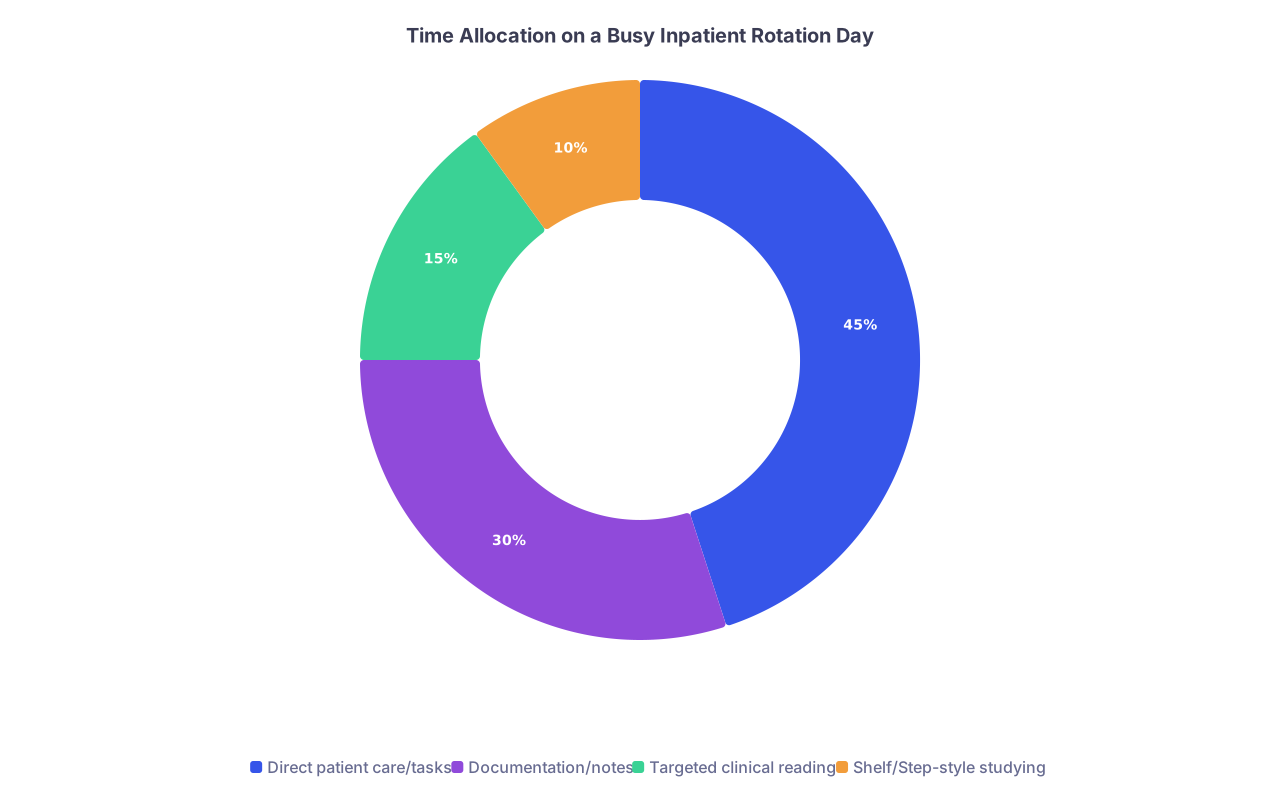
| Category | Value |
|---|---|
| Direct patient care/tasks | 45 |
| Documentation/notes | 30 |
| Targeted clinical reading | 15 |
| Shelf/Step-style studying | 10 |
You’re not going to get perfect board-style reading time on busy days. Accept that. Make your limited study time efficient instead of trying to protect big blocks during clinical chaos.
A Simple Decision Framework: Help vs Read
When you’re standing there thinking, “Should I go read or ask to help?” run this quick mental flow.

| Step | Description |
|---|---|
| Step 1 | Team activity check |
| Step 2 | Ask: What can I help with? |
| Step 3 | Do the task well and report back |
| Step 4 | Update notes, follow up labs, see patient again |
| Step 5 | Ask if team needs anything |
| Step 6 | Targeted reading on my patients |
| Step 7 | Residents visibly busy? |
| Step 8 | Any tasks for me? |
| Step 9 | Any active work on my patients? |
| Step 10 | Asked Need anything? recently? |
If you have not explicitly offered help in the last 30–45 minutes, you haven’t done your job yet. Go ask.
How Attendings and Residents Actually Judge You
Most evals are not: “How many hours did this student read per day?”
They’re closer to:
- “Did this student make my day easier or harder?”
- “Would I trust this person as an intern in July?”
- “Could they manage basic tasks without hand-holding?”
- “Did they care about their patients, or just about their notes and such?”
You get high marks if:
- You anticipate needs. “I knew we’d round on her first, so I already checked vitals, I/O, and new labs.”
- You close loops. “I called the family, explained the plan, and documented the discussion.”
- You own your patients. “I checked on him again after the new fever; here’s what changed.”
- You’re a calm presence when the team is stressed, not another problem to manage.
Students obsess over being correct when pimped. Most residents care more that you’re present, engaged, and dependable.
If you knew zero about hyponatremia but helped get three discharges out on time, tracked every critical lab, and updated families clearly—you’ll be remembered as competent and reliable. You can fix knowledge gaps later. Fixing attitude is harder.
Concrete Examples: What I’d Do in Common Scenarios
Let’s walk through a few scenarios you’ve probably lived.
Scenario 1: Post-call medicine team, 18 patients, pager exploding
Wrong move: Sit at the computer reading about sepsis while the intern is juggling five cross-cover issues.
Right move:
- “I’ll go see our three new admits again quickly and update you if anything changed.”
- “I can start the discharge summary for Mr. X and put in the med list for you to review.”
- “I’ll check all 8 am labs on our list and flag anything critical.”
You’ll learn more from seeing how that septic patient actually looks at the bedside and how their labs trend than five textbook paragraphs.
Scenario 2: Surgery, cases back-to-back, resident rushing
Wrong move: Hiding in the corner of the OR lounge doing Anki because “they don’t need me right now.”
Right move:
- Between cases: “Do you want me in pre-op to see our next patient and update you? I can check consent, mark side, and get a quick H&P.”
- After cases: “Can I write brief progress notes on my two post-op patients and present them to you to finalize?”
You’re showing that you function like a junior resident, not just a spectator with a white coat.
Scenario 3: ED, slow shift, no new patients for 20 minutes
Now it’s reasonable to read. But do it smart:
- Pick one of your patients. Look up 1–2 high-yield topics: ideal workup, red flags you might’ve missed, treatment pearls.
- Ask your senior: “I read that X and Y could change dispo decisions in suspected PE. Can we walk through how you decided to CT her?”
This marries reading + actual clinical judgment. That’s where real learning happens.
Balancing Shelf/Step and Clinical Performance Without Burning Out
Here’s the trap: you try to be a hero on the wards all day, then force yourself into 4 hours of questions at night. Two weeks later, you’re a zombie.
Be strategic instead:
On busy days:
- Be maximal on the wards
- Do 20–30 high-yield questions or 30–45 minutes of focused reading at home
- Sleep like it’s your job
On lighter days/off days:
- Front-load your shelf prep: questions, Anki, structured reading
- Reflect on clinical cases and link them to concepts you’ll see on exams
If you’re pulling real weight on the team and still passing shelves solidly, you are doing it right. You don’t need 99th percentile shelves to be a good doctor. You do need to be someone residents trust in July.
What Makes You Look Bad (Even If You Mean Well)
Let’s call out a few behaviors that send the wrong message:
- Saying “I’ll go read” when others are literally triaging chaos
- Vanishing for long stretches without telling anyone where you went
- Avoiding phones, consults, or patient/family conversations because they feel uncomfortable
- Calling every minor task “scut” and acting like you’re above it
- Refusing simple jobs because they’re “not educational”
The line is not between “scut” and “not scut.” It’s between:
- Work that moves patient care forward and helps you grow
- Pure busywork that anyone off the street could do, with no learning
You should accept plenty of the first category. You should minimize the second—but not by refusing work. By leveling up the kind of work you’re trusted with.
A Quick Comparison: Impact of “Help First” vs “Read First” Default
| Approach Default | Team Perception | Learning Quality | Typical Eval Comments |
|---|---|---|---|
| Help first, then read | Reliable, team player, future good intern | High clinical learning from real cases | "Integral part of team, took initiative" |
| Read first, help only when asked | Quiet, somewhat disengaged | Moderate, mostly book-based | "Pleasant but needs more initiative" |
| Avoids both, just present | Passive, extra body | Low | "Limited engagement, unclear ownership" |
You want to be in the first column. That’s the student people remember and fight for.
FAQs
1. Will helping the team too much hurt my shelf score?
Only if you’re sloppy with your remaining time. Students who work hard clinically and then do 20–40 focused questions most nights usually land in the solid-pass to above-average shelf range. You don’t need 4-hour daily study blocks during busy rotations. You need consistency and no wasted time scrolling.
2. When is it actually okay to say, “I’m going to go read”?
Three situations:
- The team is calm, nobody needs you, and you’ve asked if there’s anything you can help with.
- You’ve finished your notes and follow-ups and explicitly checked in: “Anything else I can do?”
- Your resident or attending says directly, “We’re good, go study.”
Say where you’ll be and for how long: “I’ll be in the workroom for the next 30 minutes reading about hyperkalemia—page me if something comes up.”
3. How do I ask to help without being annoying?
Be specific and time-limited. Instead of: “Is there anything I can do?” 10 times a day, use: “I have the next 20–30 minutes free. Do you want me to follow up any labs, see a patient, or start notes for discharges?” This shows you thought about the kind of work that’s useful and that you won’t vanish for an hour.
4. What if my resident just keeps giving me pure scut?
First, do it well and without attitude for a bit. Build trust. Then gently step it up: “I’ve been helping a lot with errands and love doing that, but I’d also like to grow clinically. Could I start writing notes on my two patients or call one of the consults and present it back to you?” Reasonable seniors will say yes when they see you’re reliable.
5. How do I explain what I did all day on my eval or to my attending?
Frame it around ownership and impact: “Today I followed my three patients closely—re-examined them after key events, updated the families, checked all labs, and started the discharge summary for Ms. X. I also called radiology for Y, and read about Z which came up in her management.” You’re telling a story where you were a functioning (junior) member of the team, not just a shadow.
Key points:
- When the team is truly busy, you help first and read later. That’s how you become the student people actually trust.
- Aim for high-yield tasks that move patient care forward and stretch your skills—notes, calls, follow-ups, re-exams—not just errands.
- Protect focused, efficient study time on quieter moments and days off instead of sacrificing clinical performance to chase perfect shelf prep.


