

It’s 6:15 a.m. You just printed the team list on your first day of inpatient medicine. There are 24 patients on the census, your senior turns to you and says, “You can pick up a couple this morning.”
You stare at the list and think:
How many is “a couple”?
How many is normal?
How many is going to make me look competent instead of clueless?
Here’s the answer you’re looking for.
The Short Answer: Target Numbers by Rotation
I’ll give you the real-world numbers first, then explain the why and how.
These are reasonable target ranges for how many patients you should follow as a medical student on common inpatient rotations, once you’re a few days in and past pure orientation.
| Rotation | Typical Range | Upper End if You’re Strong |
|---|---|---|
| Inpatient Medicine | 3–6 | 7–8 |
| General Surgery | 4–8 | 8–10 |
| ICU (Med/Surg) | 2–4 | 5 |
| OB Inpatient | 3–6 | 7–8 |
| Psych Inpatient | 4–6 | 7–8 |
Core rule:
You need enough patients to learn and to be useful, but not so many that your notes are garbage and you stop thinking.
On most rotations, that’s going to land between 3 and 6 active patients once you’re settled in.
Why The Number Isn’t One-Size-Fits-All
The right number depends on three things that actually matter:
- Rotation type and workflow
- Your level of training and speed
- How sick/complex your patients are
Let’s go through each quickly.
1. Rotation Type
Different services are built differently.
Medicine:
Each patient needs a full H&P at admission, detailed daily notes, med reconciliation, follow-up on labs, imaging, consults. You may spend 20–40 minutes per patient pre-rounding and writing a good note. So the load per student is naturally lower.
Surgery:
Rounds are fast. Notes are short. You might see 10 patients in under an hour as a team. But you’ll spend a lot of time in the OR instead of at the bedside, so the patients you “own” realistically need to be fewer than your total encounters.
ICU:
Every patient is dense: vents, drips, complex physiology. One ICU patient can be the cognitive load of 3–4 floor patients. You’ll chart-check like crazy. So the number is small.
Psych:
Fewer vitals, fewer labs, much more interviewing and long conversations. Notes can still be detailed but you’re not chasing CTs and troponins all day. You can handle more patients numerically, but they’re time-intensive in a different way.
2. Your Level and Speed
Blunt truth:
A fast, late-third-year student on their second or third inpatient rotation can handle more than a brand-new M3 who needs 45 minutes per note.
Rough guide:
- First inpatient rotation (early M3):
Start with 2–3 patients; build up to 4–5 if you’re coping well. - Mid–late M3 (after a couple of cores):
Comfortably 4–6 on medicine; 5–8 on surgery. - Sub-I / acting intern:
Different game. You’re aiming for intern-level numbers (6–10+ on medicine), but that’s a separate discussion.
3. Patient Complexity
Three septic shock ICU patients on multiple pressors? Two might be plenty.
Five stable post-op appys on POD2 going home tomorrow? You can probably handle more.
Rule of thumb I’ve used personally:
If you cannot, in your own head, explain the active problem list and plan for each of your patients at any point in the day, you have too many.
Rotation-Specific Guidance: What “Normal” Looks Like
Let’s get concrete. Here’s what I’ve seen work on typical services.
Inpatient Internal Medicine
Target: 3–6 patients
Day 1–3:
- Ask your senior: “Can I start with 2–3 patients today and add more as I get quicker?”
- Pick patients with:
- Clear main problem (CHF exacerbation, COPD flare, pneumonia)
- Reasonable social situation (not 17 complex dispo issues on day 1)
After the first few days:
- If you’re finishing pre-rounding and notes on time and not scrambling on rounds, push to 4–5.
- By week 2, many students function well at 5–6 if the service isn’t ultra-acute.
Red flags you’re overloaded:
- You regularly miss results that came back hours ago.
- Your senior frequently corrects basic facts you should know (O2 requirement, last BM, key lab trends).
- You’re finishing notes after 5–6 p.m. every day despite a normal-volume service.
If that’s you at 6 patients, drop to 4–5 and focus on depth.
General Surgery Inpatient
Target: 4–8 patients followed closely
(You might see many more briefly on rounds, but you truly “own” fewer.)
You’ll likely have:
- A running list of 10–20+ patients on the service
- A subgroup that you pre-round on, write notes on, and present
Realistic approach:
- Early on, ask for 4–5 patients that you’re primarily responsible for.
- Prioritize:
- Bread-and-butter post-op patients
- One or two more complex patients for learning (e.g., SBO, post-op infection)
Surgery trick: you’ll spend hours in the OR. So if you’re scrubbed in all morning, you may not be able to pre-round on 8 people and do quality notes. Do not overpromise.
A useful question to your senior:
“Given that I’m in the OR for most cases, how many patients would you like me to follow closely so I can still do a good job on notes and presentations?”
ICU (Medical or Surgical)
Target: 2–4 patients
Every ICU patient is data-heavy. Vent settings, ABGs, pressors, central lines, complex pathophysiology. The expectations for your understanding are higher.
Start with 1–2 patients, especially if it’s your first ICU experience. Build to 3–4 only if:
- You can present them without drowning in your own words.
- You understand the ventilator basics or pressor choices at a resident-appropriate level.
- You’re not just reading flowsheets off the screen.
If the unit is full of ECMO, CRRT, multi-organ failure — 2–3 may honestly be your max.
OB Inpatient / L&D
OB inpatient is weird: fast, episodic, lots of moving pieces.
Rough idea:
- Active labor patients: You might be following 1–3 women through labor and delivery, checking on them repeatedly.
- Postpartum/post-op (C-section) patients: You could “own” 3–6 for postpartum checks and daily notes.
Some OB services don’t emphasize individual “ownership” the same way medicine does; it’s more “be present for as many deliveries as you can.” So your “patient count” is partly artificial. Ask your resident what they prefer:
“Would you like me to follow a set group of postpartum patients and a couple laboring patients, or just help with whoever is in labor and procedures?”
Inpatient Psychiatry
Target: 4–6 patients
Psych encounters are long interviews and ongoing alliance-building. You’re not ordering 20 labs, but your time is spent in real conversation and documentation.
Many psych units will have you follow 4–6 patients, with detailed notes and full daily interviews. That’s fine. The key is: can you honestly say something meaningful about how each patient changed from yesterday?
If progress notes are turning into copy-pasted “no change” with zero reflection, you’re probably just treading water, not learning.
How to Decide Your Number on Day 1 (Without Looking Clueless)
Here’s what to do the first morning on any inpatient rotation.

| Step | Description |
|---|---|
| Step 1 | Start rotation |
| Step 2 | Ask about typical student load |
| Step 3 | Volunteer for 2-3 patients |
| Step 4 | Volunteer for 3-4 patients |
| Step 5 | Check in after few days |
| Step 6 | Ask to add 1-2 more patients |
| Step 7 | Keep same load and improve depth |
| Step 8 | First week? New to inpatient? |
| Step 9 | Consistently on time & prepared? |
The actual words you can use:
Day 1:
“This is my first inpatient rotation, so I’d like to start with 2–3 patients and then increase as I get faster. Does that work for you?”If you’ve done wards before:
“I’ve already done a medicine rotation. I’m comfortable starting with 3–4 patients and can take more once I know the system here.”
Then actually follow up a few days in:
“I’ve been managing 4 patients and feel I’m getting done on time with good notes. I can take on 1–2 more if that would help.”
Residents love this. It shows self-awareness and initiative without trying to be a fake hero.
Quality vs. Quantity: What Your Attendings Actually Care About
Most attendings do not care if you have 3 patients or 7. They care about what you do with them.
They care that:
- Your presentations are organized, concise, and accurate.
- You know the recent vitals, new labs, imaging, and overnight events without being prompted.
- You can explain the why behind the plan (even if you need help getting there).
- You follow through on tasks: calling family, checking consult notes, re-assessing after a med change.
If you’re carrying 7 patients and:
- Your plan is “continue current management” on half of them.
- You routinely say, “I’m not sure if that lab came back yet.”
- Your senior is correcting obvious stuff (like that the patient’s on 4L O2, not room air).
Then you’re overextended. And it shows.
If you’re carrying 4 patients and:
- Your notes are sharp.
- Your plans are thoughtful.
- You’re anticipating the next steps and asking good questions.
You will be evaluated better than the student drowning with 8.
How to Know When You Have “Too Many”
Here’s a simple self-check. If you answer “yes” to 2 or more of these consistently, your load is too high for where you are:
- Are you still pre-rounding or finishing the last HPI when rounds start?
- Are you finishing your notes so late you can’t go see new admissions or read?
- On rounds, do you discover lab/imaging results in real time that you should’ve already seen?
- Do you feel you’re just reading charts and copying data, not actually learning or thinking?
- Do you feel anxious every time the attending asks “what’s the plan?”
If that’s you, your next step is not to “work harder.” It’s to adjust your count and be honest:
“Right now I’m following 6 patients and having trouble staying ahead of labs and studies. Would you be okay if I drop to 4–5 so I can go deeper on each one and not miss things?”
No decent senior or attending will be upset by that. They’ll respect you more for not pretending.
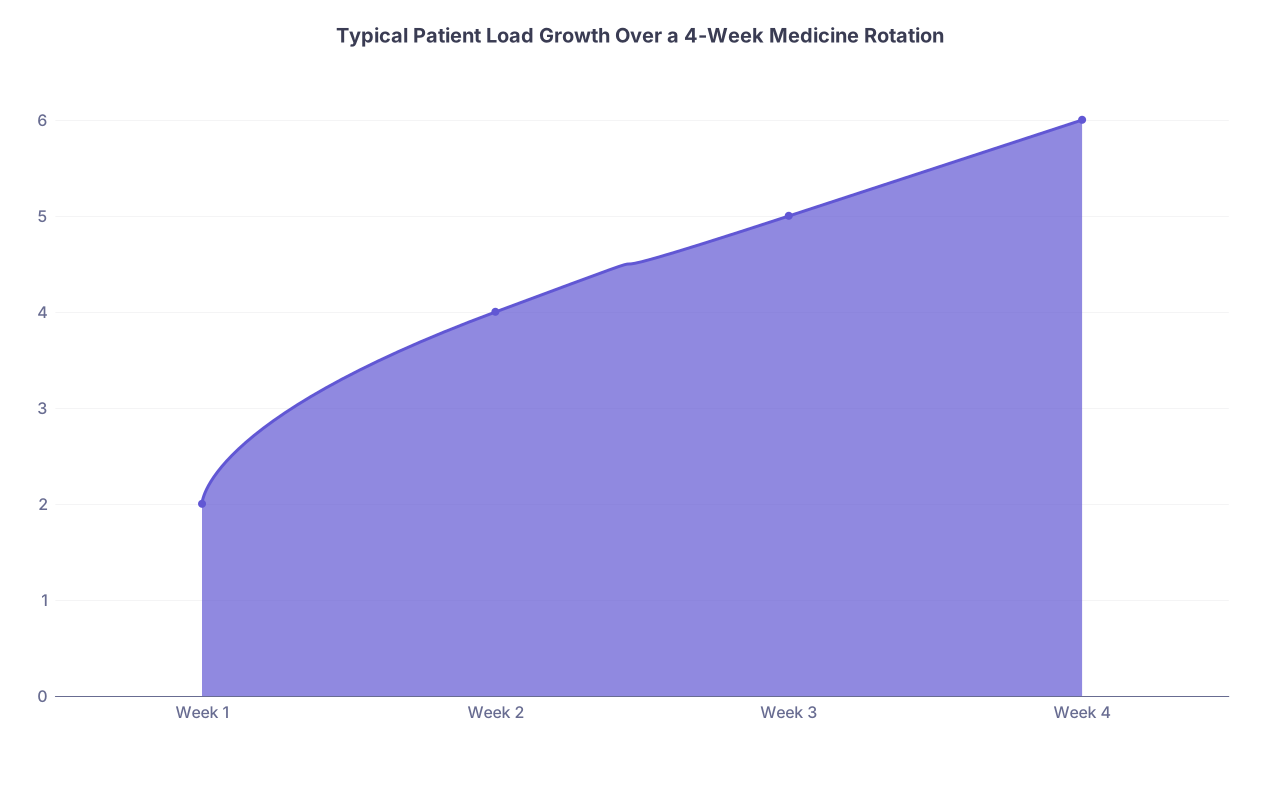
Quick Visual: How Patient Load Often Evolves
| Category | Value |
|---|---|
| Week 1 | 2 |
| Week 2 | 4 |
| Week 3 | 5 |
| Week 4 | 6 |
This is the pattern I like to see:
- Week 1: Learn the system, build efficiency, 2–3 patients.
- Week 2: Move to 4–5.
- Week 3–4: 5–6, with stronger ownership and more teaching value.
Notice: the value isn’t going from 2 to 8. It’s going from scattered/slow to efficient/deep.
Common Mistakes Students Make With Patient Numbers
I’ve watched a lot of students mess this up the same few ways.
Trying to impress by grabbing too many patients on day 1.
You end up presenting sloppily, missing labs, and your team quietly stops trusting your data.Never increasing beyond 2–3 even when you’re obviously ready.
Attendings will assume you like to coast. That dings your evaluations.Counting every “I saw them once” as a patient you “follow.”
If you didn’t write a note, present, or follow the plan day to day, it doesn’t count for learning or evaluation.Not matching your load to the day’s workflow.
Heavy OR day? Big admission surge? Step down your patient number temporarily so you don’t crash and burn.
How This Affects Your Grade and Shelf Prep
Rotations are not graded on a simple “number of patients” metric. But patient load affects the things that are graded:
- How prepared you are on rounds
- How often you speak up with plans and reasoning
- How much feedback/teaching you get (busy teams invest in students who are useful and reliable)
- How much mental space you have left to read at night
A good balance (for a core inpatient month) is:
- Start low
- Ramp to a solid, sustainable number
- Maintain quality and reliability
- Use any extra time for reading around your patients, not randomly grinding question banks while you’re still missing basic lab results
FAQs
1. Is it bad if I only follow 2–3 patients the whole rotation?
If it’s your first inpatient rotation and the service is intense, it’s not the end of the world. But if by week 3–4 you’re still at 2–3 when your peers are at 4–6 and coping fine, evaluators will notice. At some point you need to push yourself a bit.
2. Should I volunteer to take more patients than other students to stand out?
Not by a huge margin. Being the student with 10 patients who does mediocre work is worse than being the student with 5 who is consistently excellent. If you’re clearly keeping up and want a stretch week, you can take 1–2 more than your peers. Just don’t make it a vanity project.
3. Do new admissions “count” as part of my patient load?
Yes. Admission H&Ps are heavy lifts. If you admit 2 new patients in an evening, that’s equivalent to adding several more to your list. On heavy admit days, it’s totally reasonable to limit how many existing patients you’re responsible for the next morning.
4. What if my resident never tells me how many patients to take?
They’re busy and assume you’ll self-regulate. Use the ranges above as your baseline and check in with something like: “I’m currently following 4 patients and could take 1–2 more if that would help.” They’ll tell you if that’s reasonable.
5. How many patients should I follow on a sub-I / acting internship?
Different beast. On a sub-I, you’re trying to function like an intern with supervision. On wards, that often means 6–10+ patients depending on the service. You should aim higher there, but only once your basic inpatient skills are solid.
6. What if I’m slower than my classmates and feel embarrassed to have fewer patients?
Then focus fiercely on quality. Be the person whose notes are excellent, whose presentations are crisp, and whose plans are thoughtful. Ask for feedback on efficiency. Most attendings would rather work with a careful student with 4 patients than a sloppy one with 7.
Open your current or upcoming rotation schedule. For each inpatient block, write down a target range for your starting load and your week 3–4 load (for example: Medicine: start 3, aim for 5–6). Bring that to day 1 and say it out loud to your senior. That one move will make you look intentional, self-aware, and ready to work.


