

You should almost never pretend you’ve read about a patient when you haven’t.
But blurting “I have no idea what’s going on” on rounds? Also bad.
Let me give you the grown-up answer med students almost never get: you do admit it—but you do it in a way that shows ownership, judgment, and a plan. Not helplessness.
This is the line you need to learn to walk.
The Core Rule: Honesty, But With Competence
Here’s the baseline you shouldn’t cross:
- Lying about having read a chart? Wrong.
- Making up a plan when you haven’t reviewed anything? Dangerous.
- Hiding behind “I didn’t see the patient yet” as a daily habit? That’s how you get labeled unreliable.
Your goal is threefold:
- Protect the patient.
- Protect your integrity.
- Show you’re serious, not lazy.
So yes, you admit it if you haven’t read or seen the patient. But you never stop there. You always follow with: what you do know + what you’re going to do next + when you’ll be ready.
Example of what not to say on rounds:
“I haven’t read about them yet.”
Example of how an adult answers:
“I just got assigned to this new patient and haven’t fully reviewed the chart yet. I’ve skimmed the ED note and know they came in for chest pain; after rounds I’ll pull the troponin trend and ECGs and present a full plan by 10 a.m.”
Same truth. Completely different impression.
Common Scenarios: What You Actually Say
Let’s walk through the real situations you’ll see.
1. You’re Pimped About a Patient You Haven’t Read Yet
You’re on rounds, an attending points at you with the list:
“What’s going on with Mr. Rodriguez in 412?”
You recognize the name but haven’t actually read his chart.
Bad answer:
“Uh… I don’t know, I haven’t read about him yet.”
Better answer:
“I don’t know the full story yet. I know he was admitted overnight with shortness of breath and is on BiPAP. I haven’t read the full H&P, but I can review his chart after rounds and update the team.”
Here’s the structure:
- Admit the gap clearly.
- Share the little you do know if it’s accurate.
- Offer a concrete next step and timeframe.
What makes you look bad isn’t not knowing; it’s sounding passive and unprepared.
2. New Admission You Just Got Assigned
Attending:
“You’re taking the new admission in 506. Present him.”
If they mean right now and you’ve literally just heard about him:
Wrong approach:
“I haven’t seen him yet.”
Correct approach:
“I was just assigned to 506 and haven’t seen him in person yet. I’ve briefly looked at the admission, and he came in with decompensated heart failure. If it’s okay, I’ll see him right after rounds, complete the exam, and present a full assessment and plan on our next touchpoint.”
Again: honesty + a clear plan.
If there’s time before rounds and you show up saying, “I haven’t seen him,” that’s not an honesty problem; that’s a preparation problem. Different issue.
3. You Haven’t Read Enough Yet
This is more subtle and more common.
You skimmed the H&P. You saw the labs. You have some idea. Then attending asks a level deeper than where you actually are:
“What’s his home dose of insulin and how has his blood sugar trended since admission?”
You didn’t go that deep.
Bad response:
“I don’t know, I didn’t really look.”
Better:
“I don’t have his exact home insulin regimen or full glucose trend in front of me—my review focused on his sepsis workup and AKI this morning. I can pull those details up now or add them to the note after we finish this patient.”
You admit what specifically you didn’t review, not “I haven’t read about him.” Because you have—just incompletely.
That distinction matters. It tells the team where your mental work went, and that you actually thought about priorities.
4. When You Fully Dropped the Ball
Let’s not pretend: sometimes you were scrolling your phone or studying for an exam instead of pre-rounding.
Next morning, they ask for a presentation and you aren’t ready.
You do not fake it. Don’t make up a physical exam you didn’t do. Don’t invent vitals. That’s the kind of nonsense that will haunt you.
Owning it (in a grown-up way) looks like this:
“I’m not prepared to present this patient today. I didn’t pre-round like I should have. I’ve looked at some of the labs but I haven’t seen them in person or developed a full plan. I’ll see them right after rounds and have a proper presentation by noon. I know I dropped the ball this morning.”
Will they be annoyed? Yes.
Will they trust you more than if they catch you lying? Also yes.
The only thing worse than being unprepared is being unprepared and dishonest.
How To Admit It Without Looking Useless
Let’s be clear: you’re evaluated on two big things on rotations:
- Reliability
- Trajectory (are you getting better or staying flat?)
Saying “I haven’t read” in a flat, shrugging way makes it sound like this is your baseline. Saying it with context and forward motion shows trajectory.
Use this three-step template:
State the gap
“I don’t know yet / I haven’t fully reviewed his chart / I haven’t seen her in person this morning.”Anchor what you do know
“I know she came in for X… I skimmed the labs and saw Y… I read the ED note but not the overnight events.”Give a clear plan and timeline
“I’ll review the full chart and see her right after rounds and update the team by [time or next touchpoint].”
That’s it. That’s the move.
What Good Students Actually Do Before They Have to Admit Anything
Let me be blunt: if “I haven’t read about that patient yet” comes out of your mouth multiple times per week, people stop giving you responsibility.
Here’s what the strong students do to avoid that:
- They pre-round on every patient they’re assigned. Even if they’re “just following.”
- They skim at least the problem list and overnight events for anyone new on the team list.
- Before rounds, they triage:
- Own patients: full story, overnight events, vitals, I/Os, new labs & imaging, updated plan.
- Team-but-not-own patients: one-liner and main issue.
- New overnight admits: at least read the chief complaint and ED course.
You don’t need a full presentation for every single person on the list. But you need to know enough that if your name gets called, you’re not staring at your shoes.
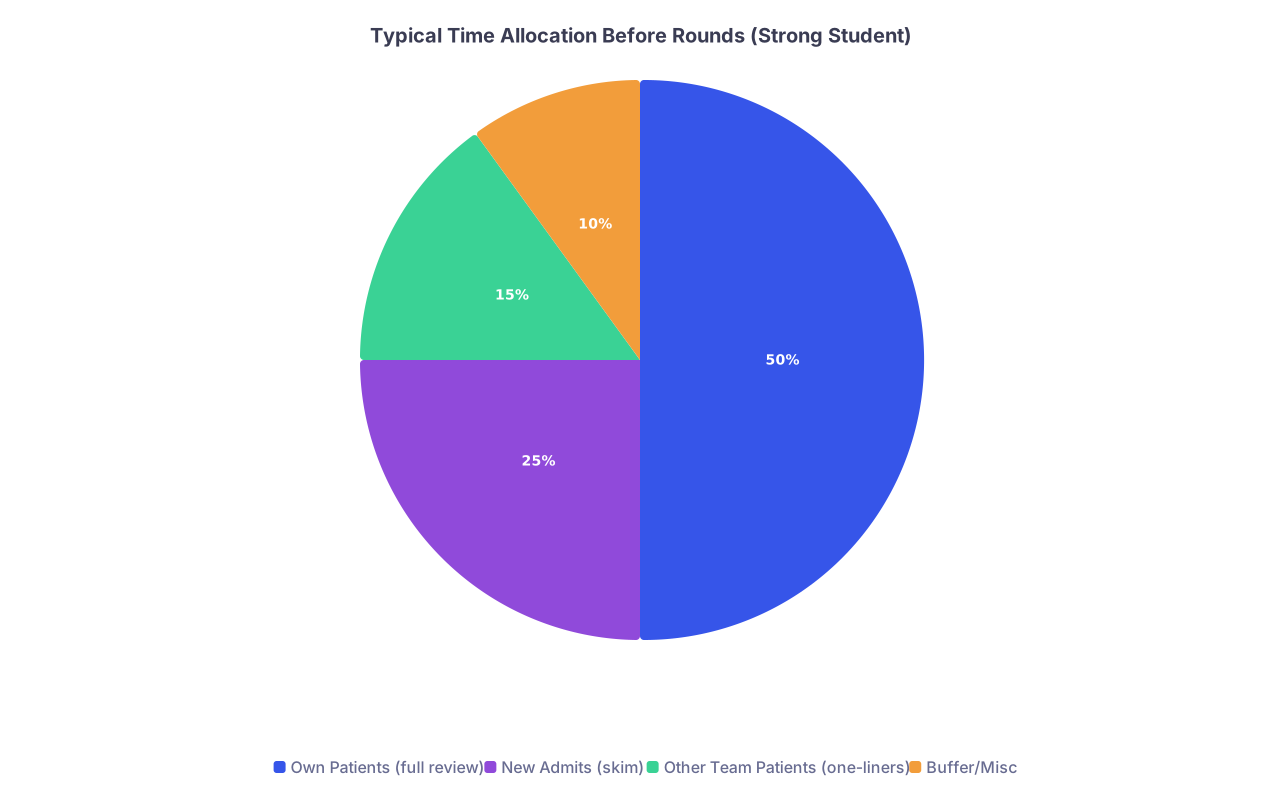
| Category | Value |
|---|---|
| Own Patients (full review) | 50 |
| New Admits (skim) | 25 |
| Other Team Patients (one-liners) | 15 |
| Buffer/Misc | 10 |
If you’re constantly getting ambushed because you truly have no idea who half the patients are, that’s not bad luck. That’s preparation.
Situations Where You Must 100% Admit Your Ignorance
There are times when “I haven’t read that” isn’t just okay—it’s mandatory.
You must speak up if:
- You’re being asked to enter an order and you don’t understand why or what it does.
- You’re asked to call a consult and don’t actually know the clinical question.
- You’re asked to consent a patient for something and don’t fully understand the procedure or risks.
- Someone assumes you followed up on a critical lab/imaging result and you didn’t.
Scripting this for real life:
Order scenario:
“Before I place that, I want to make sure I understand the reasoning. I haven’t read about that medication in this context yet—can we go over the indication and dose so I don’t enter something unsafe?”
Consult scenario:
“I haven’t reviewed the imaging myself yet—just the note. I want to quickly look at the CT and summarize the problem correctly before I call neurosurgery so I don’t misrepresent the case.”
No attending will fault you for not blindly pushing buttons you don’t understand. They will fault you for quietly doing something unsafe so you don’t look dumb.
How This Affects Your Evaluations
Here’s what actually ends up in your evals in this context:
Positive comments when you handle this well:
- “Honest and reliable. Never misrepresented what he’d done.”
- “Good insight into limitations. Asked for help appropriately.”
- “Prepared for rounds and took ownership when he fell short.”
Negative comments when you don’t:
- “Frequently unprepared and didn’t seem to know his patients.”
- “Needed repeated prompting to review charts and follow up data.”
- “Concern about reliability; not always clear what she had or hadn’t done.”
No one expects a third-year to have read every primary study or anticipate every pimp question. But they do expect:
- You know your own patients cold.
- You’re honest about what you haven’t done or don’t know.
- You’re closing those gaps quickly.
That’s the bar.
| Situation | Bad Response Example | Better Response Example |
|---|---|---|
| New patient on rounds | "I haven't read them." | "Just assigned; skimmed ED note; full review after rounds." |
| Missed labs overnight | "I didn't check." | "I missed that; I'll check now and add to my plan and note." |
| Asked to place unfamiliar order | Silently does it | "I don't know this med well; can we review indication and dosing?" |
| Follow-up after being unprepared once | Repeats pattern | Shows clear improvement and comes over-prepared next day |
A Simple Decision Framework You Can Use
If you like algorithms, here’s one you can actually keep in your head.

| Step | Description |
|---|---|
| Step 1 | Asked about a patient |
| Step 2 | Answer and admit specific gaps if needed |
| Step 3 | State what you know + what you havent reviewed |
| Step 4 | Admit you havent reviewed + commit to plan & timeline |
| Step 5 | Pause task, ask for guidance, then proceed safely |
| Step 6 | Fill in gaps after rounds |
| Step 7 | Prepare thoroughly next opportunity |
| Step 8 | Have you reviewed chart & seen patient? |
| Step 9 | Is this about a safety-critical task? |
If the thing they’re asking you to do feels like it could hurt someone if you’re wrong? That’s an automatic “I haven’t read enough to do this safely yet.”
How To Recover If You’ve Already Messed This Up
If you’ve already had the awkward “I haven’t read any of my patients” moment, don’t sulk. Fix it.
Do this over the next few days:
- Over-prepare for rounds. Know your patients cold.
- When you don’t know, use the structured, forward-looking answer.
- At a calm moment, say to your resident:
“I realized I came off unprepared the other morning. I’ve changed how I’m pre-rounding so that doesn’t happen again. If you see other gaps, I’d like the feedback.”
Residents remember improvement. Not just mistakes.
Quick Phrases You Can Steal
Use these exactly as written if you want:
- “I don’t know the answer to that yet; I focused on X this morning. I can look it up and report back after rounds.”
- “I haven’t fully reviewed this patient’s chart—I’ve only skimmed the ED note. I’ll do a full review and see them in person after this.”
- “I’m not comfortable placing that order without understanding it better—can we go over it so I don’t do something unsafe?”
- “I didn’t pre-round on this patient as thoroughly as I should have today. I’ll fix that and have a complete update by this afternoon.”
- “I don’t want to guess and give you wrong information; let me quickly check the chart so I can be accurate.”
These sound like a professional who takes both patients and learning seriously. That’s what you’re aiming for.

Bottom Line
You don’t get in trouble for not knowing everything. You get in trouble for:
- Faking it.
- Being consistently unprepared.
- Not learning from the first time it happens.
So:
- Yes, admit when you haven’t read about a patient—but do it with context, ownership, and a plan.
- Never guess about anything that affects patient safety; stop and say you don’t know.
- Use your “I haven’t read yet” moments as a trigger to tighten up your prep, not as a personality trait.
FAQ (Exactly 5 Questions)
1. Will I fail a rotation for saying “I haven’t read about this patient yet”?
Not for saying it once or occasionally, especially if you follow it with “Here’s what I do know and what I’ll do next.” You get into trouble when it’s a pattern—day after day of being unprepared—or when you lie or make things up. Honest gaps with visible improvement rarely fail anyone.
2. Is it better to guess an answer during pimping than to say I don’t know?
No. Guessing wildly, especially about management or dosing, makes you look careless. Best move: give your best reasoned attempt if you have some framework, then say, “That’s my guess based on [X]. I’m not fully sure—I’d like to read more about it.” Wild guessing with no thinking behind it is useless.
3. What if my resident seems annoyed every time I say I haven’t read something?
Some residents are just impatient. Your job is to shrink those moments by doing more prep, then be very concrete: “I haven’t read the full H&P yet; I focused on labs and overnight events. I’ll fill in the rest after rounds.” Over a few days, they should see the pattern improving. If you’re clearly working hard, most annoyance fades.
4. Do I need to know every patient on the service in detail?
No. You need to know your assigned patients in detail. For others, you should at least know a one-liner and their main issue. If your team is small or the list is short, expectations go up a bit. If it’s a 30-patient medicine service, no one expects you to have every detail memorized for patients you’re not following.
5. How do I handle being put on the spot in front of everyone?
Take a breath, don’t panic, and use the structure:
“I don’t know that yet. I do know [X]. I’ll look up [Y specific thing] and get back to you by [time].” Keeping your tone calm and matter-of-fact makes a huge difference. Everyone has been in that spot. How you recover from it is what people remember.


