The professionalism mistakes that actually get reported on clinical rotations are not the ones students obsess about. You are worrying about asking “too many questions” while someone else is getting written up for disappearing during call or falsifying vitals.
Let me be blunt: a single professionalism report can follow you into your dean’s letter, your MSPE, and your residency applications. Programs forgive mediocre shelves. They do not easily forgive integrity concerns.
Here is how students quietly sabotage themselves—and how you avoid becoming a cautionary story everyone whispers about on rounds.
1. The Cardinal Sin: Dishonesty and “Smoothing Over” the Truth
This is the one that does the most damage. Every attending I know has a story that starts with, “I could have forgiven the mistake, but then the student lied about it.”
Common dishonest behaviors that get reported
Making up patient data
- Writing “ROS negative” when you did not ask.
- Documenting “no chest pain” even though you never clarified.
- Filling in exam findings you did not actually examine (“lungs CTAB” when you never took the time).
Backfilling the story
- Claiming you saw a patient you did not actually see.
- Pretending you followed up on labs or imaging when you did not.
- Saying “I told the resident” or “I paged” when you never did.
Hiding or altering mistakes
- Forgetting to put in a crucial order, then quietly adding it later and denying the delay.
- Deleting or modifying a note to hide that you placed the wrong order, without owning it.
Dishonest excuses
- Repeatedly blaming “EMR issues,” “internet problems,” or “my alarm did not go off” when you actually just overslept or were careless.
Here is what you must understand:
Clinicians are used to error. We are not used to dishonesty. We will forgive genuine mistakes. We report patterns of lying.
Red flags faculty notice
- Your documentation never has uncertainty or gaps. Everything is “normal” and perfectly complete, which is rarely true in real life.
- You always “already did that” the moment someone suggests an action.
- Several nurses quietly mention that you are hard to find but your notes say you saw everyone.
How to avoid this trap
Admit when you did not do something. Immediately.
Say:- “I did not ask that. I can go back now.”
- “I have not seen that patient yet; I will see them right after rounds.”
Be precise with your wording.
- “Patient denies chest pain when asked today” is different from “No chest pain” copied from yesterday.
Own your errors fast, before someone else discovers them.
- “I realized I did not put in the potassium replacement. I am doing it now; I am sorry for missing that earlier.”
The mistake: trying to look perfect.
The correct move: being reliably honest and fixable.
2. Disappearing Acts: Unreliable Attendance and Vanishing on Service
You can be quiet, introverted, even awkward, and still be fine. What you cannot be is missing.
Behaviors that get tagged as professionalism issues
Chronically late
- Strolling in at 7:10 for a 7:00 start. Every. Single. Day.
- Being “just 5 minutes late” to sign-out or the OR repeatedly.
Early exits
- Regularly leaving right after conference or lunch without telling anyone.
- “Slipping out” during slow times and assuming no one notices. They notice.
Not being where you are supposed to be
- Assigned to clinic but spending half the day “studying in the library.”
- Being unpageable—phone on silent, not answering texts from the team.
The ghost on call
- Leaving the floor for hours at night, not telling the resident, and missing admissions or rapid responses.

| Step | Description |
|---|---|
| Step 1 | Assigned Start Time |
| Step 2 | Present on Rounds |
| Step 3 | Late Pattern |
| Step 4 | Perceived Reliable |
| Step 5 | Unreachable / Missing |
| Step 6 | Professionalism Concern |
| Step 7 | On Time? |
| Step 8 | Still Reachable? |
Here is why this gets reported:
Unreliability is interpreted as disrespect for patient care and for the team, not just “bad time management.”
How this shows up in your evaluation
People will not usually write “student disappeared for 2 hours” in your face. They will write:
- “Limited availability.”
- “Professionalism concerns—reliability.”
- “Frequently late and difficult to locate on service.”
- Or they will check the dreaded “Below expectations” box under Professionalism.
How to avoid looking unreliable
Clarify expectations up front.
On day one:- “What time should I arrive?”
- “When is it appropriate for me to leave? Who should I check out with?”
Always check out with someone before leaving.
- Resident not around? Text/call: “I am heading out for the day, anything you would like me to finish before I go?”
Treat “start time” as already working, not walking in.
- If rounding starts at 7:00, you are there before 7:00 with notes reviewed.
The mistake: assuming as long as you “get your work done,” timing does not matter.
The reality: reliability is part of your “work.”
3. Phones, Social Media, and the “Distracted” Student
Nothing tanks perceived professionalism faster than being the person always looking down at a phone.
Behaviors that get you reported (yes, even now)
Phones out in front of patients
- Looking up something on UpToDate without saying that is what you are doing.
- Texting while in the room, even if it is “just” your family.
Scrolling during conference or rounds
- Sitting in didactics, clearly on Instagram or TikTok.
- Standing at the back of rounds with your phone out while your attending talks.
Unprofessional social media posts
- Photos in scrubs with any patient-identifiable context in the background.
- Complaining about “crazy psych patient in room 18” or “OR case took forever, what a waste” online—even without names.
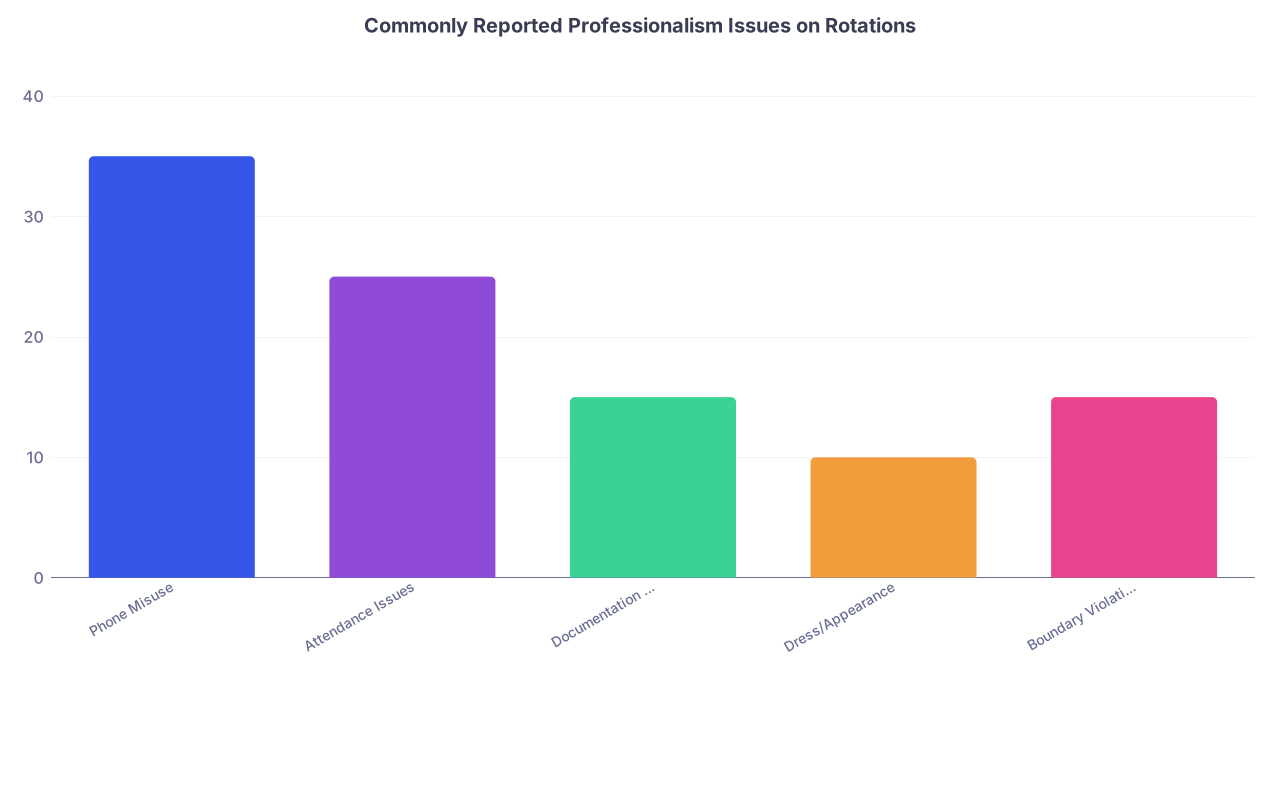
| Category | Value |
|---|---|
| Phone Misuse | 35 |
| Attendance Issues | 25 |
| Documentation Problems | 15 |
| Dress/Appearance | 10 |
| Boundary Violations | 15 |
Faculty see this as disrespectful and unsafe. And they are not entirely wrong. If a patient codes while you are glued to your phone, no one cares that you were “just checking the schedule.”
Protect yourself with clear habits
Keep your phone away by default.
- White coat pocket, bag, or on silent face-down.
- Pull it out only for a clear purpose (pager texts, references) and say what you are doing.
Narrate when using it for clinical reasons.
- “I am going to quickly check the dosing in Epocrates.”
This one sentence reframes you from “bored and texting” to “careful and thorough.”
- “I am going to quickly check the dosing in Epocrates.”
Social media rule: if you need to ask if it is okay, it is not.
- No photos at the nurses’ station.
- No posts about specific shifts, cases, or near-miss events. Ever.
The mistake: treating your rotation like a long lecture where you can half-listen.
The fix: assume everyone can see what you are doing with your hands and eyes. Because they can.
4. Boundaries With Patients: Being “Too Casual” or Too Close
Most students are not predators. They are careless. And careless boundary violations still get reported, sometimes aggressively.
Behaviors that raise serious red flags
Inappropriate jokes or comments
- Laughing with staff about a patient’s weight, hygiene, or behavior within earshot.
- Making “light” comments about sex, substances, or body parts that are clearly not clinical.
Over-sharing personal information
- Giving patients your personal phone number or social media.
- Engaging in long, personal conversations that blur whether you are a professional or a new friend.
Physical contact beyond what is clearly clinical
- Hugging patients, especially without them initiating it.
- Touching shoulders, backs, or hands during emotional conversations for longer than a brief, neutral support gesture.
Texting or DMing patients/families
- Sending information or “checking in” from your personal accounts.
- Accepting friend requests or following them back on social platforms.
Here is what people forget:
Professional boundaries are about protecting both the patient and you. Once a concern is raised, you do not get to control the narrative.
Practical rules that keep you safe
No personal contact info.
- Everything goes through clinic numbers, hospital systems, or official messaging if allowed.
Keep touch minimal and clearly supportive.
- A brief touch on the shoulder during bad news is usually fine; a long embrace is not.
Run gray-zone situations by an attending or resident.
- “The family asked if they can email me an update; is that appropriate?”
If your gut feels weird, trust it.
- “The family asked if they can email me an update; is that appropriate?”
The mistake: thinking being “the nice one” means being less boundaried.
The correct approach: kindness within clear, professional limits.
5. Disrespecting Staff, Residents, or the Team
Attitudes get reported just as often as actions. Sometimes more.
Common disrespect patterns that set off alarms
Talking down to nurses or techs
- Ignoring nursing requests or rolling your eyes at “another page.”
- Saying things like “I do not know why the nurse cannot just do that” in front of others.
Trash-talking residents or attendings
- Complaining loudly at the desk that “this attending is ridiculous” or “this resident does not know anything.”
- Sarcastic comments under your breath when you get assigned scut work.
Refusing reasonable tasks
- Saying “That’s not my job” when asked to help transport a patient, get labs, or bring a blanket.
- Withdrawing or going silent when feedback is given instead of engaging.
Public arguments
- Getting into a heated disagreement about orders in front of the patient.
- Snapping at a team member during rounds.
Staff talk. And they talk to attendings. The fastest way to tank a rotation is to be the student the nurses do not want back.
How to avoid becoming “that student”
Default to humility.
- You are learning. Everyone around you, including the unit clerk, knows things you do not.
Vent away from clinical spaces, with safe people.
- If you must complain, do it in private with someone completely outside the immediate team, and never on social media.
Take feedback without arguing in the moment.
- You can disagree internally. Out loud, say: “Thank you, I will work on that.”
Reflect later. Do not defend every action in real time.
- You can disagree internally. Out loud, say: “Thank you, I will work on that.”
The mistake: assuming your frustration is invisible. It is not.
Your micro-reactions are the entire story for people who only interact with you a few minutes a day.
6. Documentation and Confidentiality Landmines
Students underestimate how fast charting and privacy mistakes escalate to formal reports.
Documentation missteps that get flagged
Copy-pasting entire notes without reading them and leaving in wrong information:
- Wrong exam findings
- Wrong medication lists
- Outdated code status
Writing snarky, judgmental, or speculative comments in the chart:
- “Patient is drug-seeking.”
- “Difficult family, likely personality disorder.”
- “Non-compliant, probably will not follow up.”
Including gossip-level details not relevant to care:
- “Patient cheated on spouse with neighbor.”
- “Patient reports recent fight with mother about sexual history.”
Charting things you did not personally verify:
- Documenting “full neuro exam normal” when you did not do one.
Confidentiality errors that cross lines
Discussing patients in public spaces:
- Elevators, cafeterias, shuttle buses—using room numbers and diagnoses.
Someone hears you. Sometimes that “someone” is hospital administration.
- Elevators, cafeterias, shuttle buses—using room numbers and diagnoses.
Leaving patient lists visible
- Printed lists left on cafeteria tables or in conference rooms.
- Screens unlocked at workstations.
Sharing cases online
- “Wildest case on trauma today…” followed by age, mechanism, injuries, or time.
It does not take much to identify a specific patient in a small community.
- “Wildest case on trauma today…” followed by age, mechanism, injuries, or time.
| Risky Phrase in Chart | Safer Professional Alternative |
|---|---|
| "Drug-seeking behavior" | "Requests early refills; reports uncontrolled pain" |
| "Non-compliant" | "Has not taken medications as prescribed; cites cost/side effects" |
| "Difficult family" | "Family frequently questions plan; requests frequent updates" |
| Findings you did not examine | Leave blank or write "Not assessed today" |
| Personal gossip details | Omit unless directly relevant to diagnosis/care |
How to protect yourself
Treat the chart like a legal document. Because it is.
- Write like a future lawyer, reviewer, or patient will read your note. Because they might.
Only document what you actually did or clearly observed.
- “Per patient report…” is different from stating something as fact.
Zero patient details on social media.
- Even de-identified “stories” with time stamps and specific patterns can be traced.
The mistake: thinking of notes and privacy as “just paperwork.”
In reality, these are areas where professionalism is formally evaluated.
7. Emotional Reactivity, Bias, and Losing Your Cool
Nobody expects a third-year to be emotionally bulletproof. But certain behaviors make people quietly document concerns.
Patterns that worry supervisors
Hostility or visible contempt toward certain patients
- Rolling your eyes at “frequent flyers,” substance use disorders, or patients with obesity.
- Making subtle but real comments that suggest bias about race, gender identity, mental health, or socioeconomic status.
Breaking down in uncontrolled ways repeatedly
- Crying is human. But regularly leaving the floor sobbing, vanishing from care, or refusing to see certain patients because you are too upset will lead to concerns.
Anger outbursts
- Throwing pens, slamming charts, cursing at computers in front of staff.
- Sharp tone with patients or families when stressed.
Refusing “difficult” patient assignments
- Saying, “I do not want to see psych patients” or “I cannot do end-of-life talks” on principle.
Here is the quiet truth:
Attendings will go out of their way to support a struggling but self-aware student. They will not do the same for someone who denies, externalizes, or blames.
Safer ways to handle your limits
Acknowledge your reaction privately, then seek targeted help.
- “I am finding myself getting really frustrated with this case; can I get some guidance on how to approach it professionally?”
Ask for debriefs after hard events.
- Codes, deaths, trauma cases—these are emotionally heavy. Asking to discuss them shows maturity, not weakness.
If you are really not okay, say something early.
- “I am overwhelmed right now and worried I cannot safely participate in care. Who can I talk to?”
That is a professionalism win, not a failure.
- “I am overwhelmed right now and worried I cannot safely participate in care. Who can I talk to?”
The mistake: pretending you are fine until you explode.
The professional move: recognizing your threshold and loop in support before it hurts patients or the team.
8. The “Quiet Killer”: Ignoring Feedback
You will not be reported for getting constructive criticism. You will be reported for ignoring it.
Patterns faculty interpret as unprofessional
Same feedback, rotation after rotation
- “Needs to improve punctuality.”
- “Needs to participate more actively.”
Once it hits “pattern,” it becomes a professionalism problem.
Deflecting responsibility every time
- “The nurse did not tell me.”
- “The resident was late.”
- “I was not told that expectation.”
Arguing with feedback in real time
- “Actually, that is not accurate…”
- “Well, other attendings said I was doing fine.”
You may be right on the facts, but you lose on professionalism optics.
How to signal growth instead of resistance
Three-step response to feedback:
- Listen without interrupting.
- Summarize back: “So what I am hearing is I need to…?”
- Ask: “What would that look like to you on a daily basis?”
Show evidence of change quickly.
- If they told you to pre-round earlier, do it the next day.
- If they said to speak up more, volunteer to present.
Track recurring comments across rotations.
- If three people mention the same thing (lateness, engagement, tone), you have a real pattern. Fixing that is higher-yield than any extra Anki deck.
The mistake: assuming feedback is just opinion and can be ignored.
Reality: repeated unaddressed concerns become formal professionalism flags.
Final Thoughts: The Few Things You Must Not Screw Up
You can survive an average shelf. You cannot easily outgrow a reputation for dishonesty, unreliability, or disrespect.
If you remember nothing else:
- Never lie, fudge, or “smooth over” the truth in patient care. Own your gaps quickly and clearly.
- Be reliably present, reachable, and respectful. Show up when you say you will, treat everyone decently, and keep your phone in check.
- Guard boundaries, privacy, and the chart like your future depends on it. Because for residency applications, it just might.