
Most MS3s talk too long and say too little. The ones who shine do the opposite.
Teaching scripts are how you get there. Short, evidence-based, and sharp enough that attendings actually remember you said something useful.
Let me break this down specifically: you are not trying to “sound smart.” You are trying to deliver 20–40 second, guideline-anchored, exam-relevant pearls that:
- Show you read beyond UpToDate summaries.
- Help the team make a decision or remember a rule.
- Are short enough that nobody wants you to stop talking.
This is how residents and attendings quietly separate the serious students from the tourists.
What A Good Teaching Script Actually Is
A teaching script is a pre-built, rehearsed mini-teach: 2–5 sentences, one key evidence anchor, one clinical hook. That is all.
Bad:
“Um, so COPD is like, you know, chronic airflow limitation and you can classify it like GOLD 1–4, and I think like there’s FEV1 cutoffs and then there are exacerbations, and ICS is used, but it also increases pneumonia, and then there’s like triple therapy…”
Good:
“For COPD, GOLD now recommends basing initial therapy more on symptom burden and exacerbation risk than just FEV1. Patients with ≥2 moderate or ≥1 severe exacerbation in the past year benefit most from dual bronchodilators, and you add inhaled steroids if eosinophils are high or exacerbations persist. ICS helps exacerbations but increases pneumonia risk, especially in older patients.”
Notice: one guideline name, one number, one nuance. Done.
You want a small arsenal of these for each core rotation: IM, surgery, OB/GYN, peds, psych, EM. You will reuse them constantly.
How To Build A Teaching Script (Stepwise, Not Theoretical)
You do this the night before or early morning, not on the fly. On the fly is how you ramble.

| Step | Description |
|---|---|
| Step 1 | Pick a Common Problem |
| Step 2 | Find 1 Guideline or High-Yield Source |
| Step 3 | Extract 1-2 Actionable Points |
| Step 4 | Add 1 Number or Threshold |
| Step 5 | Write 2-5 Sentences, Max |
| Step 6 | Practice Out Loud Once |
Let me walk through with a concrete example: community-acquired pneumonia (CAP).
- Pick the problem: “CAP in a stable inpatient on medicine.”
- Source: 2019 ATS/IDSA CAP guideline.
- Extract:
- First-line regimen for non-ICU inpatient without MRSA/Pseudomonas risks.
- Duration (no, it is not 10–14 days by default).
- Add numbers: 5 days minimum, afebrile 48–72 hours, etc.
- Build the script.
Example script:
“Quick CAP pearl: the 2019 ATS/IDSA guideline recommends a minimum of 5 days of antibiotics for non-ICU inpatients as long as they are afebrile for 48–72 hours, hemodynamically stable, and clinically improving. For a typical adult without MRSA or Pseudomonas risk, ceftriaxone plus azithromycin or a respiratory fluoroquinolone alone are first-line. Longer courses are reserved for slow responders or complicated infections like empyema.”
Time yourself. That is about 25–30 seconds out loud. Perfect.
You want that level of precision for your highest-yield topics.
Core Internal Medicine Teaching Scripts (That Actually Impress)
These are the ones that consistently land well with IM attendings and senior residents.
1. Chest Pain / ACS Risk Stratification
“Chest pain triage pearl: for possible NSTEMI/UA, I think in terms of ECG, troponin trend, and risk score. The HEART score is simple and validated: History, ECG, Age, Risk factors, Troponin. Scores 0–3 are low risk with <2% 6-week MACE, 4–6 intermediate, 7–10 high risk. Low-risk patients with negative serial troponins and non-ischemic ECGs can often be discharged with close follow-up instead of automatic admission.”
Anchor: HEART score and <2% MACE. Shows you understand risk-stratification, not just “troponins and admit.”
2. DKA vs HHS – One Clean Distinction
“DKA vs HHS in one line: DKA is an anion gap metabolic acidosis with ketones, usually glucose >250; HHS has much higher glucose, often >600, minimal or no acidosis, and higher serum osmolality. DKA patients tend to be younger type 1 diabetics and present faster, while HHS develops over days in older type 2 patients with more profound dehydration and higher mortality.”
If you want to add a second line:
“Both get aggressive fluids first, but we are much more cautious with fluids in elderly HHS patients with comorbid cardiac disease.”
That is enough.
3. First-Line Diuretics in CHF Exacerbation
“For acute decompensated HFrEF, the mainstay is IV loop diuretics. If the patient is on chronic oral furosemide, a common approach is starting IV at 1–2 times their total daily oral dose divided BID. We look for about 1–2 liters net negative per day and adjust based on symptoms, weights, and creatinine. If diuretic resistance develops, adding a thiazide-type diuretic like metolazone 30 minutes before the loop can help but increases the risk of electrolyte derangements.”
Very practical. Sounds like you have watched people actually manage volume.
4. Evidence-Based VTE Prophylaxis Threshold
“VTE prophylaxis pearl: hospitalized medical patients with reduced mobility and a Padua score ≥4 are considered high risk for VTE and usually benefit from pharmacologic prophylaxis unless contraindicated. Low molecular weight heparin like enoxaparin 40 mg daily is standard. We avoid pharmacologic prophylaxis when platelet count is very low, active bleeding, or very high bleeding risk, and use mechanical methods instead.”
Even if your attending does not care about Padua by name, the fact that you know there is a scoring system and a threshold is impressive.
Surgery Rotation Scripts: Pack Them With Practicality
Surgeons have a short attention span for fluff. They like numbers, cutoffs, and “what do we do tomorrow morning.”
1. Antibiotic Prophylaxis Timing
“OR antibiotic timing: surgical prophylaxis is most effective when given within 60 minutes before incision for most agents, and within 120 minutes for vancomycin or fluoroquinolones. Redosing is needed if the procedure is prolonged beyond 2 half-lives of the drug or if there is major blood loss, often >1.5 liters. Extending prophylaxis beyond 24 hours after most clean-contaminated procedures does not reduce infections but increases resistance and C. diff risk.”
This hits stewardship and practical operations.
2. Post-Op Fever Framework (The One That Never Dies)
Yes, the “5 W’s” is old, but it is still used constantly on rounds.
“Post-op fever framework: I think about the 5 W’s roughly by timing. Wind (atelectasis, pneumonia) in the first 1–2 days; Water (UTI) after catheter use; Wound (surgical site infection) usually day 3–7; Walk (DVT/PE) anytime after immobilization; Wonder drugs or abscess with later or persistent fevers. Early low-grade fevers in the first 24–48 hours are often inflammatory; persistent or higher fevers deserve targeted workup based on this framework.”
Short. Systematic. Safe.
3. ERAS and Early Feeding
“ERAS pearl: for many colorectal and abdominal procedures, enhanced recovery protocols support early feeding and ambulation instead of the old ‘wait for flatus’ approach. Early enteral nutrition within 24 hours improves gut integrity, shortens length of stay, and does not increase anastomotic leak rates in stable patients. We still individualize for high-risk anastomoses or hemodynamic instability.”
Quoting ERAS principles makes surgeons perk up a bit.
OB/GYN Scripts: Show You Know Guidelines, Not Myths
OB attendings are very sensitive to outdated or anecdotal “rules.” Anchor to ACOG and major trials when you can.
1. Preeclampsia Diagnostic Cut
“Preeclampsia definition: new-onset hypertension after 20 weeks gestation—≥140/90 on two occasions at least 4 hours apart—in a previously normotensive woman, plus either proteinuria (≥300 mg per 24 hours or protein/creatinine ratio ≥0.3) or signs of end-organ dysfunction like thrombocytopenia, elevated LFTs, renal insufficiency, pulmonary edema, or new-onset cerebral or visual disturbances. Severe features include pressures ≥160/110 or significant end-organ signs and usually push us toward delivery depending on gestational age.”
Clean, guideline-consistent.
2. GBS Prophylaxis in Labor
“GBS prophylaxis pearl: intrapartum IV penicillin G is recommended for women who are GBS-positive on screening at 36–37 weeks, have GBS bacteriuria during this pregnancy, or have had a prior infant with invasive GBS disease. We can also give prophylaxis based on risk factors if GBS status is unknown and there is preterm labor, prolonged rupture of membranes ≥18 hours, or intrapartum fever. Adequate prophylaxis is at least 4 hours of antibiotics before delivery.”
Obvious value to the team. Quick decision rules.
Pediatrics: Parents, Dosing, and When To Worry
Peds attendings love when you know cutoffs cold and can talk criteria, not vibes.
1. Febrile Infant 29–60 Days Old
“For well-appearing febrile infants 29–60 days old, newer risk stratification tools like the Rochester, Step-by-Step, or PECARN criteria help identify low-risk babies who may not need a full sepsis workup or admission. Low-risk includes normal exam, no focal infection, good appearance, normal UA, low inflammatory markers, and negative viral testing where applicable. High-risk features or age <28 days still push us toward full sepsis workup and empiric IV antibiotics.”
You do not need all lab thresholds memorized as an MS3, but knowing the concept of structured risk tools is already a step up.
2. AOM (Acute Otitis Media) Treatment Thresholds
“AOM treatment pearl: for children 6–23 months with unilateral non-severe AOM, observation with close follow-up for 48–72 hours is acceptable; immediate antibiotics are recommended for bilateral AOM in this age group or for any child with severe symptoms like moderate to severe otalgia or fever ≥39°C. High-dose amoxicillin, 80–90 mg/kg/day divided BID, is first-line in most kids without recent amoxicillin exposure or purulent conjunctivitis.”
Numbers, age ranges, doses. Gold.
Psych: Short Scripts Beat Vague Labels
Psych attendings quickly lose patience with “they’re depressed” without structure.
1. Major Depression – PHQ-9 as a Tool, Not a Crutch
“Depression pearl: major depressive disorder requires at least 5 symptoms for at least 2 weeks, including either depressed mood or anhedonia, with functional impairment and not better explained by substances or a medical condition. The PHQ-9 is a quick screening and severity tool; scores ≥10 correlate with clinically significant depression. For mild cases, psychotherapy alone can be enough; for moderate to severe, SSRIs plus therapy have the best evidence.”
Short, DSM-anchored, and practical.
2. Suicide Risk – What You Actually Ask
“When I assess suicide risk, I structure it: ideation, intent, plan, means, and past attempts. Active ideation with a specific plan and access to means, especially with a history of prior attempts, puts the patient in a high-risk category and usually warrants emergent psychiatric evaluation and likely inpatient care. Passive thoughts without plan or intent, good social support, and willingness to engage in safety planning and follow-up are lower risk but still need very clear outpatient arrangements.”
Psych attendings like seeing structure and safety thinking.
EM / Cross-Rotation Scripts: These Work Everywhere
These are pearls you can use on nearly any service without sounding out of place.
1. Sepsis: Fluid and MAP Targets
“Sepsis resuscitation basics: we start with 30 mL/kg of crystalloid within the first 3 hours for hypotension or lactate ≥4, then reassess volume responsiveness and perfusion. The initial target is a MAP ≥65 mmHg; if that is not achieved with fluids, norepinephrine is first-line vasopressor. Updated data emphasize early antibiotics and source control plus individualized fluid after the initial bolus rather than reflexive large volumes in everyone.”
This shows you understand current, nuanced sepsis care, not just “give fluids and pressors.”
2. Acute PE Risk Stratification
“PE pearl: confirmed PE is risk-stratified by hemodynamics and RV strain. Massive PE is defined by sustained hypotension or need for pressors and usually prompts consideration of systemic thrombolysis or advanced interventions. Submassive (intermediate risk) has RV strain or elevated troponin/BNP but normal blood pressure, and is typically treated with anticoagulation plus close monitoring. Low-risk patients without RV strain or biomarker elevation can often be managed with standard anticoagulation and may even qualify for early discharge in some protocols.”
Attendings love when a student talks in categories that map to management.
How To Deliver These On Rounds Without Being Annoying
The content matters. The timing and tone matter more.
Where To Insert A Script
You have three high-yield slots:
After presenting your patient, when the team is deciding management.
“For this patient’s CAP, there is one quick guideline point I read last night that might be relevant—20 seconds.”Walking between patients, when the attending clearly has mental space.
“Could I run a quick 30-second pearl on DKA vs HHS that I practiced for myself?”At the end of the day, when someone asks, “Any questions?”
You say: “I actually prepared a very short teaching point about VTE prophylaxis if you are open to it.”
Do not interrupt. Do not launch into a script uninvited while the attending is actively thinking or placing orders.
How Long Is Too Long?
Aim for 20–40 seconds. If you cross 60, people feel it.
Practice with a timer once. Not because you are performing, but because you need an internal sense of how long 30 seconds actually is.
How To Signal You Are Evidence-Based (Without Flexing)
Use one anchor phrase, then move on:
- “The 2019 ATS/IDSA guideline suggests…”
- “Per ACOG, preeclampsia is defined as…”
- “Enhanced recovery protocols support early feeding…”
Do not start listing trial acronyms like a Step 1 robot. You get diminishing returns quickly.
How To Study For Teaching Scripts (Not Just Exams)
Here is the trick: you do not add work. You reframe work you already do.
You are already reading about your patients. Convert one thing per day into a script.

Concrete routine:
- Pick one patient problem from today: DKA, CAP, CHF, post-op fever, preeclampsia.
- Open UpToDate or a guideline, skim just enough to find:
- One management threshold or diagnostic cutoff.
- One “this changed recently” or “common misconception.”
- Draft 3–4 sentences in your own words.
- Practice once out loud. Edit ruthlessly.
You now have:
- Learned for the shelf.
- Prepared something valuable for rounds tomorrow.
- Started building a mental index of clean, structured frameworks.
This is exactly what strong sub-interns and junior residents do. They just stop calling them “teaching scripts.”
Example Mini-Repertoire For Each Core Rotation
If you want a simple planning map, here is what I usually tell my students to aim for by mid-rotation.
| Rotation | Number of Scripts | Example Topics |
|---|---|---|
| Internal Medicine | 8–10 | CAP, CHF, DKA vs HHS, AKI workup, VTE prophylaxis, COPD, AFib anticoagulation, sepsis bundle |
| Surgery | 5–7 | Abx prophylaxis, post-op fever, ERAS basics, SBO initial management, DVT prophylaxis peri-op |
| OB/GYN | 5–7 | Preeclampsia, GBS prophylaxis, indications for induction, postpartum hemorrhage basics, ectopic pregnancy |
| Pediatrics | 5–7 | AOM treatment, bronchiolitis admission criteria, febrile infant, asthma exacerbation management, dehydration assessment |
| Psychiatry | 4–6 | Major depression criteria, suicide risk assessment, first-line treatments for anxiety, antipsychotic side effects |
Build slowly. Two per week per rotation is enough to stand out.
Visualizing Your Growing Script Arsenal
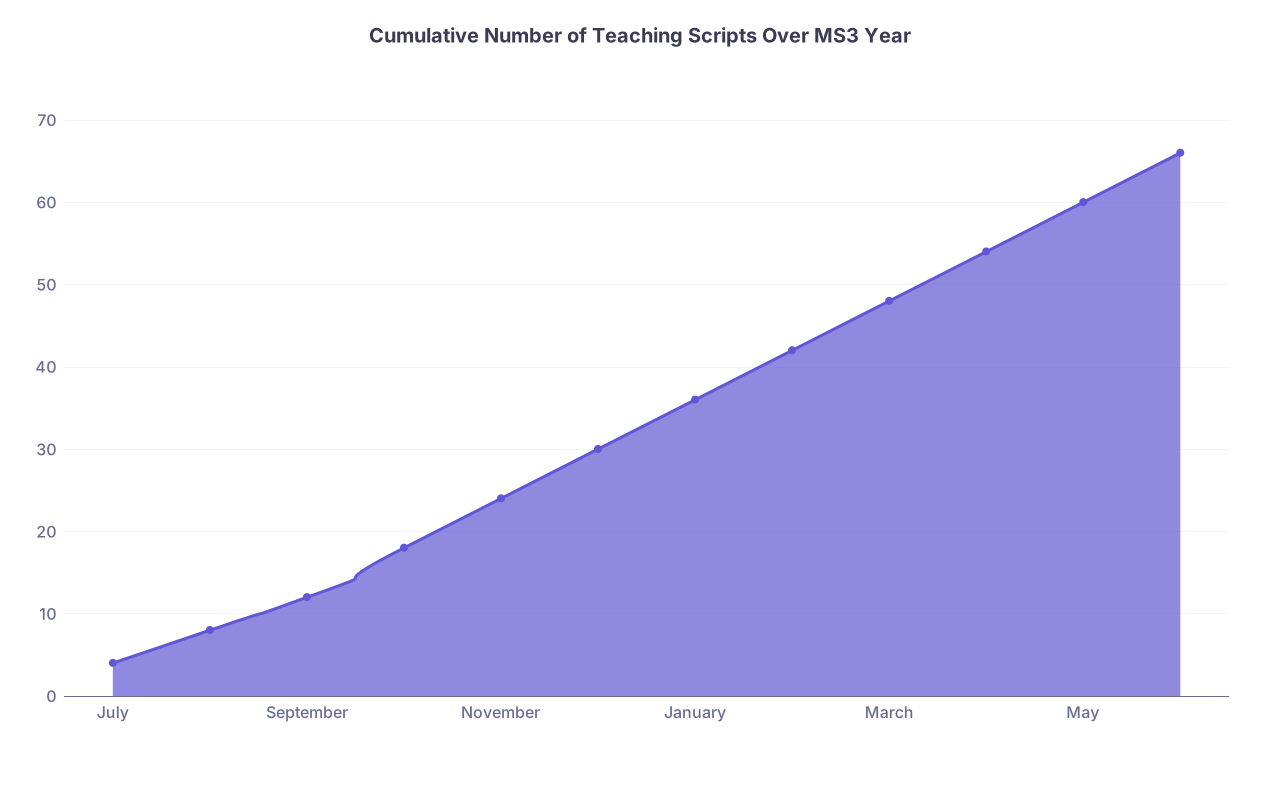
Sometimes it helps to see the accumulation. If you do just 2 scripts a week across a full clinical year, you end up with dozens.
| Category | Value |
|---|---|
| July | 4 |
| August | 8 |
| September | 12 |
| October | 18 |
| November | 24 |
| December | 30 |
| January | 36 |
| February | 42 |
| March | 48 |
| April | 54 |
| May | 60 |
| June | 66 |
By spring, you will sound like a junior resident without faking it.
How This Translates To Evaluations And Letters
Let us be blunt. Attendings write:
- “Reads around his/her patients.”
- “Offered concise, evidence-based teaching points that benefited the team.”
- “Demonstrated strong clinical reasoning and up-to-date knowledge.”
Those lines do not come from “hard work” in the abstract. They come from very specific observable behavior: clear, brief, guideline-anchored contributions that are easy to remember at write-up time.

Your teaching scripts are the most efficient way to generate that behavior, consistently.
Putting It All Together On A Real Day
Imagine an internal medicine day:
- You have a DKA patient, a COPD exacerbation, and a new CAP admission.
- The night before, you prepared one DKA vs HHS distinction script and one CAP duration/antibiotic script.
Rounds:
After presenting the CAP patient, you say:
“Quick CAP guideline point—20 seconds?”
You deliver your 5-day / criteria / antibiotic regimen script. Done.Later, walking between rooms, the attending mentions “HHS looks different.” You say:
“I actually practiced a 20-second comparison of DKA vs HHS for myself—can I share?”
You deliver it cleanly.
End of week, what do they remember?
Not that you read “a lot.” They remember that you:
- Gave two short, useful, exactly-on-topic pearls.
- Used numbers and guideline language correctly.
- Did not waste time or derail rounds.
That is how you stand out as an MS3 without being a gunner caricature.

FAQ (Exactly 4 Questions)
1. How many teaching scripts should I realistically aim to have per rotation?
For a standard 6–8 week rotation, five to ten scripts is plenty. You are not giving a noon conference; you are just having a few sharp mini-teaches up your sleeve. Prioritize the most common problems and the ones your team is actually seeing: if you are on a CHF-heavy cardiology month, you might have three different CHF-related scripts and skip something obscure.
2. What if my attending seems uninterested or shuts down teaching?
Some attendings are transactional: they want rounds fast and focused. Do not force it. In those settings, use your scripts mostly for yourself and for teaching interns/MS2s. You can still slip in a single sentence framed as a clarification: “My understanding is that current guidelines suggest at least 5 days for CAP if afebrile and stable—is that consistent with your practice?” That shows knowledge without a full monologue.
3. How do I keep from sounding memorized or robotic?
You practice just enough to be smooth, then you consciously relax your delivery. Look at the person, not your notes. Use natural phrasing and be willing to adapt mid-sentence if the attending jumps in. Scripts are scaffolding, not a script you must recite verbatim. The more you understand the underlying logic—thresholds, risk stratification, physiology—the less you will sound rehearsed.
4. Should I cite specific trials and acronyms, or just guidelines?
As an MS3, stick to guideline names and key concepts. Mentioning “the 2019 ATS/IDSA CAP guideline” or “ACOG criteria for preeclampsia” is enough. Trial names (like ARDSNet, PROSEVA, etc.) are useful only if they clearly change management and you actually understand what they showed. Overloading your script with acronyms signals insecurity more than sophistication.
Key points:
Keep your teaching scripts brutally short, anchored to one guideline or clear cutoff, and timed to the team’s actual decisions. Build them out of what you already read for your patients, two per week per rotation. Deliver them with restraint and precision, and your “reads around patients” reputation will take care of itself.