It is 4:45 a.m. Your alarm just went off in a dark apartment. You are on your first inpatient rotation. Rounds start at 7:00 a.m., your intern moves at light speed, and yesterday you got called out for not knowing your patient’s morning potassium. You are staring at your phone wondering, “What exactly should I be doing from now until rounds so I do not look lost?”
You need a clock-based plan. Not vibes. Not “show up early and work hard.” A literal, time-stamped morning playbook.
This is that playbook.
Big Picture: Your Pre-Rounding Timeline
Pre-rounding is mostly the same across medicine, surgery, peds, OB, psych inpatient, etc. Details shift, but the skeleton holds.
Assume:
- Rounds start: 7:00 a.m.
- You have 3–5 patients
- You are a MS3 on an inpatient service
We will walk backward from 7:00 a.m.
| Time | Focus Area |
|---|---|
| 6:30–6:55 | Bedside checks & exams |
| 6:10–6:30 | Chart review & note edits |
| 5:55–6:10 | Arrival & systems check |
| 5:30–5:55 | Commute / mental setup |
| 5:00–5:30 | Wake-up & quick prep |
You will adjust this once you know:
- How fast you walk
- How chaotic your team is
- How many patients you usually carry
But this is a solid starting blueprint.
(See also: How to Prepare the Weekend Before Starting Any Core Rotation for more details.)
5:00–5:30 a.m. – Wake-Up and Pre-Hospital Setup
At this point you should not be checking Epic yet. You are not a resident. You need a functioning brain first.
5:00–5:10 – Wake Up, Minimal Decision Making
- Clothes laid out the night before.
- Bag packed the night before.
- ID badge, penlight, stethoscope, hospital login token/card in the same pocket. Every. Time.
If you are deciding what to wear or hunting for your badge at 5:07 a.m., you are already behind.
5:10–5:20 – Fast Breakfast and Fluids
You do not need a gourmet meal. You do need:
- Something with protein (eggs, yogurt, protein bar)
- Water + caffeine (coffee or tea, not energy drink sludge at 5 a.m. if you can avoid it)
Eat sitting down, not while sprinting. This is probably the only guaranteed calm 10 minutes you get all day.
5:20–5:30 – Quick Mental Run-Through
On the way out the door or during your commute, mentally rehearse each patient:
- Name, age, 1–2 word diagnosis (“Smith, 64, COPD exacerbation”)
- One key active problem you know you must follow (“watch Cr, diuresis?”)
If you made an end-of-day to-do list yesterday (you should), glance at it. This keeps you from walking in and wasting 10 minutes just remembering who is who.
5:30–5:55 a.m. – Commute and On-Arrival Priorities
5:30–5:45 – Commute = Light Review
If you use public transportation or are not driving:
- Skim yesterday’s progress notes (screenshots or printed list).
- Review 1–2 guidelines or quick pearls relevant to your sickest patient (e.g., sepsis bundles, heart failure diuresis targets).
If driving:
- No PDFs. But you can run through each patient out loud:
- “Mr. Jones – GI bleed, Hgb 6.9 yesterday, transfused 1 unit, scope planned today.”
By the time you park, you should be able to summarize each patient in two sentences without thinking.
5:45–5:55 – Get in the Door and Log In
At this point you should:
- Be in the hospital by 5:45–5:50 on a medicine service with 7 a.m. rounds.
- Be on the unit or near a workstation by 5:55, not still in the lobby staring at the coffee cart.
Immediately:
- Log into EMR (Epic/Cerner/etc.)
- Log into PACS/radiology if it is separate
- Pull up your patient list
If you waste time hunting for a free computer, start earlier. Or claim “your” workstation every morning on the same side of the floor.
5:55–6:10 a.m. – Systems Check and Overnight Events
This is the most underrated 15 minutes. This is where you prevent humiliation on rounds.
At this point you should:
1. Update Your Patient List
- Make sure every patient you are following is on your personal list.
- Remove any discharges from yesterday so you are not wasting mental energy.
Then for each patient (3–5 patients, 2–3 minutes each):
2. Check Overnight Events
- Skim nursing notes from late evening and night
- Check new vitals, I/Os, pain scores
- Read any cross-cover or overnight resident notes
- Check if any new imaging or consult notes were added overnight
You are asking:
- “Did anything bad or unexpected happen since I left?”
- “Did nursing page the resident? About what?”
- “Did we get back that CT, echo, MRI from yesterday?”
3. Glance at Telemetry / Drips (where relevant)
On cards / ICU / stepdown:
- Look at telemetry strips or summary trends if easily accessible.
- Check if there were any alarm events.
On surgery:
- Know if your patient’s pressors came off, NG output, drain outputs, Foley output trends.
This is not deep analysis; it is triage. Identify who is stable vs who might be crashing quietly.
6:10–6:30 a.m. – Chart Review and Drafting Your Notes
This is your core pre-rounding work. If you blow this block scrolling aimlessly, the rest of your morning collapses.
You are now doing a structured sweep for each patient.
Step 1: Vitals and I/Os (1–2 minutes per patient)
For each patient:
- Temperature trend (fevers? afebrile?).
- HR/BP/SpO₂ trends. Any hypotensive episodes overnight?
- I/Os for last 24 hours:
- Net positive/negative
- Urine output (especially for sepsis, AKI, heart failure, post-op patients)
- Drain outputs, chest tube, NG, ostomy
Ask yourself:
- “Do these trends match what we expected?”
- “Do I need to flag low UOP, hypotension, tachycardia?”
Step 2: Labs (3–4 minutes per patient on a heavy lab day)
Focus on:
- BMP/CMP: Na, K, Cl, CO₂, BUN, Cr, glucose, LFTs as relevant
- CBC: Hgb/Hct, WBC trend, platelets
- Coags if relevant (warfarin, liver disease, pre-procedure)
- Daily labs specific to their problem: troponin, BNP, lactate, VBG/ABG, cultures, drug levels
You are doing two things:
- Comparing to yesterday (“K 3.2 from 4.0, BUN/Cr up – maybe over-diuresed?”).
- Extracting what you will say on rounds:
- “Labs: K this morning 3.2 from 4.0, Cr up to 1.6 from 1.2. Net -2.5 L.”
If morning labs are not back yet:
- Check what time the phlebotomy draw usually gets to your floor (ask a nurse once; remember it).
- Have yesterday’s values and trends ready and refresh right before bedside rounds.
Step 3: Imaging and Micro
Check:
- Any new radiology reports (CTs, MRIs, chest X-rays)
- Any pending studies ordered yesterday
- Microbiology: blood cultures, urine cultures, sputum cultures, sensitivities
Summarize in one line:
- “CT A/P yesterday: diverticulitis with small abscess, no free air.”
- “Blood cultures from 2 days ago now growing MSSA.”
Do not read the entire radiology report on rounds for the first time. That is how you sound confused and unprepared.
Step 4: Medications
Scan the MAR:
- New antibiotics? Dose changes?
- Any PRNs being used heavily (opioids, antiemetics, antihypertensives)?
- Any high-risk meds they are on (heparin drip, insulin drip, pressors)?
Be able to say:
- “On Zosyn day 3, vancomycin stopped yesterday after MRSA PCR negative.”
- “Got 3 doses of IV morphine for uncontrolled pain overnight.”
Step 5: Draft Skeleton Notes
If your institution expects student notes:
- Open yesterday’s note. Copy forward only the structure, not the content.
- Update:
- Subjective: leave blank for now or put “To be updated after AM evaluation.”
- Objective: pre-fill with vitals summary, labs, key exam findings you know will not change dramatically (rash locations, surgical incisions, etc.).
- Assessment/Plan: update big strokes based on overnight events:
- “AKI: Cr slightly up to 1.6, net -2.5 L, may need to hold PM diuresis.”
If your site does not want student notes:
- Still sketch a one-line summary and a problem list in a personal document or on index cards. That prep shows on rounds.

6:30–6:55 a.m. – Bedside Pre-Rounds: Seeing Your Patients
If you do not see your patients before rounds, it shows. Immediately. You will present like someone reading a chart, not a clinician.
At this point you should go room to room. Budget:
- ~5 minutes per patient if you have 4 patients = ~20 minutes
- That leaves 5–10 minutes buffer to update your notes before the attending appears
Standard Bedside Script (3–5 minutes per patient)
Knock. Hand sanitizer. Introduce yourself again if needed.
Then hit this sequence:
Quick Orientation
- “Good morning, I am [Your Name], one of the medical students on the team. I just wanted to check in before the team comes by.”
Targeted Subjective
- “How was your night?”
- “Any pain, shortness of breath, nausea, chest pain?”
- “Did you get up to walk at all?” (post-op / deconditioned patients)
- “Any fevers or chills?”
Focused Exam (problem-specific)
- Cardiac/Resp:
- Lung sounds, heart sounds, edema
- GI:
- Abdominal tenderness, distension, bowel sounds
- Post-op:
- Incision site, drains, Foley, calf tenderness, basic mobility
- Neuro:
- Orientation, strength in affected limbs, pupils if indicated
- Cardiac/Resp:
You do not have time for a full 30-point exam on each patient. Hit the pieces that:
- Match their problem list
- Could reasonably change overnight
- You will actually mention on rounds
Devices / Lines / Outputs
- Look at: IV lines, drains, Foley, oxygen device, NG tube.
- Double check what is actually present matches the chart.
Today’s Plan Preview (if appropriate)
- “We are planning your MRI today.”
- Do NOT promise anything: “The team is planning to…” is safer than “You’re going home.”
Close
- “I will step out now and update the team, we will all be back together later this morning.”
Watch for Red Flags
If you see:
- New confusion or lethargy
- Rapid breathing, labored breathing, or use of accessory muscles
- Very low blood pressure / very high heart rate on bedside monitor
- New severe pain, chest pain, or shortness of breath
You do not just document and walk away. You:
- Tell the nurse immediately.
- Page the intern if it seems even slightly bad.
- Then be ready to calmly report: “I saw Mr. X at 6:40, he was more short of breath than yesterday, RR 28, sat 88% on 2L.”
Those moments are how you build trust with residents fast.
6:55–7:05 a.m. – Final Updates and Pre-Rounds Huddle
By now you should have:
- Overnight events summarized
- Labs and imaging checked
- Bedside exam done
- A mental “headline” for each patient
Use the last 10 minutes wisely.
6:55–7:00 – Refresh Labs and Orders
- Hit refresh on labs – early draws might now be posted.
- Check for any new stat orders since you saw the patient.
- Confirm any time-sensitive items (e.g., NPO orders before procedures, anticoagulation holds).
7:00–7:05 – Organize Your Presentation Notes
For each patient, on one line or small index card, have:
One-liner:
- “Mr. Smith, 64, with COPD exacerbation on day 3 of admission, improving on steroids and nebs.”
Overnight:
- “No acute events, slept poorly due to coughing.”
Vitals/Labs:
- “Afebrile, sat 94% on 2L, BP stable; WBC down from 14 to 11, Hgb stable, BMP normal.”
Assessment/Plan Focus:
- “Main issue today: wean O₂ as tolerated, transition from IV to PO steroids, plan for discharge tomorrow if stable.”
Write it out. Do not rely on your 5 a.m. brain to recall everything.
Specialty-Specific Tweaks to the Morning Playbook
The core structure stays. The emphasis shifts.
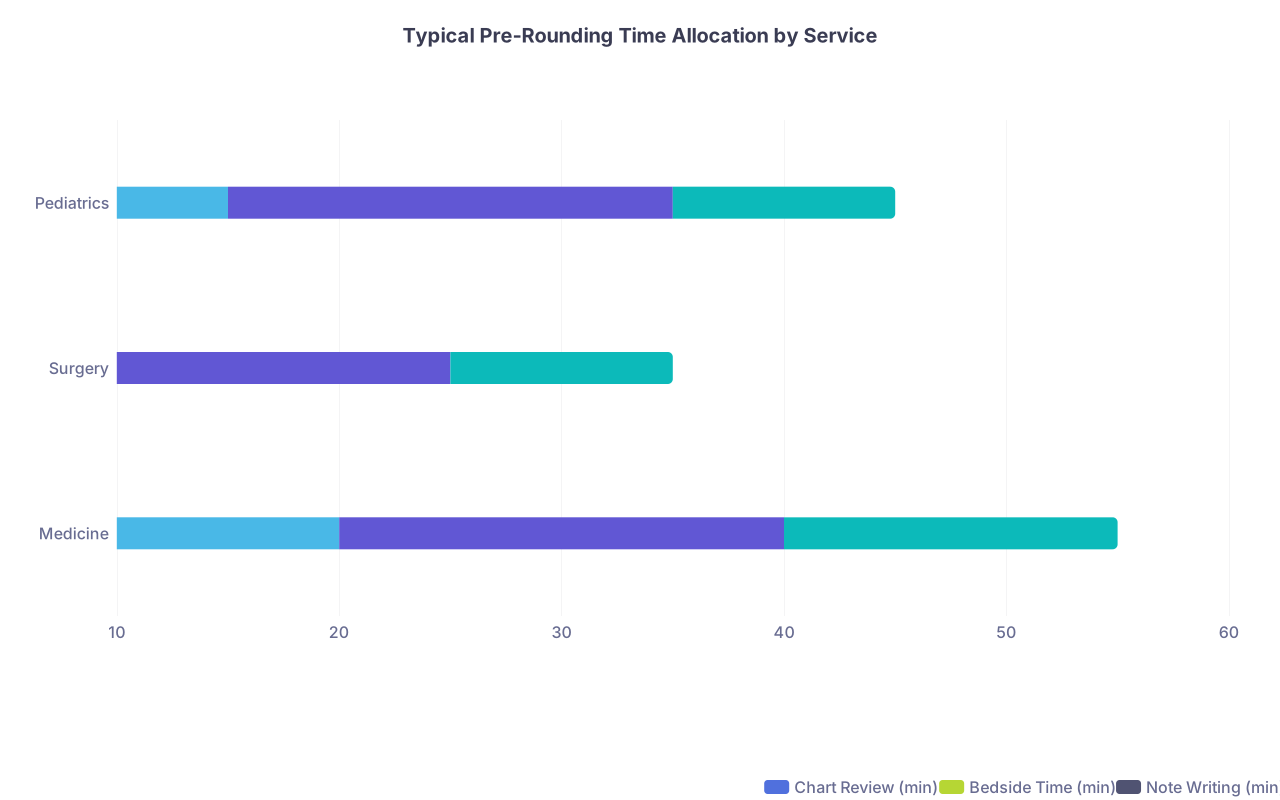
| Category | Chart Review (min) | Bedside Time (min) | Note Writing (min) |
|---|---|---|---|
| Medicine | 20 | 20 | 15 |
| Surgery | 10 | 15 | 10 |
| Pediatrics | 15 | 20 | 10 |
Internal Medicine
- Heavy on data: Vitals, I/Os, labs, imaging, cultures.
- Your notes matter more, and you will often be asked for differential diagnoses and guideline-based plans.
- You need to know trends: “Cr trend over last 3 days,” “net fluid since admission.”
Surgery
- Bedside and wounds matter more than elaborate notes.
- Focus on:
- Pain control
- Return of bowel function
- Drain outputs
- Foley status and urine output
- Ambulation and incentive spirometry
- Pre-rounding is often quicker because the residents have 15–25 patients. You still need a crisp one-liner and targeted updates.
Pediatrics
- Ask parents about overnight events; the kid may not answer you.
- Dosing and weight-specific issues: know their weight, fluid intake, and urine output clearly.
- Social context often matters more: feeding, behavior, school/play changes.
Common Pre-Rounding Mistakes (And Exactly When They Happen)
1. Showing Up at 6:30 for 7:00 Rounds with 4 Patients
What happens:
- You log in at 6:35
- You barely open the first chart by 6:40
- You see 1 patient quickly
- Attending walks in
- You have no labs, no overnight events, no exam on 3 patients
Fix:
- If you have 4+ patients, be in the hospital by 5:45–6:00. Earlier if you are slow initially.
2. Getting Lost in the EMR “Black Hole” at 6:05
You:
- Start reading a 6-page cardiology note from 3 months ago
- Open every radiology tab “just to see”
- Start reading the discharge summary from last year
By 6:30 you have seen zero patients.
Fix:
- Per patient during pre-rounding: 2 minutes for vitals/I&Os, 3–4 minutes for labs/imaging/micro, then move.
- Read deep background later in the day, not at 6:10 a.m.
3. Doing a Perfect Exam on the Wrong Findings
You:
- Spend 6 minutes per patient doing neuro checks, full MSK, full skin
- Forget to ask about chest pain in a post-PCI patient
- Forget to look at drains on a post-op colectomy patient
Fix:
- Align your exam to the main problems. COPD? Lung and work of breathing. Nephrotic syndrome? Edema and weight. Post-op day 1? Pain, incision, drains, Foley, ambulation.
Putting It All Together: A Sample Morning, Minute-by-Minute
Here is a concrete example with 4 patients, 7:00 a.m. rounds:
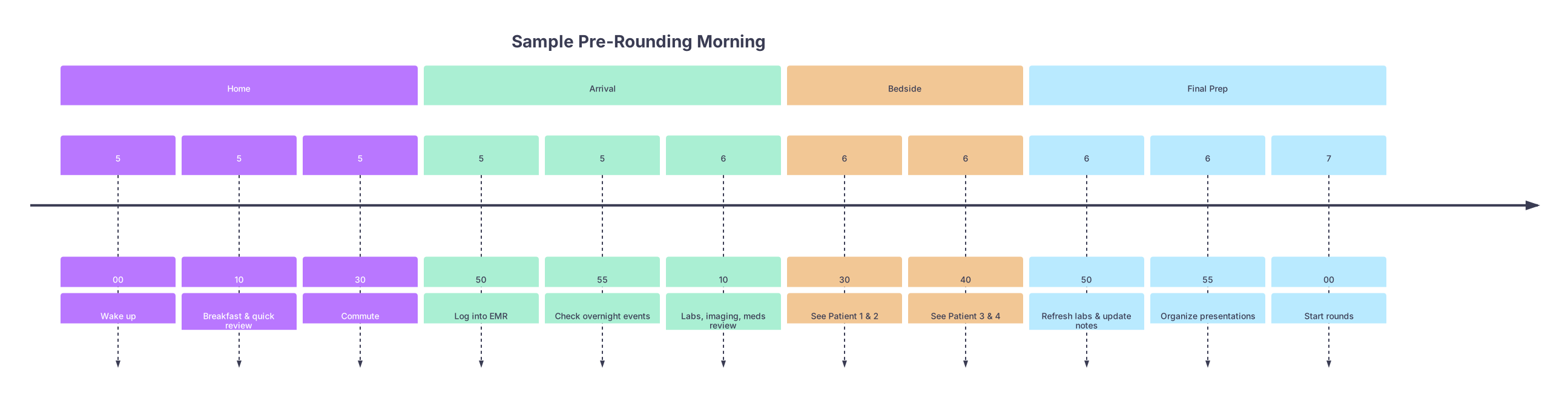
| Period | Event |
|---|---|
| Home - 5 | 00 |
| Home - 5 | 10 |
| Home - 5 | 30 |
| Arrival - 5 | 50 |
| Arrival - 5 | 55 |
| Arrival - 6 | 10 |
| Bedside - 6 | 30 |
| Bedside - 6 | 40 |
| Final Prep - 6 | 50 |
| Final Prep - 6 | 55 |
| Final Prep - 7 | 00 |
Follow that structure for a week. You will start to see where you personally run short:
- Slow on exam? Start bedside earlier.
- Slow on notes? Pre-fill more last night before leaving.
FAQ (Exactly 4 Questions)
1. How early should I arrive for pre-rounding as a medical student?
If rounds are at 7:00 a.m. and you have 3–4 patients, you should be physically in the hospital by 5:45–6:00 a.m. Minimum. First week on service, err earlier. Once you know your pace and the team’s expectations, you can adjust by 10–15 minutes, but do not experiment with “cutting it close” until you are consistently finishing on time.
2. What if morning labs are not back before rounds?
You still check all available data, then explicitly say during your presentation, “Morning labs are pending; yesterday’s K was 3.8, Cr 1.2, I will follow up as soon as today’s labs result.” Refresh labs right before the team hits the first room. Often some early draws finalize between 6:45–7:15. If the team expects you to know labs, ask the intern what time they usually start checking them.
3. Should I write my full progress note before or after rounds?
Do not try to finalize a complete note before rounds. That is how you waste time and then rewrite everything anyway. Instead, before rounds:
- Fill in data: vitals, labs, imaging summaries.
- Draft a rough Assessment/Plan for each problem.
After rounds, you update your Assessment/Plan with the attending’s decisions and sign it. The note should reflect the plan that was actually made.
4. How many patients is “normal” for a student to pre-round on?
On most medicine services: 3–5 is typical. On surgery: sometimes more patients, but your level of detail per patient is a bit lighter. If you are consistently assigned 6+ complex patients and you are drowning, speak with your resident: “I am struggling to pre-round properly on all 7 patients before 7 a.m.—could we prioritize a core group for me to follow more closely?” It is better to follow 4 patients well than 8 superficially.
Key Takeaways
- Pre-rounding is won or lost before 6:30 a.m.—arrive early enough to do real work, not just wander the EMR.
- For each patient, hit a consistent sequence: overnight events → vitals/I&Os → labs/imaging/meds → focused bedside check → one-line summary.
- Your goal is simple: by 7:00 a.m., you should be the person on the team who actually knows what happened to your patients in the last 12 hours.