
The worst mistake MS3s make is treating rotation order like a lottery instead of a weapon.
If you are smart about the sequence, your “toughest blocks” stop being landmines and start becoming launch pads: for shelf exams, for Step 2, and for residency applications. If you are lazy about it, you stack high‑stakes, high‑evaluation months in the wrong season and you pay for it all fourth year.
I am going to walk you month by month through a strategy for your third year and show you exactly when to schedule:
- Surgery vs Internal Medicine (the two big hitters)
- OB/GYN, Pediatrics, Psych, Family, Neuro
- Your hardest block personally (where your weaknesses are)
- Dedicated Step 2 prep and sub‑Is
You will see the year differently by the end.
Big Picture: Your MS3 Calendar By Season
First, zoom out. The typical MS3 year runs July–June. I will assume:
- Step 1 already taken (pass/fail era)
- You have 6–8 core clerkships, mostly 4–8 weeks each
- Your school lets you choose at least some order
Here is the basic seasonal logic:
- Early MS3 (July–October)
Build core clinical skills and test‑taking stamina. Do not waste these months on fluff. - Mid MS3 (November–February)
Peak cognitive performance. This is where you want at least one of your heaviest blocks. - Late MS3 (March–May)
Clean‑up rotations, lighter specialties, and set‑up for Step 2 and sub‑internships. - Early MS4 (June–August)
Audition rotations and sub‑Is in your target specialty.
So the real question is: which “tough” blocks anchor each season?
Step 1: Rank Your Toughest Blocks (Not What You Think)
Before building the timeline, you need clarity on what “toughest” means for you.
There are three different kinds of hard:
- Time‑intensive hard
- Long hours, call, weekend shifts
- Example: Surgery, OB/GYN at busy academic centers
- Cognitively hard (shelf exam depth)
- Massive volume of material, complex reasoning
- Example: Internal Medicine, Pediatrics
- Evaluation hard
- High pressure, subjective grading, reputation‑sensitive
- Example: Your future specialty, medicine at home program, neuro at a malignant site
At this point you should sit down and be brutally honest:
- Which rotation will wreck your sleep?
- Which rotation’s shelf terrifies you?
- Which rotation could make or break an honors in your chosen specialty?
Make a quick grid like this:
| Clerkship | Time-Intensive? | Shelf Difficulty? | Evaluation Pressure? |
|---|---|---|---|
| Surgery | High | Medium | Medium |
| Medicine | Medium | High | High |
| OB/GYN | High | Medium | Medium |
| Pediatrics | Medium | High | Medium |
| Psychiatry | Low | Low | Low |
| Family Med | Low | Medium | Low |
Your true toughest blocks are the ones with multiple “High” columns. That is what we are scheduling around.
Step 2: Ideal Year Blueprint (Month‑by‑Month)
Here is the rotation order I recommend for most students who want strong shelves, reasonable Step 2 timing, and solid residency positioning.
I will assume 12 months, starting in July. If your school starts in May or August, shift everything accordingly.
July–August: Start with a “Medium” Core Rotation
Goal: Learn to function on the wards without getting crushed.
At this point you should avoid:
- Jumping straight into Surgery at a malignant site
- Jumping straight into Internal Medicine at a tertiary care center
You want something:
- Clinically real, not a joke rotation
- With a shelf that is manageable with standard prep
- With somewhat predictable hours
Ideal options:
- Family Medicine
- Psychiatry
- Neurology (if your school treats it as moderate)
- Pediatrics at a smaller community site
Why? Because in your first 8 weeks you need to learn:
- How to preround without taking 4 hours
- How to write a note that does not bore an attending to death
- How to present on rounds without reading off the EMR
- How to plan your study schedule after 8–10 hour days
You are building systems here: wake‑up time, commute, meals, flashcards, shelf prep. Do not waste this period on something too cushy. But also do not start with 5 am pre‑rounds and 80‑hour weeks.
September–October: First Heavy Hitter (Medicine or Surgery)
Goal: Anchor your fall with your first truly hard rotation.
At this point you should schedule one of:
- Internal Medicine
- Surgery
Which goes first?
- If you are leaning IM or any medicine‑based specialty (cards, GI, heme/onc, etc.), do Medicine now.
- If you are leaning procedural/surgical (surg, ortho, ENT, EM), you can start with Surgery now.
Case 1: Medicine in Sep–Oct
Pros:
- You now have basic clinical skills from July–Aug
- You are not yet burned out, so you can grind UWorld and NBME practice
- Sets you up beautifully for later: medicine knowledge lifts every other shelf
Cons:
- Presenting on complex patients is rough early on, but you learn fast
Case 2: Surgery in Sep–Oct
Pros:
- You get your earliest brutal hours out of the way before winter fatigue
- You look stronger on later rotations because surgery toughened you early
- Shelf is manageable with decent prep
Cons:
- Studying after 12–14 hour days is real. You need ruthless time management.
Key rule: this first heavy hitter should not be your future specialty if you can avoid it. Save prime timing for when you are sharper and more confident.
November–December: Second Heavy Hitter (The Other One)
If you did Medicine in Sep–Oct, you slot Surgery here.
If you did Surgery in Sep–Oct, you slot Medicine here.
You want these two big rotations finished by the calendar year’s end. Why?
- They give you the bulk of the pathophysiology and management knowledge that Step 2 loves.
- Their shelves are among the hardest and most heavily weighted.
- Every later clerkship becomes easier if you have seen real inpatient medicine and perioperative care.
Yes, back‑to‑back heavy hitters is intense. That is not a bug; it is a feature. Your brain stays in high‑gear clinical reasoning with no “soft” dip in the middle.
To keep it survivable:
- Front‑load Anki/UWorld questions daily, even if it is only 20–40 a night early on.
- Use weekends aggressively (1 half‑day break; 1.5 days of focused shelf prep).
- Protect sleep more than social life. Third year is not the season to be a hero on both.
January–February: OB/GYN and Pediatrics (High Cognitive Load, Slightly More Control)
At this point you should tackle OB/GYN and Pediatrics, in either order.
Why here?
- You already have a medicine base, which makes peds and OB much more logical.
- Winter is mentally solid but physically draining; these rotations are intense but often more structured than surgery.
- Their shelves are tricky; you want them in the middle of the year, not as your very first or very last.
Recommended sequence:
- Jan–Feb: Pediatrics
- Feb–Mar: OB/GYN
or vice versa, depending on your school calendar.
What matters is that:
- You do not shove both OB and Peds into the last 2–3 months of the year
- You time them so they are not immediately before dedicated Step 2 time
March–April: Lighter Cores + Your Weakest Shelf
Now you are entering late MS3. You are tired. You are better. And you are starting to think about:
- Step 2 CK timing
- Letters of recommendation
- Sub‑I selection
This is where you place:
- Psychiatry
- Family Medicine
- Neurology (if shorter / mid‑intensity at your school)
Here is the trick.
At this point you should specifically put your weakest test subject into a lighter clinical month.
Example:
- You have always struggled with neuro. Then do Neurology during a month where hours are lighter so you can lean into shelf prep.
- Or your school has a notoriously brutal Psych shelf. Then take Psych when you are not on call q4 nights.
The idea: the “hardest” block for you may not be what other people complain about. You solve that by pairing your hardest academic content with lighter clinical demands.
May–June: Clean‑Up, Targeted Scheduling, and Step 2 Positioning
By late spring, most of your cores are done. Whatever is left goes here:
- A final 4‑week core
- An elective
- Research / reading month (if allowed)
Now the question becomes: where does Step 2 fit?
Here is how most students who do well structure it:
- Take Step 2 CK between late June and mid‑August, after finishing the bulk of MS3 cores.
- Use your last 1–2 MS3 months + first MS4 month as a hybrid: light clinical + focused Step 2 prep.
A very common winning structure:
- May: Final core rotation or lighter elective
- June: Dedicated Step 2 prep (plus minimal elective or vacation)
- Late June / early July: Take Step 2
- July–August (MS4): Sub‑I / audition rotations in target specialty
You do not want to be on your hardest, most time‑intensive block within 4–6 weeks of your Step 2 date if you can control it. That is just self‑sabotage.
Visual Timeline: Example Year Layout
Here’s what this might look like in a clean, high‑yield view:
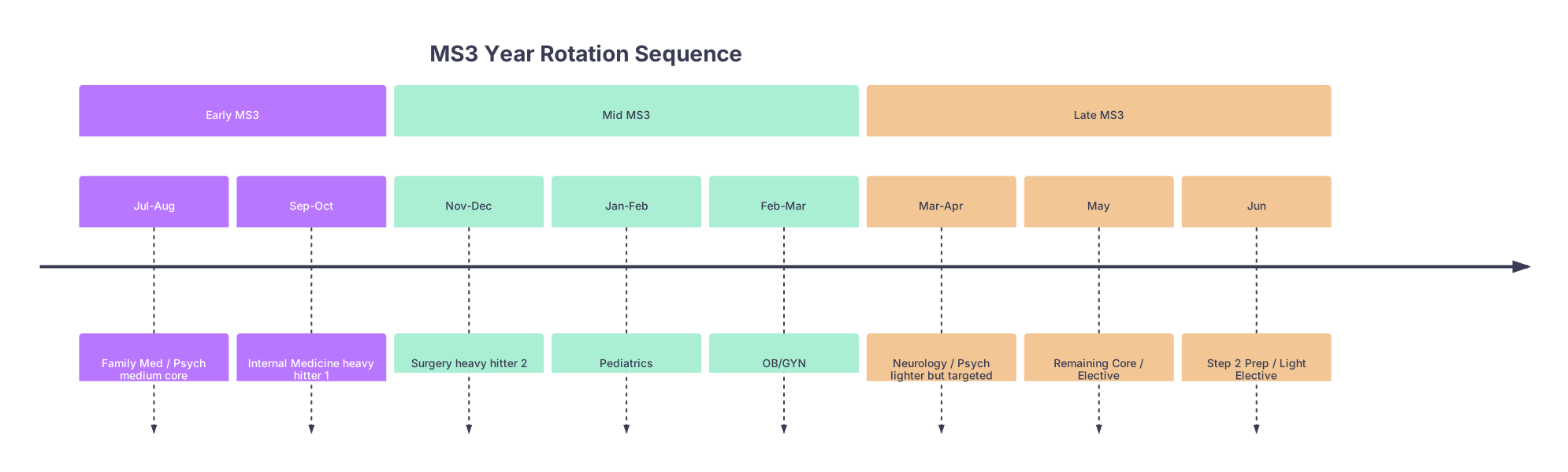
| Period | Event |
|---|---|
| Early MS3 - Jul-Aug | Family Med / Psych medium core |
| Early MS3 - Sep-Oct | Internal Medicine heavy hitter 1 |
| Mid MS3 - Nov-Dec | Surgery heavy hitter 2 |
| Mid MS3 - Jan-Feb | Pediatrics |
| Mid MS3 - Feb-Mar | OB/GYN |
| Late MS3 - Mar-Apr | Neurology / Psych lighter but targeted |
| Late MS3 - May | Remaining Core / Elective |
| Late MS3 - Jun | Step 2 Prep / Light Elective |
You can swap specific specialties around, but the backbone stays the same:
- Medium → Heavy → Heavy → Medium‑heavy → Lighter → Clean‑up
- Hardest time demands earlier. Hardest knowledge demands after you have some clinical base.
Where To Put YOUR Toughest Block: 3 Scenarios
Now let us make this personal. Here is how to slot your single toughest block depending on what it is.
Scenario 1: Your Toughest Is Surgery (Hours)
If you fear the hours, not the content:
- Put Surgery between September and December.
- Do not put it:
- As your first ever rotation (July)
- Right before Step 2
- Back‑to‑back with OB at a malignant site
Recommended:
- July–Aug: Family or Psych
- Sep–Oct: Surgery
- Nov–Dec: Medicine
You will suffer, but you will survive. And you will come out sharper for medicine.
Scenario 2: Your Toughest Is Internal Medicine (Shelf)
If the cognitive load scares you:
- Put Medicine in Sep–Dec when you already have some basic clinical rhythm but are not yet mentally fried.
- Avoid Medicine as your very first rotation or last rotation.
You might do:
- July–Aug: Neuro or Family
- Sep–Oct: Medicine
- Nov–Dec: Surgery
Studying for the Medicine shelf after a warm‑up rotation dramatically improves your odds of an honors.
Scenario 3: Your Toughest Is A Smaller Shelf (Neuro / Psych / Peds)
If, say, Neurology content is your Achilles heel:
- Schedule Neurology in March–April, paired with relatively sane hours.
- Make a rule: 1–2 hours daily of shelf‑focused study, non‑negotiable.
Your toughest academic subject should not also be your toughest lifestyle month.
Weekly and Daily Planning Inside Tough Blocks
Timing is only half the game. You also need an internal rhythm.
During your hardest blocks, your week should roughly look like this:
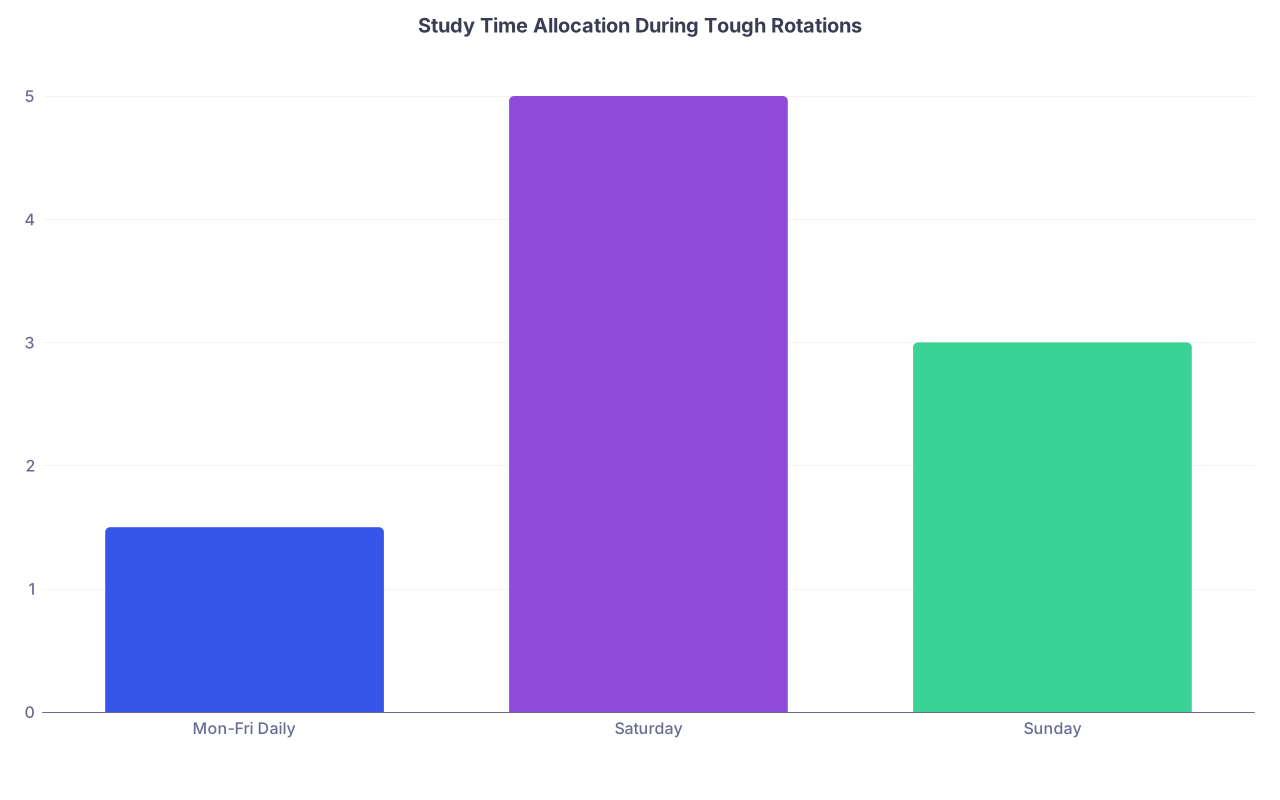
| Category | Value |
|---|---|
| Mon-Fri Daily | 1.5 |
| Saturday | 5 |
| Sunday | 3 |
- Mon–Fri:
- 60–90 minutes after work of:
- UWorld questions (10–20)
- Reviewing incorrects
- A small Anki set
- 60–90 minutes after work of:
- Saturday:
- 4–6 hours total in 2–3 blocks
- One longer practice block + targeted reading
- Sunday:
- 2–3 hours max
- Light review, reset, logistics (laundry, food prep, schedule check)
At this point in a hard block, you should:
- Batch your life tasks (groceries, laundry, cleaning) into one chunk weekly.
- Pre‑pack food for 3–4 days to avoid wasting 45 minutes nightly.
- Protect at least one half‑day each week for sanity.
If your rotation has 24‑hour calls, you adjust by moving your heavy study to post‑call days after sleeping, and evenings before non‑call days.
Common Scheduling Traps (And How To Avoid Them)
You will see classmates do these; do not copy them.
Stacking surgery + OB/GYN back‑to‑back as your first two rotations
- You burn out before you even know how to preround.
- Fix: At least one medium‑intensity core before your first brutal block.
Saving Medicine for the very end of MS3
- You take the hardest shelf with the least remaining runway for Step 2.
- Fix: Place Medicine in the first half of the year.
Scheduling future specialty during your absolute worst mental season
- Example: You want EM, but you put EM selective in February when you have seasonal depression and 6 other shelves behind you.
- Fix: Put target specialty when you can perform, not when “it fits the calendar.”
Treating Step 2 as an afterthought
- You scatter light electives around and end up taking Step 2 in October of MS4.
- Fix: Commit to a testing window by early spring of MS3 and protect ~4–6 weeks.
How Rotation Sequence Sets Up Step 2 and Residency
Done correctly, your MS3 timeline should deliver three payoffs:
Step 2 feels like a consolidation, not a new mountain.
- You took Medicine, Surgery, OB, and Peds before intensive Step 2 prep.
- You are not learning CHF, sepsis, and preeclampsia from scratch in UWorld.
Your best evaluation months align with residency signaling.
- You are not flailing on your future specialty as your very first core.
- You hit your letters‑generating rotations when you are already competent.
You survive.
- You do not stack three call‑heavy rotations back‑to‑back.
- Your hardest academic subject gets breathing room.
- You walk into MS4 tired but not broken.
Final Takeaways
- Sequence is strategy. Put Medicine and Surgery in the first half of the year, not at the edges, and never both immediately before Step 2.
- Match your toughest content to lighter hours, and your toughest hours to periods when you are fresh and still motivated.
- Decide on a Step 2 window by mid‑MS3 and build the final 3–4 months of rotations around that exam, not the other way around.