
The biggest mistake students make on four-week rotations is waiting until week four to act like week one matters.
You do not “see how it goes” and then ask for a letter. You build the letter from day 1. And you schedule your feedback, your visibility, and your ask on a timeline. If you leave this to vibes and luck, you will get exactly that—vague feedback and lukewarm letters.
Here is your four-week rotation roadmap: day-by-day, week-by-week, with explicit points where you should ask for feedback and when to ask for a letter.
Before Day 1: 3–5 Days Before the Rotation Starts
At this point you should be setting up the entire four-week arc, not just figuring out where to park.
Identify potential letter-writers on paper
- Look at:
- Course/rotation director
- Clerkship site director
- Core attendings assigned to your team
- Your best letter will come from:
- Someone who works with you repeatedly (not a one-off consult attending)
- Someone who actually writes strong letters (ask a trusted upperclassman who’s done this site)
- Look at:
Clarify your goals for this rotation
- Decide:
- Is this a “letter rotation” for your future specialty?
- Or is it mainly to pass and move on, with maybe a backup letter if things go well?
- Be honest with yourself. Letter rotations get a different level of energy. They must.
- Decide:
-
- You will not improvise well at 6:30 a.m. prerounds.
- Prepare a 1–2 sentence summary:
- Who you are (M3, interests)
- What you hope to get out of the rotation
- Example:
- “I am a third-year interested in internal medicine, trying to really improve my clinical reasoning and presentations this month, and I would appreciate feedback as we go.”
At this point you should know exactly who you hope might write your letter if the month goes well. Circle 1–2 names.
Week 1: Positioning Yourself for Feedback and Letters
Week 1 is not a warm-up. It is your audition.
Day 1–2: First Contact and Expectations
At this point you should be doing three things: showing up prepared, setting expectations, and signaling that you want feedback.
On Day 1 (or first day with each attending):
Arrive early and observe the culture
- Who leads table rounds?
- How do residents present (SOAP vs. systems-based)?
- Are notes detailed or minimal?
-
- Early in the day:
- “I really want to grow on this rotation. If you notice anything I can improve—especially on presentations and clinical reasoning—I would appreciate direct feedback.”
- This makes it normal later when you ask again.
- Early in the day:
State your learning focus
- For potential letter-writers, say something like:
- “I am considering [specialty] and was hoping to really work on my [presentations/assessment and plan/procedural skills] this month.”
- For potential letter-writers, say something like:
This is not subtle. It should not be. Attending physicians are busy. They forget which student wants what unless you say it clearly.
Mid–Week 1 (Day 3–4): First Feedback Checkpoint
By the middle of Week 1, someone should have seen you present, write at least one note, and interact with patients.
At this point you should ask for targeted formative feedback, not global judgment.
Pick one attending or senior who has seen enough of you to comment.
Use language like:
- “I want to check in early. Based on what you have seen these first few days, is there one thing you would recommend I focus on improving this week—presentations, notes, or clinical reasoning?”
Notice what I did not suggest:
- Do not ask: “How am I doing?”
You will get: “You are doing fine.” Useless. - Do not wait until Week 3 to ask how to improve. Too late.
Take whatever they say and visibly act on it the next day. This is how you create a story for your letter: “The student responded to feedback quickly and improved over the rotation.”
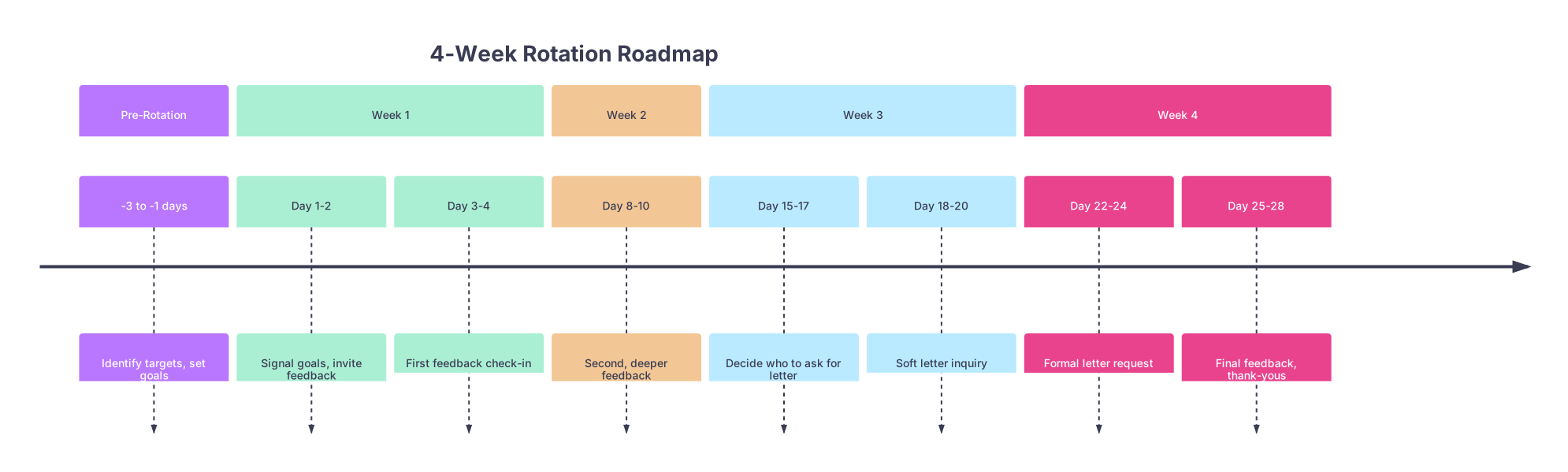
| Period | Event |
|---|---|
| Pre-Rotation - -3 to -1 days | Identify targets, set goals |
| Week 1 - Day 1-2 | Signal goals, invite feedback |
| Week 1 - Day 3-4 | First feedback check-in |
| Week 2 - Day 8-10 | Second, deeper feedback |
| Week 3 - Day 15-17 | Decide who to ask for letter |
| Week 3 - Day 18-20 | Soft letter inquiry |
| Week 4 - Day 22-24 | Formal letter request |
| Week 4 - Day 25-28 | Final feedback, thank-yous |
Week 2: Build the Case and Get Real Feedback
Week 2 is where you prove you are coachable and consistent. This is when many attendings begin mentally deciding who they will support strongly and who is just “average.”
Early Week 2 (Day 6–8): Show Improvement
At this point you should be deliberately demonstrating that you listened to Week 1 feedback.
If they told you last week: “Tighten up your assessment and plan,” then this week:
- You start presentations with a one-liner and a prioritized A/P.
- You verbalize your thought process instead of listing problems passively.
- You ask: “Does that prioritization make sense, or would you structure it differently?”
This does two things:
- Proves you improve.
- Gives your potential letter-writer something specific to write about.
Mid–Week 2 (Day 8–10): The First Serious Feedback Conversation
This is your first formal feedback ask. It should be 5 minutes, in person, at a natural break (post-rounds, end of clinic session).
At this point you should say something like:
- “We are about halfway through the rotation, and I wanted to ask for more detailed feedback. Could you share:
- One thing you think I am doing well so far.
- One or two specific areas where I can improve in the next two weeks?”
Then stop talking. Let the silence work.
Write it down afterwards. You will forget the exact wording otherwise, and your improvement later should track directly back to this conversation.
If you get something vague like, “You are doing good, just keep reading,” push gently:
- “I appreciate that. If you had to pick one concrete area—presentations, differential building, efficiency, or communication with patients—where should I focus this week?”
That nudge often converts generic feedback into something actionable.
Week 3: Decide Who to Ask for a Letter
By the start of Week 3, the die is mostly cast. Not completely, but mostly.
You will know, in your gut, which attendings have:
- Seen you the most
- Given you feedback
- Watched you improve
Those are your letter targets.
Start of Week 3 (Day 11–13): Assess Your Standing
At this point you should be doing a quick personal audit for each potential letter-writer:
Ask yourself:
- Have I worked with them on multiple days?
- Have they seen me on:
- New patient encounters?
- Follow-ups?
- A busy or stressful day?
- Have I:
- Asked them for feedback at least once?
- Incorporated that feedback obviously?
If the answer is “no” across the board, your letter prospects from this rotation are weaker. You can still ask, but you should diversify and not depend on it.

Mid–Week 3 (Day 15–17): Soft Letter Inquiry
You do not wait until week four to bring up a letter out of nowhere. That feels transactional and last-minute.
At this point you should float a soft inquiry with your top-choice attending, if the rotation is specialty-relevant (for your chosen field or a close relative).
Example language:
- “I have really appreciated working with you these past couple of weeks, especially the feedback on my assessment and plan. I am planning to apply to [specialty], and I would be very interested in a strong letter from someone who has seen my growth over the rotation. If things continue to go well this final week, do you think you might be comfortable supporting me with a letter?”
This phrasing does a few things right:
- You explicitly say “strong letter”. That matters.
- You give them an out without putting them on the spot: “If things continue to go well…”
- You are asking for a preliminary sense, not demanding a commitment on the spot.
If they respond with anything lukewarm—“Sure, I can write something” in a flat tone—that is code for a bland letter. You want:
- “Yes, absolutely.”
- “I would be happy to.”
- “You are doing very well; I would be glad to support you.”
If you do not get that level of enthusiasm, you pivot. Identify another potential writer (resident, site director) or accept that this rotation may be more about growth than letters.
Week 4: Secure the Letter and Close the Loop on Feedback
Week 4 is not the time to suddenly become amazing. It is the time to be predictably good, consistently professional, and intentional about closure.
Early Week 4 (Day 18–21): Final Performance and Visibility
At this point you should be:
- Taking a bit more ownership (with supervision):
- Volunteering to present new admissions.
- Proposing first-pass plans.
- Showing reliability:
- Notes in on time.
- Following up on labs and imaging without being asked.
Visibility is key. If your letter-writer barely works with you in Week 4, your story ends at Week 3. Try to align call days/clinic days with them if possible (within reason, and within schedule constraints).
Mid–Late Week 4 (Day 22–24): The Formal Letter Ask
This is your hard ask window. Do not leave it to the very last day when people vanish early, cases run over, or clinic explodes.
At this point you should request the letter explicitly.
In person script (ideal):
- “We are coming to the end of the rotation, and I wanted to ask formally: would you be willing to write a strong letter of recommendation for my [internal medicine/emergency medicine/etc.] residency applications?”
If they say yes, respond with:
- “Thank you, I really appreciate that. I will send you:
- My updated CV
- My personal statement draft (or specialty paragraph, if PS not final)
- A short summary of patients or situations we worked on together that you might remember.”
Then actually send that email within 24 hours.
If this is a shorter 2-week block within a larger 4-week clerkship, you still follow the same pattern, just compressed: soft ask end of Week 1, formal ask mid–Week 2.
| Timing | Feedback Ask Type | Letter Ask Type |
|---|---|---|
| Week 1, Day 3–4 | Early, targeted | Do not ask yet |
| Week 2, Day 8–10 | In-depth, formative | Still too early |
| Week 3, Day 15–17 | Brief check + progress | Soft, exploratory inquiry |
| Week 4, Day 22–24 | Final, summative check | Formal, explicit letter request |
How to Structure the Follow-Up Email for a Letter
You will make your attending’s life easier if you do this right. That usually means a better letter.
At this point (same day you get a “yes”) you should send something like:
- Subject: “Letter of Recommendation Request – [Your Name], [Rotation Name/Month]”
Body:
- Thank them again.
- Remind them who you are and what rotation/timeframe.
- Reiterate your specialty and goals.
- Attach:
- CV
- Personal statement or specialty paragraph
- ERAS letter request link / instructions
- Include 4–6 bullet points:
- Specific patients you managed together
- Situations that show growth (presentations, procedures, communication)
- Feedback they gave you and how you applied it
You are not writing your own letter. You are jogging their memory so they can write a detailed one.
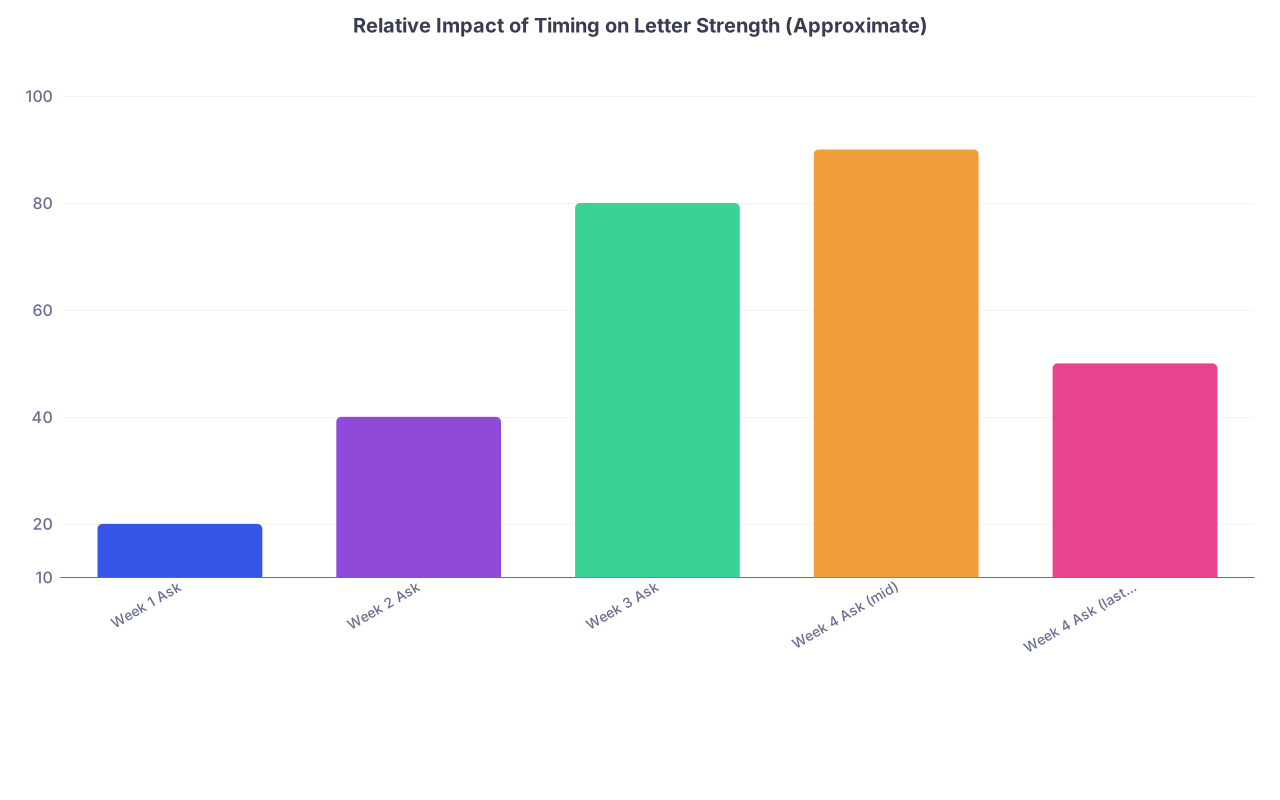
| Category | Value |
|---|---|
| Week 1 Ask | 20 |
| Week 2 Ask | 40 |
| Week 3 Ask | 80 |
| Week 4 Ask (mid) | 90 |
| Week 4 Ask (last day) | 50 |
The point of that chart: asking on the last afternoon, after everyone is mentally checked out, is a bad strategy.
Daily Micro-Timeline: The Feedback–Letter Mindset
Here is how this actually feels when done correctly across a standard four-week inpatient rotation.
Week 1
- Day 1–2: Introduce yourself clearly. Ask for feedback culture:
- “How do you usually like students to get feedback during the rotation?”
- Day 3–4: Ask specific feedback from resident and at least one attending.
- Day 5: Implement feedback deliberately and say once (briefly), “I tried to make my presentations more focused today based on your feedback.”
Week 2
- Day 6–7: Sustain performance; keep showing up early, ready.
- Day 8–10: Schedule a 5–10 minute mid-rotation feedback talk with your primary attending:
- Name strengths.
- Ask for 1–2 focused improvement areas.
Week 3
- Day 11–13: Target improvement based on Week 2 feedback.
- Day 15–17: Soft letter inquiry with your top-choice attending.
- Day 15–17: Confirm whether they seem genuinely enthusiastic. If not, identify backup.
Week 4
- Day 18–21: Solid, consistent performance. No new major mistakes.
- Day 22–24: Formal letter ask, in person if possible.
- Day 23–25: Send follow-up email with CV, PS, bullet list.
- Last 1–2 days: Ask for final summative feedback:
- “As I go on to my next rotation, is there one thing you think I should especially continue working on?”

One More Hard Truth
If you never ask for feedback until the final evaluation meeting, you will get clichés. “Pleasure to work with. Read more.” That is what ends up in your letter.
If you never signal that you are seeking a strong letter early enough, your attending will treat your performance as “another student doing okay,” not as “this might be one of my letter students this year.”
This is not about being pushy. It is about being intentional.
Today, take 10 minutes and write out the exact sentences you will use for:
- your Week 1 feedback ask,
- your Week 2 formal feedback conversation, and
- your Week 3 soft letter inquiry.
If you cannot say them out loud smoothly, you are not ready for Day 1 of your next rotation.