

The last week of a rotation makes or breaks your eval.
By this point, people have decided whether you are “great,” “fine,” or “forgettable.” Your job in the final 5–7 days is not to reinvent yourself. It is to lock in Honors, secure a strong letter, and close every open loop before you disappear to the next service.
I am going to walk you through that last week day by day. What to say. What to ask for. What to fix. And exactly when to do it.
Big Picture: What This Final Week Is Actually For
At this point you should be clear on the three outcomes that matter:
- Your grade (Honors / High Pass / Pass)
- Your written evaluation text (what ends up in your MSPE)
- Your letter of recommendation (for core or away rotations)
Everything this week should push one of those three.
Here is the rough structure of the last week:
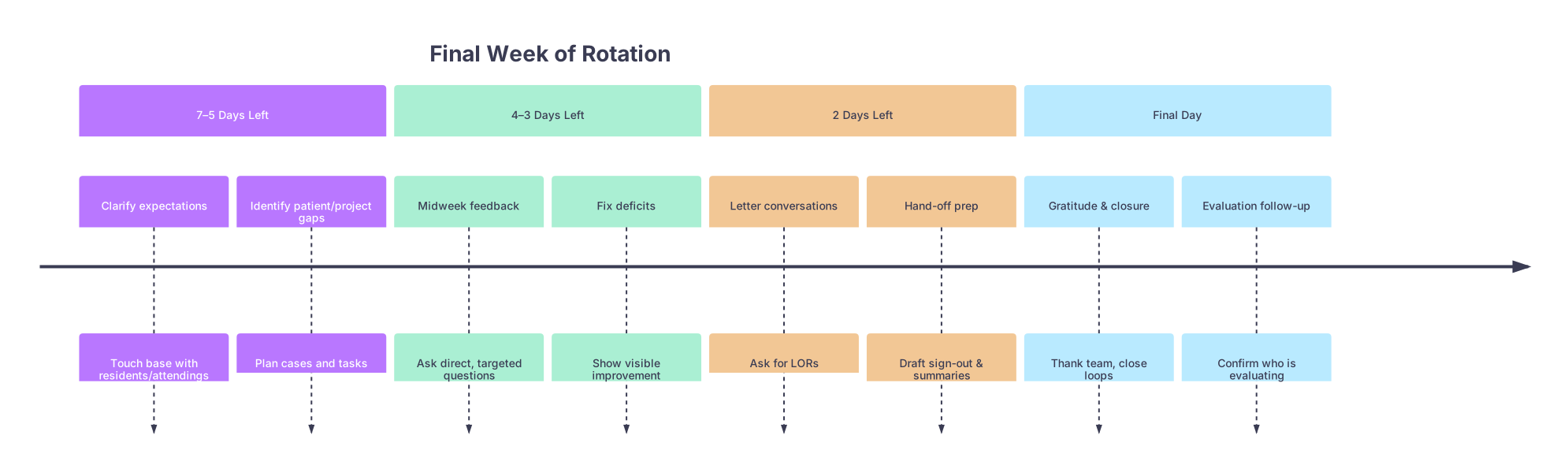
| Period | Event |
|---|---|
| 7–5 Days Left - Clarify expectations | Touch base with residents/attendings |
| 7–5 Days Left - Identify patient/project gaps | Plan cases and tasks |
| 4–3 Days Left - Midweek feedback | Ask direct, targeted questions |
| 4–3 Days Left - Fix deficits | Show visible improvement |
| 2 Days Left - Letter conversations | Ask for LORs |
| 2 Days Left - Hand-off prep | Draft sign-out & summaries |
| Final Day - Gratitude & closure | Thank team, close loops |
| Final Day - Evaluation follow-up | Confirm who is evaluating |
You will not do everything on the last day. That is how people blow it. You start a full week out.
7–5 Days Left: Set Up the Finish
At this point you should:
- Know the grading criteria
- Know who is actually evaluating you
- Have a sense of whether Honors is still realistically on the table
If you do not, you fix that now.
Step 1: Confirm expectations and your status
On the first day of your last week (usually Monday), do a quick, targeted check-in with your senior resident or attending.
Script you can use with a senior:
“I am heading into my last week and really want to finish strong. How am I doing compared to expectations for this rotation, and what would I need to focus on in this final week to be in the Honors range?”
With an attending:
“This is my last week on the rotation. I have really enjoyed working with the team. From your perspective, what are one or two things I could do in these last days to meet or exceed expectations for a top evaluation?”
You are asking three things indirectly:
- How am I doing?
- Is Honors realistic?
- What specific behavior do you want to see this week?
Take notes. Phrase them back:
“So focusing on more independent plans and reading on my patients’ conditions would be most helpful?”
Lock in those targets.
Step 2: Identify key patients and opportunities
Honors-level students are remembered for ownership. Not for “helping out” vaguely.
By 5–7 days out you should:
- Choose 2–4 patients you will follow obsessively.
- Identify one or two learning or teaching moments you can deliver on (e.g., a 2-minute chalk talk on COPD management, or a brief literature summary).
Concrete checklist for this point:
- Confirm who actually fills out your evaluation (attending, senior, both)
- Ask directly what you can do to reach the top evaluation range
- Pick 2–4 primary patients to own
- Identify 1 mini-teaching idea or brief topic you can read on and present
- Skim your clerkship grading rubric again
If nobody has seen you present independently, you are not in Honors territory. Plan at least one clean, concise presentation this week.
4–3 Days Left: Midweek Calibration and Visible Improvement
This is the most important window. You still have time to change the narrative.

At this point you should deliberately surface feedback and then fix something in a way that people can see.
Step 3: Force real-time feedback
Midweek, grab 3–5 minutes with your senior or a resident who works closely with you.
You do not say, “Any feedback for me?” That yields nothing.
You say:
“I have a few days left and want to course-correct anything I can. Could you give me one thing I am doing well that I should keep doing, and one thing I should change or improve before the end of the week?”
Then you wait. Silent. Let them think.
Common answers:
- “Your presentations are detailed, but you could tighten them up and lead with your assessment and plan.”
- “You are solid with data gathering, but step out with your own plan more.”
- “You are quiet on rounds. I want to hear you think out loud a little more.”
That is your playbook for the next 48 hours.
Step 4: Engineer visible changes
Now, you need people to actually see improvement. That means:
If they said “presentations too long” → Next rounding session, you open with:
“For Ms. X, briefly: she is HD#3 for CHF exacerbation, clinically improving, and I have three updates and two plan items.”
Cut fluff. Hit problem-list format. Stop reading the EMR to them.If they said “be more independent” → On each patient:
“For his AKI, I think this is likely pre-renal from diuresis; I would check a urine sodium, hold the ACE inhibitor today, and increase his fluids slightly. Do you agree or would you modify that?”
If they said “be more engaged” → During teaching or cases:
Ask 1–2 specific, non-awkward questions per day.
Example:“For this patient’s NSTEMI, would you have managed anything differently if she had presented 12 hours later?”
Then you explicitly label your change once:
“You mentioned earlier this week that I should work on tighter presentations, so I have been trying to lead with assessment and plan first. Please let me know if that is closer to what you had in mind.”
Now they have a story: you take feedback, adjust rapidly, and improve.
Midweek checklist:
- Ask for “one thing to keep, one thing to change” feedback
- Implement at least one visible change on rounds that same day
- Verbally anchor your change back to their feedback once
- Keep owning your few key patients (notes on time, labs pre-checked, updated plans)
- Do one minor but noticeable helpful act: calling a family, clarifying a discharge med list, printing discharge instructions, etc.
2 Days Left: Letters and Legacy Work
Most students wait until the last day to ask about letters or evaluations. That is a mistake.
At this point you should be:
- Having the LOR conversation
- Finalizing the “paper trail” of your work
- Cleaning up anything that could irritate people after you leave
Step 5: Ask for letters of recommendation (the right way, at the right time)
Ideal time: 2–3 days before your last day, after a strong morning and when the attending is not obviously rushing.
You do not ask if they will “write a letter for you.” You ask if they can write a strong one.
Script:
“I have really appreciated working with you this rotation and I am planning to apply into [specialty]. If you feel you know my clinical work well enough, would you be comfortable writing a strong letter of recommendation for me?”
Three possible answers you will hear:
- “Yes, I would be happy to.”
- “I can write a letter, sure.” (translated: weak)
- “I am not sure I know you well enough.” (good, you just avoided a bad letter)
If they say yes:
- Immediately say you will email your CV, personal statement draft (if you have one), and a short bullet list of patients/cases you worked on with them.
- Ask about logistics:
“Would you prefer a reminder closer to ERAS season, or should I send you the link as soon as it opens?”
If they hedge:
- Accept that and do not push.
- Pivot silently to another potential letter writer: another attending, senior, or sub-I later.
Step 6: Build your “evidence file” for evaluators
You want your evaluators to remember specifics. Help them.
Before your final day, prepare:
- A one-page summary (or even half page) of:
- Patients you owned (a few specific, interesting ones)
- Roles you played (took point on discharges, ran morning pre-rounding efficiently, etc.)
- Any extra work (topic presentations, QI project, helpful call with a family, weekend call you picked up)
You do not hand this to them and say “Here is what you should write.” You keep it ready to email after they agree to complete an evaluation or letter.
Two-days-out checklist:
- Ask target attending(s) about LORs
- Clarify timeline and logistics for letters
- Prepare a one-page bullet summary of your work and patients
- Make sure all your notes are signed, accurate, and not creating work for others
- Start drafting clean sign-outs for your patients
Final Day Minus One: Close the Clinical Loops
At this point you should be acting like a reliable junior resident. Not a visitor.
This is the day to make sure the team is not cleaning up after you once you are gone.
Specific tasks:
Patient ownership check
- Run through each of your patients and ask yourself:
- Are labs for tomorrow ordered appropriately?
- Is imaging followed up?
- Are outstanding consult recommendations acknowledged in the plan?
- If there is a complex or long-stay patient you have followed the whole time, draft a concise hospital course summary in your own notes or sign-out that will make life easier for everyone after you leave.
- Run through each of your patients and ask yourself:
Sign-out prep
- For inpatient:
- Prepare a clean written sign-out for each patient you follow: current issues, “if X then Y” plans, anticipated discharges.
- For outpatient:
- Confirm follow-up plans, refills, or patient education notes are documented properly.
- For inpatient:
Team signal
- Briefly let your team know the next day is your last:
“Tomorrow is my last day on the service, so I am preparing thorough sign-outs for my patients. Please let me know if there is anything you would like me to tie up before I go.”
- Briefly let your team know the next day is your last:
This plants the idea “organized, responsible, thinks ahead.”
Night-before-final-day checklist:
- All notes for the day completed and signed
- All tomorrow labs/imaging/consult follow-ups anticipated
- Clean sign-outs drafted for each of your patients
- Attending/residents aware tomorrow is your last day
- Clothes and gear ready so you are not late on your last day
Final Day: Lock In the Narrative
This is the day they will remember you. Not every detail, but the tone.
| Priority Action | Common Mistake |
|---|---|
| Early, prepared arrival | Coasting, showing up just on time |
| Clean sign-outs | Leaving loose ends for team |
| Brief thank-yous | Ghosting without saying goodbye |
| Quick feedback check | Avoiding eval talk completely |
| Professional goodbye email | No follow-up or contact info |
Step 7: Show up early, finish strong
On the final morning:
- Arrive early enough to pre-round thoroughly.
- Have updated numbers and plans ready without being asked.
- Avoid any sign of “mentally checked out.” People notice.
During rounds:
- Keep doing what you improved midweek: tight presentations, explicit plans, clear communication.
- If an attending or resident gives you an opening, take one last brief teaching opportunity (30–90 seconds, max).
Example:
“For Mr. Z’s GI bleed yesterday, I read a bit about risk stratification scores. Just as a quick summary, the Glasgow-Blatchford score can help predict need for intervention; his was high given his BUN and melena, which fits with what we saw.”
Short. Relevant. Done.
Step 8: Verbal closure with key people
Before you leave physically, you should have spoken to:
- The attending(s) who worked with you
- Your senior resident
- Any resident who invested heavily in teaching you
Quick, direct, and not cheesy:
To an attending:
“Dr. Smith, today is my last day. Thank you for letting me be part of the team; I learned a lot from how you approached [X]. If there is any additional feedback you have for me going forward, I would really appreciate it.”
To a senior resident:
“Thanks for all the teaching this month. I appreciated your help on [specific thing]. If there is anything else you think I should work on before my next rotation, I would be grateful to hear it.”
If someone already agreed to write a letter:
“Thank you again for being willing to write a letter for me. I will email you my CV and a brief summary of my work with you so you have details at hand.”
Step 9: Confirm evaluations and send follow-up email
Same day or that evening, send one short, professional email to your primary attending (and possibly the clerkship coordinator if appropriate).
Template:
Subject: Thank you and evaluation – [Your Name], MS3 on [Service]
Dear Dr. [Name],
Thank you again for the opportunity to work with you on the [service] this month. I learned a great deal, especially from [brief, specific example].
I wanted to confirm that you will be completing my evaluation for this rotation. For your reference, I have attached a brief summary of the patients I followed closely and my responsibilities on the team.
Please let me know if there is any additional information that would be helpful.
Best regards,
[Name]
[School], MS[3/4]
[Contact info]
Attach that one-page “evidence file.”
For letter writers, a separate email:
- CV
- Personal statement draft or short paragraph about your interest in the specialty
- List of patients/cases with them
- Deadlines and submission instructions
Final-day checklist:
- Arrived early and fully prepared
- Delivered clean, concise presentations and plans
- Verbally thanked attending(s) and residents
- Confirmed who is completing your evaluation
- Email sent with thanks + summary of your work
- LOR emails (with attachments) sent to any letter writers who agreed
After You Leave: 1–2 Week Follow-Up
The rotation is over, but the paperwork is not.
You should:
- Check your evaluation portal after 7–10 days.
- If your eval or letter is still missing after 2–3 weeks, send a very short reminder email to the attending.
Something like:
Dear Dr. [Name],
I hope you are doing well. I wanted to kindly follow up regarding my [rotation] evaluation / letter of recommendation. If there is any information I can provide to make this easier, I would be happy to.
Thank you again for your time and teaching.
Best,
[Name]
Do not spam them. One reminder after a couple of weeks is reasonable.
Where Students Actually Lose Honors in the Final Week
Let me be blunt. I have watched students sabotage an otherwise strong month in 3 predictable ways:
They mentally check out.
They start saying, “Oh, it’s my last week,” and everyone can feel the disengagement. Honors students accelerate into the finish.They never ask for concrete feedback.
Then they are “surprised” by a comment about presentations, independence, or knowledge that could have been fixed in 48 hours.They vanish without closure.
No thanks, no email, no sign-outs. Those same residents later click “meets expectations” instead of “outstanding.” Because they are annoyed.
You do not need to be brilliant to avoid these. You just need a system.
One Thing To Do Today
Open your calendar and identify the last 7 days of your current (or next) rotation.
For each of those days, write one line:
- “Day -7: Ask senior where I stand and what Honors would look like.”
- “Day -4: Force ‘one thing to keep, one thing to change’ feedback and implement it.”
- “Day -2: Ask attending about LOR, prepare one-page patient summary.”
- “Day -1: Finalize sign-outs, tell team tomorrow is last day.”
- “Day 0: Early arrival, strong rounds, thank-yous, evaluation + LOR emails.”
Then, when that week comes, you are not guessing. You are executing a plan.


