

What actually happens to your evaluation if you leave at 4:30 when the residents stay until 7?
Let me answer the core question first, so you’re not scrolling for 10 minutes:
If no one explicitly tells you expectations and you’re asking, “Should I stay late?” the rule is this:
Stay long enough to be useful, visible, and aligned with team norms.
Do not make a habit of disappearing early.
Do not make a habit of martyr-style, pointless staying late either.
Now let’s get specific.
The Real Answer: It Depends (But Not As Much As You Think)
On most rotations, staying a little later helps you. Staying absurdly late does not.
Here’s the practical rule of thumb I use with students:
- Leave when:
- All your assigned tasks are done
- You’ve explicitly checked out with the resident/attending
- There is no active teaching, sign-out, or work you can reasonably help with
- Stay later when:
- People are clearly still slammed and you can legitimately help
- There’s sign-out you’re allowed to observe
- A good learning case is coming in (new admission, procedure, consult) and your presence is wanted
If you’re regularly leaving more than 1–2 hours before the rest of the team, you will look disengaged.
If you’re regularly staying more than 1–2 hours after you’ve stopped being useful, you will look like you don’t understand boundaries or efficiency.
The sweet spot is being the student who offers to stay, occasionally actually does, and never just ghosts.
How Different Rotations See “Staying Late”
Not all services think about this the same way. Some rotations judge you hard on “face time.” Others care more about efficiency, notes, and reliability.
| Rotation Type | Culture Around Staying Late | What Impresses Most |
|---|---|---|
| Surgery | Often values staying late | Help in OR, sign-out, hustle |
| Internal Med | Mixed; efficiency matters | Good notes, follow-up, patient ownership |
| EM | Basically shift-based | Being on-time, engaged entire shift |
| OB/GYN | Often values availability | L&D coverage, deliveries, helping with triage |
| Psych | Less about hours | Communication, notes, patient interactions |
Surgery
On surgery, leaving right at 3 pm every day while the team is still in the OR is a bad look. I’ve literally heard residents say, “That student peaces out at 3 no matter what; I’m not ranking them high.”
Do you need to stay every night until the intern leaves at 8 pm? No.
On a heavy surgery service:
- Aim to stay until after afternoon rounds and any new consults are reasonably managed.
- If a late case is going and they invited you in, stay.
- If things are clearly winding down and the intern says, “You can head out,” do not reply with, “Are you sure?” five times. Say thanks and go.
Internal Medicine
Medicine tends to care more about whether you:
- Know your patients cold
- Write useful notes
- Follow up labs and imaging
- Communicate clearly at rounds
If you routinely leave at noon on a day you’re not explicitly excused, you’ll look bad. But staying until 8 pm while the intern is fighting the note queue? That doesn’t magically make you honors material.
On IM, I like students to:
- Stay through sign-out if allowed (you learn a ton)
- Finish all notes, follow-ups, and patient communication before leaving
- Ask once in the afternoon, “Anything else I can do before I head out?”
After that, you can go.
Emergency Medicine
In EM, you’re on shifts. This is simple: show up early, be on the entire time, and leave when your shift ends unless a patient you’re actively involved in is crashing or getting a procedure you were asked to join.
Staying extra without being engaged is pointless. They grade you on how you work your shift, not on pretending to be a resident.
OB/GYN, Pediatrics, Psych, etc.
Similar pattern:
- OB/L&D: staying for a delivery you’ve been following makes sense. Camping in triage “just to be there” when there’s nothing to do does not.
- Peds: family communication and attention to detail matter more than hours.
- Psych: leaving early consistently will look disengaged, but they won't care if you vanish 15 minutes after sign-out.
The Hidden Curriculum: What Residents Actually Notice
Let me be blunt. Residents notice three things more than “number of hours stayed”:
- Do you ask before leaving?
- Do you finish what you start?
- Do you show up the next day prepared?
Staying late helps your evaluation when:
- You volunteered: “I can stay and help with the new admission if that’s useful.”
- You followed through: you didn’t vanish halfway through a consult.
- You use the time to add value: calling family, tracking labs, helping admit, writing a draft note, looking up something relevant.
Staying late hurts or does nothing when:
- You just sit at a computer looking at UpToDate because you’re afraid to leave.
- You clearly look miserable and exhausted.
- No one actually knows you stayed.
That last one matters. If you stay until 9 pm and no one sees, it doesn’t go in your eval by magic. This isn’t a karma system. It’s people writing comments based on what they saw during normal working hours.
A Simple Decision Framework: Should I Stay or Should I Go?
Use this mental checklist around mid/late afternoon:
Are my patients’ issues all addressed?
- Notes done or nearly done?
- Follow-up tests checked?
- Plans for the next morning thought through?
Is there active work I can reasonably help with?
- New admits or consults?
- Discharges that need patient education you’re allowed to do?
- Procedures where your presence is wanted?
Is there structured learning I should be at?
- Teaching conference?
- Sign-out I’m invited to?
- A specific case my resident said: “Stick around for this”?
If the answer to all three is basically “no,” then ask:
“Hey, is there anything else I can help with before I head out?”
If they say “No, you’re good, go home,” here’s the part a lot of students screw up:
You actually go home.
Not, “Are you sure? I can totally stay late.” You’re not applying for martyrdom.
How Much Does Staying Late Really Affect Grades and Letters?
Here’s what I’ve seen writing evaluations and reading hundreds of them.
The things that actually move the needle:
- Reliability: you do what you say you will, on time
- Engagement: you show interest, ask reasonable questions, follow up
- Ownership: you know your patients and act like they’re your responsibility
- Team behavior: easy to work with, not dramatic, doesn’t complain all day
Staying late occasionally contributes to the perception of “engaged” and “team player.” That’s where it’s useful.
But if you’re a weak performer during the day—lost on rounds, poor notes, low initiative—staying late won’t rescue you. It looks like trying to brute-force a good eval with “face time” instead of competence.
On the flip side, if you’re strong during the day and occasionally leave a bit earlier because you have a long commute or childcare, and you communicate clearly? Most decent residents and attendings will not punish you.
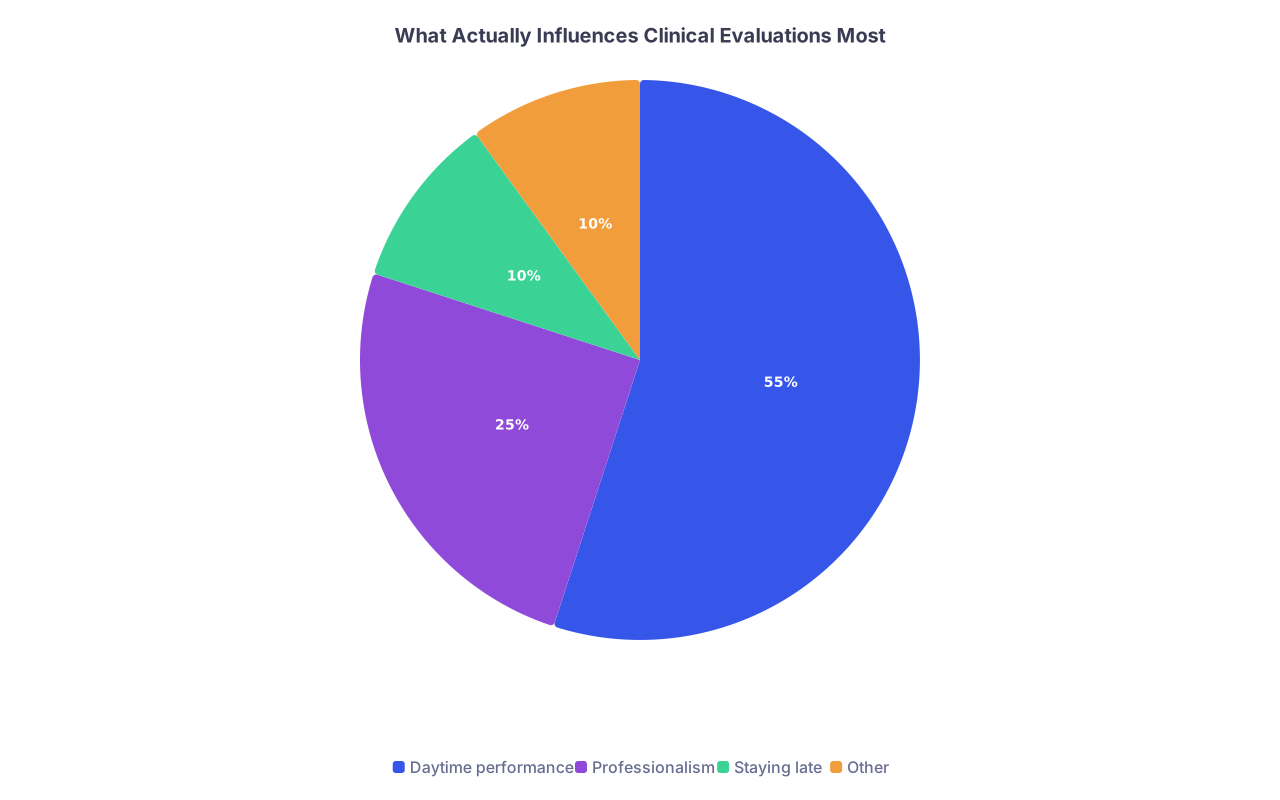
| Category | Value |
|---|---|
| Daytime performance | 55 |
| Professionalism | 25 |
| Staying late | 10 |
| Other | 10 |
How To Communicate About Leaving (So You Don’t Look Bad)
The number one move that protects you: clear checkout.
Do not disappear. Ever.
Use language like:
- “My notes and follow-ups are done for my patients. Is there anything else I can help with before I head out?”
- “I can stay for the admission if you’d like extra help, or I can take off now if that’s easier.”
- “I’d like to review for the shelf tonight. Is it okay if I go after sign-out?”
Notice the pattern: you offer help, you show awareness, and you give the resident an easy way to say “go home” without guilt.
If expectations are unclear on Day 1–2, ask directly:
“What time do students usually leave on this service when things are normal?”
Residents actually appreciate that question. It beats them wondering why you’re still there at 7 pm hovering behind them.
Red Flags: When Leaving Early Really Will Hurt You
You’re playing with fire if you:
- Leave before rounds or scheduled teaching without telling anyone
- Regularly disappear before notes and follow-up work are done
- Say, “I’m going to pre-round on my patients” and then vanish
- Lie about where you are (“I’m just downstairs” when you’re in your car)
I’ve watched evals go from honors to pass with one sentence comment:
“Frequently left early without checking out or finishing tasks.”
Residents don’t need to be poetic. That one line is enough.

| Step | Description |
|---|---|
| Step 1 | All tasks done? |
| Step 2 | Finish tasks |
| Step 3 | Is team busy with useful work? |
| Step 4 | Offer to help or stay |
| Step 5 | Ask to check out |
| Step 6 | Stay if asked, else leave |
But What About Shelf Studying and Work-Life Balance?
You’re not wrong to care about this. And yes, it’s legitimate.
You will not honor every rotation if you try to “out-stay” everyone all the time. You’ll just burn out and start resenting patients and staff. Most residents can see that coming from a mile away.
Reasonable approach:
- For demanding core rotations (IM, surgery, OB):
Expect some days you stay later. Build studying into mornings, post-call time, or lighter days. - For lighter rotations (psych, outpatient, some electives):
Don’t linger for no reason. Leave when your work is done and use the time to study.
Here’s what I tell students bluntly:
If you leave at 3 pm every day “to study” but spent half the day on your phone on the ward, no one believes the story. On the other hand, if you work hard all day and ask to head out at 4:30 to prep for your exam, most humans will understand.
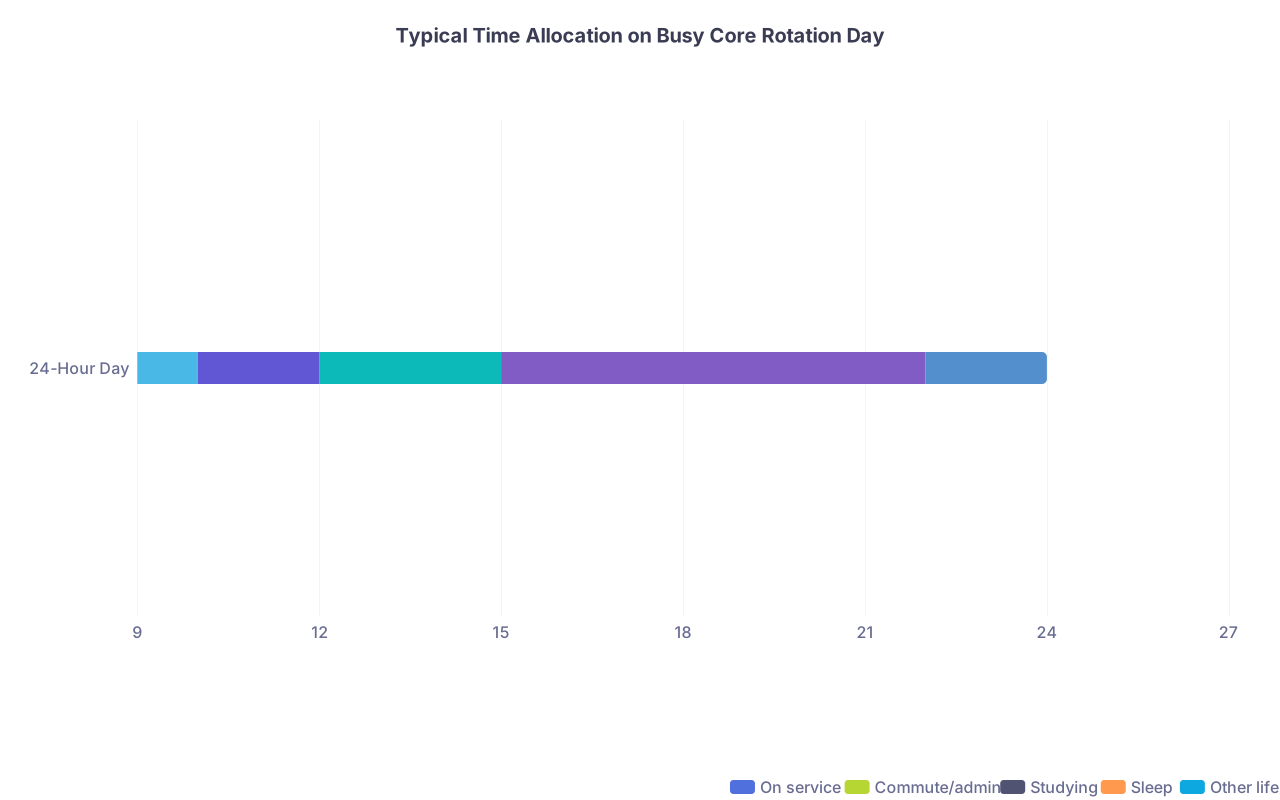
| Category | On service | Commute/admin | Studying | Sleep | Other life |
|---|---|---|---|---|---|
| 24-Hour Day | 10 | 2 | 3 | 7 | 2 |
How This Plays Into Letters of Recommendation
Letters rarely say, “This student stayed late a lot.”
They say things like:
- “He consistently went above and beyond to help the team.”
- “She took ownership of her patients and was always available when needed.”
- “He stayed late to see challenging cases and was eager to learn.”
Notice the phrasing: “above and beyond,” “always available,” “stayed late to see challenging cases.” It’s not about sheer extra hours. It’s about being present when it mattered.
You get those comments by:
- Saying: “Can I stay to see how this works?” when something interesting happens.
- Asking: “Can I call the family and update them?” and actually doing it well.
- Volunteering: “If you need someone to help with the next admission, I’m happy to stay.”
Not by lurking silently until 9 pm every night.

Quick Templates You Can Steal
Use these in real life.
Early afternoon (around 2–3 pm):
- “What else would be most helpful for me to do this afternoon?”
- “Is there anything you’d like me to read about and present tomorrow?”
End of day:
- “I’ve finished my notes and checked all today’s results. Anything else I can help with before I head out?”
- “I can stay to help with the new consult, or I can take off now and read about DKA for tomorrow. What’s more helpful?”
On a heavy day when you’re at your limit:
- “I’m feeling pretty wiped and want to make sure I’m safe to drive home and functional tomorrow. My tasks are done—would it be okay if I head out now?”
That last one? Residents with a soul will respect it.

FAQ: Staying Late on Rotations
1. If I leave right when the resident says “You can go,” will I look lazy?
No. If they’ve released you and your work is done, you are fine. The problem is students who leave early without asking, not those who take yes for an answer.
2. How many days per week should I volunteer to stay late?
On heavy services, once or twice a week of meaningful extra staying is plenty. For example: staying to help with a complex admit, a night OR case, or a key procedure. Quality beats quantity.
3. Should I tell attendings I stayed late?
You don’t need to brag. But you can say things like, “I stayed to see a couple of late admissions this week and learned a lot about X.” That signals engagement without flexing about hours.
4. Is it okay to leave earlier than residents if I’m done?
Yes—on almost every service, students usually leave earlier than residents. As long as you’ve checked out and not left anything hanging, it’s normal.
5. What if residents give mixed signals—some say “go home,” others stay all night?
Ask for explicit expectations: “Different people have said different things about when students usually leave. What do you prefer for our team?” Then follow whatever your primary senior or attending says.
6. Can staying late ever hurt my evaluation?
Indirectly, yes. If you’re clearly exhausted, sloppy, or making mistakes because you won’t go home, you look inefficient. If you hang around uselessly or annoy the team by refusing to leave, they may see you as lacking judgment.
Key Takeaways
- Do not disappear early; always check out and finish your work.
- Stay late when you can actually help or learn something meaningful—not just to rack up hours.
- The strongest evals come from being reliable, prepared, and engaged during the day, with occasional well-chosen moments of “above and beyond,” not from living in the hospital.


