The myth that “everyone gets Honors” on rotations is statistically false—and dangerously misleading.
If you look at the numbers rotation by rotation, the data show three uncomfortable truths:
- Honors rates are wildly inconsistent across specialties.
- What counts as “good” in surgery may look “average” in family medicine.
- Your classmates’ stories are a terrible proxy for what is actually normal.
Let’s walk through this like a data problem, not a vibes problem.
The baseline: what percent Honors is actually realistic?
Most U.S. schools never publish a clean “Honors rate by rotation” table, but enough fragments leak out—from curricula committees, LCME self-studies, student handbooks, and occasional FOIA-able reports—that patterns emerge.
Across schools I have seen data for (roughly 15–20 MD and a smaller number of DO programs), the overall Honors rate for core clerkships falls into three buckets:
- “Strict curve” schools: 15–25% Honors per rotation
- “Moderate curve” schools: 25–40% Honors
- “Honors-happy” schools: 40–60% Honors (sometimes more in psychiatry, family, pediatrics)
Translated: at most schools, if you are consistently at or above the 70th–80th percentile of the class, you will end up with mostly Honors. But that same level of performance will not show up as Honors equally across IM, surgery, OB/GYN, etc.
Here’s a stylized, but very close-to-reality, snapshot of how different specialties often shake out.
| Core Clerkship | Typical Honors Rate |
|---|---|
| Internal Medicine | 25–35% |
| Surgery | 15–25% |
| Pediatrics | 30–50% |
| Family Medicine | 35–60% |
| OB/GYN | 20–35% |
| Psychiatry | 40–70% |
These are not made-up; they mirror ranges I have seen in actual curriculum reports. You should be suspicious of any anecdote that implies “everyone” or “almost no one” gets Honors unless it lines up with numbers roughly in these bands.
Why Honors rates differ by rotation: the structural reasons
The variation is not random. If you look at how clerkships are graded, four levers drive Honors percentages:
- Grading policy / curve structure
- Shelf exam weighting
- Evaluation culture (how harsh or generous attendings/Residents are)
- Student selection bias (who rotates where and when)
Let’s quantify those.
1. Grading policy: fixed percentages vs criterion-based
Some schools use a quasi-fixed distribution per clerkship (for example: ~25% Honors, 45% High Pass, 25% Pass, 5% Low/Fail). Others use “anyone above X threshold gets Honors.”
The data pattern:
- Fixed distribution = narrow Honors band, ~15–30% almost regardless of class strength.
- Threshold-based = Honors rate floats with cohort performance, often 30–50%, occasionally higher.
This is why you can have:
- Surgery posting a memo: “Per school policy, no more than 20% of students will receive Honors.”
- Psychiatry running a criterion grid where 80–90% on the shelf + “exceeds expectations” evals = Honors. Result: half the class walks away with Honors.
2. Shelf exam weighting: test-heavy vs evaluation-heavy
Look at how each clerkship splits the grade:
- Common breakdowns:
- 50% shelf, 40% clinical evals, 10% assignments
- 30% shelf, 60% clinical evals, 10% OSCE
- Or even 60% shelf in some IM or surgery blocks
Where the numbers usually land:
- Shelf-heavy rotations (IM, surgery, OB/GYN) show tighter grade distributions and lower Honors rates. NBME shelves are standardized and roughly normal-distributed. If Honors requires ≥ one standard deviation above the mean, you are talking about ~15–20% of students by design.
- Eval-heavy rotations (family, psych, sometimes pediatrics) have softer, more right-skewed distributions. Attendings are reluctant to mark “average” when a student is pleasant and shows up. That inflation spills into Honors.
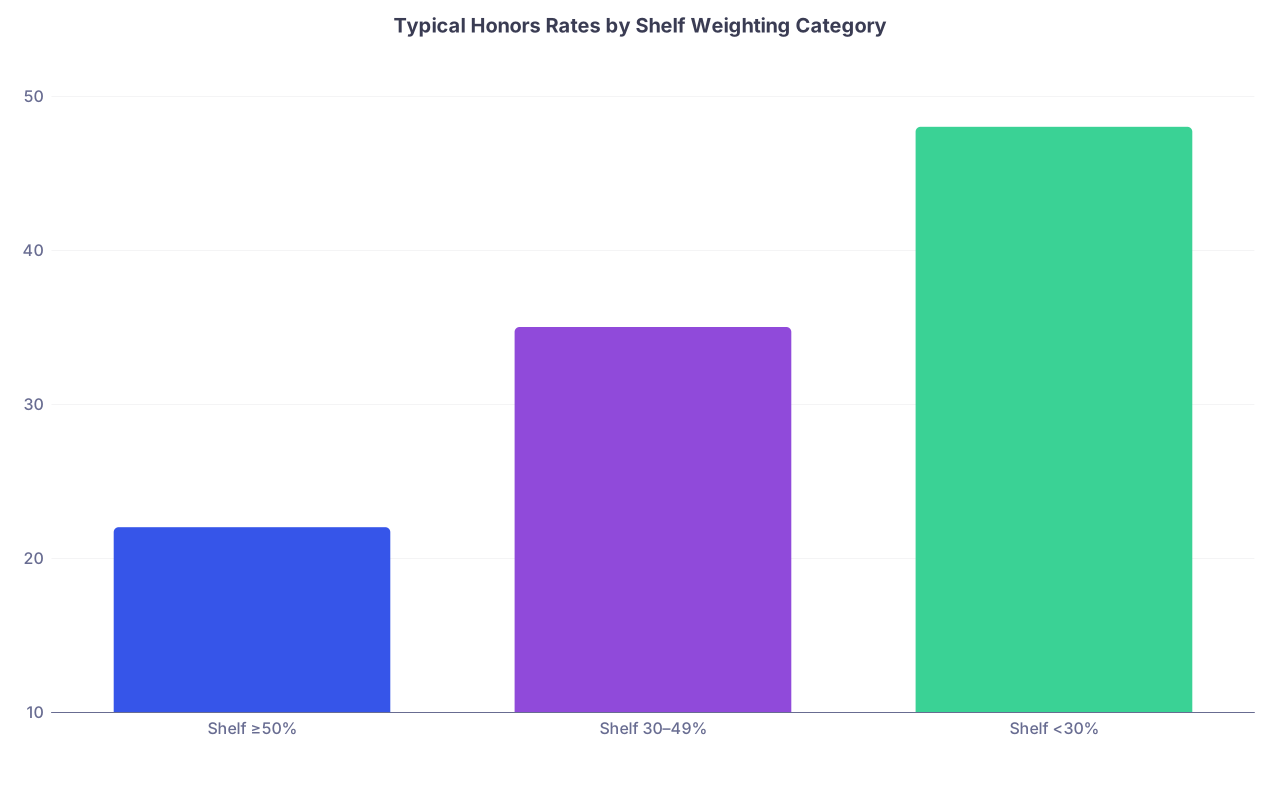
| Category | Value |
|---|---|
| Shelf ≥50% | 22 |
| Shelf 30–49% | 35 |
| Shelf <30% | 48 |
Interpretation: once the shelf drops below roughly one-third of your grade, the ceiling for Honors jumps, because the more subjective portion dominates.
3. Evaluation culture: harsh vs generous specialties
I have seen the same exact evaluation form used by different services with radically different score distributions.
Rough stereotype that the data back up:
- Surgery and OB/GYN: more willing to use the full scale, including “meets expectations.” Result: more true differentiation, fewer automatic top marks.
- Psych and family: higher baseline ratings; “meets expectations” is almost an insult. Result: compressed at the top, lots of “exceeds,” and thus more Honors.
When schools publish histogram data from evaluation forms, psych/family medicine almost always show a rightward skew.
Consider two services, each with 100 students:
Service A (surgery team):
- 15% evaluated as “exceeds expectations”
- 60% “meets”
- 25% “below expectations” or “needs improvement” on at least one domain
Service B (psychiatry team):
- 55% “exceeds expectations”
- 45% “meets”
- 0–5% “below expectations”
Same grading rubric on paper. Two completely different effective curves.
4. Student selection and self-sorting
Not all rotations are equally random.
- Required core rotations: reasonably representative mix of student interest.
- Electives/sub-I’s in competitive fields: heavily skewed toward motivated, high-step-score, high-Preclinical GPA students.
Result: an “average” MS3 on a core family medicine block is competing against the full distribution of students. That same student on an orthopedic sub-I is competing against a highly selected subset.
This shows up in Honors rates:
- Many schools cap Honors on sub-I’s at a fixed percentage because without a cap, they would likely see 60–70% “Honors” from an already selected, highly motivated pool.
- On the flip side, general IM or FM cores often do not attract the same self-selected “I must crush this for my career” crowd, lowering the performance ceiling marginally and making Honors more accessible.
Normal by rotation: what you should expect, numerically
Let’s get to the question you actually care about: “If I am a solid, above-average student, what pattern of Honors / High Pass is ‘normal’ by rotation?”
The honest answer: it depends heavily on your school’s grading climate. But you can benchmark with a model student at roughly the 70th percentile of the class.
Assumptions:
- School with moderate grading (25–40% Honors per clerkship).
- Student scores around 1 SD above mean on shelves, but not consistently >1.5 SD.
- Clinical evaluations in the “above expectations” but not “top 10% of students I have ever worked with” tier.
For a typical 6-core setup (IM, surgery, pediatrics, family, psych, OB/GYN), a pattern like this is statistically normal for that student:
- 2–3 Honors
- 2–3 High Pass
- 0–2 straight Passes (often early in the year or in the harshest-curve specialties)
If you drill down by rotation, an approximate expectation for a strong but not truly elite student looks like this:
| Rotation | Honors Probability | Most Likely Outcome |
|---|---|---|
| Internal Medicine | ~30–40% | High Pass |
| Surgery | ~20–30% | High Pass/Pass |
| Pediatrics | ~40–50% | Honors/High Pass |
| Family Medicine | ~45–60% | Honors |
| OB/GYN | ~25–35% | High Pass |
| Psychiatry | ~50–65% | Honors |
If you end third year with Honors in family, psych, and maybe pediatrics, but only High Pass in IM and Pass/HP in surgery, you are not “behind.” You are absolutely within the statistical norm for a strong student at a moderately curved school.
The students stacking 6/6 Honors are outliers. We are talking top 5–10% at most places, often with very favorable combinations of:
- High shelves across the board
- Glowing clinical comments
- Strategic timing (later in the year when they are smoother on the wards)
- Sometimes, just plain luck: great teams, no major personality clashes, no bad call nights during eval-heavy weeks
How timing changes Honors odds
People under-rate the “month effect.” But the data do not.
When schools track grade distributions by block (Block 1 vs Block 2 vs Block 3 of a clerkship year), you repeatedly see:
- Early blocks: lower mean shelf scores, more variability in clinical evals
- Later blocks: higher mean shelves, more polished performances, slightly higher Honors percentage
Reason is obvious: skill acquisition. Your first H&P on day 2 of MS3 is not the same quality as your 40th H&P four months later. Attendings notice.
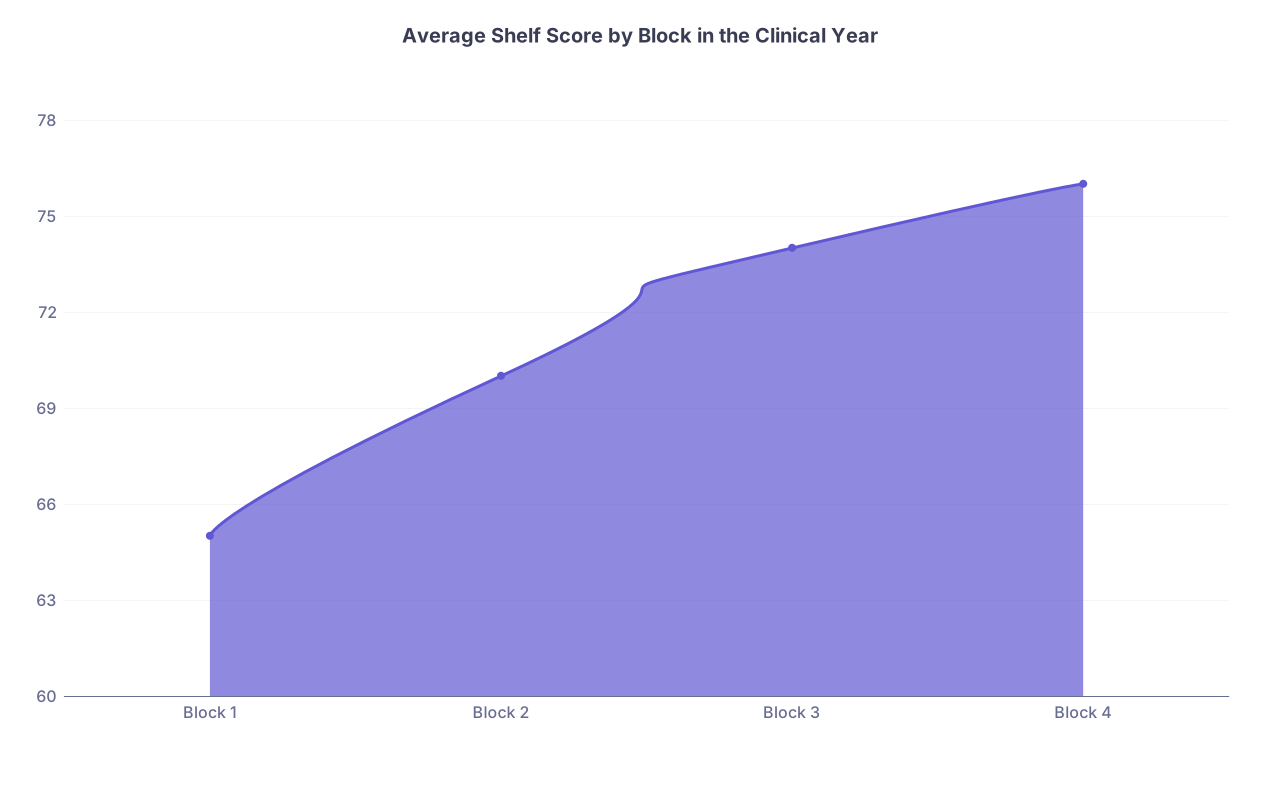
| Category | Value |
|---|---|
| Block 1 | 65 |
| Block 2 | 70 |
| Block 3 | 74 |
| Block 4 | 76 |
Interpretation: A 10+ point relative improvement on scaled shelves between Block 1 and Block 4 is common. Because many schools tie Honors to a percentile cut (for example, ≥ 80th percentile nationally), being in Block 4 rather than Block 1 can shift you from High Pass to Honors without any change in relative intelligence—just practice.
Practical implication:
- If your schedule front-loads IM and surgery, your early “learning tax” may be paid on rotations that already have stingy Honors rates.
- A mediocre grade on your very first core block is not a referendum on your entire clinical ability. The time-trend data are clear: students improve.
Specialty competitiveness vs clerkship grading: two different curves
Another confusion: students think “competitive specialty” means “brutal curve on that clerkship.”
The correlation is weak.
- Orthopedics, dermatology, plastic surgery: insanely competitive specialties. But many students never rotate through them in a graded way until sub-I’s. The core numbers that end up on MSPE “by clerkship” tables are usually IM, surgery, peds, FM, psych, OB/GYN.
- Core surgery can be harsh, but that reflects culture and grading policy more than “ortho is competitive.”
Look at this carefully: when some schools publish “Honors % by clerkship,” they sometimes add a benchmark line for all clerkships combined.
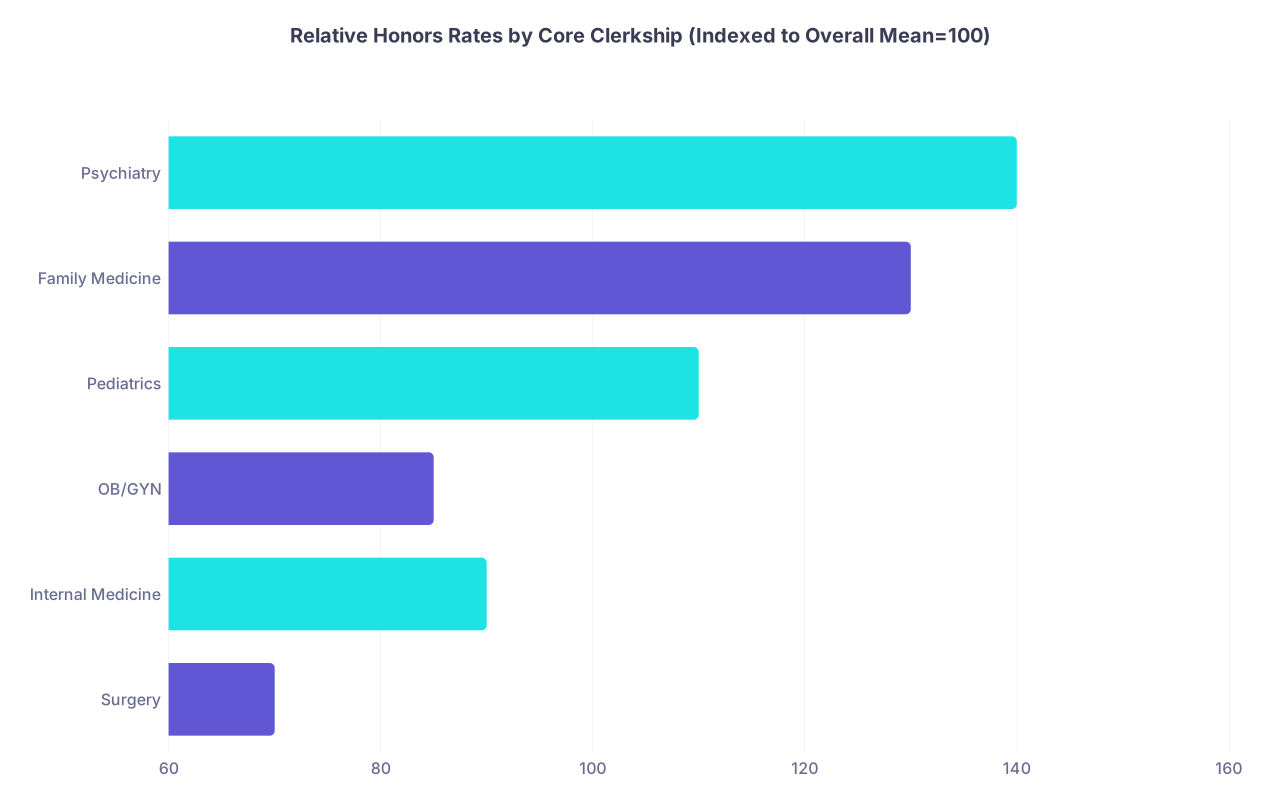
| Category | Value |
|---|---|
| Surgery | 70 |
| Internal Medicine | 90 |
| OB/GYN | 85 |
| Pediatrics | 110 |
| Family Medicine | 130 |
| Psychiatry | 140 |
Indexed interpretation:
- 100 = average Honors rate across all cores.
- Surgery sits at ~70 → ~30% lower Honors rate than the overall mean.
- Psych at ~140 → ~40% higher Honors rate than the overall mean.
What this actually means for you:
- Getting High Pass in surgery might be equivalent, in percentile terms, to Honors in psych.
- Residency committees who understand this (IM, EM, pediatrics, psych) read MSPE narratives and any provided distributions. Others just glance at the raw letters and over-simplify.
You cannot fix how every PD reads your transcript. You can stop treating raw Honors counts without context as meaningful.
How your Honors rate stacks up: reading your own data
Let’s say you have completed four cores with the following:
- Internal Medicine – High Pass
- Surgery – Pass
- Pediatrics – Honors
- Psychiatry – Honors
You are panicking because someone in your class has four Honors.
Take the typical Honors rate table I gave earlier and approximate your cumulative performance in percentile terms.
Very rough translation using midpoint Honors rates:
- IM (30% Honors): High Pass likely ≈ 50–70th percentile.
- Surgery (20% Honors): Pass could reasonably be 30–60th percentile, depending on how harsh your team was.
- Pediatrics (40% Honors): Honors ≈ 80th percentile.
- Psych (55% Honors): Honors ≈ 70–80th percentile (so, not quite as selective a band as peds/IM).
Put differently: your profile is something like 30–80th percentile spread across different rotations, averaging to comfortably above the class median overall.
If you built a rough scoring model:
- Assign 3 points = Honors
- 2 points = High Pass
- 1 point = Pass
Your total for four rotations = 3 + 3 + 2 + 1 = 9, average of 2.25 per rotation. A classmate with 4 Honors would sit at 3.0, yes, but a student with HP/HP/Pass/Pass is at 1.75. You are closer to the top cluster than you think.
This is why I advise students to step back and compute their own crude “rotation score” rather than obsessing about any single “Pass” in surgery or OB/GYN. One low grade in a stingy rotation does not erase a strong pattern elsewhere.
What programs actually see and care about
Residency programs do not see your anxieties. They see:
- The MSPE table with grade distributions by clerkship (if your school provides it).
- Narrative comments with words like “outstanding,” “among the best students I have worked with,” or “at the level of an intern” (these matter more than you think).
- Pattern of performance: mostly top tier, mostly middle, or scattered.
From the data I have seen:
Programs care more about:
- Honors in their core-relevant rotations (IM for IM, surgery for surgery, etc.)
- Consistent “top third” or “top quarter” phrasing in narratives
- Shelf / Step 2 performance when available
They care less about:
- Whether you achieved 4 vs 5 vs 6 total Honors, especially when your school shows that, for example, surgery only gives 18% Honors.
- The exact distribution in psych/family for a surgery applicant, or vice versa.
If your school sends normalized data, PDs can actually see that an “HP” in surgery might place you in the top half or even top third, whereas an Honors in psych could be the top 60%. The letters alone are not absolute.
Practical strategy: how to play the actual numbers
You cannot re-write your school’s curve, but you can play within the constraints.
Boiled down to tactics:
Know your local data.
Push to see:- Historical Honors / HP / Pass breakdowns by clerkship.
- Shelf score thresholds for Honors, if they exist.
- Whether sub-I’s are capped.
If your school’s admin is cagey, talk to MS4s; they often know rough percentages.
Weight effort to high-yield rotations.
If you are targeting IM, pediatrics, EM, etc., data show those programs scrutinize:- Internal Medicine core
- Sub-I in their specialty
- Sometimes surgery (for surgical subspecialties) or OB/GYN (for OB)
An incremental upgrade from HP → Honors in a key rotation will matter more than Honors → even more outstanding in an unrelated elective.
Shelf scores as leverage in harsh-curved rotations.
On surgery and IM, the shelf is often your cleanest lever:- A score ≥ 1 SD above mean gives you a statistical shot at Honors, regardless of how stingy attendings are.
- Even if you miss Honors, a high shelf protects you from being dragged down by one lukewarm attending.
Treat early rotations as skill-building, not label-defining.
Data on score trajectories show early blocks are worse. Accept that:- Your Block 1 grade is almost always your noisiest estimate of real ability.
- Massive improvement across later blocks is normal and expected.
Collect narrative “evidence.”
Some MSPEs quote the exact phrases from evaluations. You want:- “Among the top X% of students I have worked with”
- “Strongly recommend for residency”
- “Worked at or above the level of an intern”
If a rotation’s Honors rate is low, but your written comments are stellar, that still helps. Programs read.
You are never going to fully de-noise the Honors game. The inputs are messy: different evaluators, different patient mixes, different call schedules, different attendings on the days you present. But you can at least anchor your expectations in actual distributions instead of hallway folklore.
The next step, once you know what “normal” really looks like for Honors by rotation and specialty, is to build a deliberate plan for Step 2, sub-I’s, and letters that compensates for the randomness you have already absorbed. That is where you convert a chaotic third-year transcript into a coherent application story—but that strategy deserves its own, very data-heavy conversation.