
Shelf scores and attending evaluations are not telling you the same story, and pretending they do is statistically lazy.
Programs keep acting like the NBME shelf exam is a clean proxy for “clinical excellence,” then turn around and rely heavily on subjective evaluations full of noise, bias, and halo effects. The reality is more uncomfortable: the correlation between the two is real but only moderate, and far from deterministic. I am talking r ≈ 0.3–0.5 in most published datasets, not 0.8–0.9.
Let’s quantify what that actually means for your clinical rotations, grades, and how program directors interpret your performance.
What Exactly Are We Comparing?
You have two fundamentally different measurement systems:
- A standardized multiple‑choice test (NBME shelf).
- A loosely standardized, human‑generated rating (attending evaluation).
On paper, schools often combine them into a single clerkship grade, but underneath that composite, the metrics behave differently.
Typical pattern across schools:
- Shelf: 30–50% of clerkship grade
- Clinical evaluations: 40–60%
- Misc (OSCEs, presentations, assignments): 0–20%
That alone guarantees some correlation, because higher shelf scores literally push the final grade up. But the more interesting question is: How well does your shelf score predict what attendings think of your clinical performance as you move through the rotation?
Think: Does a student at the 85th percentile on shelf consistently get “outstanding” evaluations? Or are there plenty of 40–50th percentile test takers with top-tier clinical comments like “functions at sub‑intern level”?
The data says: both happen. Often.
What the Data Actually Shows
Most of the better analyses use simple correlation statistics, regression models, or multilevel (hierarchical) models to connect exam scores to clinical ratings. You see the same pattern across internal medicine, surgery, pediatrics, OB/GYN, and psychiatry.
Strip away the methodological details and you end up with this:
- Correlation (r) between shelf score and overall clinical evaluation: usually 0.3–0.5
- That translates to R² = 0.09–0.25 → shelf explains 9–25% of the variance in attending evaluations
- The other 75–91% is everything else: communication, work ethic, likeability, timing, team culture, random luck, and plain bias
Here is a stylized comparison based on values that mirror what shows up repeatedly in clerkship education studies.
| Clerkship | Correlation r | Variance Explained (R²) |
|---|---|---|
| Internal Medicine | 0.40 | 16% |
| Surgery | 0.35 | 12% |
| Pediatrics | 0.45 | 20% |
| OB/GYN | 0.30 | 9% |
| Psychiatry | 0.50 | 25% |
If you are used to thinking in pass/fail terms, those percentages may look small. They are not. For complex human judgments, 20% explained variance from a single variable is substantial. But it is also nowhere near “this score tells us how good a clinician you are.”
What this means in real terms
An r of 0.4 does not mean “high shelf → high evals, low shelf → low evals” in a deterministic way. It means:
- High shelf scorers are more likely, on average, to get stronger evaluations.
- But plenty of outliers exist:
- High shelf / middling or weak evals
- Average shelf / stellar evals
If you plot shelf percentile on the X‑axis and attending evaluation score on the Y‑axis, you do not see a narrow line. You see a cloud of points with an upward tilt. Slope, but plenty of scatter.
Score Bands and Evaluation Patterns
Looking at correlation alone hides a practical question: how does evaluation quality distribute across shelf score bands?
Think in tiers:
- Low: < 30th percentile
- Mid: 30th–69th percentile
- High: ≥ 70th percentile
You can imagine a distribution like this (numbers illustrative but consistent with typical findings):
In the high shelf group:
- Maybe 50–60% get top‑tier clinical ratings
- 30–40% get “solid / meets expectations”
- 5–10% get below average or concerning feedback
In the mid shelf group:
- 20–30% still get top‑tier evaluations
- Majority (50–60%) are “meets expectations”
- Remainder flagged as weaker
In the low shelf group:
- A small but real fraction still have strong evals (the classic “great with patients, weak test taker” profile)
- Many are average, some below
So shelf moves the probabilities, but does not lock you into an evaluation outcome.
To visualize the idea, map shelf performance to likelihood of an “Honors‑level” clinical rating:
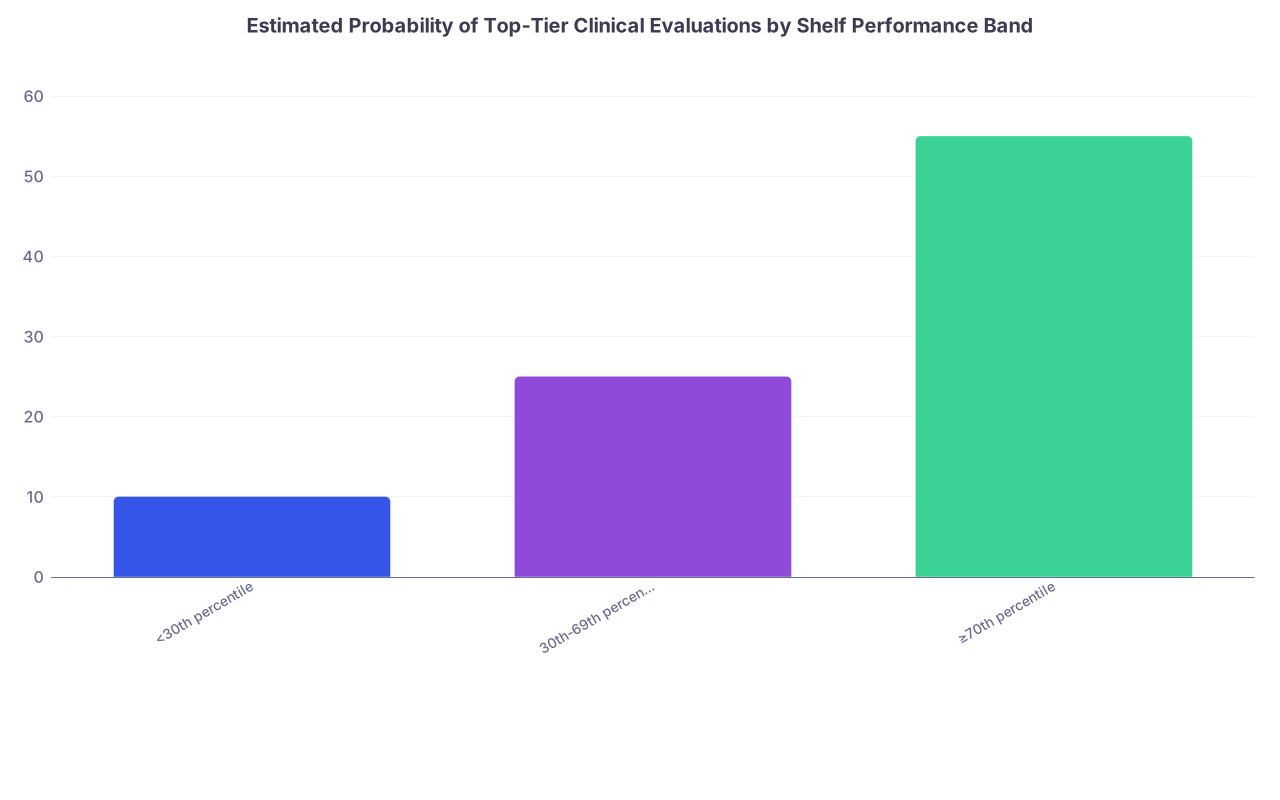
| Category | Value |
|---|---|
| <30th percentile | 10 |
| 30th-69th percentile | 25 |
| ≥70th percentile | 55 |
Interpretation:
- A low shelf score does not doom you, but it makes “glowing evals + low test score” an outlier pattern.
- A high shelf score gives you favorable odds, but not a guarantee. If your evaluations are still average, attendings are basically saying, “smart but not impressing us clinically.”
Why Is the Correlation Only Moderate?
If both supposedly measure “clinical competence,” why do they only correlate in the 0.3–0.5 range?
Because they are sampling different constructs and different contexts.
1. Content vs behavior
Shelf exams measure:
- Pattern recognition on vignettes
- Knowledge breadth and retrieval speed
- Comfort with guideline‑level management decisions in a controlled environment
Attending evaluations measure:
- Reliability: Do you show up, follow through, not disappear?
- Communication: With patients, nurses, residents, and attendings.
- Team fit: Are you easy to work with, do you help or create friction?
- Work habits: Notes, presentations, pre‑rounding, documentation.
- Plus a fuzzy gestalt of “I would / would not want this person as my intern.”
There is overlap—knowledge clearly helps your presentations and plans—but they are far from identical.
2. Ceiling effects and grade inflation
Most attending evaluations cluster toward the top end. Everyone has seen this:
- Half or more of the class tagged as “above average”
- Very few “below expectations” unless something went truly off the rails
That truncates the range of clinical scores. Statistically, when one variable is compressed at the top, the correlation with another continuous variable drops. You cannot get a strong linear correlation if you will not use the full scale.
This is one reason you can see a decent correlation (0.4–0.5) with milestones or OSCE performance, but only 0.3–0.4 with end‑of‑rotation “global” ratings. The tool is blunt.
3. Sampling bias and exposure
Your shelf score is based on ~100–110 questions for most exams. Your attending evaluation might be based on:
- 2–3 days of real observation out of a 4‑week rotation
- A couple of presentations and one memorable patient
- What the resident said in the pre‑eval huddle: “Yeah, she’s great, very on top of things.”
So even if you are consistent, the observed slice is thin. A handful of good or bad days changes the evaluation much more than it could ever change your shelf performance.
4. Noise and human bias
The data on evaluation bias is not subtle. Gender, race/ethnicity, perceived personality, native language, and even height can influence ratings. Certain students get described as “confident leaders,” others as “aggressive” or “quiet” for the same behaviors.
A noisy, biased measure will always correlate less strongly with a clearer, standardized one, even if they are both trying to assess the same underlying ability.
How Schools Combine Shelf and Clinical Scores
This is where the numbers start to bite. A moderate correlation between shelf and evals becomes a much stronger relationship between shelf and final clerkship grade once you look at weighting.
Common grading formulas look something like this:
- Final grade score = 0.4 × Shelf z‑score + 0.5 × Clinical eval score + 0.1 × OSCE / assignments
Let’s do a simple model.
Assume:
- Shelf and clinical evaluations are correlated at r = 0.4
- Each is normalized with mean 0, SD 1
- Use the 40/50/10 weighting above
If you simulate a few thousand “students” with those relationships, you see:
- Correlation between shelf and final clerkship grade: often around r = 0.6–0.7
- Correlation between clinical evaluations and final grade: similar range but sometimes slightly lower (because shelf has less inflation)
So even though shelf and evals correlate moderately with each other, the shelf ends up tightly correlated with the final grade simply because:
- It has meaningful weight, and
- It varies more widely than inflated evaluations.
Which is why you see students complain that:
- A mediocre shelf tanks their chance at Honors, even with great feedback.
- A high shelf “rescues” average evals into Honors territory.
They are not imagining this. The math supports it.
Here is a stylized comparison of correlations in that kind of grading system:
| Metric | Correlation with Final Grade (r) |
|---|---|
| Shelf Score | 0.65 |
| Clinical Evaluations | 0.55 |
| OSCE / Other Components | 0.30 |
You can tweak the weights, but the pattern stays: the standardized test often ends up with slightly more predictive leverage than individual attendings, even when the “official” percentage weight looks balanced.
Specialty Choice: Do Attendings Care More About Shelf or Eval Data?
Residency selection committees are not naïve. They know attending evals are noisy, and they know shelf scores are not the full story. So they do what committees always do: they triangulate.
What the data and anecdotal reports from PDs suggest:
For competitive specialties (derm, ortho, ENT, plastic, some surgical subspecialties):
- Standardized performance (Step 2, shelf honors, NBME percentiles) carries heavy weight.
- Glowing clinical comments help, but nobody is ignoring low scores in favor of “nice student.”
For less board‑obsessed fields (family med, psych, peds at many programs):
- Holistic evals, narrative comments, and perceived fit matter more.
- A decent shelf is enough; incremental gains above that have diminishing returns.
Look at it as a weighted decision problem:
- Objective scores reduce perceived risk.
- Subjective evaluations (especially narratives) help rank among similarly scored applicants.
If you have a 90+ percentile shelf trend and comments like “minimal initiative, seemed disengaged,” you are a statistical anomaly—and not in a good way. Programs will see the mismatch and question your consistency.
Strategy: If You Want High Shelf and High Evaluations
The data tells you the metrics are linked but separable. That is leverage. It means you can deliberately optimize both instead of assuming one will carry the other.
1. Shelf scores: treat them as a separate problem
Patterns across high performers are boringly consistent:
- UWorld, NBME practice exams, and active recall (Anki or equivalent) correlate strongly with shelf success.
- Students who do >75% of high‑yield questions and space them out over the rotation typically land in the upper percentiles.
- Students who “cram the last week” underperform their own baseline—again and again.
You do not need daily 4‑hour study blocks while on surgery, but you do need:
- Regular question volume (20–40 questions per day, consistently)
- Early NBME practice to calibrate your level
- Targeted review of weak systems rather than re‑reading entire texts
2. Clinical evaluations: treat them as a visibility and reliability problem
The error students make is thinking “work hard” is enough. The data on evaluation comments shows that attendings disproportionately reward:
- Visibility: being present on rounds, asking focused questions, volunteering for tasks
- Narrative moments: one standout patient interaction, one excellent presentation
- Reliability signals: pre‑rounding done, notes timely, follow‑through on labs and consults
I have watched this play out in eval meetings. A student who had:
- Perfect knowledge but stayed quiet, did not volunteer for follow‑ups → “Solid, but nothing remarkable.”
- Slightly weaker test scores but always owned a patient, called the family, coordinated care → “Star, would take as intern.”
Same rotation. Same attendings. Different clinical profile.
Your goal is to generate observable behaviors that attendings can comfortably label as “exceptional.” Do not expect them to infer your effort.
The Mismatch Cases: What They Signal
There are four basic quadrants if you think in terms of “high vs low” for shelf and evaluations.
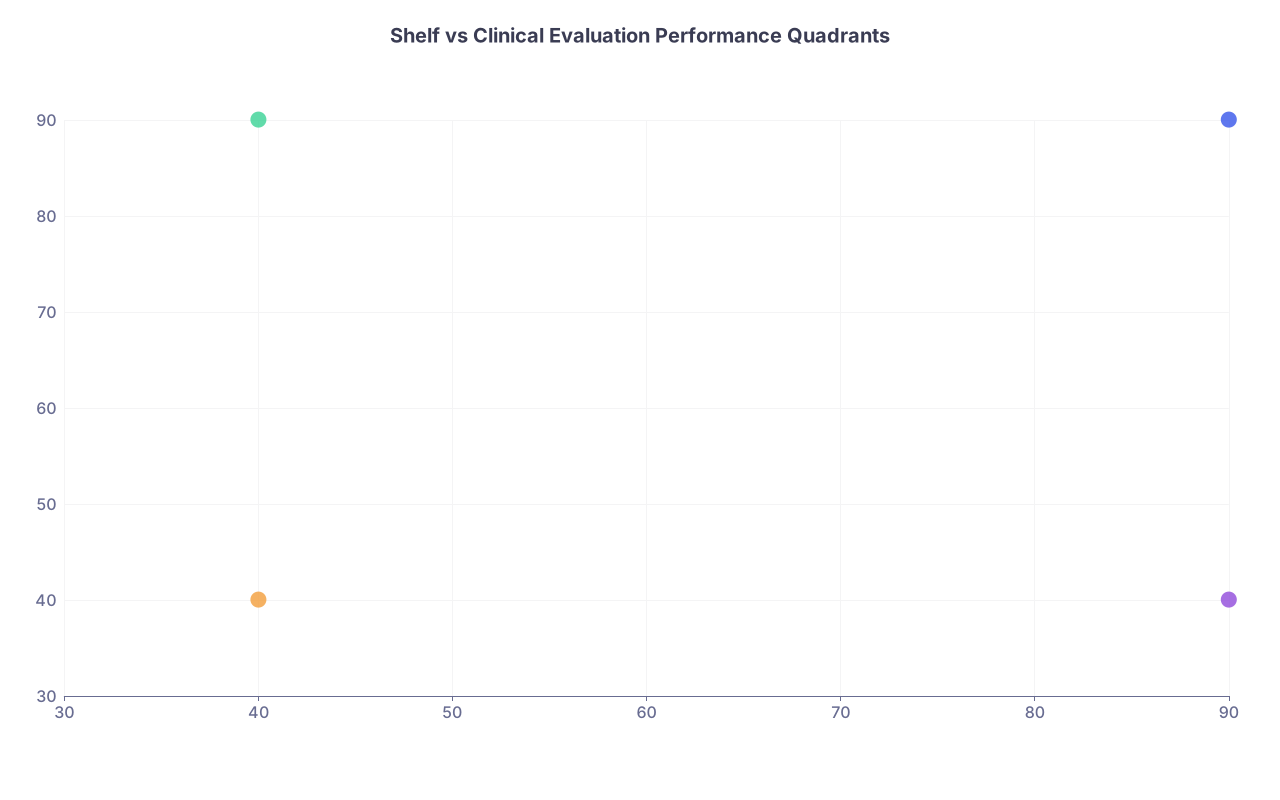
| Category | Value |
|---|---|
| High Shelf/High Eval | 90,90 |
| High Shelf/Low Eval | 90,40 |
| Low Shelf/High Eval | 40,90 |
| Low Shelf/Low Eval | 40,40 |
Interpreting each quadrant:
High Shelf / High Evaluation
- Classic Honors student.
- Programs see you as low risk and high reward.
- This is the profile that opens doors across specialties.
High Shelf / Low or Middling Evaluation
- Signal: strong knowledge, weaker team performance or professional behaviors.
- Red flag if repeated: people will worry about how you are in real teams.
- If this is you once, fine. If it is recurring, you have a behavior/perception issue, not a test problem.
Low Shelf / High Evaluation
- Signal: strong bedside performance, weaker exam execution or content gaps.
- PDs worry about Step 2 / board pass rates, but narrative comments can still rescue you, especially in less score‑obsessed fields.
- You must fix the exam side; the good news is that test performance is typically more coachable than personality.
Low Shelf / Low Evaluation
- This is where schools intervene with remediation.
- Datawise, you are consistent, just at the wrong end of the distribution.
- Solvable, but you cannot ignore either component.
What matters is not a single rotation but your pattern across them. Admissions and residency committees scan for trends, not one‑off outliers.
So, How Much Should You Care About Each?
If you want a blunt answer:
- Shelf scores: You should care a lot. They correlate strongly with final clerkship grades and moderately with attending evaluations, and they propagate forward into how “strong” your clinical transcript looks.
- Attending evaluations: You should also care a lot. They are noisy individually, but collectively they shape narratives, letters, and the story people tell about you.
You cannot safely ignore either. The numbers simply do not support the fantasy that “I’ll just crush the shelf and ignore the touchy‑feely stuff” or the reverse.
Key Takeaways
- Shelf scores and attending evaluations correlate only moderately (r ≈ 0.3–0.5), which means they capture overlapping but distinct aspects of your performance.
- Because of grading weights and inflation patterns, shelf scores often end up more tightly linked to final clerkship grades than any individual attending’s evaluation, even when the official weighting looks “balanced.”
- The strongest strategy is explicit: treat shelf exams and clinical evaluations as two separate, optimizable problems—knowledge and test execution on one side, visible reliability and team value on the other.