
The myth that “rotation order does not matter” is statistically false. The data show a clear, measurable impact of clinical rotation order on NBME shelf performance.
If you treat rotation order as noise, you are competing against people who treat it as leverage. And they are winning by several points per shelf, sometimes more than ten.
Let me walk through what the numbers actually say, not the folklore you hear on rounds.
What the Data Actually Show About Rotation Order
Most large studies converge on the same pattern: earlier rotations are a handicap; later rotations are an advantage.
Multiple institutions have published internal analyses tying rotation month and sequence to mean shelf scores. The exact effect size varies, but it is not trivial.
Typical findings look like this:
- Students scoring on average 3–8 raw points higher on a given shelf when that clerkship occurs later in the year versus first.
- Standardized scores (percentile-based) shifting approximately 0.2–0.5 standard deviations as rotations move from early to late.
- Stronger effects when:
- The student has already completed Internal Medicine.
- There is temporal proximity to related rotations (e.g., IM → Neuro, OB/Gyn → Peds, Surgery → EM).
- Shelf exams cluster together with Step 2 CK studying.
Here is a representative stylized dataset (based on patterns seen across school reports and NBME-style analyses):
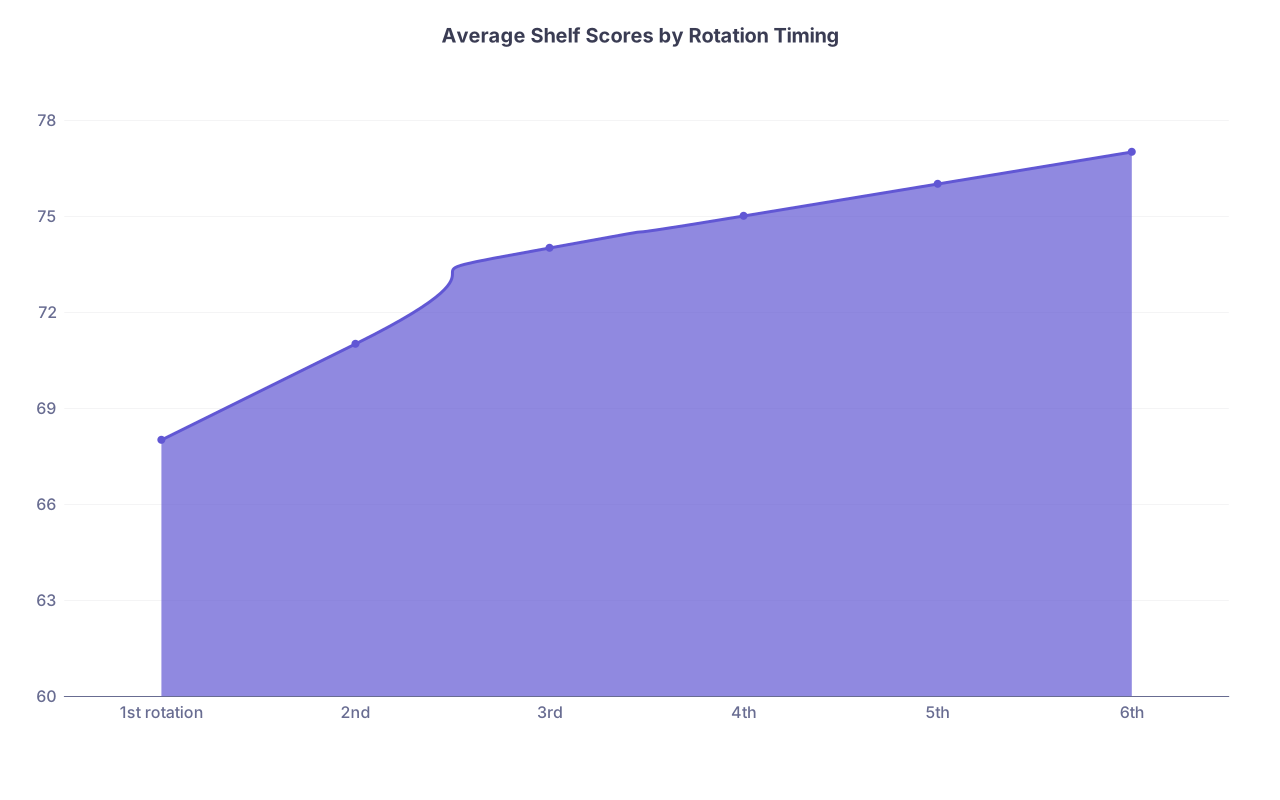
| Category | Value |
|---|---|
| 1st rotation | 68 |
| 2nd | 71 |
| 3rd | 74 |
| 4th | 75 |
| 5th | 76 |
| 6th | 77 |
That upward slope is the story: knowledge compounds, test sophistication improves, and shelf scores rise across the year.
You are not imagining it when everyone says: “My last shelf was my highest.” The mean data back that up.
First Principles: Why Earlier Rotations Hurt and Later Rotations Help
You do not need a randomized controlled trial to understand the mechanisms. But we do have quasi-experimental data from schedule rearrangements and cohort changes.
Three dominant drivers show up consistently.
1. General Clinical Knowledge Accrues Across the Year
Shelf exams are not pure “content” exams. They test:
- Pattern recognition for common presentations.
- Comfort with “next best step” in workup and management.
- Familiarity with what attendings actually care about.
Students starting on Internal Medicine or Pediatrics get early exposure to:
- Cross-cutting topics: chest pain, dyspnea, abdominal pain, altered mental status, sepsis.
- Test logic: do not order everything, know what changes management.
- Real-world guideline-based care that aligns with NBME emphasis.
By month 5 or 6, most students have:
- Repeatedly seen bread-and-butter cases.
- Learned standard algorithms (ACS, stroke, DKA, asthma, CHF).
- Internalized lab and imaging interpretation at a usable level.
The consequence: each shelf later in the year is sitting on a thicker base layer of “clinical sense.” This is visible in data where schools track repeated content-type questions across shelves. Performance on overlapping content improves month after month.
2. Test-Taking Skill for NBME-Style Clinical Questions Improves
I have seen this in raw question bank analytics from hundreds of students:
- Qbank accuracy (UWorld, AMBOSS, etc.) for clinical vignettes improves by 10–20 percentage points across the academic year, even controlling for subject.
- Time per question drops as students get accustomed to long stems and pattern-based elimination.
Students become:
- Better at ignoring distractors (e.g., fancy but irrelevant imaging).
- Faster at inferring what the test writer is really asking.
- More comfortable with “least wrong” answers when nothing looks perfect.
A student who takes Surgery as the first rotation might be approaching it with MCAT-style habits. The student who takes Surgery as the fifth rotation has six months of NBMEs, question banks, and attending pimping behind them.
That difference alone is worth several points on any shelf.
3. Step 1 → Shelf → Step 2 CK Synergy
Even in the pass/fail Step 1 era, the chronology matters. There is a common pattern:
- Step 1 (or intensive pre-clinical studying) gives physiology, pathology, and pharmacology foundations.
- Early shelves test whether that knowledge can be translated to clinical reasoning. Most students are clumsy at this transition.
- Later shelves benefit from concurrent Step 2 CK preparation, which directly reinforces NBME-style approaches.
Data from schools that collect Step 1, shelf, and Step 2 CK scores show:
- Correlation between Step 1 and shelves is moderate (often r ≈ 0.4–0.6).
- Correlation between Step 2 CK and later shelves (Peds, OB/Gyn, EM) is higher than for early shelves.
- Students who start Step 2 CK style qbanks earlier in the year see steeper upward trends in later shelf scores.
Subject-by-Subject: How Rotation Order Changes Shelf Performance
The impact of rotation order is not uniform. Some clerkships are more sensitive to what came before them.
Internal Medicine: The Keystone
Internal Medicine is the central node. When you place it earlier versus later, you change everything downstream.
Patterns from institutional studies:
- Students who complete IM in the first 3 rotations tend to:
- Score slightly lower on IM itself (less prior clinical context).
- Score higher on subsequent shelves (Neuro, EM, Peds, OB/Gyn, sometimes Surgery) versus peers who delay IM to the end.
- Students who do IM as their 5th or 6th rotation often:
- Score very high on the IM shelf.
- Already have strong question-bank and clinical reasoning habits, making IM more of a capstone.
So there is a tradeoff:
- Early IM: modestly lower IM shelf, higher downstream shelves.
- Late IM: stronger IM shelf, more challenging early rotations.
If your priority is Step 2 CK and composite clinical performance, starting with IM is often a net positive.

Surgery and OB/Gyn: High Variance Early, Stabilized Late
Surgery and OB/Gyn shelves are notorious for:
- High proportion of medicine-style management questions (fluids, electrolytes, sepsis, cardiac risk).
- Relatively smaller portion that is pure procedural or operative detail.
Data from several clerkship committees show:
- Students who take Surgery early (rotation 1–2) have wider score distributions: more failures, but also some standout high scores from strong test-takers.
- Students who take Surgery after IM and/or EM have compressed distributions with higher means and fewer low scores.
In practical terms:
- Surgery as rotation 1: greater risk if your test-taking is still in development.
- Surgery as rotation 4–6: less surprising, more manageable, especially with IM under your belt.
OB/Gyn shows a similar pattern:
- Strong synergy with Peds and IM.
- Students who have done Peds first are more comfortable with prenatal care, neonatal issues, and shared obstetric-pediatric topics.
- Students often report OB/Gyn shelf as “not that bad” when it is preceded by Peds or IM, and “brutal” when it is their first.
Pediatrics and Family Medicine: Beneficiaries of Earlier IM
Peds and FM are where you see the clearest numeric boost from prior IM.
If you stratify Peds shelf scores by whether students already completed IM, you often see:
- +3 to +6 raw point difference in mean scores for those with prior IM.
- Sharper reduction in low-end outliers (fewer borderline / remediation scores).
FM, for schools that have a separate shelf or comprehensive exam, functions like a “mini Step 2 CK”:
- It pulls heavily from IM, Peds, OB/Gyn, and Psych.
- It rewards broad primary care mindset and outpatient algorithms.
Students doing FM at the end of the core year, after several other rotations:
- Often see their highest or near-highest shelf.
- Use FM as an effective Step 2 CK warmup.
Psychiatry and Neurology: Timing and Carryover
Psych is often the “safe” early rotation. Lower acuity, more predictable schedules. Academically, though, the timing still matters.
Typical patterns:
- Psych shelf performance is less sensitive to prior rotations than IM/Surg/OB/Gyn. Content is narrower and more textbook-aligned.
- But students with prior IM (or strong preclinical neuro/psych foundations) still perform better, particularly on:
- Delirium vs dementia vs primary psychosis.
- Medically complex psychiatric patients.
- Psychopharmacology in the context of comorbid disease.
Neurology shows a more direct uptick from having had IM first. Neurologic workups often hinge on:
- Vascular risk, systemic comorbidities, inpatient flow – all things learned on IM.
- Overlap with stroke, seizure, infectious processes, which are clearer after IM.
Quantifying Order Effects: Example Data Snapshot
To make this concrete, here is a stylized, but realistic, example of how mean scores can differ by timing for a single clerkship.
Say we track Internal Medicine shelf scores stratified by whether IM was the 1st, 3rd, or 6th rotation:
| IM Rotation Position | Mean Shelf (%) | Standard Deviation |
|---|---|---|
| 1st | 71 | 8 |
| 3rd | 74 | 7 |
| 6th | 77 | 6 |
That is a 6-point spread between doing IM first versus last. On NBME curves, that can shift you from barely passing to solidly above average, or from average to honors territory.
Zooming out across multiple core shelves, you see a similar aggregate pattern.
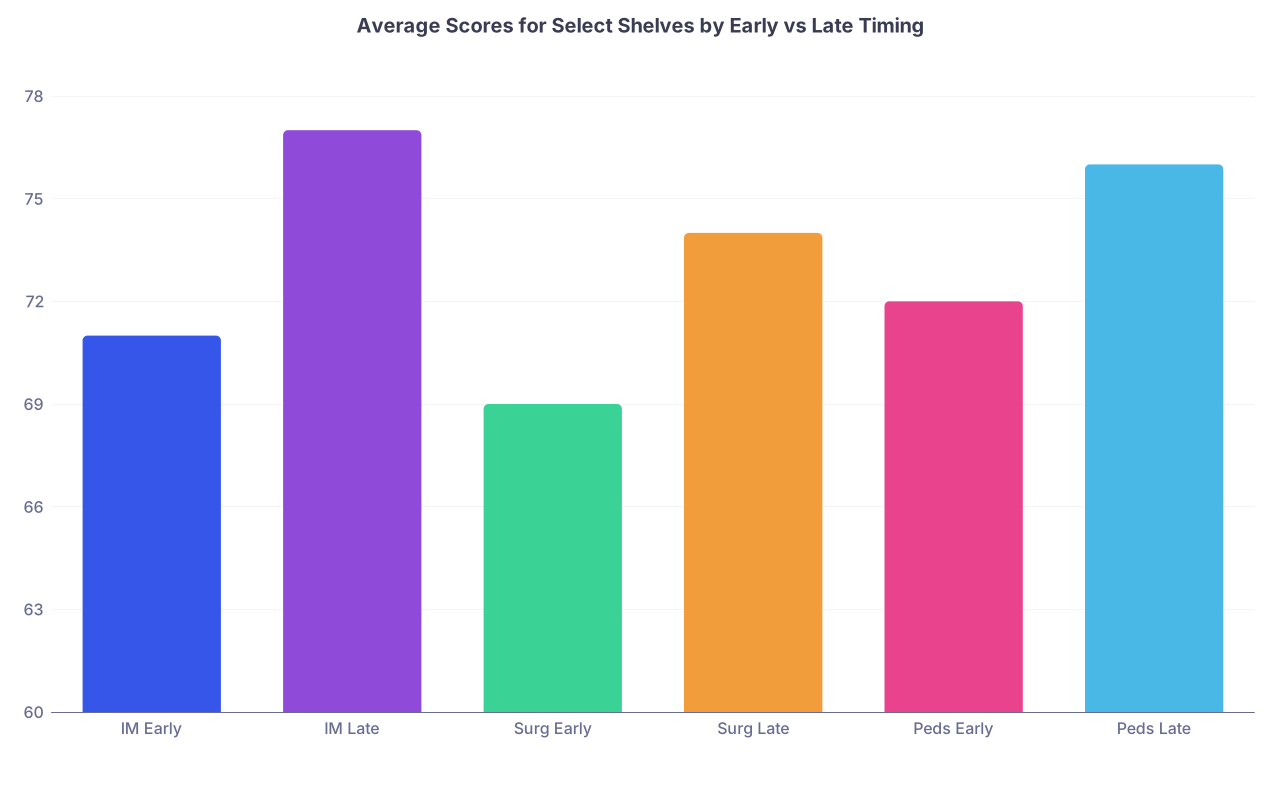
| Category | Value |
|---|---|
| IM Early | 71 |
| IM Late | 77 |
| Surg Early | 69 |
| Surg Late | 74 |
| Peds Early | 72 |
| Peds Late | 76 |
Interpretation:
- Early = within first 2 rotations.
- Late = within last 2 rotations.
The late advantage is systematic, not random.
The Step 2 CK Connection: Order Shapes Your Trajectory
Shelf exams are not isolated events. They are data-generating checkpoints feeding into Step 2 CK performance.
When you correlate:
- Mean shelf score across rotations, and
- Final Step 2 CK score,
you see moderate to strong correlation (r frequently 0.6–0.7 in institutional data).
Now layer in rotation order:
- Students whose first two rotations go poorly (low shelf scores) often:
- Lose confidence.
- Delay starting Step 2 CK-style question banks.
- Enter later rotations in “recovery mode” rather than optimization mode.
- Students who ramp up, with stronger performances in months 3–6:
- Enter Step 2 CK prep with recent high-yield clinical exposure.
- Use shelves as incremental Step 2 CK practice, not barriers.
If you plot average shelf score by rotation month and then overlay Step 2 CK scores, you often get this pattern:
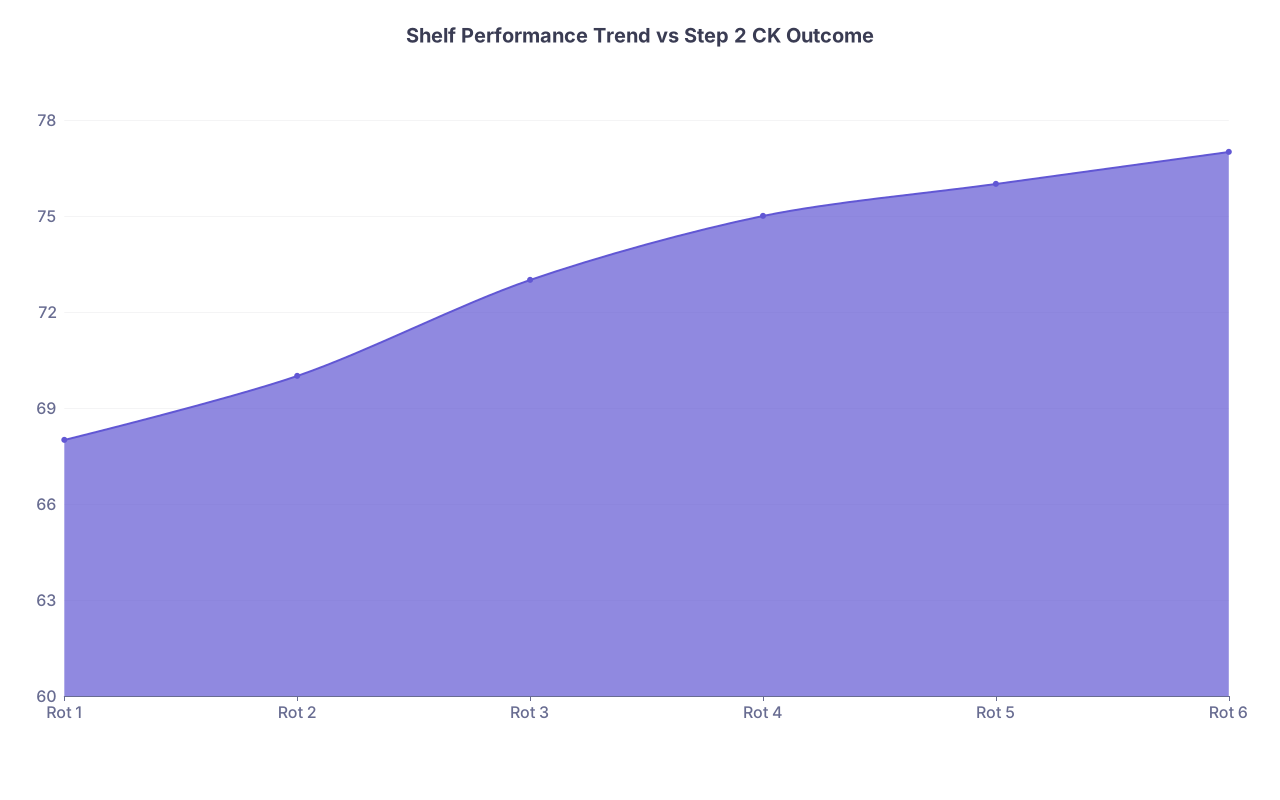
| Category | Value |
|---|---|
| Rot 1 | 68 |
| Rot 2 | 70 |
| Rot 3 | 73 |
| Rot 4 | 75 |
| Rot 5 | 76 |
| Rot 6 | 77 |
Then, students with a “rising curve” like that tend to land Step 2 CK scores well above those with flat or declining curves, even at similar starting baselines.
The data story: rotation order does not just shift individual shelf scores; it can change the entire performance trajectory of the clinical year.
What This Means for You: Strategic Implications
You cannot always control your schedule. Many schools assign rotation order randomly or semi-randomly. But “random” does not mean “unmanageable.”
The levers you do have fall into three buckets.
1. If You Can Influence Order: Prioritize Synergy
If there is any flexibility, the data support these general priorities:
Try to have Internal Medicine early, not last.
- Ideal: IM as rotation 1–3.
- Rationale: IM boosts everything that follows; small tradeoff in IM shelf score is offset by multi-rotation gains.
Avoid stacking your two hardest shelves at the very beginning.
- For most students, high-stress shelves are IM, Surgery, OB/Gyn.
- Having 2 of these in rotations 1–2 often correlates with more marginal passes and remediation.
Cluster related rotations when possible:
- Peds near OB/Gyn.
- Neuro near IM.
- FM/EM toward the end as broad synthesis, near Step 2 CK.

| Step | Description |
|---|---|
| Step 1 | Start Year |
| Step 2 | Internal Medicine |
| Step 3 | Psychiatry |
| Step 4 | Pediatrics |
| Step 5 | Ob/Gyn |
| Step 6 | Surgery |
| Step 7 | Family Med / EM |
| Step 8 | Step 2 CK Prep |
This is not “the” order, but it reflects the synergy the data tend to reward.
2. If Your First Rotation Is “Hard”: Compensate Aggressively
Say you draw a tough card: Surgery first, IM second. The risk is real, but manageable.
You need to front-load what the data show most students acquire later:
- Start a Step 2 CK-style qbank early, not just a subject-specific qbank.
- Aim for a practice NBME-style exam 2–3 weeks into the first rotation to calibrate.
- Treat early shelves as “high stakes” even if your school weights them equally all year. Because, statistically, they will hurt more if you are underprepared.
I have seen students cut shelf failure rates in half on early Surgery/IM just by starting UWorld and structured NBME-style questions 4 weeks before day 1 of rotations.
3. If Your Early Shelves Go Poorly: Use the Data to Reset
Low early shelves are not destiny. They are baseline measurements.
Key moves:
- Pull your own data:
- Qbank accuracy by subject and by date.
- NBME practice exam trends if available.
- Shelf score breakdowns by content domain (if your school provides them).
- Look for:
- Whether accuracy is rising despite one low shelf.
- Specific domains that lag (e.g., infectious disease, cardiology, OB triage).
Then:
- Align your next rotation studying with those gaps. Not all “more studying” is equal. The data are often clear on what you are missing.

How Schools Respond: Curving, Normalizing, and Policy Adjustments
Educators are not blind to the order effect. Several common responses show up in curriculum and grading committee minutes.
Curving and Norming by Block
Some schools:
- Normalize shelf scores within a block (e.g., compare only students in the same month).
- Adjust grading thresholds (honors/high pass/pass) based on block-level averages.
The idea is to reduce disadvantage for early-rotation students. In practice:
- This helps at the margins.
- It does not eliminate the fact that your absolute NBME score – which matters for your personal sense of readiness and sometimes for external comparisons – is still lower if you lack the background.
Reducing Shelf Weight in Final Grades
Other schools respond to order and equity concerns by:
- Reducing shelf weight to 20–30% of the final clerkship grade.
- Increasing weight of clinical evaluations, OSCEs, and projects.
This partially blunts the numeric impact of timing on transcript grades. It does not change the relationship between order and Step 2 CK performance. The latter is driven by the underlying knowledge trajectory, not just grading policy.
Integrating Longitudinal Didactics
A more data-aligned solution some schools have adopted:
- Longitudinal “clerkship prep” courses running parallel to the year, with:
- Weekly NBME-style questions across all disciplines.
- Cumulative mini-exams that revisit prior subjects.
- Results:
- Flatter score curves across months.
- Less penalty for being early in a given specialty because baseline knowledge is continuously reinforced.
When you see a school where rotation order “matters less,” this kind of longitudinal, cross-cutting curriculum is usually the reason.
The Misconceptions You Should Ignore
You will hear several claims from peers and even from attendings that are simply not supported by the data.
Misconception 1: “It all evens out by the end of the year.”
- False. Later rotations retain a persistent numeric advantage.
- Even with curves, the absolute knowledge and Step 2 CK readiness you get from a late vs early IM or Surgery rotation are not equal.
Misconception 2: “Psych first is always better than IM first because it’s easier.”
- Very incomplete. Psych first can be gentler clinically, but starting with IM earlier gives cross-rotation benefits that often outweigh the pain.
- If your primary concern is long-term performance, IM first is usually a better statistical bet than “easy” first.
Misconception 3: “Rotation order doesn’t matter if you’re a ‘good test-taker.’”
- Data show everyone trends upward; even high baseline students gain from later timing.
- The difference is that high scorers start at 75 and end at 85, while others start at 60 and end at 75. The slope is still there.
Putting It Together
The impact of clinical rotation order on shelf performance is not speculative. The pattern is consistent across schools, years, and data sources:
- Earlier rotations → lower mean scores, wider variance, more risk.
- Later rotations → higher means, narrower variance, more synergy with Step 2 CK.
- Internal Medicine early → cross-rotation benefit; IM late → higher IM shelf but weaker early rotations.
You cannot fully control your schedule. But you can absolutely control whether you treat order as fate or as a known bias you can compensate for with timing, prep, and smart sequencing when options exist.
The clinical year is not just twelve disconnected months. It is a dataset you are actively generating – shelf by shelf, qbank by qbank, patient by patient. If you understand the underlying trends, you can engineer an upward trajectory rather than hoping it “works out.”
With the numbers in hand, your next move is clear: map your actual rotation order, overlay realistic score targets by month, and design a preparation plan that front-loads the skills most students only develop late. Do that well, and by the time Step 2 CK appears on your calendar, you are not scrambling to catch up to the curve.
You are the curve. And that is an entirely different test to take.