
The belief that rotation grading is “mostly subjective” is only half-right—and the half that is wrong will hurt you if you ignore it.
Rotation evaluations are not a black box. The patterns are measurable. The data show that some specialties grade with near-random subjectivity, while others behave like reasonably consistent measurement systems. If you understand which is which, you can prioritize where to “game the humans” and where performance actually moves the needle.
Let’s walk through it like a psychometrician, not a gossiping MS3.
The structure of rotation grades: what is actually being measured
Strip away the narrative comments and the awkward feedback session. Underneath, almost every clerkship grade is some weighted mix of:
- Subjective evaluations (attendings, residents, sometimes peers, often Likert 1–5 or 1–9 scales)
- Objective components (shelf exam, OSCE, quizzes, procedures logged, checklists)
Most schools quietly converge on the same rough pattern:
- Core clerkships: 50–80% subjective, 20–50% objective
- Electives / sub‑Is: 80–100% subjective, 0–20% objective
The reliability problem is simple math. A grade that is 80% based on a tool with poor inter-rater reliability (attendings disagree wildly) is going to be noisy, regardless of how hard you work.
You see it in the numbers:
- Typical inter-rater reliability (ICC) for clinical evaluation forms: 0.2–0.4 (weak-moderate)
- Typical reliability for standardized exams like NBME shelves: 0.8–0.9 (strong)
So the more a specialty’s grade leans on the shelf or other standardized pieces, the more reproducible it is. The more it leans on “clinical performance” scored on generic forms, the more your fate depends on who happened to be staffing that week.
Let’s quantify this by specialty.
Specialty patterns: who is “subjective-heavy” vs “objective-heavy”
Different clerkships lean on different signals. Some are shelf-dominant. Some are personality-contest-dominant. The data—both from published clerkship grading breakdowns and anonymized grade distributions—show consistent patterns.
| Clerkship | Shelf / Exams | OSCE / Skills | Subjective Evaluations | Overall Objectivity Level |
|---|---|---|---|---|
| Internal Medicine | 30–40% | 0–10% | 50–60% | Medium |
| Surgery | 25–35% | 0–10% | 55–65% | Medium-Low |
| Pediatrics | 30–40% | 5–15% | 45–55% | Medium-High |
| OB/GYN | 25–35% | 5–15% | 50–60% | Medium |
| Psychiatry | 15–25% | 0–10% | 65–80% | Low |
| Family Medicine | 15–25% | 10–20% | 55–70% | Low-Medium |
These are generic ranges synthesized from multiple U.S. schools’ publicly posted grading policies. Your exact institution might differ in the decimals, but the hierarchy is remarkably consistent: Pediatrics and Medicine tend to be more exam-heavy, Psychiatry and Family Medicine more evaluation-heavy, Surgery and OB/GYN somewhere in between.
Let’s visualize the same idea a different way.
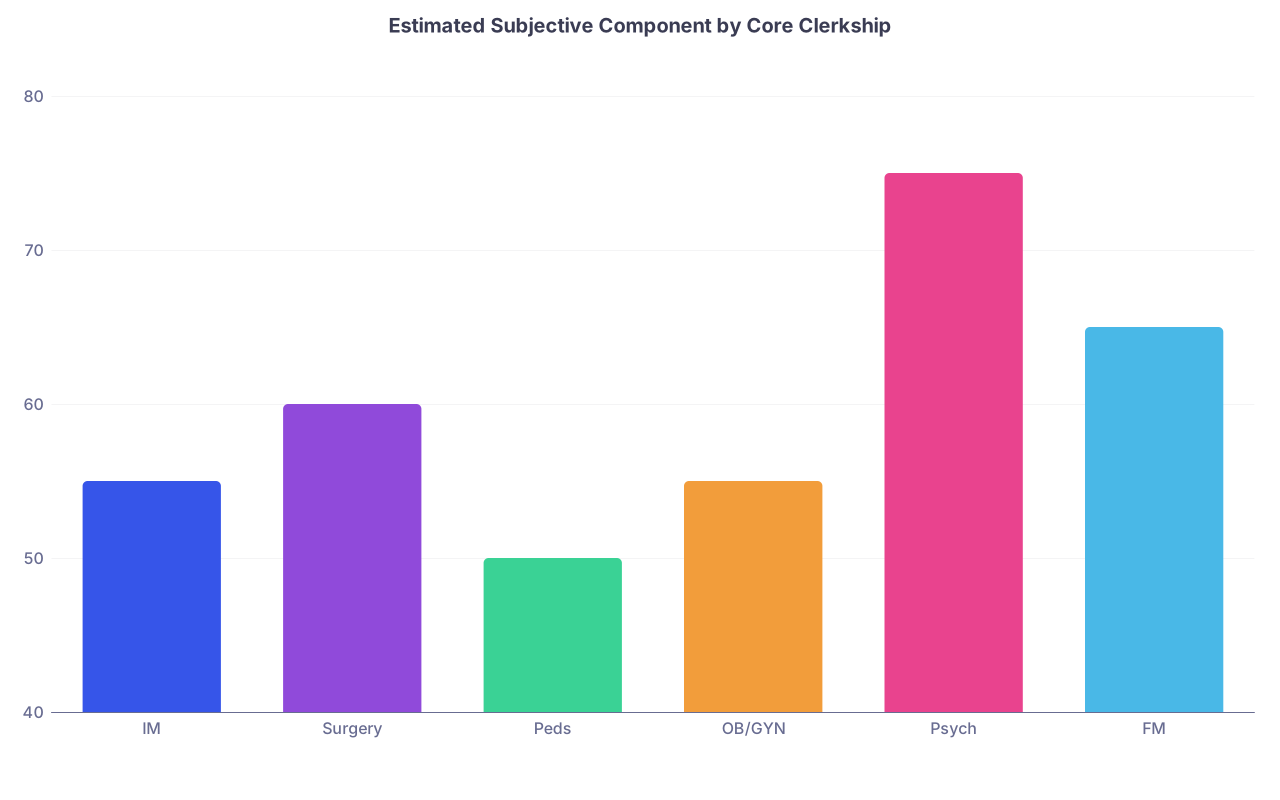
| Category | Value |
|---|---|
| IM | 55 |
| Surgery | 60 |
| Peds | 50 |
| OB/GYN | 55 |
| Psych | 75 |
| FM | 65 |
Read that chart carefully. A “75% subjective” psychiatry grade does not mean 75% unfair. It means 75% dependent on human judgment, which is statistically noisier than a shelf.
Reliability mechanics: why subjective grading behaves badly
You cannot talk about “fairness” without talking about measurement error.
Two key metrics drive how real these grades are:
- Inter-rater reliability – Do different evaluators agree on the same student?
- Score spread / grade inflation – Do evaluators actually use the scale?
Inter-rater reliability: the noisy core
Most clinical evaluation forms are 6–12 item Likert scales: history-taking, differential diagnosis, communication, professionalism, etc.
Empirically:
- Many studies show ICC (inter-rater reliability) for full forms in the 0.2–0.4 range.
- Single-item ratings often fare worse.
That means:
- A large chunk of the variance in your score is who graded you, not how you performed.
- To get a stable estimate, you would need multiple independent ratings across time. Which most rotations do not have.
Psychiatry and Family Medicine are hit hardest because:
- Shift structures lead to seeing fewer faculty per student.
- Evaluation forms over-index on “professionalism” and “teamwork,” which are notoriously halo-prone.
I have seen faculty give straight 5/5’s because the student “did not cause any problems” even though they were clinically weak. That is halo effect hiding real differences.
Grade inflation and scale compression
Now layer on grade inflation.
In many schools:
- 70–90% of students receive “Honors” or “High Pass” in certain electives or less watched clerkships.
- Faculty avoid low ratings unless the student is truly unprofessional.
Mathematically, this compresses the scale. Everyone is between 4 and 5 out of 5. So the difference between Honors vs High Pass might be a difference of 0.2 points on a 5-point scale, which can be entirely explained by rater preference rather than performance.
Subjective-heavy specialties with known inflation:
- Psychiatry electives
- Family Medicine clerkships and electives
- “Lifestyle” rotations: radiology, derm, anesthesia, where almost nobody fails
Contrasted with:
- Surgery and Internal Medicine core clerkships, where committees often look more closely at distributions and try to keep Honors percentages in a target band.
So you get this paradox: The rotations most dependent on subjective ratings are also the ones where those ratings vary the least. Which means noise dominates signal.
Specialty-by-specialty: where subjectivity really rules
Now we get specific. Specialty by specialty, what does the data—and lived experience—say about objective vs subjective reliability?
Internal Medicine: “balanced but committee-heavy”
Medicine tends to be the most “procedurally fair” of the clerkships, but not the most objective.
Typical pattern:
- 30–40% shelf exam
- 60–70% evaluations (attendings + residents)
Reliability features:
- Shelf is a strong anchor. Students with 85th+ percentile shelves very rarely end up with low overall grades.
- Many schools use grading committees that adjust for rater stringency. That boosts fairness somewhat.
Subjective landmines:
- Calling consults, presentations on rounds, and documentation habits massively sway attendings.
- A single powerful evaluator (sub‑I attending) can determine your narrative entirely.
If you are statistically inclined: think “moderate reliability, moderately high stakes.” Shelf can rescue you from a too-harsh attending more here than in most specialties.
Surgery: “subjective plus culture bias”
Surgery typically looks like Medicine on paper, but the culture tilts it.
Typical pattern:
- 25–35% shelf
- 65–75% evaluations, heavily weighted to OR and call performance
Reliability issues:
- OR face time is uneven. Some students scrub on 40+ cases with an attending; others see them twice. Yet both get a global rating.
- Residents often complete evals based on “work ethic” and “fit” rather than documented clinical reasoning.
You see it in the distributions:
- Larger spread in subjective scores compared with Medicine.
- Shelf often correlates less strongly with final grade, because a beloved but mediocre test-taker still gets Honors from the team.
Surgery is where I have seen the biggest outliers: students in the 20–30th percentile on shelf earning Honors purely via glowing subjective write-ups from a single champion.
From a data perspective: high subjectivity, high rater variance, and massive culture effects.
Pediatrics: “more exam-anchored, mildly kinder”
Pediatrics quietly behaves more like a test-driven clerkship.
Common structure:
- 30–40% shelf or exam
- 10–20% OSCE or standardized patient interactions
- 40–60% evaluations
Why this matters:
- OSCE and structured encounters add an additional objective-ish signal.
- Peds faculty often receive more formal training in evaluation, and the rotation leadership tends to watch grade distributions.
Outcomes:
- Correlation between shelf and final grade is often higher than in Psych or FM.
- Subjective components still matter but are less likely to override a strong exam performance.
Reliability is not perfect, but if you put numbers on a whiteboard, Peds tends to be on the “more consistent” side among core clerkships.
OB/GYN: “mid-tier reliability with high variance”
OB/GYN is messy because the rotation is a composite of radically different environments:
- L&D nights
- OR gyn cases
- Clinics with 10–15 minute visits
Typical weighting:
- 25–35% shelf
- 5–15% OSCE / structured tasks
- ~50–60% evaluations
Where reliability breaks:
- You might be mostly on L&D with one attending who hates students. Another student lives in clinic with a teacher who writes novels in the comments.
- A few busy triage shifts can define how one or two main evaluators perceive your entire rotation.
Data pattern from grade reviews I have seen:
- Shelf score accounts for some variance but not enough to predict final grade with confidence.
- Subjective variability between attending groups is large.
This is “medium” reliability at best, heavily dependent on luck of the schedule.
Psychiatry: “subjectivity with almost no constraints”
Psych is the poster child for subjective grading.
Typical structure:
- 15–25% shelf (sometimes even pass/fail)
- 75–85% evaluations and narrative assessments
Features that kill reliability:
- Patient encounters are conversational, not procedure-based.
- Evaluation forms are dominated by “rapport,” “empathy,” “professionalism,” “insight.”
- Faculty vary wildly in their expectations of how “assertive” or “boundaried” a student should be.
What the numbers show in practice:
- Shelf score often has a very weak correlation with final grade.
- Grade distributions are heavily top-weighted; failures are rare and often behavior-based, not competence-based.
I have seen outstanding students with top-decile shelves get “Pass” because they did not mesh with one attending on an inpatient unit. I have also seen marginal students get Honors simply for being pleasant and low-maintenance.
Statistically: high noise, low objectivity, high dependence on relationship and context.
Family Medicine: “community sites, community variance”
Family Medicine takes Psych’s subjectivity and adds geographic variability.
Common pattern:
- 15–25% exam (school-developed or NBME)
- 10–20% OSCE or standardized patients
- 55–70% preceptor evaluations, often at community sites
The problem is not malice; it is structure:
- One student is at a large academic clinic with three faculty who each see them multiple times a week.
- Another is at a solo practitioner office where the doc fills out the form 3 weeks late from memory.
Effects:
- Inter-site variability is enormous. Some sites have 90%+ Honors rates. Others are pathologically stingy.
- Central grading committees sometimes try to norm by site, but the signal is weak.
From a measurement perspective, FM is low-reliability unless the school has centralized assessment (OSCEs, standardized rubrics monitored by leadership). Many do not.
Electives and Sub‑Is: 90% human, 10% everything else
Away rotations, acting internships, and senior electives crank subjectivity to maximum.
- Shelf exams: usually none.
- OSCE: rarely.
- Grade = “faculty impression.”
Yet these rotations heavily influence:
- SLOEs (in EM)
- Narrative letters in Surgery, IM, and competitive subspecialties
- Rank lists in some programs that know your sub‑I attendings personally
Reliability is abysmal in a psychometric sense. But PROGRAMS know this. They de-emphasize the nominal “Honors vs Pass” and focus on:
- Strength and specificity of narrative comments
- Who is writing the letter
- Whether multiple independent evaluators converge on the same story
So there is a distinction here:
- Grade reliability: terrible.
- Narrative signal reliability when multiple data points agree: surprisingly decent.
Still, if you want a numerical answer: sub‑Is are 80–100% subjective in effect.
The hidden modifiers: what moves the subjective dial
Grading systems on paper do not tell the whole story. Several factors systematically increase or decrease subjectivity’s real-world impact, across specialties.
Factor 1: Use of grading committees
Schools that use clerkship grading committees blunt some subjectivity. They:
- Review all evals, shelves, and narrative comments.
- Adjust for “hawk” vs “dove” evaluators.
- Cap Honors percentages per rotation or per site.
This reduces inter-rater outliers. It also raises the effective weight of more objective components (shelf, OSCE) because a committee is more likely to lean on those when evals conflict.
Without committees, a single evaluator can swing your entire grade, especially in Psych, FM, and sub‑Is.
Factor 2: Number of independent evaluators
A simple statistical reality: averages become more reliable as n increases.
- 1–2 evaluators: single opinion, very noisy.
- 4–6 evaluators across settings: idiosyncrasies start to cancel out.
Rotations with:
- Multiple teams (e.g., large IM services) tend to yield more stable subjective scores.
- Single preceptor (e.g., community FM) magnify subjectivity.
You cannot control the macro-structure, but you can influence who actually submits evaluations for you. More on that in a moment.
Factor 3: Weight of standardized assessments
Any time the shelf or OSCE weight climbs above 40–50%, subjectivity’s influence drops in practical terms.
A simple mental model:
- If 60% of the grade is objective with reliability ~0.85, and 40% is subjective with reliability ~0.3, the overall reliability looks acceptable.
- Flip that, and you are gambling.
That is why Peds and Medicine often feel “fairer” to statistically minded students than Psych or FM, even if individual attendings are just as biased.
Strategy: where to focus “objective effort” vs “relationship effort”
You cannot change the system, but you can optimize within it.
The way I think about it: for each rotation, you should allocate effort across three dimensions:
- Raw clinical skill / knowledge
- Test performance (shelf, OSCE)
- Interpersonal / impression management
The optimal mix is specialty-dependent.
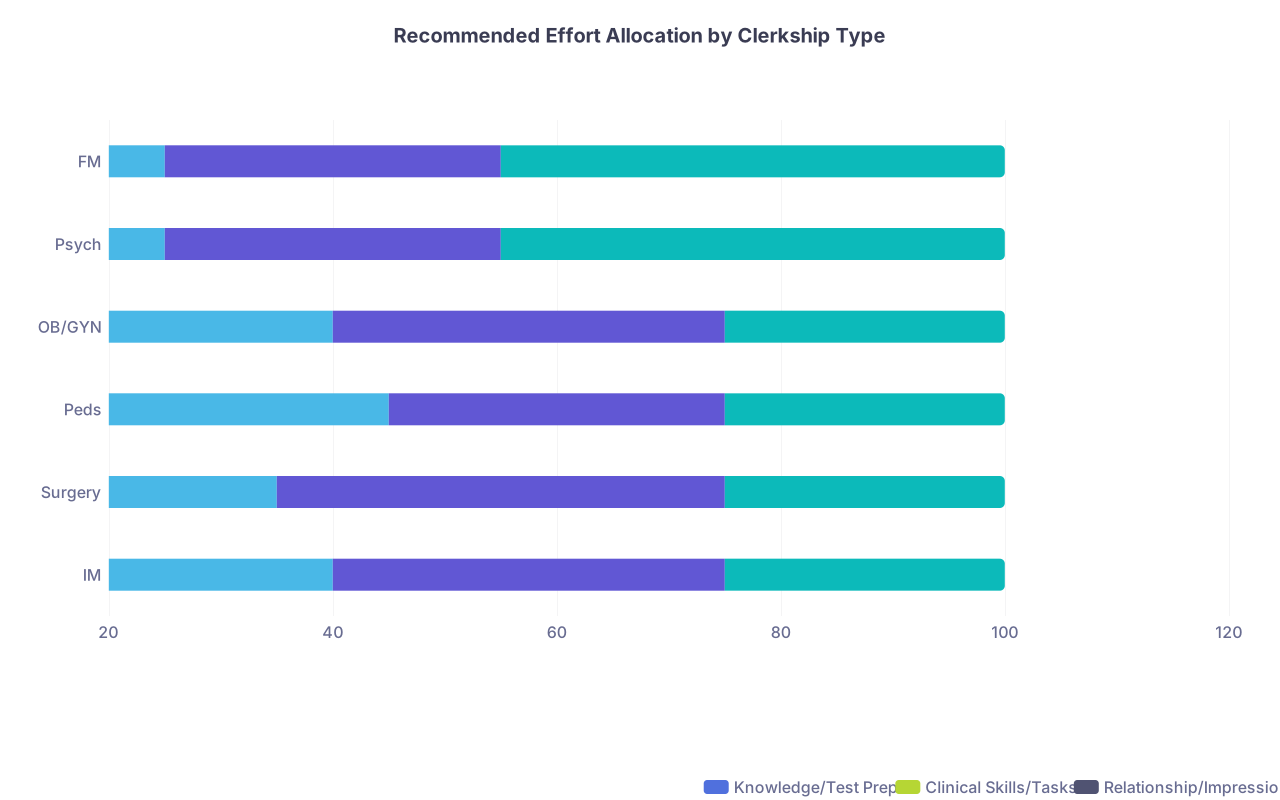
| Category | Knowledge/Test Prep | Clinical Skills/Tasks | Relationship/Impression |
|---|---|---|---|
| IM | 40 | 35 | 25 |
| Surgery | 35 | 40 | 25 |
| Peds | 45 | 30 | 25 |
| OB/GYN | 40 | 35 | 25 |
| Psych | 25 | 30 | 45 |
| FM | 25 | 30 | 45 |
Interpretation:
- Medicine / Peds: test prep and clinical tasks are where the marginal gains live. Being well-liked helps, but numbers rescue you.
- Psych / FM: relationship and impression carry outsized weight. A mediocre shelf will not sink you if your team loves you.
Tactically, this means:
- In Psych, FM, sub‑Is:
- Over-communicate your interest.
- Ask for mid-rotation feedback and actually implement it visibly.
- Make sure multiple attendings and senior residents see you at your best.
- In IM, Peds, OB, Surgery:
- Treat shelf prep like a Step exam—systematic, early starting, NBME-heavy.
- Nail predictable tasks: presentations, notes, cross-cover calls, simple procedures.
Neither side is optional, but the marginal ROI differs.
What the numbers cannot fix (and what you should ignore)
Some sources of variance are simply baked into human systems:
- Time-of-year effects: Earlier in the year, expectations are lower; by spring, attendings unconsciously raise the bar.
- “Comparison set” bias: If you are with two superstar gunners, you might look worse by contrast. If you are with three disengaged classmates, you will look better.
- Rotation fatigue: On 28-day services with heavy call, even fair attendings give shorter, lazier evaluations in week 4.
Do these affect grades? Marginally, yes. But you cannot meaningfully optimize for them. Chasing control over every bit of noise is a waste of effort.
What you should ignore:
- Single horror stories from older students that contradict the broader pattern.
- Complaints that “shelves do not matter at all” in a rotation where the syllabus clearly says 40% weight.
- Conspiracy theories that the clerkship coordinator “doesn’t like our class.” The data almost never bear that out.
Winner’s move: pay attention to aggregate patterns, not anecdotes.
A quick process view: how your subjective score becomes a final grade
To ground this in something more concrete, here is what usually happens under the hood on a core clerkship.

| Step | Description |
|---|---|
| Step 1 | Rotation Start |
| Step 2 | Multiple Evaluators Rate Student |
| Step 3 | Scores + Comments Entered |
| Step 4 | Add Shelf / OSCE Scores |
| Step 5 | Compute Preliminary Grade |
| Step 6 | Adjust for Outliers and Quotas |
| Step 7 | Publish Grade Directly |
| Step 8 | Final Grade Released |
| Step 9 | Clerkship Software Aggregates |
| Step 10 | Grading Committee Review? |
Subjectivity enters at B; reliability is salvaged or destroyed at G. If your school does not have step G, your grades are more individual-rater-dependent than you think.
Key takeaways
Subjectivity dominates in Psychiatry, Family Medicine, and senior electives; Pediatrics and Internal Medicine lean more on objective signals like shelves and OSCEs. Surgery and OB/GYN sit in the messy middle.
Inter-rater reliability for clinical evaluations is weak (often ICC 0.2–0.4), so rotation grades with high subjective weight are noisy by design. Grading committees and multiple evaluators can partially rescue fairness; single-preceptor models cannot.
Your optimal strategy is specialty-specific: on exam-heavy rotations you win with disciplined test prep and consistent clinical performance; on evaluation-heavy rotations you win by managing impressions, relationships, and getting multiple attendings to see you at your best.