The blanket advice that “all-nighters are always bad and never help” is wrong. The truth is nastier: all-nighters almost never help you learn medicine—but in a few narrow, ugly situations, they can help you salvage an exam. That’s not the same thing, and pretending it is just makes people more reckless.
You want honesty, not slogans. So let’s go through what the data actually shows, what I’ve seen real med students do, and when an all-nighter is a desperate tool versus self-sabotage disguised as “grind.”
What sleep actually does to your brain (and your test score)
Start with the basic reality: med school exams are not vocabulary quizzes. They’re complex reasoning, integration of details, and long test days. That combination is brutal when you’re sleep-deprived.
Controlled sleep studies are ruthless about this. After about 18–20 hours awake, your performance on attention and reaction tasks looks like having a blood alcohol level of 0.05–0.1. Stay up all night? You’re basically cognitively tipsy during the exam.
But people like numbers, so here are some:
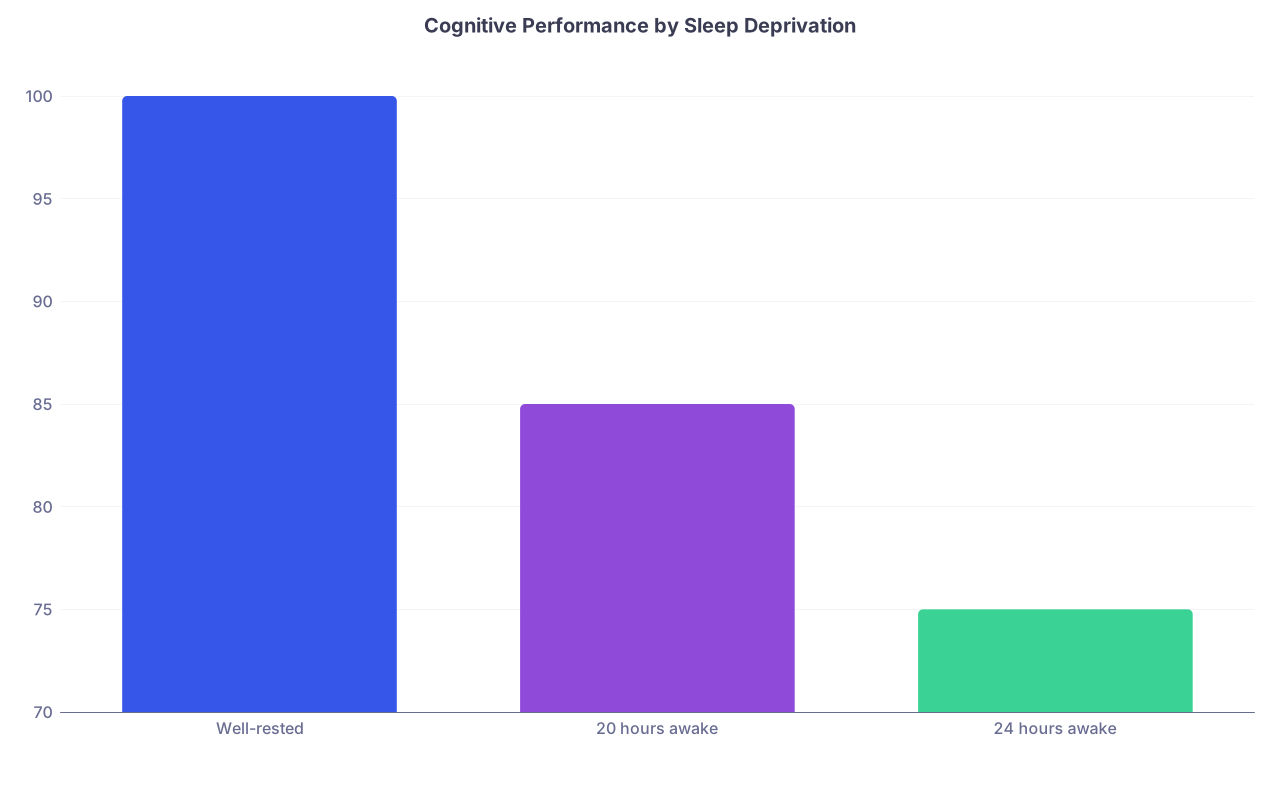
| Category | Value |
|---|---|
| Well-rested | 100 |
| 20 hours awake | 85 |
| 24 hours awake | 75 |
This is simplified, but consistent with what multiple lab studies show: sustained attention, working memory, and executive function drop 15–25% after one night without sleep.
Now think about what Step-style or NBME exams require:
- Holding multiple pieces of information in working memory
- Integrating physiology, pathology, and pharmacology into one decision
- Ignoring irrelevant details in wordy vignettes over several hours
Those are exactly the functions sleep deprivation wrecks first. It does not just make you “feel tired.” It specifically sabotages the core cognitive skills your exam depends on.
But here’s the catch that trips people up: knowledge and performance are related but not identical. You can cram factual associations overnight. Your recall will be poorer than if you slept, but not zero. And if your baseline is “I don’t know this at all,” a small bump in content plus a performance penalty can still net a better score than walking in cold.
That’s where the “it helped me” stories come from. They’re not completely fake. They’re just describing a rescue operation, not a strategy.
The myth of the heroic all-nighter
Walk through any med school library the week before exams, and you’ll hear the mythology live:
- “I’m going to just grind Anki all night and crush it tomorrow.”
- “Sleep is for after the test.”
- “It’s just one exam. My body can handle it.”
I’ve watched this play out: someone at 2 a.m., pupils huge from caffeine, bragging about doing “600 questions tonight,” then stumbling into the exam looking washed out and shaky.
The research on learning is not ambiguous:
- Memory consolidation happens during sleep, especially slow-wave and REM sleep.
- Sleep after studying is more effective than extra study time without sleep.
- Even one night of restricted sleep can impair encoding and consolidation of new information the next day.
Here’s a rough idea of how efficient different approaches are in terms of net test performance, not just hours studied:
| Approach | Relative Performance (approx.) |
|---|---|
| Study well, sleep 7–8 hours | 100% |
| Study late, sleep 4–5 hours | 90–95% |
| Cram all night, no sleep | 75–85% |
| Don’t study, sleep well | 40–60% (depends on baseline) |
Those are conceptual numbers, not from a single paper. But they match what we see in both lab data and real students: there’s a steep penalty for no sleep, a moderate penalty for short sleep, and a huge upside for being prepared earlier like a functioning adult.
The heroic story of “I stayed up all night and crushed it” usually leaves out context:
- They probably had a decent foundation and were just topping off.
- The exam might have been easy compared to their prep.
- Their definition of “crushed it” might be “I passed with a 73.”
Without a counterfactual (how they’d have done with 6–7 hours of sleep), they’re just telling stories.
When all-nighters absolutely do not help
There are specific situations where pulling an all-nighter before an exam is basically self-harm disguised as work ethic.
High-stakes, reasoning-heavy exams (Step 1/2, shelf exams)
These are exactly the tests most vulnerable to the cognitive penalty of no sleep. You need sustained attention and judgment over hours. Sleep-deprived, you will:- Misread vital parts of questions
- Make more impulsive answer choices
- Struggle to hold multi-step mechanisms in your head
I’ve seen strong students turn a likely 240-ish Step score into a 220-something because they spent the last 36 hours “finishing UWorld” instead of sleeping. That’s not discipline. That’s fear driving bad decisions.
When you already have a decent foundation
If you know 70–80% of your material reasonably well, there is almost no world where zero sleep plus more cramming beats 5–6 hours of sleep and light review. The marginal gain in factual recall is small; the performance hit is large.Multiple exam days or back-to-back tests
Sleep debt compounds. Pull an all-nighter for one exam and your cognitive function can be impaired for days afterward. If you have another exam or a heavy clinical responsibility 24–48 hours later, you’re borrowing from future you with interest.Clinical duties the next day
Showing up to wards or call post all-nighter is not “hardcore,” it is unsafe. Error rates go up. Judgment goes down. There’s a reason duty-hour restrictions exist (even if people work around them).
Bottom line: if the exam is complex, long, and high-stakes, and you’re not dangerously underprepared, an all-nighter is a bad trade almost every time.
The rare edge cases where an all-nighter can help
Here’s where I’m going to be more honest than most “wellness” talks.
Sometimes, the choice is not between “study and sleep” versus “all-nighter.” The real choice is:
- Walk into the exam knowing maybe 20–30% of the content
- Or stay up, cram like a maniac, know 50–60%, and accept operating at 75–80% of your cognitive capacity
That’s not smart planning. That’s triage. But triage has its place.
In these narrow cases, an all-nighter can net a better outcome:
You are dangerously unprepared very close to the exam
I’m talking about having barely touched the material and the exam is in under 24 hours. You miscalculated your time, had a personal crisis, or just screwed up. A full night’s sleep will not magically make you know renal phys.If failing the exam has serious consequences (remediation, delay of rotations, financial fallout), grinding overnight to push your content knowledge from catastrophic to borderline can be rational. You’ll feel like garbage during the test, but going from 25% familiarity to 55% familiarity can matter.
Lower-stakes, fact-heavy exams
Some preclinical block exams are essentially anatomy tagging, micro/ID bugs and drugs, lists of associations. These are more brute-force memorization. Cognitive flexibility matters less; raw recall matters more.In that context, brutal rote memorization overnight can move the needle enough to pass, especially if your school only needs a 65–70% to clear the bar.
You literally cannot sleep because of anxiety
I’ve seen this: a student lying awake until 4 a.m., heart racing, running through Worst Case Scenarios. At some point, the “just rest” advice becomes useless. If you’re not going to sleep anyway, gently reviewing, doing light flashcards, or going over high-yield tables is not insane. It’s damage control.
None of this makes an all-nighter “good.” It makes it the lesser evil in a situation you ideally would’ve never created.
If you’re going to do it anyway, at least be strategic
I’m not naïve. Someone reading this is still going to pull an all-nighter. So let me be blunt about how to reduce the damage.
First, understand what you’re trying to maximize in that last 8–12 hours:
- High-yield recall of facts you absolutely need
- Familiarity with question style and traps
- Avoiding total cognitive collapse during the exam
You’re not going to “master” cardiology overnight. You’re trying to turn a D into a low B or avoid an F.
So no, you don’t just “keep grinding” until the moment of the exam. That’s amateur hour.
Here’s a far smarter (still suboptimal) overnight structure:

| Step | Description |
|---|---|
| Step 1 | 18:00 Assess status |
| Step 2 | Accept outcome, sleep 7h |
| Step 3 | 18:30-23:00 Focused high-yield review |
| Step 4 | 23:00-01:00 Mixed practice questions |
| Step 5 | 01:00-03:00 Light flashcards & summaries |
| Step 6 | 03:00-06:00 Dark room, doze if possible |
| Step 7 | Exam with caffeine & hydration |
| Step 8 | Hopeless or salvageable? |
This is not “healthy.” It is battlefield medicine for your exam:
- Front-load high-yield facts, not deep dives into obscure content
- Do mixed questions to wake up pattern recognition and see common traps
- Shift to lighter review when your brain is fried, to avoid total burnout
- Protect the last 2–3 hours in a dark, quiet space; even micro-naps help
And yes, use caffeine, but don’t get cute. If your exam’s at 8 a.m., don’t chug 400 mg at 4 a.m. and then crash at noon. Simpler: modest dose before exam, maybe a small top-up mid-exam if allowed and if you’re used to it.
The cumulative damage nobody talks about
One all-nighter during MS1 is a problem. Five per block, every block, is a slow-moving disaster.
Chronic partial sleep deprivation is the silent killer in med school. People like to brag, “I function fine on 4 hours,” as if they’re special. They’re not. Studies show people become bad at noticing how impaired they are when they’re chronically sleep-deprived.
You get:
- Slower learning day to day
- Higher baseline stress, irritability, and anxiety
- Worse immune function
- More errors in clinical reasoning
In other words, the culture of glorifying sleep deprivation is not just macho nonsense, it’s directly anti-learning. You are in school to build a brain capable of safely practicing medicine. Repeatedly trashing that brain’s recovery cycle during the years you’re supposed to be encoding massive amounts of long-term knowledge is idiotic.
One dramatic all-nighter is less dangerous than a year of “I average about 4–5 hours most nights.” But the second one looks more “normal,” so people ignore it.
The real prevention: you cannot out-cram bad systems
Here is the part that hurts: if you’re regularly needing all-nighters to stay afloat, the problem is not the night before the test. It’s your entire upstream system.
Patterns I see:
- People confuse activity with learning. They re-read notes instead of doing questions.
- They start “serious studying” 5–7 days before a cumulative exam.
- They avoid topics they dislike until the week before, then panic.
- They do huge passive Anki decks but never practice using the information in context.
No “grind harder” mindset fixes this. You do not respect the volume and complexity of medical knowledge if you repeatedly put yourself in a situation where only heroic last-minute trauma surgery on your schedule can save you.
You fix it by:
- Doing small, daily question blocks weeks in advance
- Identifying weak systems early and revisiting them rather than saving them for last
- Treating sleep like you actually believe it’s part of your study plan, not a hobby
None of this is magical. It’s just the stuff people claim to know and then ignore until three days before the exam.
So, do all-nighters ever help?
Yes—but not in the way people like to pretend.
They rarely help you optimize an exam performance. They sometimes help you avoid disaster when you’re already in a bad spot.
The nuance:
- For major, reasoning-heavy exams (Step 1/2, shelves), an all-nighter almost always hurts your score if you’re even moderately prepared.
- For low- to mid-stakes, fact-heavy preclinical exams, a carefully managed cram night can pull you from fail territory to barely passing.
- As a lifestyle or repeated tactic, all-nighters are academically and cognitively corrosive. You won’t notice how much they’re dragging you down until you’re staring at a disappointing score report asking, “But I worked so hard…”
If you remember nothing else, remember this:
- Sleep is not optional bonus time; it’s how your brain locks in what you studied.
- All-nighters are emergency tools, not “grind culture” badges of honor. If you’re needing them regularly, your entire approach is the problem.
- For almost every substantial exam in med school, 5–7 hours of sleep plus slightly less cramming beats an impressive-looking, completely sleepless “hustle” almost every time.
You’re training to respect physiology. Start with your own.