
64% of top-scoring USMLE takers in one large online survey reported not relying on Anki as their primary resource.
So no, you’re not crazy if Anki isn’t “clicking” for you. And no, Anki itself is not some magical Step 1 or Step 2 rocket fuel.
Let me be blunt: the strongest evidence we have says spaced repetition is powerful, but “Anki-only” as a USMLE strategy is overrated, misused, and often downright sabotages understanding when done wrong.
Let’s separate the myths from what actually works.
What the Science Really Says About Anki and Memory
First, the uncomfortable truth: Anki is not special.
Spaced repetition and retrieval practice are.
Every controlled study that gets cited to defend “Anki is life” is actually about:
- Spaced repetition (reviewing information at increasing intervals)
- Active recall (forcing your brain to retrieve, not reread)
Anki just happens to implement them in a convenient way. A few key findings from the cognitive psych literature:
- Karpicke & Roediger (2008): Repeated recall produced more than 100% improvement in retention vs repeated review, even when total study time was the same.
- Meta-analyses on spaced repetition (e.g., Cepeda et al.) consistently show substantial long-term retention gains, across domains, not just medicine.
- Medical-education studies on spaced-repetition tools show improved quiz and exam scores—but the tools are generic; Anki is one skin on that skeleton.
So the principle is rock solid:
If you do not use some form of spaced retrieval for the USMLE-sized pile of facts, you’re fighting with one arm tied behind your back.
But that doesn’t mean:
- Any card deck → good
- More cards → better
- Doing 1,000 reviews a day → guaranteed 260+
That’s fantasy. And a lot of students learn that the hard way.
How Most Students Actually Use Anki (And Why It Fails)
I’ve watched this pattern on repeat:
MS2, dedicated season. Student says, “I’m serious this time.”
They subscribe to the full AnKing deck, 40k+ cards. They hit 800 reviews/day. They’re miserable. NBME scores flatline. Panic.
The problem isn’t “Anki doesn’t work.”
The problem is how they’re using it.
Here’s the typical failure mode:
Importing massive premade decks without pruning
- Zanki/AnKing/Lightyear/whatever. 30–40k+ cards.
- Half the cards don’t match their school’s curriculum.
- Many cards are redundant or test obscure minutiae.
Treating flashcards as primary learning instead of reinforcement
- Diving into cards before reading/watching/doing questions on the topic.
- Essentially trying to brute-force understanding from disconnected snippets.
Mindless “spacebar spamming”
- Marking “Good” just because the card looks familiar.
- Never editing or suspending bad or low-yield cards.
- Reviews become background noise, not actual recall.
Crowding out higher-yield tasks
- Two hours of cards, then too mentally fried to do a full block of UWorld.
- Calling 600 reviews “a good day” even though they did zero questions.
Let me put it plainly:
If Anki starts replacing questions and deep review instead of supporting them, your USMLE prep is upside down.
You’ll end up with shaky reasoning, poor integration, and trivia-level knowledge that collapses the second NBME asks the question a different way.
What the Outcome Data and Real‑World Patterns Show
We don’t have a randomized trial of “Anki vs no Anki for Step 1 scores.” Probably never will.
But we do have converging sources:
- Survey data from large study groups (Reddit, Discord, class surveys)
- Internal data some schools collect on resources vs performance
- Step score correlations shared by advisors and learning specialists
- Pattern recognition: who actually scores 250+ vs who plateaus at 220–230
Here’s what consistently shows up:
High scorers almost always use multiple tools
- UWorld (or another big Qbank) is nearly universal.
- They usually have a core content spine (First Aid, Boards & Beyond, Pathoma, OnlineMedEd, etc.).
- Anki is often there—but as a supporting tool, not the main event.
“Anki-only” students cluster around average
- Tons of hours logged.
- Impressive review stats.
- But NBME practice exams show mediocre performance. Because cards ≠ clinical reasoning.
Targeted Anki use is associated with better outcomes than shotgun use
Advisors who track this see a difference between:- Students who use 10–15k carefully chosen or customized cards aligned to their weak areas
versus - Students who dump in 30–40k cards and try to brute-force the entire deck
- Students who use 10–15k carefully chosen or customized cards aligned to their weak areas
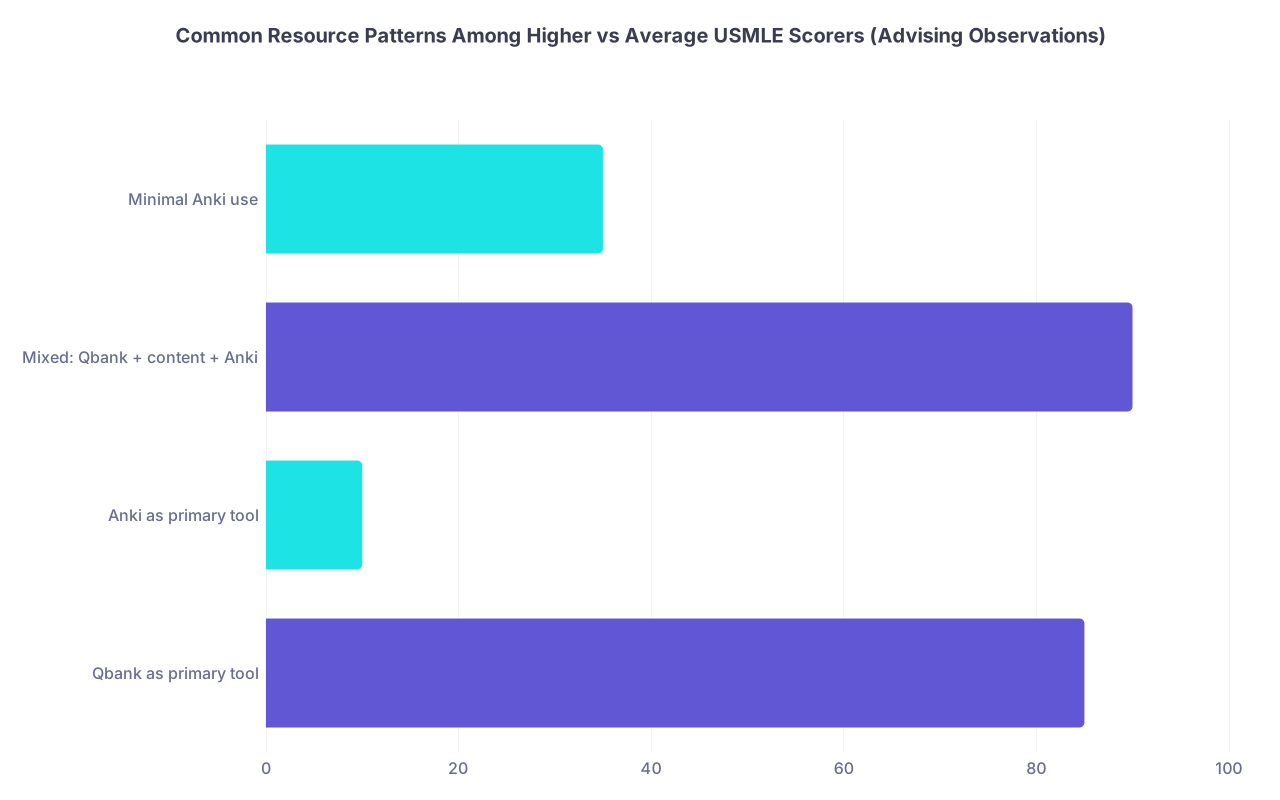
| Category | Value |
|---|---|
| Qbank as primary tool | 85 |
| Anki as primary tool | 10 |
| Mixed: Qbank + content + Anki | 90 |
| Minimal Anki use | 35 |
Not randomized, not perfect. But the trend is brutally consistent across schools and years: USMLE is question- and integration-heavy. Flashcards alone can’t train that.
The Biggest Myth: “If I Just Do All My Reviews, I’ll Be Fine”
This is the one that burns students out.
You see screenshots: “8,000 reviews due. Pray for me.”
People flex their review streak like a Peloton badge.
Let me be direct: the card count is a vanity metric.
What actually predicts USMLE performance?
- Consistent, timed blocks of high-quality questions (UWorld, NBME-style)
- Careful post-question review and error analysis
- Solid conceptual understanding of core systems and pathophysiology
- Then, yes, spaced reinforcement of those facts and patterns
Anki can handle that last part beautifully.
But it can’t compensate for the first three being weak.
I’ve seen students who:
- Did 200–300 Anki reviews/day
- Did 40 questions/day, reviewed thoroughly
- Regularly revisited weak topics with dedicated reading/videos
…score significantly higher than classmates doing 800–1000 reviews and 10–20 questions a day.
Because the limiting factor wasn’t fact exposure. It was reasoning.
What Anki Is Good For in USMLE Prep
Now for the part people mis-hear. I’m not anti-Anki. I’m anti–bad Anki.
When used sanely, Anki is incredibly useful for:
High-yield, concrete facts that must be instant recall
- Bugs and drugs (mechanisms, side effects, classic associations)
- Path buzzwords and key lab findings
- Diagnostic criteria, triads, formulas
Reinforcing what you learned from questions or videos
- Turning your UWorld wrongs into custom cards
- Adding a few cards for that weird glycogen storage disease you keep forgetting
Maintaining older material while you move to new systems
- Keeping cardio facts alive while your course shifts to renal
- Keeping biochem from evaporating while you’re drowning in micro
Used this way, Anki becomes your long-term memory maintenance system, not your primary learning pipeline.
That’s a huge difference.
When Anki Is Not Enough (and What To Add)
Anki breaks down when you try to make it do jobs it’s not built for:
- Teaching you a complex physiology pathway for the first time
- Showing you how a concept appears in a clinical vignette
- Training you to manage time, triage, and reasoning under test pressure
- Integrating multi-step problems that involve several organ systems
That’s where:
- UWorld / AMBOSS / Kaplan Qbanks
- First Aid / Pathoma / Boards & Beyond / Sketchy
- NBME practice exams
…come in.
You need three layers for USMLE prep:
Conceptual Layer – videos, lectures, books
Understand the story: pathophys, mechanisms, big-picture patterns.Application Layer – Qbanks, NBMEs
See how the test actually asks. Practice diagnosis, next-step logic, multi-order reasoning.Retention Layer – Anki (or similar)
Keep the necessary facts accessible on demand, long term.
If Anki is doing 80–90% of your daily “study time,” your stack is upside down.
How to Use Anki Smartly for Step 1 and Step 2
Let’s get practical. Here’s a rational, evidence-aligned way to integrate Anki.
1. Limit total active cards
You don’t need 40,000.
Most students do far better with 8,000–15,000 high-quality cards that are:
- Aligned to their curriculum and exam content
- Focused on things they truly need help remembering
- Pruned of obscure or redundant trivia
If you inherit a giant premade deck (AnKing, etc.):
- Suspend entire subdecks that don’t match your resources or goals
- Unsuspend as you go by system/topic, not all at once
- Be ruthless: if a card feels like useless detail, suspend it
2. Make cards from your questions
The most powerful cards I see are “born” from UWorld/AMBOSS wrongs and NBMEs. Example:
Bad card (from a generic deck):
“Treatment of primary hyperaldosteronism?”
Better card (post-UWorld):
“Primary hyperaldosteronism:
– Key lab findings?
– Classic cause?
– First-line treatment?”
Now that card is anchored to a real question you saw, with a patient and a vignette. Much harder to forget.
3. Keep daily reviews sustainable
A useful rule of thumb:
If Anki reviews > questions + review time, you’re probably overdoing cards.
For dedicated:
- Many strong scorers sit around 200–350 reviews/day
- Some go up to 400–500 in peak times, but only if they can also hit 40–80 questions/day with solid review
If you’re consistently seeing 700+ reviews/day and you’re not near the exam, that’s a red flag. You’re building a system that future-you will resent.
Where Different Phases of Training Change the Role of Anki
Anki’s “enoughness” changes through med school.

Preclinical years (MS1–MS2 lectures)
Here, Anki can carry more weight—if it’s grounded:
- You attend lecture or watch a board-style video
- You annotate slides or a concise written source
- Then you reinforce using focused Anki decks, ideally linked to that content
Anki can be your main retention tool, but not your only contact with the material.
Dedicated Step 1
This is where Anki must become secondary:
- 40–80 questions/day
- Deep review of misses and marked questions
- Short blocks of Anki to keep facts fresh, nothing more
If you’re turning down extra NBME practice because “I have 500 reviews due,” you’re optimizing the wrong metric.
Clerkships and Step 2 CK
Here, Anki works best for:
- Shelf-specific facts (OB drug safety, psych adverse effects, etc.)
- High-yield clinical management pearls
- Things you miss repeatedly on question blocks
But the real king for CK is still question volume + good review. Cards are there to prevent repeated forgetting, not to teach you how to manage DKA vs HHS.
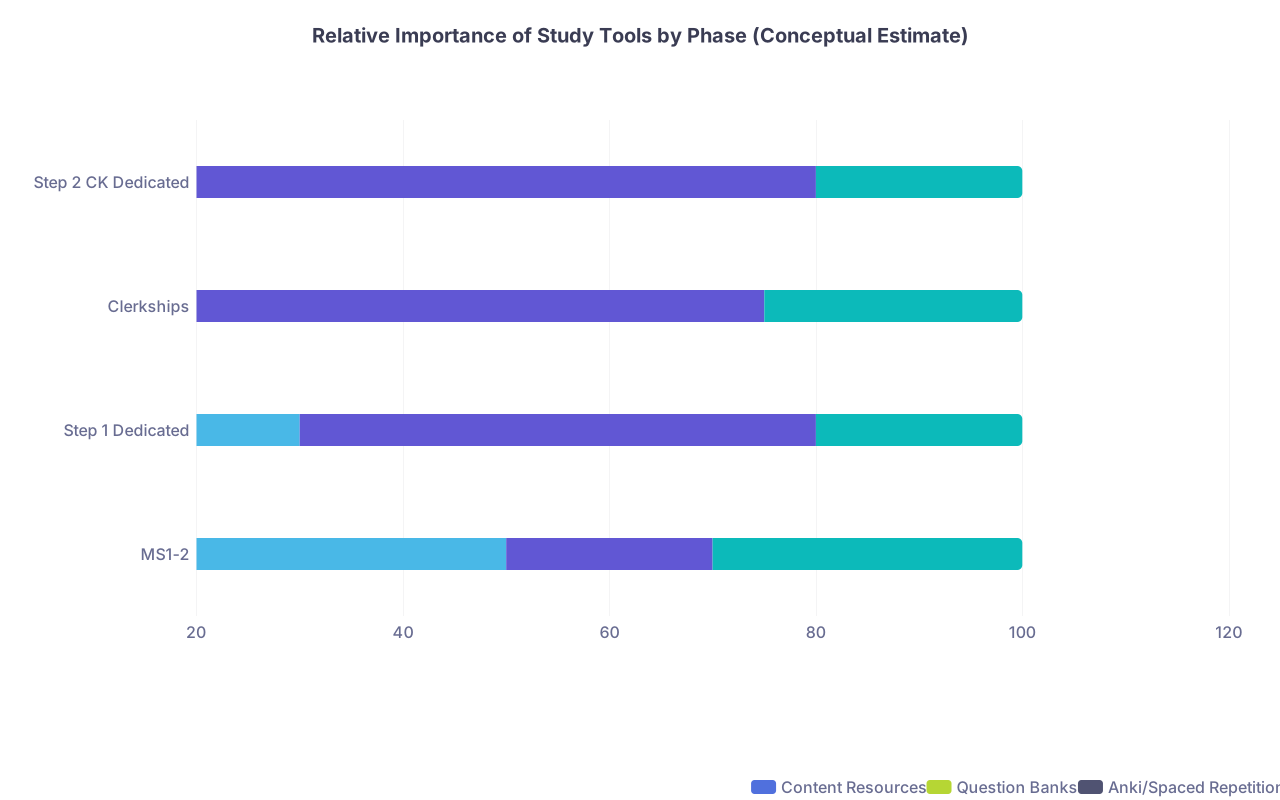
| Category | Content Resources | Question Banks | Anki/Spaced Repetition |
|---|---|---|---|
| MS1-2 | 50 | 20 | 30 |
| Step 1 Dedicated | 30 | 50 | 20 |
| Clerkships | 20 | 55 | 25 |
| Step 2 CK Dedicated | 20 | 60 | 20 |
Numbers aren’t absolute, but the pattern is clear: as you transition toward clinical exams, questions dominate.
What About People Who Say “I Did Anki Only and Scored 260+”?
There are always anecdotes. The “I only used Anki and got a 260+” stories.
Here’s what usually gets left out when you actually talk to these people:
- They had extremely strong lecture notes or conceptual understanding before they ramped Anki.
- They selectively unsuspended only the highest-yield tags in those massive decks.
- Many of them did a ton of questions but don’t count them as “resources” because “everyone does UWorld.”
Or they’re just statistical outliers—people who would score high with pretty much any half-reasonable system.
Outliers shouldn’t define your strategy.
You’re better off copying the most common patterns of reliably strong scorers, not the most extreme.
A Sane, Evidence-Aligned Summary
Is Anki enough for USMLE?
No.
Not if “enough” means “primary or sole tool.”
Not if “enough” means “I’ll crush the exam just by clearing my review queue every day.”
But:
Is Anki a powerful, almost unfair advantage when used as a supporting tool for spaced recall of high-yield material?
Yes.
Consistently. Repeatedly. Across many cohorts and schools.
If you want a one-sentence strategy to walk away with, it’s this:
Use questions and explanations to learn, use concise resources to understand, and use Anki to remember what actually matters.
Years from now, you will not remember whether you hit a 500-day streak or finished that giant deck. You will remember whether your system made you confident walking into the exam—or just tired and scared.