
Clerkship Grades vs Board Scores: What Actually Predicts Success
Which would you rather have on your record: glowing Honors in every core clerkship with an average Step score… or average Pass/High Pass grades and a top-decile Step score?
If you think that’s an easy question, you have not been paying attention to how residency programs actually behave—or to what the evidence shows about who becomes a good doctor.
Let’s dismantle a few sacred cows.
The Big Myth: “Clerkship Grades Are More ‘Real’ Than Board Scores”
You’ll hear this from plenty of faculty: “Standardized tests are artificial. Clerkship grades show how you really function as a clinician.”
Nice story. The data is uglier.
Clerkship grades are among the noisiest, most biased, least standardized metrics in all of medical education. And yet, many schools still pretend that an “Honors in Medicine” at Hospital X is directly comparable to “Honors in Medicine” at Hospital Y.
It is not. At all.
Here’s what multi-institutional studies have repeatedly shown:
- Huge variation in grade distributions between schools and even between sites within the same school
- Attending-level subjectivity dominating student evaluations
- Documented disparities in grades by gender and race, independent of objective performance
- Inflated narratives in MSPEs (“top 1/3 of the class” applied to half the class—yes, really)
Board scores, for all their flaws, at least have one virtue: a 245 at School A is a 245 at School B. No dean can “narrative comment” you into a higher percentile.
So when people say clerkship grades are more “real,” what they often mean is: “We like them because we can shape them.”
That doesn’t mean board scores are the only thing that matters. It does mean you should stop treating clerkship grades as some pristine measure of your true clinical ability. They are partly performance, partly politics, partly luck, and partly who happened to be on service that month.
What Actually Predicts Performance: Not What You Think
Let’s get specific. When people say “success,” they mash together at least three different outcomes:
- Matching into a desired residency
- Performing well in residency (clinical competence, milestones)
- Long-term board certification and practice quality
Those are different beasts, with different predictors.
1. Matching Into Residency
Here, the brutal truth: board scores (or now, Step 2 CK scores) matter more than any individual clerkship grade for most competitive specialties.
Look at NRMP Program Director Surveys over the last decade. When directors are asked what factors they use to decide whom to interview and how to rank them, standardized scores consistently land in the top tier.
To make that visual:
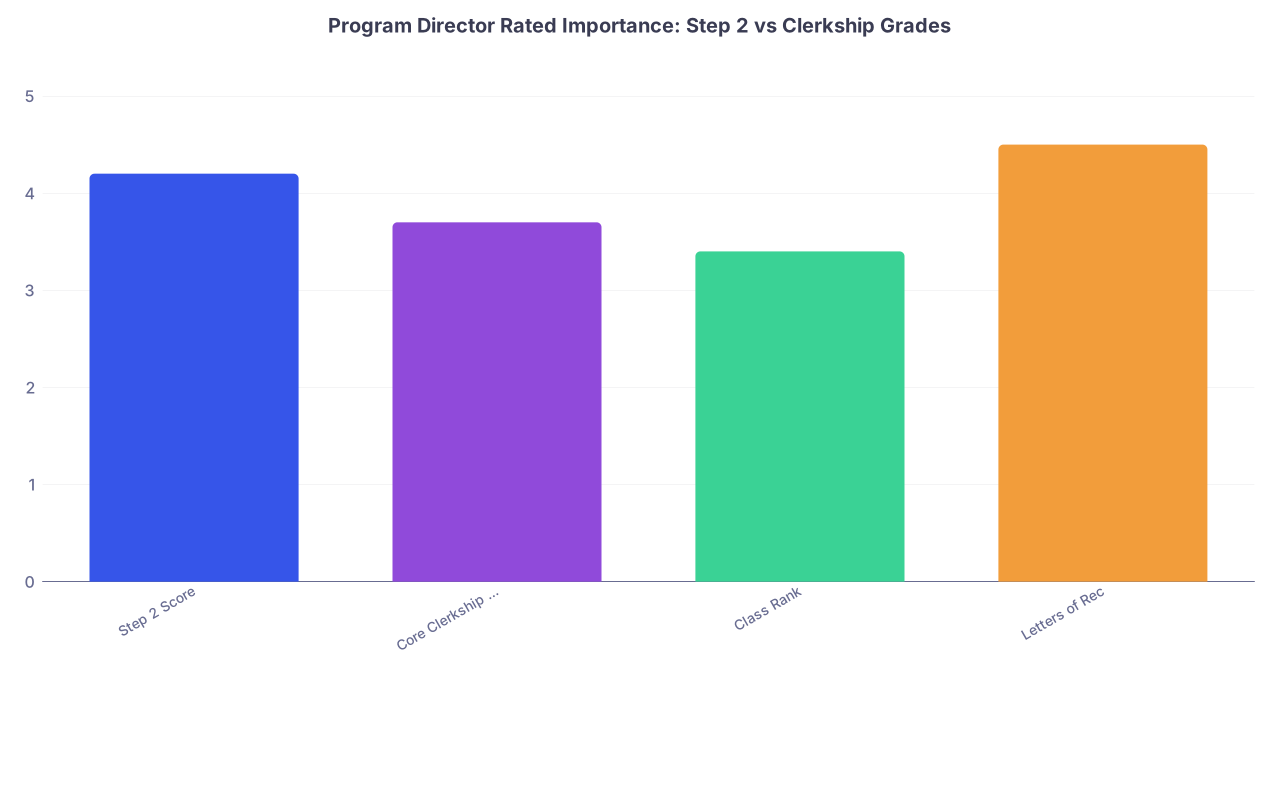
| Category | Value |
|---|---|
| Step 2 Score | 4.2 |
| Core Clerkship Grades | 3.7 |
| Class Rank | 3.4 |
| Letters of Rec | 4.5 |
(Scale here is approximate: 1 = not important, 5 = very important, based on aggregate survey patterns.)
Do some programs care deeply about clerkship performance? Yes. Especially in fields like Internal Medicine, Pediatrics, Family Medicine—where they want evidence you can function on the wards and get along with teams.
But when it comes to screening large piles of applications, a standardized number is faster and “fairer” (from their perspective) than trying to decode fifty versions of “excellent clinical performance” or “outstanding student.”
There’s also the gaming problem: schools with notorious grade inflation or opaque “Honors” systems lose credibility. Many PDs I’ve talked to ignore the actual words and look only at relative statements (“top 10%” vs “average”) and class rank.
So if your question is: “What’s more likely to get me in the door for an interview in a competitive field?”—a strong board score usually beats a couple extra Honors on your transcript.
2. Performance During Residency
Here’s where things flip a bit. Once you’re in residency, your Step 1 or Step 2 scores start to lose predictive power.
Multiple studies have found that while board scores correlate with passing in-training exams and later specialty boards, they’re only weak to moderate predictors of clinical performance ratings, professionalism, or patient care.
On the other hand, nothing predicts residency clinical evaluations perfectly. Not clerkship grades. Not OSCEs. Not “professionalism” comments. The relationship is noisy across the board.
What does show some signal?
- Patterns of consistently strong clerkship performance (especially in fields similar to your chosen specialty)
- Narrative comments that highlight reliability, work ethic, teachability
- Prior struggling with professionalism or teamwork—these unfortunately tend to repeat
But again, the signal is modest. I’ve watched residents with mediocre board scores become outstanding clinicians and leaders. I’ve also watched 260+ scorers implode under real-world workload and interpersonal friction.
So no, a glowing clerkship record does not guarantee you’ll thrive in residency. It just nudges the odds in your favor slightly—especially if the narratives match the grades.
3. Long-Term Practice Outcomes
This is the part nobody likes to talk about, because the data is less flattering for some cherished metrics.
Long-term, standardized test performance does correlate with things like:
- Passing specialty boards on first attempt
- Adherence to guideline-based care in certain specialties
- Some aspects of quality metrics (though these datasets are messy)
But when you shift to broader measures—patient satisfaction, communication quality, clinical judgment in complex cases—test scores alone do not explain much.
Clerkship grades? Even weaker. By the time you’re 5–10 years out, nobody cares whether you got High Pass in OB/GYN. What matters is whether you’re safe, reliable, and competent in your field.
The honest answer: neither clerkship grades nor board scores, by themselves, are great predictors of who will be an excellent attending. They predict different slivers of the job.
The Structural Problem: We Treat Noisy Signals Like Gospel
Let me be blunt. The entire “Honors / High Pass / Pass” ecosystem is a mess.
Different schools use radically different grading policies. Some cap Honors at 15–20% of students; others hand it out to 50% or more. Some weight shelf exams heavily; others barely count them. At a few places, you can almost predict your grade by your Step 1 score. At others, the subjective evals matter more than any objective exam.
Here’s a simplified look at how wildly things can vary:
| School Type | Honors % | Shelf Weight | Narrative Detail |
|---|---|---|---|
| Highly selective | 20% cap | 50% | Extensive |
| State flagship | 35% avg | 40% | Moderate |
| Grade-inflated | 55%+ | 30% | Vague |
| Pass/Fail clinical | N/A | 0–60% | Heavy emphasis |
| Hybrid model | 25–30% | 40–60% | Variable |
Now imagine a program director trying to compare “Honors in IM” from each of those places. They can’t. So they reach for whatever is standardized: Step 2 scores, class rank, AOA, maybe the shelf percentiles if your school includes them.
You, the student, think: “If I just Honor everything, I’ll be set.” But the downstream decision-makers often can’t even interpret your Honors without a decoder ring.
That gap between what you’re told to care about and what actually moves the needle is where a lot of anxiety and burnout comes from.
Step 1 Pass/Fail: Did Clerkship Grades Become King?
Here’s the other misconception floating around: “Now that Step 1 is pass/fail, clerkship grades are the most important thing.”
No. Programs didn’t suddenly forget they still have Step 2 CK. They simply shifted more weight to it.
Look at application advising now: most competitive specialties are explicitly asking for Step 2 before ranking, and many want it before interview offers. They’re not shy about this.
So what changed?
- Step 1 no longer functions as the blunt screening weapon
- Step 2 gained even more power than before
- Preclinical honors (where still graded) and overall patterns matter more in tie-breakers
- Clerkship narratives and letters matter more once you’re past the initial screen
If anything, the Step 1 change made the shelf exams more quietly influential. In many schools, shelf performance feeds directly into clerkship grades. In others, raw shelf percentiles show up in the MSPE appendices.
So you ended up with the worst of both worlds in some places: subjective clerkship grading sitting on top of an NBME exam that wasn’t designed to be a gatekeeper for residencies—but is now used that way.
Where Students Miscalculate (Over and Over)
The most common strategic mistake I see? Students anchoring too hard to one metric and ignoring the rest.
Some examples:
- The “board score or bust” student who crushes Step 2 but phones in clinical years, ends up with mediocre letters and zero champions in their chosen field. Great score. Weak application.
- The “I’m a people person, exams don’t matter” student who rakes in strong narratives and good rapport with teams, but sits on a low Step 2 for a competitive specialty. They get filtered out before anyone reads the glowing comments.
- The perfectionist chasing Honors in every clerkship, burning out, and tanking their Step 2 from sheer exhaustion and anxiety.
The reality is more boring and more brutal: residency selection—and later success—is multi-factorial. No single number saves you. No single grade ruins you.
But if you want a cold-blooded hierarchy of what tends to move decisions:
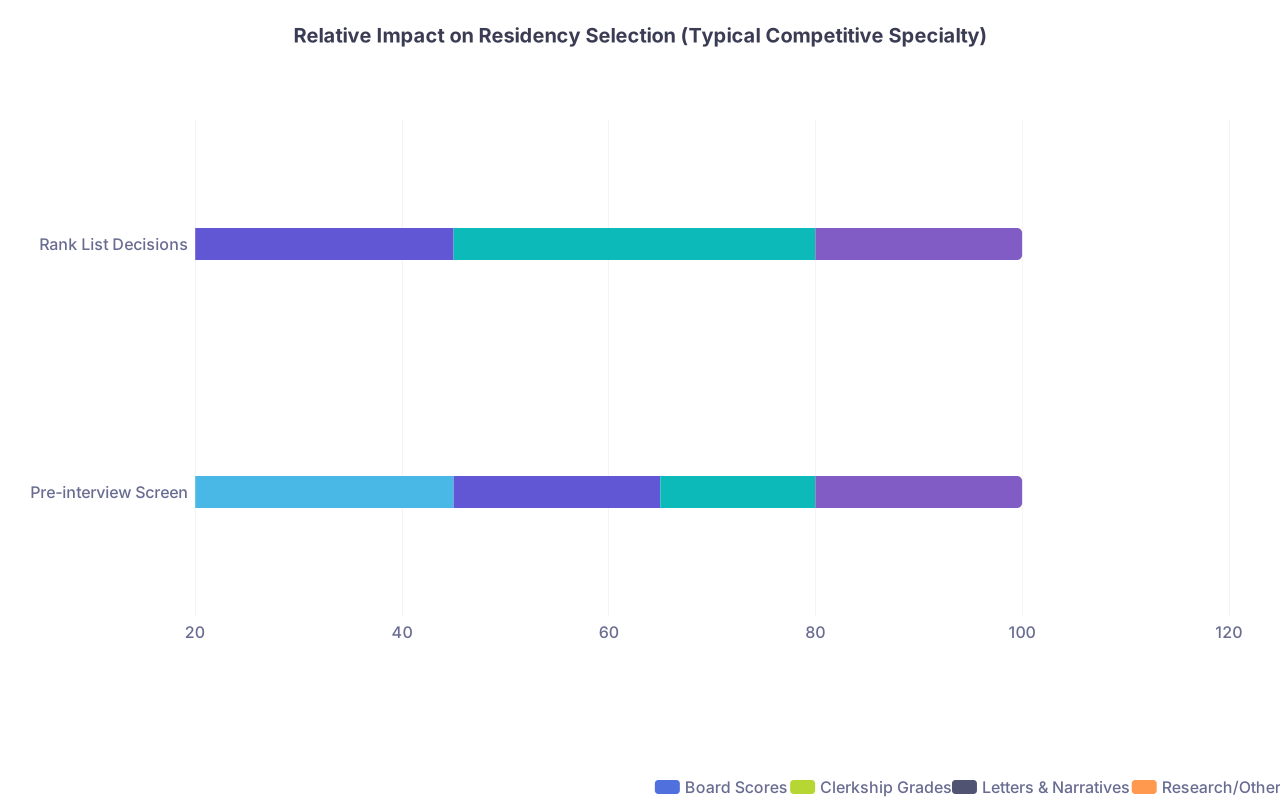
| Category | Board Scores | Clerkship Grades | Letters & Narratives | Research/Other |
|---|---|---|---|---|
| Pre-interview Screen | 45 | 20 | 15 | 20 |
| Rank List Decisions | 20 | 25 | 35 | 20 |
Rough, but directionally correct. Scores get you past the first gate. Clerkship performance and letters shape how people feel about you once they meet you.
So What Actually Predicts Your Success?
Strip away the noise and a clearer picture emerges.
Patterns matter more than one-off data points.
- Consistent, solid performance across clerkships tells programs you can show up, function on a team, and not implode under normal pressure.
- A Step 2 that’s in line with or slightly above your target specialty’s norms keeps doors open.
- Narrative comments that repeatedly mention reliability, ownership, and growth mindset are gold. Those are the people who tend to do well in residency.
Where do clerkship grades fit in?
They’re a proxy. Imperfect, distorted, but not useless. Honors in IM and Surgery probably mean more for a general surgery application than Honors in Psych and FM. A string of borderline passes raises questions, regardless of your Step 2.
Where do board scores fit in?
They’re your currency for initial credibility. Programs assume (rightly or wrongly) that if you can’t clear a certain cognitive bar, you’ll struggle with in-training exams and boards. High scores reassure them. Low scores make them nervous.
Neither metric really captures bedside manner, diagnostic intuition, or long-term professional growth. Those show up later—through feedback, mentors, and patient outcomes.
How to Play This Without Losing Your Mind
You’re not going to hack the system perfectly. No one does. But you can stop operating on myths.
Here’s the practical approach I give students when I’m not sugarcoating anything:
Focus on trajectory and balance.
- Use preclinical and early clerkships to prove you can master content and pass standardized exams at a high level. That’s your insurance policy.
- On the wards, fight less for a specific letter grade and more for specific behaviors that produce good narratives: owning your patients, following through, showing curiosity, not being a jerk at 3 a.m.
- Protect some bandwidth for Step 2 studying even during busy rotations—because that number will follow you around much longer than whether you got Honors vs High Pass in OB.
- Don’t martyr your mental health chasing an “Honors sweep.” Programs would rather have a stable, teachable High Pass student than a brittle, exhausted Honors robot.
And if your record is already “flawed”? Welcome to the club. The vast majority of residents and attendings have at least one ugly grade, one disappointing score, or one rotation where everything fell apart.
What matters is whether the overall story makes sense:
- Did you learn?
- Did you recover?
- Do the later data points show growth?
That’s what thoughtful program directors—and later, your colleagues—actually care about.
The Bottom Line
- Clerkship grades are noisy, biased proxies; board scores are narrower but more standardized. Neither alone predicts “success” well.
- For getting interviews, strong board scores usually carry more weight; for ranking and residency performance, patterns of solid clerkship work and strong narratives matter more.
- Aim for balanced, consistent performance and a clear upward trajectory—not perfection in any single metric.