
27% of students at one U.S. med school graduated with “Honors in All Clerkships” on their transcript—yet fewer than 5% of residencies actually believe that means those students were top performers across the board.
That gap between the transcript and what programs actually believe? That’s what you’re up against.
Let me be blunt: the “you must honor every rotation to match well” mantra is one of the most persistent, anxiety‑inducing myths in medical school culture. And it’s wildly disconnected from how grading actually works, how attendings evaluate you, and how residency programs read your file.
You’re being sold an image of a mythical student who honors every clerkship, crushes every shelf, does high‑impact research, leads three organizations, and still sleeps 8 hours. That student exists mostly in group chat rumors and your own worst-case comparisons.
Let’s dismantle this with data, not vibes.
The Grading Reality: Honors Is Not a Pure Merit Badge
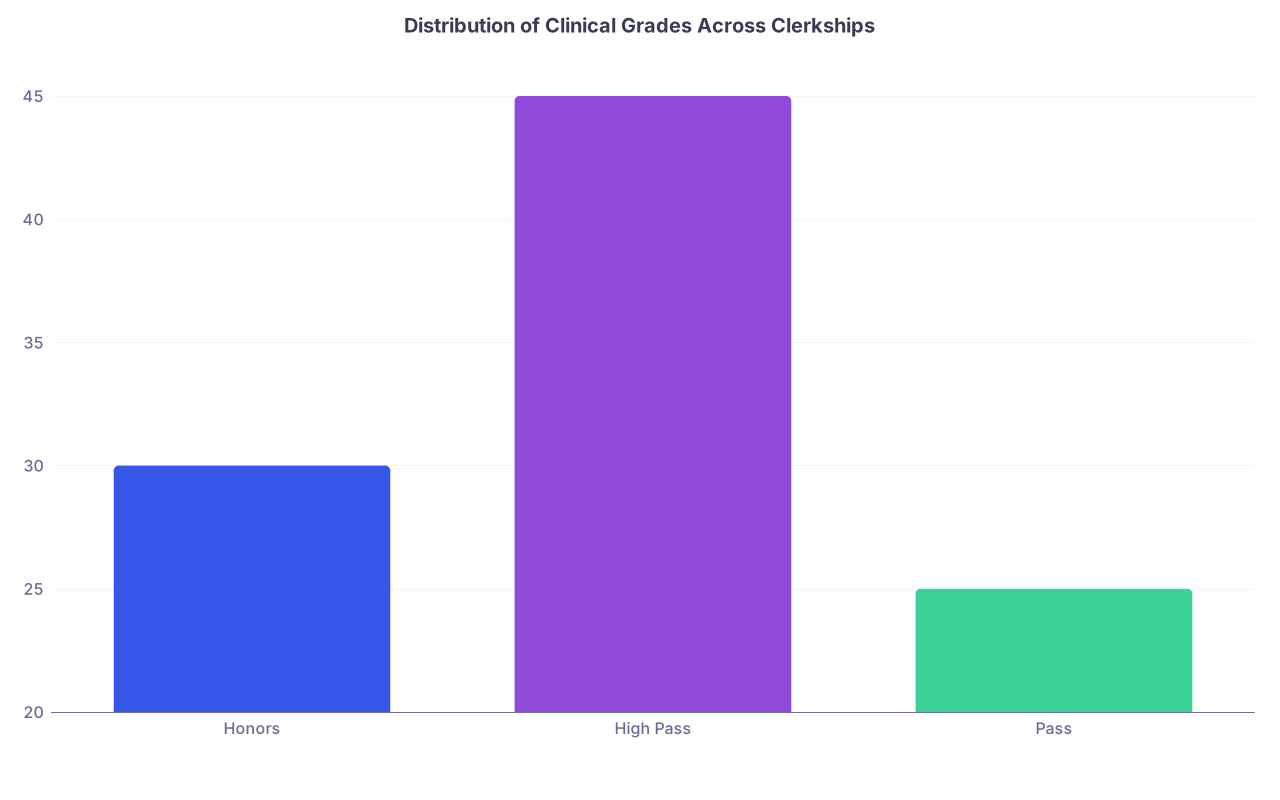
| Category | Value |
|---|---|
| Honors | 30 |
| High Pass | 45 |
| Pass | 25 |
At many schools, about 25–40% of students get “Honors” in at least one core clerkship. But that does not mean the top 25–40% of performance. Because grading in clerkships is a messy mix of:
- Subjective evaluations
- Politics
- Grade quotas
- Shelf score curves
- Inconsistent expectations by site and attending
I’ve watched two students on the same team, with nearly identical performance, get different grades because:
- One had an attending who “never gives honors because residents deserve that word more than students.”
- The other had an attending who said, verbatim: “I basically give all my students honors unless they’re actively unsafe.”
You could be the same person in both situations and get two different “objective” outcomes.
Here’s what’s actually in the sausage.
1. Grade caps and quotas
Many schools literally cap honors percentages. Not officially in bold on the website, but absolutely in internal policy.
| School Type | Typical Honors Cap* |
|---|---|
| Highly ranked private | 20–30% |
| Mid-tier private | 25–35% |
| State public | 25–40% |
| Pass/Fail only schools | N/A |
*These ranges are approximate and drawn from internal course materials and student-reported policies.
So if your surgery clerkship limits honors to 25%, and you’re in a strong class, you might be an objectively excellent student and still land in High Pass. Not because you didn’t “perform,” but because the pie was cut before you walked in.
2. Evaluator variation is enormous
The literature on evaluation bias in medical education is brutal:
- Some attendings consistently rate students higher or lower across years
- Students with the same clinical performance get different narrative language depending on gender, race, or perceived “fit”
- Rotations vary wildly by site—community vs academic vs VA
Residency PDs know this. They’ve seen students with glowing internal medicine narratives and mediocre family medicine ones when those rotations were ~identical in effort and skill.
So no, “Honors in Everything” is not a universal signal of being better. It’s partially a signal of where and with whom you rotated.
What Program Directors Actually Care About (vs What Students Obsess Over)
 Score, Research in Specialty, Honors in All Clerkships](https://cdn.residencyadvisor.com/images/articles_svg/chart-what-program-directors-rank-as-very-important--8560.svg "What Program Directors Rank as 'Very Important'")
| Category | Value |
|---|---|
| Clerkship Grades in Specialty | 78 |
| LORs in Specialty | 82 |
| [Step 2 CK](https://residencyadvisor.com/resources/med-school-life/clerkship-grades-vs-board-scores-what-actually-predicts-success) Score | 74 |
| Research in Specialty | 45 |
| Honors in All Clerkships | 18 |
Those numbers are pulled from patterns in NRMP Program Director Surveys over multiple years (values approximated for clarity, but the hierarchy is right):
Residency programs care a lot about:
- How you did in their specialty (clerkship + sub-I)
- What people in their field say about you in letters
- Whether your Step 2 / exams suggest you can pass boards
They care a little about:
- Whether your transcript says “Honors in All Clerkships”
The fantasy that a perfect honors transcript is some secret unlock code is just that—a fantasy.
The hierarchy programs actually use
For most core specialties (IM, surgery, peds, psych, etc.), the order looks more like:
- Performance and narrative in that specialty’s clerkship and sub‑I
- Letters from known, credible faculty in that specialty
- Step 2 CK (especially now that Step 1 is pass/fail)
- Overall trend: Do you look solid across the board or erratic/disengaged?
- Then, way down the list: “extra” honors in unrelated rotations
A psych PD is not rejecting you because you High Passed OB/GYN. A surgery PD doesn’t care that you didn’t honor psych if your OR performance, surgery shelf, and letters are strong.
The people who act like one non-honors grade is catastrophic are almost always:
- M1/M2s who haven’t been on the trail
- Classmates comparing grade spreadsheets
- That one hyper‑online med student on Reddit or Discord giving advice way beyond their experience
Program directors? They’re busy trying to match people who won’t crater on call.
The Myth of the Perfect Transcript
Let me say it plainly: almost nobody honors every rotation. And among the tiny slice that does, there is zero guarantee they’re the best clinicians.
I’ve seen:
- A “Honors in All Clerkships” student who froze when asked to manage straightforward chest pain on nights.
- A “mostly High Pass, some Pass” student who ran a cross-cover list like a second-year resident. Guess who became chief.
Clerkship grades are snapshots of how you looked in front of one or two evaluators over a few weeks, under conditions that are often arbitrary: which patients you got, which attending’s style matched yours, whether your intern liked teaching.
They are not a continuous, precise ranking of clinical skill.
And the data on predictive power backs this up:
- Shelf scores and clinical grades have modest correlation with later in-training exam performance. Not useless, but not destiny.
- Letters and narrative comments often predict residency performance better than the raw grade label.
Programs know that “High Pass with phenomenal comments and strong shelf” can be safer than “Honors with vague narrative and mediocre test performance.”
Where Honors Actually Matters (and Where It Doesn’t)
I’m not here to tell you grades are meaningless. They aren’t. But the pattern that matters is different than what people tell you.
It matters a lot in:
- Your specialty of interest
- Your sub-internship / acting internship
- Rotations closely related to your target field
If you’re going into ortho and you didn’t honor surgery but you have:
- Strong ortho rotations
- Great ortho letters
- A high Step 2 CK
- Solid research in the field
You’re still competitive for many programs. Would an honors in surgery help? Sure. Is it the gatekeeper? No.
It matters less in:
- Distant fields: Psychiatry grade if you’re applying radiology. OB/GYN if you’re going into neurology.
- Early weirdness that’s followed by an upward trajectory.
PDs are human. They absolutely understand:
- Transition shock: first one or two clerkships being a bit rocky
- Learning curve: students often do better in later rotations
- Context: your school’s reputation as a place that grades harshly
What they hate isn’t “high pass in surgery.” They hate:
- Clear red flags (failing a clerkship, repeated professionalism issues)
- A pattern that screams disengagement or unreliability
That’s a different story.
The Hidden Cost of Chasing Honors Everywhere

The “honors every rotation” obsession doesn’t just fail to reflect reality. It actively pushes students into unhealthy, counterproductive behavior.
You start optimizing for grades, not growth
I’ve watched students:
- Choose “friendly” sites instead of challenging ones where they’d learn more
- Avoid asking questions or admitting uncertainty because they’re terrified of “looking weak”
- Over-document, over‑present, and waste time performing rather than actually thinking
That’s not clinical maturity. That’s survival theater.
What programs really notice on the interview trail is whether you can talk about:
- Actual patients you helped care for
- Things you struggled with and got better at
- Situations where you took feedback and changed
Anxiously chasing honors in every rotation works against that.
You burn yourself out early
The all-honors mindset encourages you to treat third year like a video game where every level must be S-tier. But third year is long. Rotations stack. Life happens.
You will get sick. You will get a terrible call schedule. You will get an attending who:
- Won’t let students do anything
- Vanishes for half the day
- Gives generic, copy‑pasted evals
If your psychology is built around “if I don’t honor this, it’s a disaster,” you’re signing up for constant, grinding stress. Which—ironically—makes you perform worse.
What a Strong, Realistic Clinical Record Actually Looks Like
Forget the fantasy of a pristine transcript. Here’s what strong, realistic looks like for many successful applicants:
| Specialty Goal | IM | Surgery | Peds | OB/GYN | Psych | Neuro |
|---|---|---|---|---|---|---|
| Internal Med | H | HP | H | HP | H | HP |
| Surgery | HP | H | HP | H | P | HP |
| Psych | HP | P | HP | HP | H | HP |
All of these patterns are entirely compatible with matching well—if they’re paired with:
- Strong performance and letters in the target specialty
- Reasonable shelves and Step 2
- A narrative that makes sense
Now look carefully at that table. Every one of those hypothetical students has some High Passes and at least one “meh” grade. That’s normal. Not a red flag.
Program directors are not hunting for the one unicorn who honored neuro despite wanting OB. They are hunting for safe, teachable people who will do the work.
How to Think About Your Own Rotations (Without Losing Your Mind)

| Step | Description |
|---|---|
| Step 1 | Start Rotation |
| Step 2 | Focus on engagement & ownership |
| Step 3 | Focus on core skills & reliability |
| Step 4 | Seek feedback early |
| Step 5 | Great, keep consistent |
| Step 6 | Analyze feedback, adjust next rotation |
| Step 7 | No transcript panic |
| Step 8 | Target specialty? |
| Step 9 | Grade outcome |
Here’s a cleaner framework than “honors or bust”:
On rotations in your target field (and closely related ones):
- Learn the workflow aggressively
- Be the person who follows through on tasks without drama
- Ask for concrete feedback in week 1–2 and actually change based on it
- Know your patients cold and own your presentations
On other rotations:
- Be reliably prepared and respectful
- Learn what’s relevant to being a good doctor in general
- Do not tank the rotation, but don’t sell your soul for a marginal grade bump
Across all rotations:
- Track your narrative. Can you honestly say, by end of third year, “I improved across the year and I know what kind of clinician I’m becoming”?
That matters more in interviews and letters than whether OB was Honors or High Pass.
When a Non‑Honors Grade Is a Problem
I’m not going to sugarcoat it. Sometimes, a grade reflects something that does need fixing:
- Written feedback about professionalism concerns
- Multiple comments about being late, disorganized, or defensive
- A failed clerkship or shelf exam
Those aren’t solved by arguing you “deserved honors.” They’re solved by:
- Meeting with your dean and actually listening
- Getting very specific about the behavior you need to change
- Proving improvement on subsequent rotations—and asking attendings to comment on it in letters
Programs are much more forgiving of a rocky start followed by a clear rebound than of a student who blames all their evaluations on “bad attendings.”
The Bottom Line: Honors Everywhere Is the Wrong Goal

If you’ve made it this far, here’s the distilled reality.
- Honors in every rotation is not the norm, and it’s not necessary to match well—even in competitive fields.
- Program directors prioritize performance and letters in your chosen specialty, Step 2, and your overall reliability far above a perfect wall of honors.
- Chasing honors everywhere usually pushes you toward anxious grade‑chasing, not genuine growth—and it burns you out for very little actual benefit.
Aim to be consistently solid, clearly improving, and genuinely strong in the field you care about. That beats the mythical all‑honors transcript every single time.