Myth: You Must Answer Every Pimp Question to Impress Attendings
What actually happens to your eval when you miss half the pimp questions on rounds?
Not what most students think.
Every year I watch third-years walk off rounds looking shell-shocked, convinced they just tanked their rotation because they blanked on the diagnostic criteria for some zebroid disease or the fifteenth step of the coagulation cascade. And every year, when evaluations come in, there’s the same surprise: the student who missed plenty of questions is “outstanding,” and the one who gunned every trivia question sometimes gets tagged as “arrogant,” “rigid,” or “struggles with uncertainty.”
So let’s kill this myth properly.
You do not impress attendings by answering every pimp question.
You impress them by how you handle not knowing.
And there’s actual data on this, not just vibes and anecdotes.
What Pimping Really Measures (And What Attendings Think It Measures)
First, let’s separate fantasy from reality.
Students think pimping is a pure knowledge assessment. Like a live oral exam where your score is “number correct divided by number asked.” That’s not how most attendings use it.
In practice, pimping is a messy mixture of:
- Knowledge probe
- Stress test
- Engagement check
- Professionalism and humility test
And different attendings weight those very differently.
There’s some literature here. Studies on the “Socratic method” and “pimping culture” in medical education show:
- Questioning can help retention and clinical reasoning.
- But students overwhelmingly experience it as anxiety-inducing and often humiliating, especially when used as a power play.
- Faculty are actually pretty bad at judging student raw knowledge from on-the-spot questioning alone; impressions are heavily colored by demeanor and communication, not just correctness.
Here’s the key: on almost every standardized evaluation form I’ve seen, there is no checkbox for “percentage of pimp questions answered correctly.” But there are boxes for:
- Clinical reasoning
- Teamwork
- Communication
- Initiative / self-directed learning
- Receptiveness to feedback
Your behavior when you do not know an answer hits almost every one of those boxes.
And attendings know—whether they admit it or not—that a student who answers every question perfectly is more likely gaming the system (pre-reading just today’s topics, or already did the sub-I) than showing some magical superior brain.
The Data: What Actually Predicts Good Clinical Evaluations
Let’s talk evidence instead of hallway mythology.
Studies on clerkship performance consistently show stronger links between high clinical ratings and:
- Professionalism
- Work ethic and reliability
- Communication skills
- Team integration
- Initiative in reading and following up
…than raw medical trivia recall.
And for knowledge? Your NBME shelf or end-of-rotation exam does the heavy lifting. That’s the standardized, scaled knowledge tool. Pimping is not.
In one study of factors predicting honors in core clerkships, faculty comments and ratings were dominated by words like “hardworking,” “kind,” “prepared,” “great with patients,” “team player,” rather than “knew every answer.”
Attendings expect you to miss things. Many of them want you to miss some questions so they can teach. The red flags for them look more like:
- Making stuff up instead of admitting you don’t know
- Getting defensive or argumentative when corrected
- Checking out mentally after getting a few questions wrong
- Showing no pattern of follow-up learning (“We discussed this three days ago… and you’re still blank.”)
Missing questions is not the problem. Being someone they cannot trust with “I don’t know” is.
Why Trying to Answer Everything Actually Backfires
The myth that you must answer everything sounds ambitious. In reality, it usually pushes students straight into bad habits.
Common self-sabotage moves I’ve watched on rounds:
Guessing wildly and confidently
Student gets asked: “What’s the most likely cause of this patient’s normocytic anemia?”
They don’t know. So they shotgun: “Aplastic anemia?” with full confidence.
The problem isn’t the wrong answer. It’s that the attending now wonders whether you’ll make similarly confident, baseless decisions with actual patients.Overcompensating with word salad
You sort of know something, so you ramble: “Well, there are like, a lot of causes… so it could be chronic disease, or hemolysis, or like bone marrow suppression, or, I guess nutritional too…”
Now the team is confused and you look disorganized, even if the kernel of what you know is actually decent.Panicking and freezing
Some students get so locked into “I must be right” that when they’re not, they shut down for the rest of rounds. That’s visible. Everyone sees it. Evaluations often translate this as “lacks resilience” or “struggles in uncertain situations.”Prioritizing pimp questions over patients
I’ve seen students skip checking vitals, not updating a note, or ignoring a family at bedside so they can cram “things I might be pimped on today.” Nobody writes “honors” for the student who knows all the cytokines but misses that the patient’s blood pressure has been 80/50 for an hour.
The pattern: obsessing over getting everything right shifts you from “learning doctor” to “performer.” Attendings are not fooled. A few might reward the performance. Most will not.
How Good Students Actually Handle Not Knowing
Let me contrast two types of students I’ve watched on the same service.
Student A: high Step 1, neurotic about pimping.
On rounds, the attending asks: “What’s the mechanism of spironolactone?”
Student A: long pause, then, “It’s a diuretic that works in the kidney” — said as if that’s definitely the complete answer.
Attending pushes: “Where?”
Student doubles down, gets visibly tense, fumbles through and ends up trapped.
After rounds? They sulk, read for three hours, but never circle back with the attending.
Student B: solid but not perfect knowledge, actually enjoys the challenge.
Same question.
Student B: “It’s a potassium-sparing diuretic that antagonizes aldosterone in the collecting duct. Beyond that, I’m a little fuzzy on the downstream details. I’ll look up the specifics and get back to you.”
Next morning:
Student B: “Quick follow-up from yesterday — spironolactone blocks aldosterone at the mineralocorticoid receptor in the collecting duct, which reduces sodium reabsorption and potassium secretion. There’s also its anti-androgen effect we see in conditions like PCOS.”
Guess who gets the better eval 9 times out of 10?
Not because B knew more in the moment. Because B shows:
- Humility
- Specific partial knowledge
- Comfort with uncertainty
- Follow-through and self-directed learning
That’s what attendings want in a future colleague.
The Real Skill: Graded “I Don’t Know”
Saying “I don’t know” is not a binary. There’s a right way to do it that signals competence, not ignorance.
You want graded responses:
Recognize the domain
“This is definitely renal physiology, but I’m blank on the exact mechanism.”State what you do know
“I know it’s a potassium-sparing diuretic that acts in the collecting duct, but I’m missing the receptor-level details.”Admit the gap cleanly
“I’m not sure of the receptor or exact downstream effects.”Commit to closing it
“I’ll read up on that today and report back tomorrow.”
Then actually follow up. That last step is where many students fail.
Attendings notice patterns. If three times this week you said “I’ll look that up” and never closed the loop, they’ll mark you down as performative. If three times you close the loop with 30-second, clear explanations, they start thinking “this person is serious about learning.”
This also lines up with what we know from education research: retrieval practice plus feedback plus spaced repetition is how knowledge sticks. The “I didn’t know yesterday, I learned it today, I can explain it tomorrow” loop is actually an optimal learning pattern.
What Your Evaluation Actually Reflects
Let’s be honest: evaluations are not objective scorecards. They’re vibes plus a little structure.
But the structure matters. Most forms hit the same categories. And most attendings convert their impression of your behavior into those boxes.
Here’s how things really connect.
| What They See On Rounds | Where It Shows Up On Eval |
|---|---|
| How you handle not knowing | Clinical reasoning, professionalism |
| Whether you own and fix gaps | Initiative, self-directed learning |
| Your demeanor under questioning | Communication, teamwork |
| If you follow through on “I’ll look it up” | Reliability, motivation |
| Trivia recall for rare facts | Barely, or under vague narrative comments |
Notice what’s missing: “percent of questions answered correctly.”
I’ve watched attendings explicitly say in feedback meetings: “She didn’t know some details, but she was thoughtful, safe, and eager to learn. Strong evaluation.” Versus: “He knows a lot but I’m not sure I trust him when he doesn’t know. Needs work.”
If you focus your energy on the part that’s barely measured (trivia correctness) and ignore the parts that are heavily measured (professional behavior under uncertainty), you’re playing the game wrong.
How to Prepare for Rounds Without Feeding the Myth
This doesn’t mean “don’t study.” It means stop trying to brute-force every possible pimp question and start preparing strategically.
You want three things:
Strong grasp of common, high-yield bread and butter
Pneumonia, heart failure, COPD, DKA, GI bleed, sepsis, preeclampsia, appendicitis, etc. Look at your own service census: if half your patients have CHF and COPD and you’re reading about paraneoplastic syndromes, you’re misallocating effort.A mental habit of thinking before speaking
When pimped, pause for 1–2 seconds and think. Verbally organize: “My approach would be…” or “I think of three main categories…” This often turns a half-answer into a credible one.A reflex for clean, honest “partial knowing”
Practice how you’ll respond when you know 40–60% of the answer. That’s most of the time on rotations. You don’t need a script, but a pattern like:
“I know X and Y, but I’m not sure about Z. I’d like to read more about Z.”
To make this concrete, here’s a simple way to prep your brain, not just your memory:

| Step | Description |
|---|---|
| Step 1 | Pre-round: skim key problems |
| Step 2 | Predict 2-3 likely questions |
| Step 3 | Look up mechanisms/management briefly |
| Step 4 | Get pimped on rounds |
| Step 5 | Answer, then listen to teaching |
| Step 6 | Admit gap + commit to follow-up |
| Step 7 | End of day: review missed topics |
| Step 8 | Next day: close the loop with attending |
| Step 9 | Know it? |
This loop builds credibility. You’re not trying to be a walking UpToDate. You’re training yourself to be the kind of doctor who learns continuously and visibly.
What Actually Impresses Attendings
People love to say “attendings just want you to care,” which is true but vague. Let’s be sharper.
Things that consistently impress:
- You saw something on rounds you didn’t understand (like a complex ventilator setting) and the next day you show up with a succinct explanation of what it meant for that patient.
- You admit when you’re uncertain, especially if it could affect patient safety: “I’m not comfortable with this interpretation of the EKG—I’d like a second look.”
- You change behavior based on feedback. If on Monday you’re told your presentations are too long, and by Thursday they’re focused and tight, that’s memorable.
- You link what you’ve read to actual patients: “I read last night that we should be careful about X in someone with Y; is that why we’re avoiding this med?”
These behaviors scream “safe future colleague.” That’s what attendings want written on your eval, even if the box they tick is “Exceeds expectations.”
None of that requires answering every question right.
To underscore that, let’s look at what students think matters vs what actually does.
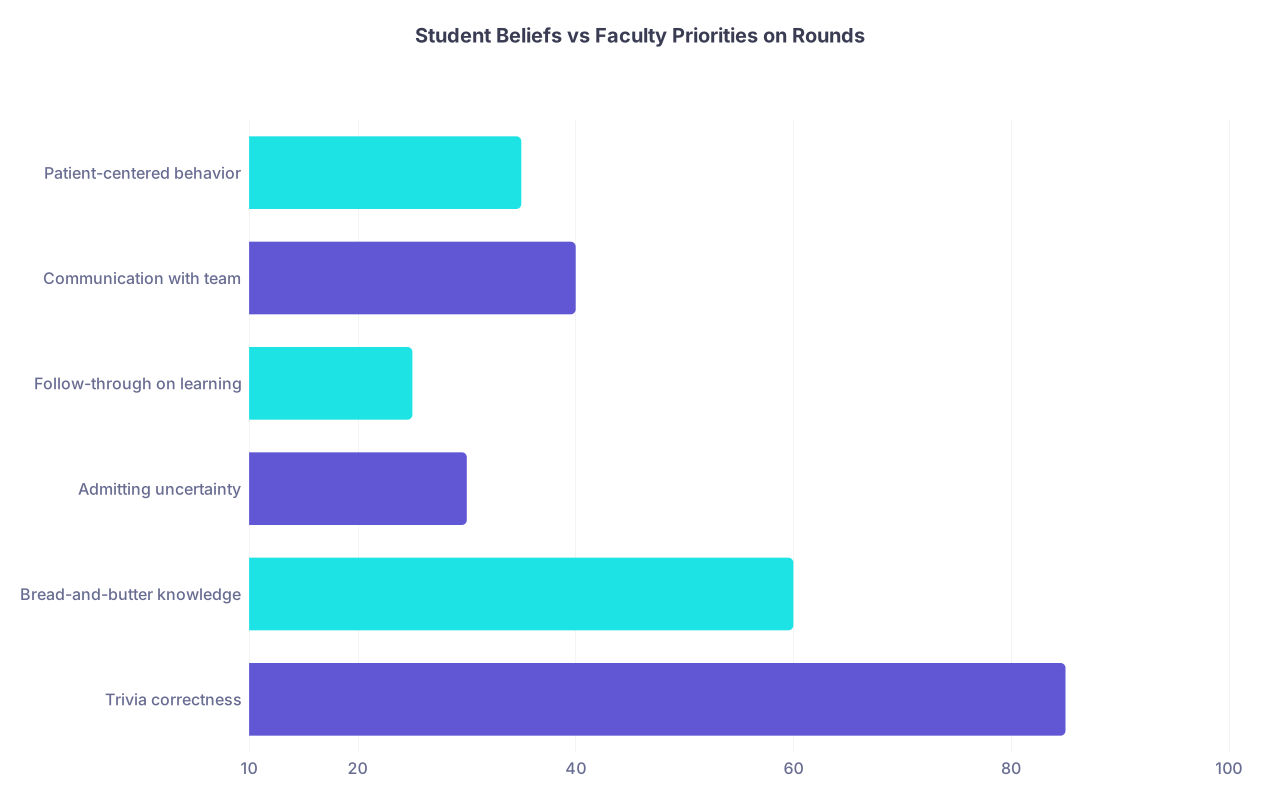
| Category | Value |
|---|---|
| Trivia correctness | 85 |
| Bread-and-butter knowledge | 60 |
| Admitting uncertainty | 30 |
| Follow-through on learning | 25 |
| Communication with team | 40 |
| Patient-centered behavior | 35 |
Assume this chart as “percentage of students who think each item is top-3 most important.” If you asked attendings to rank the same list, “trivia correctness” would plummet and “admitting uncertainty” and “follow-through” would shoot up.
The perception gap is your opportunity.
The One Line You Need to Remember
When you’re standing on rounds and your brain locks, remember this:
You are not being graded on being right. You are being graded on being honest, thoughtful, and teachable.
Most of the time, the fastest way to tank an attending’s trust is not by being wrong, but by refusing to be seen as someone who can be wrong.
Two Sanity Checks Before You Beat Yourself Up
Next time you walk off rounds replaying every missed question, run through these:
- Did I make up an answer I had no basis for, or did I accurately represent what I knew and didn’t know?
- Did I commit to closing at least one knowledge gap from today—and am I actually going to follow through and bring it back tomorrow?
If you can say “I was honest, I engaged, and I’ll be smarter tomorrow than I was today,” you’re doing the job.
You’re training to be a doctor, not auditioning to be a Jeopardy contestant.
Key Takeaways
You don’t impress attendings by answering every pimp question; you impress them by how you handle not knowing, how you think out loud, and whether you actually learn from the gaps exposed.
Obsessing over perfect correctness pushes you toward guessing, rambling, and hiding uncertainty—behaviors that hurt your evaluations far more than simply missing a question ever will.