
78% of clerkship students in one survey believed that “good” students pre-read every single patient before rounds. Less than 25% of residents said they actually want that.
There’s your disconnect.
You’ve probably heard some version of this on day one of rotations: “Always pre‑read every patient. Know every lab, every imaging, every note. That’s how you impress.”
Sounds noble. Sounds hardcore. Also sounds like a fast track to burnout and shallow learning.
Let’s pull this apart.
Where This Myth Comes From (And Why It’s Overblown)
The “pre‑read every patient” religion is a mix of three things:
- The nostalgia of older attendings who trained in paper-chart days.
- Gunners bragging about staying up until 1 a.m. reading every node-positive CT scan on the floor.
- Students confusing work ethic theater with actual clinical value.
I’ve watched third‑years scroll through 48‑hour‑old BMPs, old PT notes, and irrelevant clinic letters at 5:45 a.m., eyes half‑shut, because someone told them “you should really pre‑read all the patients before rounds.” Then they present and still miss what the team actually wants: what changed overnight and what we’re going to do today.
That’s the core problem. The myth focuses on volume of chart time. Reality is about precision and timing.
What The Data And Real-World Behavior Actually Show
No, there isn’t a randomized trial of “pre‑read every patient vs half the patients.” But there is reasonable data and a ton of converging evidence about how people learn and how patient care actually happens.
Let’s start with the time sink.
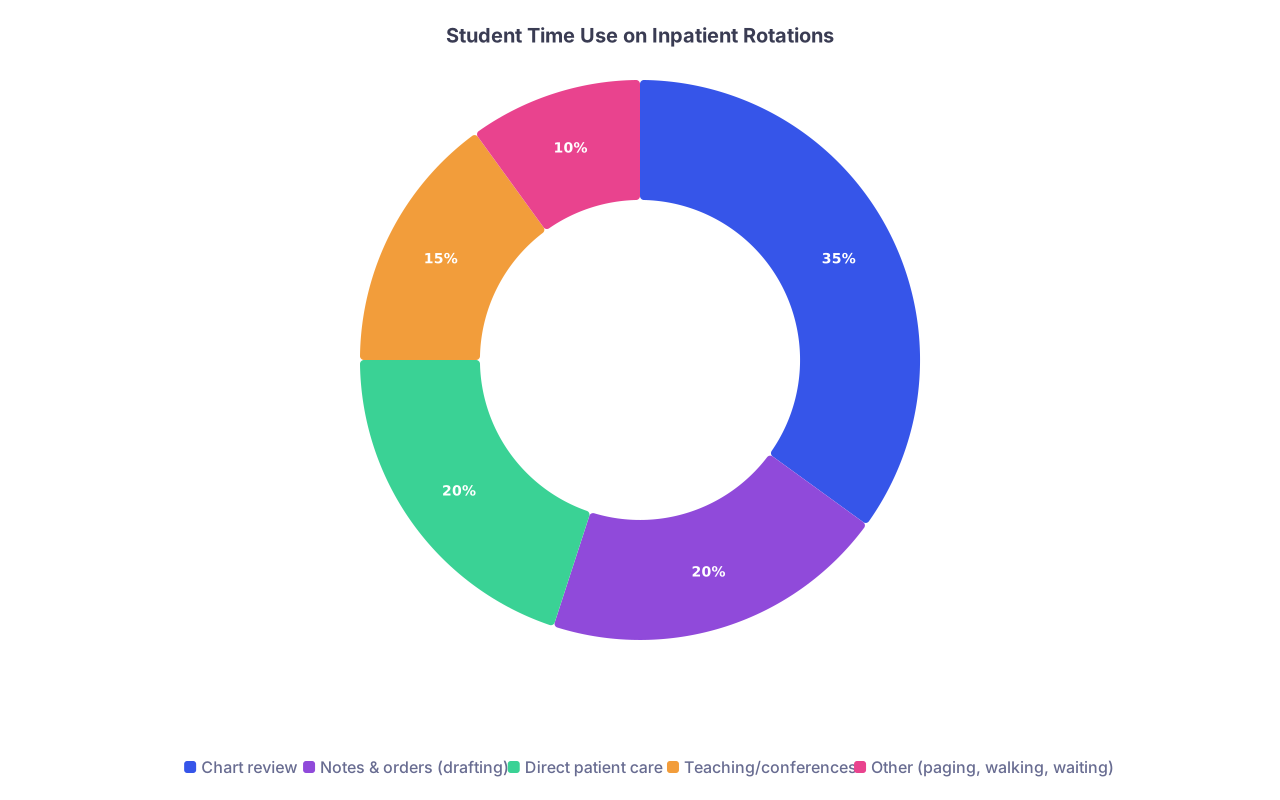
| Category | Value |
|---|---|
| Chart review | 35 |
| Notes & orders (drafting) | 20 |
| Direct patient care | 20 |
| Teaching/conferences | 15 |
| Other (paging, walking, waiting) | 10 |
Observational studies of clerkships routinely show that chart review eats up the largest chunk of student time—often more than direct patient care. Not because that’s what’s best for learning, but because students are terrified of being caught not knowing some obscure lab value.
Meanwhile:
- Residents and attendings are spending less and less time on pre-rounds and more on real-time decision-making.
- Teaching evaluations consistently rate bedside teaching and active problem-solving higher than “extensive chart prep.”
I’ve seen two kinds of students:
- Student A: Pre‑reads every patient on the list, including the 24 stable post‑op day 17 hip fractures. Can tell you the chloride from two days ago.
- Student B: Deep-reads their 3–5 patients very well, skims the rest briefly, then spends the extra time actually seeing their patients, thinking about plans, and asking specific questions.
Student B almost always gets the better evals. Not because they’re smarter. Because their time is aligned with how teams actually work.
What “Pre-Read Every Patient” Gets Wrong
The absolutist rule fails for three reasons.
1. It assumes you have infinite time (you don’t)
On a busy medicine service, the list can be 20–30 patients. On surgery, 40+. If you’re trying to:
- Pre‑read every patient in detail,
- See your assigned patients in the morning,
- Write your notes,
- Be on time to rounds,
you end up either sleep-deprived, cutting corners somewhere else, or skimming everything so shallowly that it barely counts as knowing the patient.
You’re not a database. You’re supposed to be a clinician in training.
2. It confuses information hoarding with clinical reasoning
Filling your brain with every lab from the last week isn’t clinical thinking. It’s hoarding.
Residents and attendings rarely care if you missed that the magnesium was 1.6 three days ago in a now‑stable patient. They care whether you can:
- Identify clinically relevant changes from yesterday to today.
- Integrate those changes into a coherent daily plan.
- Recognize red flags that need escalation.
Raw recall of trivia from the chart doesn’t impress nearly as much as people think it does. When I hear a student recite a five-minute lab timeline on rounds, I don’t think “wow, they’re brilliant.” I think: “They don’t know what’s important yet.”
3. It ignores cognitive load and memory limits
Educational psychology 101: working memory is limited. When you stuff it with every data point from 15 patients, you leave less bandwidth for pattern recognition and reasoning.
You’d be much better off:
- Deep-diving into a few representative or complex cases,
- Building mental models from those cases,
- Using the rest of your time for spaced repetition, reading, and feedback.
But the “pre‑read everyone” myth pushes you toward surface‑level, fear‑driven checking instead of targeted, concept‑driven learning.
When Pre-Reading Actually Matters
Now the flip side. There are times when pre-reading is absolutely the right move. The trick is knowing when and how much.
Your own patients: yes, but with discipline
If you are following 3–6 patients, they’re your responsibility. You should know:
- Why they’re here.
- What has changed since yesterday (new labs, new events).
- What the plan is today.
That doesn’t mean you scroll through every note they’ve ever had in the system. It means you have a structured, efficient pre‑round routine.

| Step | Description |
|---|---|
| Step 1 | Arrive to floor |
| Step 2 | Check overnight events |
| Step 3 | Scan new vitals & outputs |
| Step 4 | Review new labs/imaging only |
| Step 5 | Quickly see patient & exam |
| Step 6 | Draft one-liner & plan |
Notice what’s not in there: deep-reading every old consult or outpatient note unless it directly informs today’s decisions or your learning goals.
High-acuity or new admits
If you’re presenting a new admit on call tonight or a complex ICU patient in the morning, a deeper pre‑read makes sense. Not because of “looking good,” but because you will be actively involved in their management.
You still don’t read everything. You focus on:
- Admission story and initial ED/H&P.
- Problem list and major hospital events.
- Key imaging and trend labs.
- Active issues for today.
That’s it. You’re not writing a biography.
Teaching rounds on a flagship case
Sometimes the attending clearly signals, “This patient is a teaching case—we’ll spend time on them.” Like the classic vasculitis, weird rheum case, or zebra endocrine tumor.
Then yes. Do the deep dive. Read the chart—and the UpToDate article, and maybe even a paper—for that one case. That’s where you actually build durable knowledge.
When Pre-Reading Everyone Is Low-Yield (And Often Dumb)
Here’s where the myth really wastes your time.
Days with huge lists and low complexity
You’re on ortho. List of 35. Most are post‑op day 5+ “doing well, pain controlled, dispo pending rehab.” Pre‑reading each chart in detail at 5:30 a.m. will not advance your education or change patient care.
On these days, the smarter move:
- Deep-know the 3–4 patients you’re following.
- Have a general sense of the rest of the list from sign‑out and a quick scan.
- Save your limited energy for the OR, clinic, and teaching cases.
Overnight nothing-burgers
You already rounded in depth on your patients yesterday. They’re stable, expected post‑op course, no new symptoms. Overnight: no issues, vitals stable, no new labs.
Spending 10 minutes “pre‑reading” that chart is performative. A 20-second check is enough: any event? Any lab? Any change? No? Move on.
Specialty services with siloed issues
On subspecialty services (e.g., GI consults, ID consults), you’ll often be only asked about one narrow slice of the patient’s course. If your team is only managing the GI bleed, spending 15 minutes on their chronic neuropathy workup from 2018 is not smart triage.
Residents don’t do this. Attendings don’t do this. You don’t get extra points for doing it either.
What Residents And Attendings Actually Want From You
Let’s translate the vague “pre‑read” advice into what most supervisors actually care about. I’ll put it bluntly.
They want you to:
- Know your own patients well and accurately.
- Spot meaningful changes since yesterday.
- Propose a reasonable, structured daily plan.
- Ask thoughtful questions that show you’re thinking.
Notice what’s missing: “Be the human EHR.”
I’ve literally heard residents say to each other about a student: “They know their three patients cold and actually think through the plans. I don’t care if they can’t recite the sodium on Mrs. Jones in room 603 who they’ve never seen.”
Here’s how expectations really scale with level:
| Role | Primary focus | Breadth of pre-reading |
|---|---|---|
| Student | Own patients, basics on others | Narrow, targeted |
| Intern | Own team list, handoff patients | Moderate, time-limited |
| Senior | Entire list, anticipate issues | Broad, strategic |
| Attending | Key issues, decision points | Focused, high-level |
You’re not supposed to behave like a senior resident as a third‑year. Trying to mimic that is how you end up exhausted and still missing the forest for the trees.
A Rational, Evidence-Consistent Approach
So what does a sane, reality-based strategy look like?
1. Deep, not wide, on your patients
For the 3–6 patients you actually follow:
- Know their story: one-line ID, admitting problem, major comorbidities.
- Know the trajectory: what changed in the last 24–48 hours.
- Know today’s key questions: what decisions are we making this morning?
If you do that consistently, your presentations become tight, your plans make sense, and staff start trusting you. That’s worth 100x more than saying “her chloride was 104 yesterday and 105 today” on a patient you don’t own.
2. Targeted skimming of the rest
For non‑assigned patients, especially on huge services:
- Before rounds, glance at sign‑out or team list.
- If someone is flagged as “sick,” new, or teaching case, skim that chart more.
- Otherwise, accept that you won’t know everything about everyone.
This isn’t laziness; it’s prioritization. If something important comes up, you can open the chart on the fly. That’s what the rest of the team does.
3. Use your saved time for actual learning
Here’s the part almost nobody tells you. Every hour you don’t waste on low-yield pre‑reading is an hour you can spend on:
- Reading 1–2 focused topics related to your patients (e.g., “acute decompensated heart failure inpatient management”).
- Practicing presentations and getting feedback.
- Asking the resident to walk you through how they’re actually thinking about dispo, risk, and tradeoffs.
That’s where exam scores and clinical intuition actually come from. Not from memorizing every lab value on a 25‑person list.
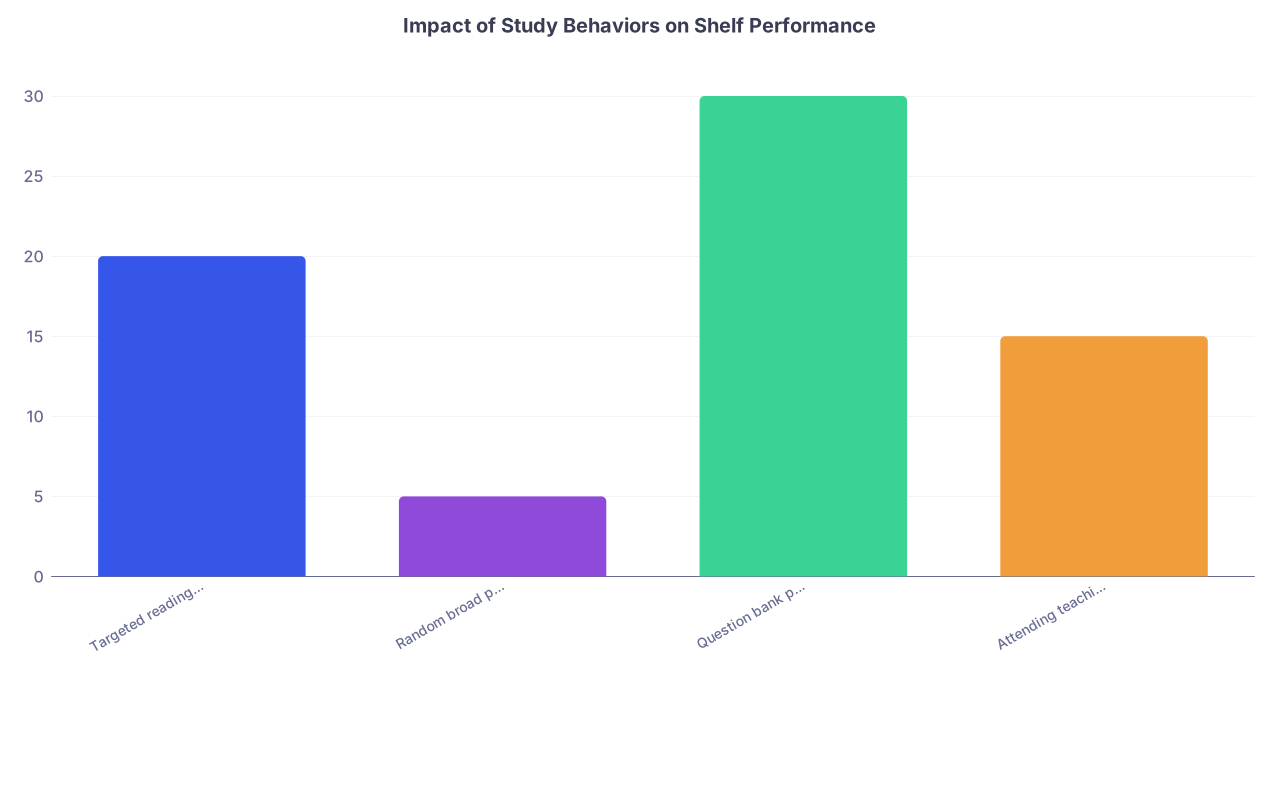
| Category | Value |
|---|---|
| Targeted reading on own patients | 20 |
| Random broad pre-reading | 5 |
| Question bank practice | 30 |
| Attending teaching time | 15 |
The specific numbers will vary, but every study of clerkship performance points in the same direction: active learning and question practice beat mindless chart review. By a lot.
4. Adjust to the culture—but don’t blindly comply
Yes, a few programs and specific attendings are old-school and expect more exhaustive pre‑reading. If they tell you directly, adjust. This isn’t about being rebellious for fun.
But don’t project expectations that aren’t there. If no one has said “you must know every patient in detail,” don’t invent that rule and then torture yourself following it.
Simple move: ask on day 1.
“For pre‑rounding, would you prefer I know my own patients in depth and have a general idea about others, or try to pre‑read the whole list?”
I’ve heard this question asked. The overwhelming answer from residents: “Know your own patients well. Have a basic idea of the rest. Don’t kill yourself trying to memorize everyone.”
The Bottom Line: Myth vs Reality
Myth: You must pre‑read every patient in depth to be a “good” student.
Reality: You need to know your patients very well, have a working sense of the rest, and use your time for real learning, not performance.
Myth: The more chart time, the better your evals and exam scores.
Reality: Above a basic threshold, more indiscriminate chart review has rapidly diminishing returns. Question practice, targeted reading, and active participation correlate far more with shelf scores and strong evaluations.
Myth: Residents and attendings are silently judging you if you do not know every obscure detail on every patient.
Reality: They usually judge you on how you think, how you communicate, and how reliable you are with the patients you actually follow.
If you remember nothing else, keep this:
Pre‑read deeply on your patients. Skim strategically on everyone else. Spend the rest of your energy on understanding medicine, not worshiping the EHR.