
The belief that gunners “win” medical school is wrong. They do not. At least, not in the way most students think.
“Gunner” behavior—hoarding resources, flexing scores, asking performative questions, loudly announcing how early you woke up to study—is sold as the price of admission to competitive specialties. You hear it from classmates, sometimes even from residents: “You’ve got to be a little gunnery if you want derm, ortho, plastics.”
Let me be blunt: the data on peer perception, team dynamics, and evaluation patterns point in the opposite direction. Gunner behavior reliably damages how others see you, and that blowback is not just social. It seeps into group projects, informal reputation, and yes, sometimes into the narrative parts of your evaluations and letters.
What “Gunner” Actually Means (And What It Doesn’t)
Most people misuse the word “gunner.” They conflate two completely different things:
- High performance and ambition
- Socially toxic, self-serving behavior
Those are not the same. A lot of high performers are not gunners. A lot of mediocre students are.
When med students describe a “gunner,” they usually mean behaviors like:
- Monopolizing discussion or pimp sessions to show off
- Withholding or selectively sharing resources (e.g., “forgetting” to share the review slides with the group)
- Volunteering constantly in a way that blocks others from participating
- Flexing: announcing scores, hours studied, practice test results
- Sabotaging or undercutting peers (subtle digs, spreading anxiety, “Are you sure you want to take a day off before the exam?”)
- Performing “enthusiasm” in front of attendings while being dismissive or rude to peers and nurses
Contrast that with:
- Quietly studying a lot
- Asking for feedback
- Wanting a competitive specialty
- Leading a project efficiently without stepping on people
The second list is not “gunner.” It is just being serious.
The research on medical student professionalism and peer assessment is very clear on this point: ambition alone doesn’t tank peer perceptions. Aggressive, self-focused behavior does.

What Do Peers Actually Think of Gunners? The Data
We do not have a randomized controlled trial of “be a gunner vs don’t,” but we do have several consistent streams of evidence: peer assessment studies, professionalism evaluations, group learning research, and qualitative surveys of student impressions.
1. Peer assessments reliably punish antisocial high-achievers
Many schools incorporate anonymous peer assessments in small groups, PBL, TBL, or anatomy teams. The pattern across schools is remarkably similar:
Students are rated highly when they:
- Share resources
- Help weaker team members
- Balance speaking with listening
- Show reliability and humility
Students are rated poorly when they:
- Dominate discussion
- Undermine or ignore others
- Appear performative (participating mainly when faculty is watching)
Study after study on peer assessment in medical education shows this same thing: “collaborative competence” is rewarded, “individualistic dominance” is penalized. And those peer scores are often fed back to faculty and can influence professionalism narratives.
In several published reports, the students flagged repeatedly for unprofessional behavior aren’t the “lazy” ones; they’re the aggressive, high-achieving but self-centered ones. Exactly the classic gunner archetype.
2. Group learning effectiveness drops with one dominant member
There’s a whole chunk of literature on team-based learning (TBL) and problem-based learning (PBL). One consistent finding: a single dominant, over-talking member lowers:
- Group satisfaction
- Perceived psychological safety
- Others’ willingness to ask questions or admit confusion
You can guess what happens next. The “gunner” thinks they’re elevating the level of discussion. The reality: half the group stops engaging, lets them talk, and quietly resents them.
You might not care about group satisfaction. But here’s the catch: those same dynamics show up later on the wards. Faculty and residents can sense when a team is functioning poorly. They may not know why. But they pick up on tension, and they often trace it back—consciously or unconsciously—to the person who keeps trying to be the star.
3. Social reputation becomes a shadow CV
Ask any clerkship director about “back-channel” reputations. You’ll hear things like:
- “She’s brilliant, but people hate working with her.”
- “He knows a ton, but the nurses can’t stand him.”
- “Very strong test scores. Team player? Not so much.”
That’s not just gossip. Narrative evaluations, committee discussions, and rank meetings all feature comments about “teamwork,” “collegiality,” and “easy to work with.”
No one writes, “Gunner.” They write:
- “Sometimes overly competitive”
- “Can come across as dismissive to peers”
- “At times focuses more on looking knowledgeable than on team function”
Translation: your gunner reputation just became part of your professional record.
Does Gunner Behavior Improve Objective Outcomes?
Here’s where people push back: “Sure, maybe people dislike gunners, but they get higher grades, better evals from attendings, and stronger letters. Isn’t that worth it?”
Let’s break that down.
Preclinical exams and class rank
Being extremely driven often helps your scores. That’s not controversial.
But the “gunner” packaging—bragging, hoarding resources, monopolizing discussion—doesn’t cause the better performance. The studying does. You can keep the latter and drop the former with zero penalty.
The belief that you need to act like a gunner to score high is a confusion of correlation and causation. High scores correlate with obsessive effort and good study habits, not with obnoxious social behavior.
Clinical grades and honors
On the wards, your behavior matters more than your raw knowledge. Yes, you need to know your stuff. But the evaluation rubrics almost always include:
- Teamwork
- Communication
- Professionalism
- Receptiveness to feedback
- Relationships with patients and staff
Students who treat their peers as competition rather than teammates often trip over several of those domains. I’ve seen this repeatedly:
Student answers every question during rounds, talks over colleagues, and volunteers for everything. Attending writes: “Very enthusiastic, but sometimes struggles to share space with peers. Needs to work on team awareness.” Translation: no honors.
Another student: solid knowledge, doesn’t dominate, helps others pre-round, shares handouts, speaks up concisely. Attending writes: “Outstanding team member, pleasure to work with, elevates peers.” That’s the student who gets “high honors” even with the same fund of knowledge.
Letters of recommendation
Ask any faculty who’s written hundreds of letters. There’s a tone difference between:
- “Top 10% of students I’ve worked with. Brilliant and tireless. Sometimes a bit intense in competitive settings, but overall very strong.”
vs.
- “Top 10% of students. Outstanding clinical reasoning, superb team player, universally praised by staff and peers. I would trust them with my own family.”
Program directors read those between the lines for a living. The first one smells like subtle gunner. The second one screams, “No risk, bring them here.”
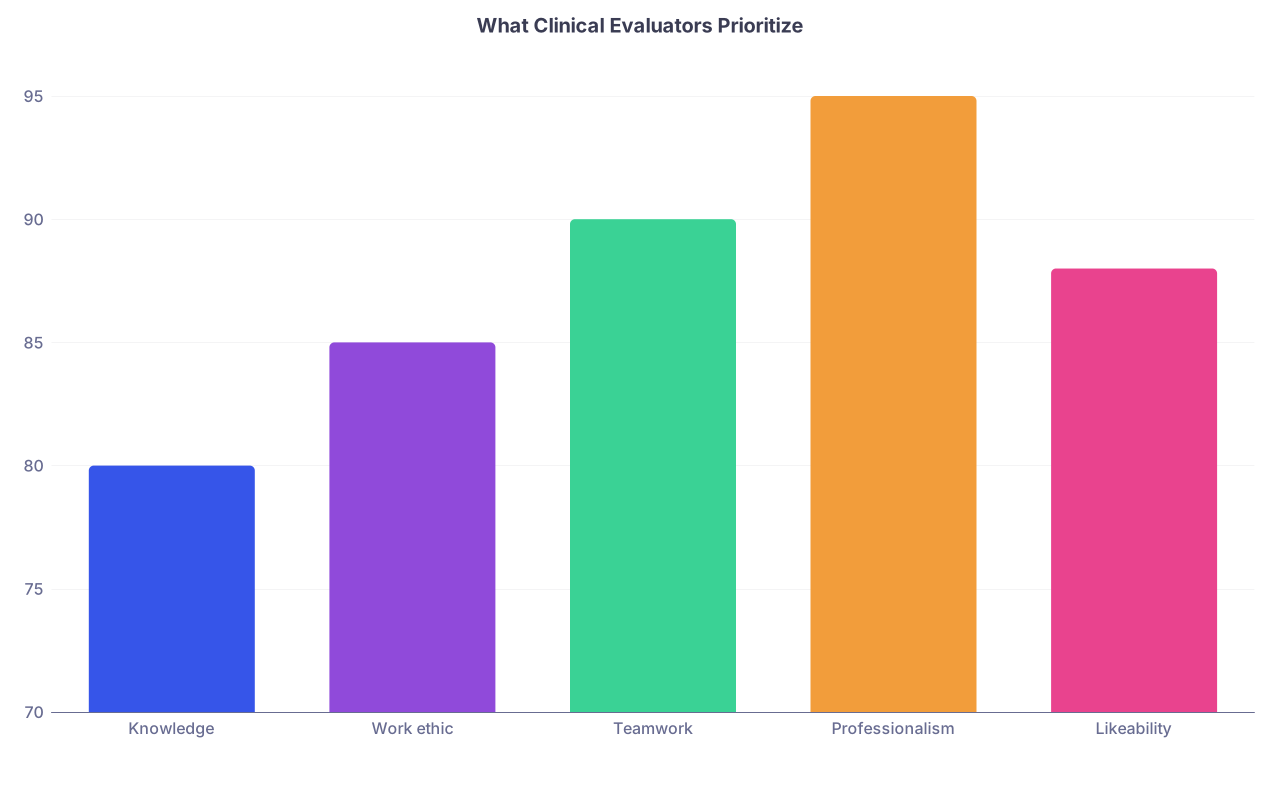
| Category | Value |
|---|---|
| Knowledge | 80 |
| Work ethic | 85 |
| Teamwork | 90 |
| Professionalism | 95 |
| Likeability | 88 |
(Those numbers are illustrative, but they match the general pattern from surveys: knowledge matters, but teamwork/professionalism repeatedly rank just as high or higher in clinical evaluation importance.)
How Peer Perceptions Really Form
Here’s the unglamorous truth: your classmates’ perception of you is built from dozens of tiny interactions they never consciously analyze.
Things they remember:
- Did you share that Anki deck or guard it like state secrets?
- Do you ever ask others how they’re doing, or only talk about your own studying?
- On group projects, do you volunteer and then control, or volunteer and then collaborate?
- Do you ask questions in large group only when it helps you, or when it helps the room?
They also remember your anxiety-generating habits:
- “Wow, I only slept four hours; I had to get through all of Amboss on renal last night.”
- “You’re just starting to study pharm? I finished it last week.”
- Publicly scrolling through Step scores, NBME numbers, or UWorld percentages.
Most gunners don’t see this as hostile. They see it as “sharing my grind.” But peers read it as one of three things: flexing, insecurity, or both. None of those give you social capital.

The Hidden Cost: Lost Social Capital
Here’s what almost no one tells you as an MS1: your classmates are not just competitors. They are:
- Future residents you might match with
- Fellows you’ll call for advice
- Colleagues who will later be on selection panels, committees, maybe even your hiring committee
In other words, they are your long-term professional network.
Several surveys of medical students show that “peer support” is one of the strongest buffers against burnout and depressive symptoms. Who do you think has less peer support? The collaborative, reliable student… or the one everybody calls a gunner behind their back?
I’ve seen this play out brutally:
- Student with a strong Step score but a “gunner” label struggles to find group partners for research or QI projects. Less involvement. Thinner CV narratives.
- Another student with similar scores but a positive reputation gets pulled into new projects constantly. “We need someone solid and easy to work with—ask her.”
By the time residency applications roll around, both have numbers. Only one has a deep bench of people who are eager to help.
So What Actually Works Better Than Gunner Behavior?
If you strip away the ego and theater, here’s the formula that consistently works in medical school and beyond:
- Be ruthlessly serious about your own learning.
- Be aggressively generous with everyone else’s.
Concretely, that looks like:
- Study as hard as you want. Just stop announcing it like a press release.
- Share resources without keeping a secret stash.
- Ask yourself before you speak in groups: is this for my ego, or for the case/patient/team?
- When you know more, help without condescension.
- When you don’t know, admit it plainly. People trust that.
| Dimension | Gunner Style | High-Performer, Non-Gunner Style |
|---|---|---|
| Study effort | High | High |
| Resource sharing | Selective, guarded | Open, proactive |
| In groups | Dominates, performs | Balances speaking and listening |
| Reputation | “Smart but annoying” | “Smart and great to work with” |
| Long-term effect | Social capital erosion | Social capital compounding |
You will not lose a single residency interview because you failed to broadcast how competitive you are as a second-year. You can, however, lose real opportunities if you become the person others quietly avoid.
The Core Myth, Busted
The myth:
“Gunner behavior is the natural, maybe even necessary, side effect of aiming high in medicine. If people don’t like it, they’re just not serious enough.”
The reality:
- High ambition and high performance are absolutely compatible with being well-liked, trusted, and respected.
- The specific behaviors we label as “gunner” mostly hurt peer perception, group function, and sometimes formal evaluations.
- Over a whole career, your reputation for being collaborative and decent will open more doors than any single flex ever will.
This is not a call to be average. It’s a call to stop confusing antisocial behavior with excellence.

| Step | Description |
|---|---|
| Step 1 | Ambition & Hard Work |
| Step 2 | High Knowledge & Scores |
| Step 3 | Strong Objective Profile |
| Step 4 | Behavior Toward Others |
| Step 5 | Positive Peer Perception |
| Step 6 | Negative Peer Perception |
| Step 7 | Strong Narratives & Network |
| Step 8 | Weak Narratives & Limited Support |
| Step 9 | Residency Opportunities |
You keep the ambition and the grind. You drop the theater and the sabotage. That’s the actual high-yield move.