
The way most students present cases on the wards is inefficient, disorganized, and frankly painful to listen to.
You can do much better. With a precise template for each rotation, you stop guessing what to say and start sounding like someone the team can trust.
Let me break this down specifically.
Core Principles Before You Touch Any Template
There is one structure underneath all good oral case presentations, regardless of rotation:
- Why we care today
- Who this patient is
- What the problem is
- What the key data show
- What you think is going on
- What you want to do about it
Every rotation just weights those elements differently.
You are not reading the chart out loud. You are curating. That means:
- Only include data that change assessment or management.
- Say the conclusion before the details when possible.
- Translate numbers into meaning: “so this is consistent with…”
The other non‑negotiable: tell the team, early, what kind of presentation this is.
“New admission H&P.”
“Follow‑up, hospital day 3, focusing on his fever overnight.”
“Brief consult follow‑up with a new CT result.”
Say that in your first sentence. It frames everything.
The Universal Skeleton: Template You Can Bend, Not Break
Here is the basic template I expect a third‑year to have hard‑wired, no matter the service:
- One‑liner
- Brief interval events (for follow‑ups)
- Focused subjective (symptoms, overnight events, ROS)
- Focused objective (vitals, exam, new labs/imaging)
- Problem‑based assessment
- Plan per problem
On H&P‑style admissions, you expand the story and exam. On busy surgical follow‑ups, you compress symptoms and go straight to “eating? passing gas? pain control? walking?”
To make this concrete, let us customize by rotation.
Internal Medicine: The Gold Standard Template
Medicine is where your structure gets tested hardest. If you master this one, everything else feels easier.
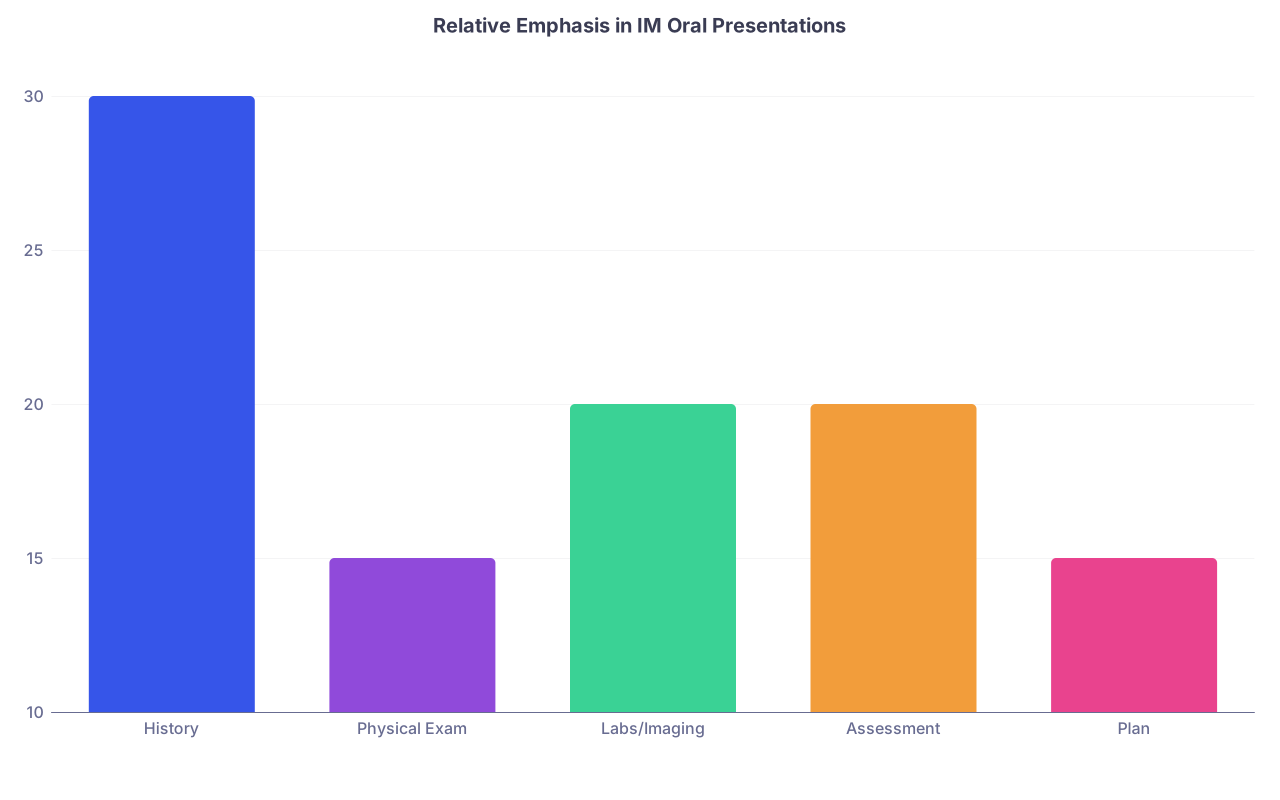
| Category | Value |
|---|---|
| History | 30 |
| Physical Exam | 15 |
| Labs/Imaging | 20 |
| Assessment | 20 |
| Plan | 15 |
New Admission (Full H&P) – Internal Medicine
Target length: 5–7 minutes, max. If you are going past 8, you are rambling.
Template:
One‑liner
“Mr. Smith is a 64‑year‑old man with poorly controlled type 2 diabetes and CAD presenting with 2 days of progressive shortness of breath and orthopnea, admitted for acute decompensated heart failure.”That sentence should have: age, sex (if clinically relevant), key past conditions, chief problem with duration, and your working diagnosis or concern.
History of Present Illness (HPI) – problem‑oriented, not diary‑style
Tell a story with clinical reasoning baked in.- Onset, progression, key associated symptoms
- Relevant negatives (no chest pain, no fever, etc.) that steer diagnosis
- Targeted risk factors / context
Example structure:
“Two days prior to admission, he noticed gradually worsening dyspnea on exertion, now occurring after walking 10–15 feet. He also reports new orthopnea requiring 3 pillows and paroxysmal nocturnal dyspnea. No chest pain, palpitations, fever, or cough. He has had similar symptoms during prior heart failure exacerbations when he gained weight from dietary indiscretion.”
Do not list every blood pressure reading for the last year. Anchor on what explains today.
Relevant Past History
Only what matters for today’s problem.- Past medical: “Notable for HFrEF (EF 30% in 2023), MI in 2018 with stent to LAD, long‑standing type 2 diabetes, CKD stage 3.”
- Medications: “Home meds include lisinopril, metoprolol succinate, furosemide 40 BID, metformin, and insulin glargine 20 units nightly.”
- Allergies: brief
- Social: “Lives alone, ex‑smoker 30 pack‑years, stopped 10 years ago, no alcohol or drugs.”
- Family: only if relevant (CAD in father at 50, etc.)
Compress ruthlessly. The attending can read the full EMR if they really want every surgery dates.
Focused Review of Systems (ROS)
Integrate into HPI. Do not do a 10‑system ROS out loud. One focused line is enough:“Otherwise negative ROS for weight loss, night sweats, hemoptysis, or syncope.”
Objective Data
Sequence:- Vitals with trends: “Afebrile, BP 150/90, HR 96, RR 22, sat 92% on 2L, up from 90% on room air in the ED.”
- General statement: “Appears mildly dyspneic at rest.”
- Focused exam: start with cardiopulmonary, then targeted relevant systems (JVP, lungs, heart, extremities, neuro if relevant).
Say exam in an organized, predictable pattern, same way every time. For medicine:
Gen → HEENT → Neck/JVP → Heart → Lungs → Abdomen → Extremities → Neuro (brief) → Skin.New labs/imaging
Present only what links to the current problems.“CBC: WBC 8, Hgb 10.2 (baseline 10–11), Plt 210. BMP: Na 132 (down from 138 last month), K 4.6, BUN 32, Cr 1.7 (baseline 1.5). Troponin negative x2. BNP 1200 (baseline 400). CXR: pulmonary vascular congestion and bilateral pleural effusions, no focal infiltrate.”
Assessment – Problem‑List Style
This is where most students crumble. Do not say “Assessment: this is a 64‑year‑old male with CHF.” That is just your one‑liner repeated.Use numbered problems, each with your reasoning:
“1. Acute on chronic decompensated HFrEF
Likely triggered by dietary indiscretion and medication non‑adherence; he missed two doses of furosemide and reports increased salt intake over the holidays. Exam with elevated JVP, bilateral crackles, and 2+ edema; imaging supports volume overload; troponins are negative, making ACS less likely.”Plan – Also Problem‑List, Parallel to Assessment
Tie your plan to each problem, and show you know what you are monitoring.“1. Acute on chronic HFrEF
- Continue IV furosemide 40 mg BID, goal net negative 1.5–2 L over next 24 hours.
- Strict I/Os, daily weights, 2g sodium and 1.5L fluid restriction.
- Monitor BMP and weights daily, replete K > 4, Mg > 2.
- Repeat echo if no improvement over 48–72 hours.
- Cardiology consult if inadequate diuresis or worsening renal function.”
State contingency plans if appropriate: “If worsening oxygen requirement, consider ICU transfer and noninvasive ventilation.”
That is a clean, high‑level internal medicine admission. Notice what is missing: every CT from 2019, every A1c since med school started, and your life story from the social history.
Follow‑Up Presentation – Internal Medicine
Target length: 2–3 minutes.
Structure:
Identify the patient and hospital day
“This is Mr. Smith, 64, with HFrEF, hospital day 3 for acute decompensation.”Overnight events and new complaints
“Overnight he had increased dyspnea and a Tmax of 38.2, but no hypotension. This morning he reports improved orthopnea, but new productive cough with yellow sputum.”Focused objective update
- Vitals and trends: “This morning afebrile, BP stable 130s/80s, HR 88, sat 94% on 2L, down from 4L yesterday.”
- Exam changes: “Lungs now with fewer crackles at bases, still bilateral. JVP slightly down, about 9 cm. Edema improved to 1+.”
- New data only: “CXR today shows a new right lower lobe infiltrate; WBC increased from 8 to 13; cultures pending.”
Problem‑based assessment and plan
Focus on what changed. Do not rehash stable problems in detail.“1. HFrEF exacerbation – improving clinically with ongoing diuresis, net negative 1.8 L yesterday. Continue current diuretic regimen, monitor BMP.
- New likely HAP – new infiltrate, fever, leukocytosis on hospital day 3. Start empiric vanc/zosyn, follow cultures, consider narrowing based on results in 48–72 hours.”
That is it. You do not need to re‑state that he lives alone, is an ex‑smoker, or had an MI in 2018. The team remembers.
Surgery: What Changes and What You Cut
On surgery, nobody wants a 7‑minute poetic HPI of the appendicitis.
They want:
- Are they alive and stable?
- Are they leaking, bleeding, infected, or obstructed?
- Are they eating, pooping, peeing, and walking?

New Consult / Admission – Surgery
Template:
One‑liner
“Ms. Jones is a 23‑year‑old woman with no significant past history presenting with 12 hours of right lower quadrant abdominal pain, imaging consistent with acute appendicitis.”HPI: Short, surgical decision‑focused
- Time course of pain
- Migration, associated GI symptoms
- Fever, chills
- Prior abdominal surgeries
- Pregnancy status if relevant
“Pain began peri‑umbilically 12 hours ago, migrated to the RLQ over 6 hours, now 8/10, worsened by movement. Associated nausea and one episode of non‑bloody emesis, no diarrhea or urinary symptoms.”
Key past history
Only: prior abdominal surgery, anticoagulation, bleeding disorders, major cardiopulmonary disease, allergies.Objective and imaging
- Vitals
- Focused abdominal exam: tenderness, rebound, guarding
- Spigelian hernia? Distention? Surgical scars?
- Labs: WBC, H/H, creatinine, pregnancy test
- Imaging: “CT abdomen/pelvis with enlarged, 10 mm appendix with wall thickening and periappendiceal fat stranding, no abscess.”
Assessment and Plan
“Uncomplicated acute appendicitis” → recommended appendectomy, NPO, IV fluids, pre‑op antibiotics, consent, etc.
That is all the attending needs. Anything beyond that is for your note, not your mouth.
Post‑Op Follow‑Up – Surgery
Post‑op day presentations must be brutally concise.
Use this structure, almost telegraphic:
Identify: “Ms. Jones, POD#1 s/p laparoscopic appendectomy for uncomplicated appendicitis.”
Overnight / subjective
“No acute events overnight. Pain well‑controlled with oral meds. Tolerating clear liquids without nausea. No flatus yet, no bowel movement. Has ambulated twice with assistance.”Objective
- Vitals stable? Say that clearly.
- I/O summary: “Net +500 yesterday, UOP 0.7 mL/kg/hr.”
- Exam: particularly incision, abdomen, lungs, extremities for DVT.
Assessment and Plan
- “Doing well POD#1. Advance diet as tolerated to regular. Encourage ambulation, incentive spirometry. Transition completely to oral pain regimen. Continue DVT prophylaxis. Likely discharge tomorrow if still tolerating diet and ambulating independently.”
Notice what is missing: full ROS, complete past medical history, detailed review of her CT report. Nobody wants to hear it at 5:45 am.
Pediatrics: Same Skeleton, Different Emphasis
In pediatrics the medical reasoning structure is the same, but you must clarify:
- Age and developmental stage (matters clinically)
- Reliability of historian(s)
- Perinatal history for young infants
- Vaccination status
| Element | Adult Medicine Focus | Pediatric Focus |
|---|---|---|
| Historian | Usually patient | Parent/guardian, reliability explicit |
| Development | Rarely central | Age milestones, feeding, growth |
| Vitals | Norms by age | More interpretation needed |
| Social context | Living situation, ADLs | Home, daycare/school, exposures |
| Vaccinations | Seldom central | Often crucial (fever, meningitis risk) |
New Admission – Pediatrics
Template:
One‑liner
“Liam is a 4‑year‑old previously healthy boy presenting with 2 days of fever and increased work of breathing, admitted for management of community‑acquired pneumonia.”HPI with context
Who is telling you the story? Developmental / feeding baseline?“History obtained from mother. Two days ago he developed rhinorrhea and low‑grade fever to 38.2, progressing to high fevers to 39.5 yesterday with cough and decreased oral intake. Baseline is an active, verbal 4‑year‑old in preschool, but yesterday he was more lethargic and breathing faster. No vomiting, diarrhea, or rash. No known sick contacts other than daycare.”
Past and birth history as relevant
- Birth: term / preterm, complications if they matter for lung, neuro, etc.
- Growth and development: normal vs delayed.
- Vaccinations: “Fully vaccinated for age, including pneumococcal and influenza this season.”
- Social: daycare, smokers at home, recent travel.
Focused ROS, especially red flags
Brief: altered mental status, decreased urine output, poor PO, seizures, etc.Objective with age‑specific interpretation
Do not just read vitals. Interpret.“T 38.9, HR 140, RR 36, sat 93% on room air. For age, tachycardic and mildly tachypneic.”
Exam: general appearance (toxic vs non‑toxic), work of breathing, retractions, grunting, hydration status.
Assessment and Plan
“Likely right‑middle lobe pneumonia vs viral bronchiolitis with focal consolidation.” Then your plan: antibiotics if indicated, oxygen support, fluids, monitoring, parental education.
Follow‑ups are similar to IM but emphasize feeds, wet diapers, activity, and parental concerns.
Obstetrics & Gynecology: Two Structures in One
OB/GYN splits into two worlds: obstetrics (pregnant patients) and gynecology (everything else). Your template must handle both.
Obstetric Presentation (Inpatient)
Start with gestational frame. Always.
One‑liner
“Ms. A is a 27‑year‑old G2P1 at 38 weeks and 2 days by LMP consistent with 8‑week ultrasound, admitted in spontaneous labor.”OB‑specific data up front
- Gravida/para, prior deliveries and complications
- Dating and EDD
- Pregnancy complications this time (gestational diabetes, preeclampsia risk, etc.)
- GBS status, Rh status
HPI tailored to labor
- Onset of contractions, frequency, rupture of membranes, bleeding, fetal movement.
Objective
- Vitals
- Fetal heart tracing summary: “Category I tracing, baseline 140, moderate variability, no decels.”
- Cervical exam: “5 cm dilated, 80% effaced, −1 station, vertex presentation.”
- Membrane status, fluid color.
Assessment/Plan
Very specific to stage of labor and maternal/fetal status: “Active labor, expectant management vs augmentation, pain control plan, monitor for fetal distress, prepare for delivery.”
Gyne presentations mirror internal medicine more, but with emphasis on menstrual, sexual, and reproductive history.
Psychiatry: Strip to the Essentials, But Get Them Right
Psych oral presentations sound weird if you import full IM style. The template trims some exam and labs, but your mental status exam becomes the “physical.”
New Psychiatry Admission
One‑liner
“Mr. B is a 32‑year‑old man with a history of major depressive disorder presenting with 1 week of worsening suicidal ideation with a plan to overdose, admitted voluntarily for safety and stabilization.”HPI
- Time course of mood/psychotic/anxiety symptoms
- Triggers, psychosocial stressors
- Substance use (non‑negotiable)
- Prior episodes, hospitalizations, medications, response history
- Safety: intent, plan, means, past attempts.
Past psych and medical history, meds, family psych history
Relevant. Brief for medical, complete for psychiatric.Social history
Living situation, employment, supports, legal issues.Mental Status Exam (MSE) – structured
Appearance, behavior, speech, mood/affect, thought process, thought content (SI/HI/psychosis), cognition, insight, judgment.Assessment and Plan
Diagnosis differentials, risk assessment, level of care, meds, therapy, safety planning.
Follow‑ups: focus on interval events (sleep, appetite, SI severity), med changes, side effects, participation in therapy, MSE updates.
How to Adapt Quickly Between Rotations
If you are rotating month to month, you need a mental switchboard. Here is how I used to teach interns to think about it:

| Step | Description |
|---|---|
| Step 1 | Patient Encounter |
| Step 2 | Full H&P template |
| Step 3 | Problem-focused, status first |
| Step 4 | MSE-centered |
| Step 5 | Problem-based Assessment & Plan |
| Step 6 | Edit for Time & Team Preference |
| Step 7 | Which Service? |
Before you present, silently ask yourself 3 questions:
- What does this team care about most? (Status vs narrative vs risk vs function)
- How much time do I realistically have? (Rounds with 30 patients is not storytelling hour.)
- What one sentence do I want the attending to remember after I finish?
Then you prune. In real life, on surgery rounds at 6:00, you might compress an IM‑style 7‑minute H&P into a 90‑second highlight reel, but you must keep structure:
- Clear one‑liner
- Status change or key symptom
- The one or two most critical pieces of data
- A crisp assessment and procedural next step
Once you stop trying to “include everything,” you finally start sounding sharp.
Common Structural Mistakes (And How to Fix Them Fast)
I see the same structural errors on almost every rotation.
Chronological re‑telling of the chart
You are not writing a novel. Reorganize by clinical reasoning, not admission timestamps.Fix: Write your own brief outline before presenting: One‑liner → Main problem story → Targeted prior history → Key data → Assessment.
Burying the lede
Saying “69‑year‑old with hypertension and diabetes here with shortness of breath” and only later mentioning “oh and by the way he is in septic shock with a lactate of 6.”Fix: First line contains your severity: “…now in septic shock secondary to presumed pneumonia.”
No clear problem list
Rambling “assessment” with no numbering, no structure.Fix: Always number your problems out loud. “First, acute hypoxic respiratory failure… Second, chronic CKD stage 3…” The team can follow and respond per problem.
Repeating stable data every day
On hospital day 7, you do not need to re‑tell his A1c and family history of CAD. Focus on what changed since yesterday.Fix: For follow‑ups, literally start a separate page in your brain: “What is NEW? What is WORSE? What is BETTER? What is THE SAME (and I can skip saying)?”
A Simple Practice Routine That Actually Works
You do not get fluent at this by reading about it. You get fluent by repetition.
Here is a realistic, no‑nonsense practice loop:
- Take one real patient per day.
- Write a one‑liner and a numbered problem list with 1–3 bullets per problem.
- Stand in the hallway or empty call room and say your presentation out loud, timed.
- Force yourself to cut 30 seconds while keeping all essential information.
- Next day, repeat with a different patient and different service.
If after two weeks you are still going over time or losing your structure, you are not editing hard enough. Or you are still trying to show what you know instead of what the team needs.
FAQs
1. Should I memorize different templates for every single rotation?
No. Memorize one universal skeleton: one‑liner → subjective → objective → problem‑based assessment → plan. Then tweak the emphasis. Surgery compresses HPI and exam, expands peri‑op status. Psych shortens labs, expands MSE. Pediatrics adds development and vaccines. Once you see it as re‑weighting, not entirely new scripts, the learning curve drops dramatically.
2. How long should my oral case presentation be on average?
New medicine H&P: 5–7 minutes. New consults on busy services (surgery, OB, ER): 2–4 minutes. Follow‑ups: 1–3 minutes. If your attending interrupts you mid‑presentation consistently, you are too long or too unfocused. Time yourself once or twice; your internal clock is usually wrong at first.
3. Is it acceptable to read from notes during presentations?
Glancing at a small card for vitals, lab values, or medication doses is fine. Reading full sentences from your note is not. You sound disengaged, and attendings notice. Aim to know the story and structure cold, and keep a few hard numbers written down. Over time, you will rely on the card less.
4. What if my attending wants a totally different structure than what I learned?
Adapt without argument. Some attendings want system‑based assessment, others want problem‑based; some want labs before exam. You can adjust the order easily once you understand the components. Think of your template as the default; then treat each attending’s preference as a local customization layer. Ask once: “Would you prefer I go system‑based or problem‑based for the assessment?” Then do it their way for the rest of the rotation.
With these templates wired into your thinking, you stop wasting cognitive bandwidth on “what comes next” and start focusing on “what matters clinically.” That frees you up for the next step in your development: not just presenting the case, but actually driving the plan. That, however, is a conversation for another day.