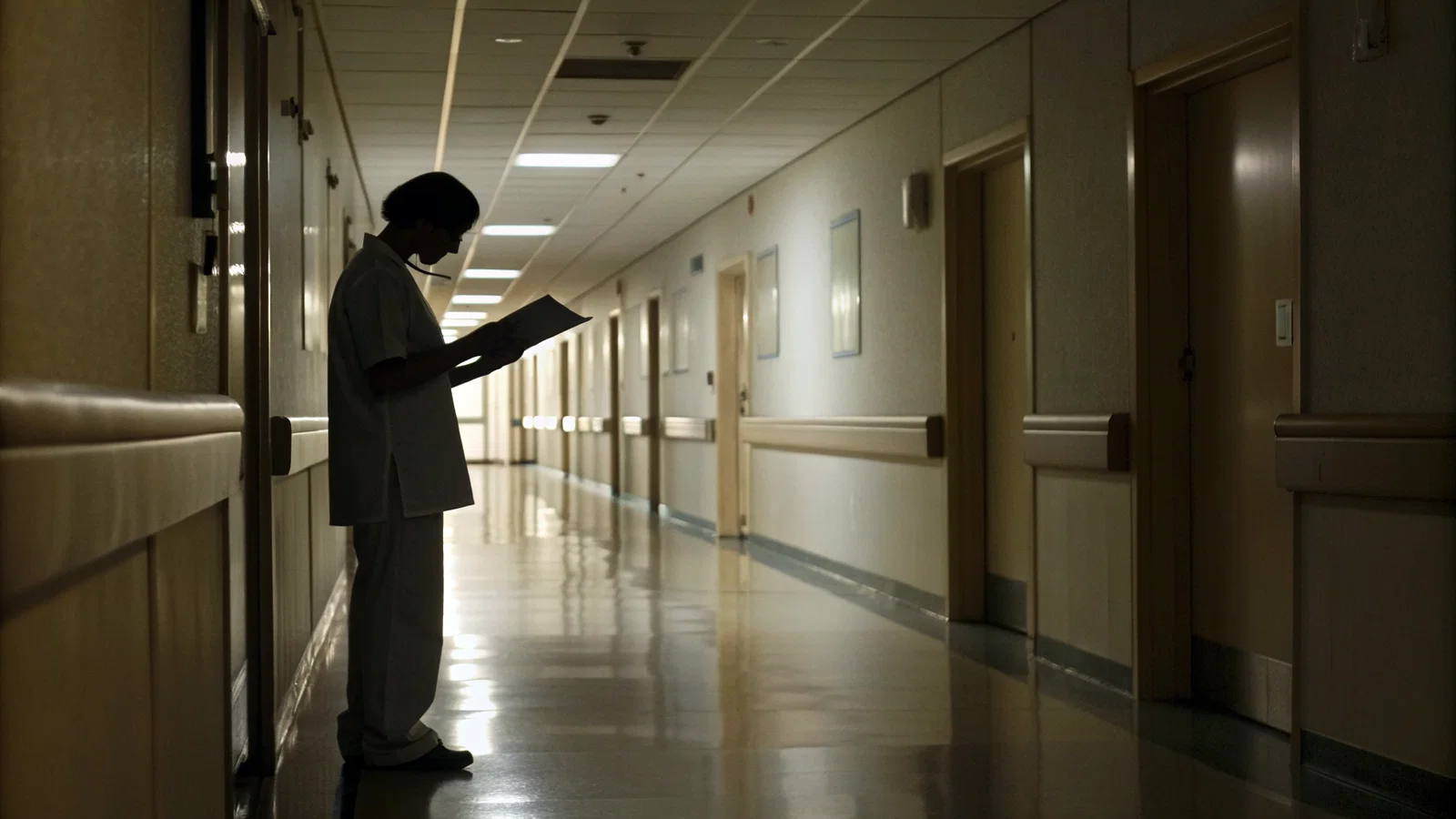
You pre-rounded at 4:30 AM. You knew the overnight vitals, the exact input-output from the night shift, and the creatinine trend for the last six months. You presented first on rounds. You stayed until 7 PM to help the intern discharge three patients.
And then rotation evaluations came out.
"Meets expectations. Good fund of knowledge. Quiet."
If you struggle with the constant pressure to be noticed, consider how introvert strategies for clinical success can help you stand out without forcing a personality change.
Quiet? You bled for this team. You sacrificed sleep, meals, and your sanity. Let me tell you what really happens behind the closed doors of the grading committee. Your hard work isn't just invisible; it's actively being misinterpreted. The medical education system runs on an unspoken set of rules that no one bothers to teach you. If you want to stop getting generic feedback and start getting the honors you actually earned, you need to understand how the game is really played.
The Illusion of Hard Work
There is a toxic myth in medical school that if you just keep your nose to the grindstone long enough, the attendings will notice and reward you. Pure fiction. Attendings care about efficiency, not duration.
Before you approach your next round of evaluations, keep in mind why your outpatient performance matters for your final grade.
I've sat in countless grading meetings where a student's name comes up, and the attending says, "They were always there, but I'm not sure what they actually did." When you are the last person to leave the hospital every night, you don't look dedicated to the faculty. You look disorganized. You look like you lack the time-management skills to finish your work in a normal shift.
Faculty value clinical synthesis and brevity over raw endurance. They are looking for the silent metrics. Can you distill a complex patient's overnight course into three sentences? Can you anticipate the next step in management without being prompted?
Here is the brutal insider reality: Attendings have about thirty seconds to form an impression of you on rounds. If your massive, exhaustive pre-rounds work isn't articulated in a tight, high-yield presentation, it simply does not exist to them. I watched a third-year student spend forty-five minutes formatting a beautiful, color-coded problem list for a patient with heart failure. On rounds, the attending cut him off after twenty seconds to ask about the diuretic plan. The student fumbled. The attending wrote "struggles with prioritization" on the evaluation. The extra work actually hurt him.

The Evaluation Funnel: How Decisions Are Really Made
To understand why your effort vanishes, you have to understand the cognitive load theory of clinical teaching. Your attending is managing a dozen complex patients, fielding calls from the OR, and answering to hospital administration. Their brain is at maximum capacity. They subconsciously reward students who minimize their mental burden, not the ones who add to it with disorganized data dumps.
There is a strict hierarchy of impact in how you are judged. Patient care decisions are seen. Documentation is merely expected, nobody gets a medal for writing a thorough progress note, it's just the baseline. Bedside manner is remembered. If you hold a dying patient's hand or calm down an angry family member, the attending will remember that for years. But if you spend three hours perfectly formatting a discharge summary, it vanishes into the EMR ether.
Most students think grading is a cumulative process over four weeks. Wrong. The secret grading rubric is front-loaded. Most evaluators decide your grade in the first three days based on two factors: team fit and safety. If you are safe (you don't make things up, you ask for help when out of your depth) and you fit the team (you aren't awkward, you anticipate needs, you don't complain), you have locked in a high grade. The rest of the rotation is just them looking for evidence to confirm their initial bias.
This is why your "extra work" fails to show up on end-of-rotation feedback forms. If you didn't establish your value in that initial 72-hour window, all the late nights in the world won't change the narrative.
Re-engineering Your Workflow for Maximum Visibility
So, how do you fix this? You stop working harder and start working strategically. You need to re-engineer your workflow to ensure your clinical value is impossible to ignore.
First, master strategic communication using the Bottom Line Up Front (BLUF) method. Never start a presentation with the patient's age, gender, and past medical history unless it is directly relevant to the acute problem. Start with the headline. "Mr. Smith is a 65-year-old with acute decompensated heart failure who is diuresing well but needs a cardiology consult for a new arrhythmia." You have their attention. Now fill in the details.
Second, use anticipatory guidance. This is a game-changer. You must mention tasks before you do them to ensure credit is logged in the attending's mind. Don't just quietly call the cardiologist and put the consult in the chart. Say, "I'm going to page cardiology right now to ask about rate control, and I'll update the team when they call back." When you deliver the answer later, the attending connects the result to your proactive effort. If you just do it quietly, they assume the resident did it.
Third, execute the "Question Pivot." Stop asking your residents and attendings, "What can I do to help?" That makes you a task-monkey. It forces them to stop their workflow and invent busywork for you. Instead, ask for reasoning feedback. "I was thinking we should switch to IV antibiotics because his gut absorption is questionable with the ileus. Do you agree with that reasoning?" You just positioned yourself as a thinking junior colleague, not a pair of hands.
Finally, you must learn to manage up. Managing up is not bragging. It is professional advocacy. At the end of your shift, when you are signing out to the resident, give a rapid-fire summary of your wins. "I followed up on the three sets of blood cultures, they are all negative. I also called Mrs. Jones's daughter to update her on the discharge plan, and she's picking her up at 5 PM." You are subtly ensuring the team knows exactly what you accomplished. If you don't tell them, they won't know.

The Future of Your Clinical Persona
This isn't just about surviving medical school or padding your MSPE. This is about moving from "student mode" to "junior colleague mode" as a career-long strategy.
The skills you are developing right now to be "seen" are actually the exact foundation for becoming an efficient, highly sought-after resident. When you become an intern, your attending won't have time to hold your hand. They will rely on the interns who can synthesize information, communicate efficiently, and manage up without being prompted. By mastering visibility now, you are building the muscle memory for residency survival.
You also need to learn how to close the loop. Maintain professional boundaries, but ensure your contribution to the team's success is noted. When a patient has a great outcome, make sure you are the one who tells the attending the final piece of good news. "The pathology just came back benign, and the patient is going home." Own the narrative.
My final advice for the long haul: Work smarter for the sake of the team, not just to boost your grade. When your primary goal shifts from "getting honors" to "making this team function flawlessly," the honors grade becomes an inevitable byproduct.
Hard work is a prerequisite, not a differentiator. Clinical clarity is what gets you the honors grade. Attendings don't count your hours; they count the number of times you made their day easier. Documentation of your effort is not bragging; it is professional advocacy that ensures you are accurately evaluated. Shift your focus from doing everything to owning specific outcomes.
Stop hiding in the chart. Step into the light.