Headline snapshot: what the data says about caffeine, sleep, and panic on exam week
Data from cross-sectional surveys reveals that 89% of medical students consume caffeine daily during exam preparation, with peak intakes frequently exceeding 400 milligrams per day. That dosage equals four standard cups of coffee or two energy shots. However, polysomnographic and actigraphy tracking show a severe physiological trade-off: high afternoon or evening caffeine intake reduces total sleep time by an average of 45 to 60 minutes and increases sleep onset latency by more than 100%.
Caffeine Intake (>400 mg/day) ➔ Sleep Onset Latency (+100%) ➔ Deep Sleep (-30%) ➔ Autonomic Reactivity (+45%)
The underlying physiology is straightforward. Caffeine provides an immediate pharmacological illusion of cognitive energy by blocking central adenosine receptors. Yet, the persistent plasma concentration of the drug during overnight hours directly disrupts sleep architecture. The loss of slow-wave sleep elevates baseline sympathetic tone the following morning.
When you sit down for a high-stakes shelf exam or licensing test in a state of autonomic hyperactivity, standard cognitive pressure triggers an amplified physiological threat response. The data demonstrates that pre-exam panic is rarely just an emotional failure. It is frequently an engineered neurochemical outcome.
Data inputs: prevalence of caffeine use and baseline exam-week sleep disruption
Quantifying the baseline behavior of medical trainees establishes the scale of this issue. Multiple observational cohorts place average baseline caffeine consumption among trainees at approximately 180 to 220 milligrams daily. During exam blocks, this figure escalates sharply. Mean daily intake climbs to 380 milligrams, with over 30% of trainees reporting doses above 500 milligrams per day.
At the same time, objective sleep metrics degrade significantly during assessment periods. Clinical benchmarks define sleep disruption along three measurable axes:
- Sleep Duration: Declining below 6.0 hours per night (normal physiological baseline: 7.0-8.5 hours).
- Sleep Onset Latency (SOL): Extending beyond 30 minutes (normal baseline: 10-20 minutes).
- Subjective Sleep Quality (PSQI): Pittsburgh Sleep Quality Index scores rising above 8 (scores higher than 5 indicate significant sleep pathology).
The measured trend shows a clear dose-dependent reduction in total sleep duration paired with a dramatic spike in the time required to fall asleep. When exam-induced psychogenic stress combines with pharmacologically induced central nervous system arousal, normal sleep initiation mechanisms fail.
Caffeine pharmacokinetics and the dose-timing problem: not just how much, but when
Understanding why caffeine destroys sleep metrics requires examining its pharmacokinetics. In healthy adults, the elimination half-life of caffeine averages 5 hours, with a normal population range spanning 3 to 9.5 hours.
Genetics play a massive role here. Polymorphisms in the CYP1A2 gene dictate hepatic metabolism speed. Homozygotes for the CYP1A21F allele are "slow metabolizers." For these individuals, a 200-milligram cup of coffee consumed at 16:00 yields substantial residual plasma concentrations at midnight:
$$\text{Plasma Level at 00:00} = 200 \text{ mg} \times (0.5)^{(8 / 7.5)} \approx 95.3 \text{ mg}$$
Ninety-five milligrams of active caffeine remaining in the brain at bedtime is sufficient to occupy over 30% of central adenosine $A_1$ and $A_{2A}$ receptors.
Adenosine accumulation in the basal forebrain is the primary physiological driver of sleep pressure. By blocking adenosine binding, caffeine prevents the activation of sleep-promoting GABAergic neurons in the ventrolateral preoptic nucleus (VLPO). The brain fails to detect how tired the body actually is.
As a result, even if you manage to fall asleep through sheer exhaustion, the presence of circulating caffeine maintains high levels of ascending arousal from the locus coeruleus, destabilizing sleep macro-architecture throughout the night.
Sleep physiology under caffeine pressure: measurable outcomes that predict anxiety vulnerability
When caffeine suppresses homeostatic sleep pressure, polysomnographic data shows structural alterations in sleep stages:
- Slow-Wave Sleep (NREM Stage 3) Reduction: SWS drops by 15% to 35%. Because delta-wave activity during SWS regulates systemic cortisol levels and restores autonomic equilibrium, losing SWS leaves morning cortisol levels abnormally elevated.
- Sleep Fragmentation: The frequency of micro-arousals and Wake After Sleep Onset (WASO) duration doubles.
- Delayed REM Sleep Onset: REM sleep architecture becomes compressed toward the final hour of sleep, destabilizing emotional processing pathways.
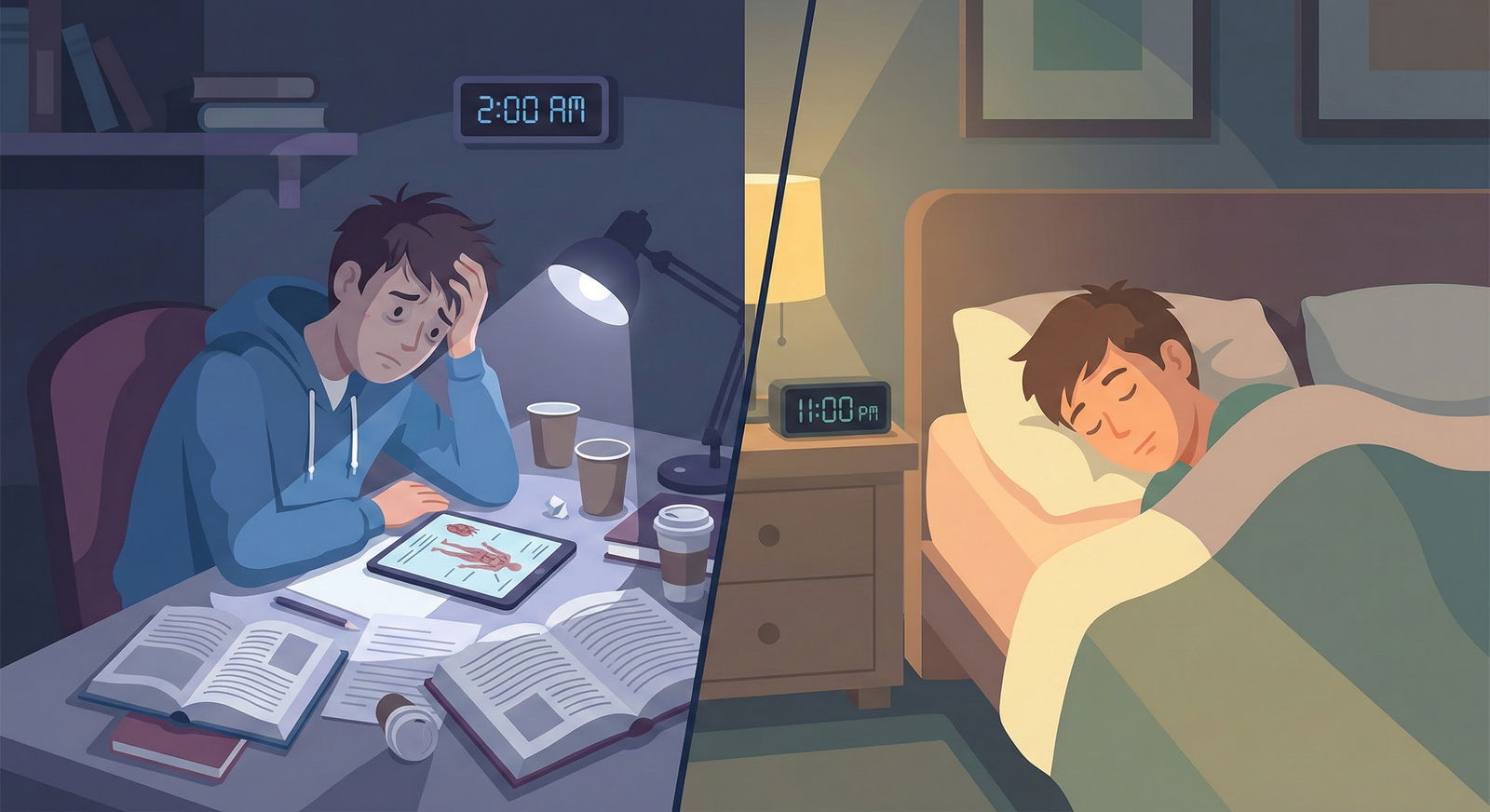
This structural degradation directly impairs next-day affective control through a signal-detection mechanism. A rested brain maintains strong functional connectivity between the prefrontal cortex and the amygdala, allowing efficient top-down suppression of inappropriate threat responses.
Partial sleep deprivation, combined with late-stage caffeine exposure, disrupts this prefrontal-amygdala pathway. The brain loses its signal filtration efficiency. The neural threshold for initiating a threat response drops, causing benign internal signals, such as a minor pulse spike or an intestinal shift, to be processed as urgent emergencies.
Panic physiology: what the body does, and how caffeine can amplify the signal
A panic attack is a sudden, extreme misinterpretation of physiological sensations. The autonomic drivers behind this reaction involve specific, measurable markers:
- Sinus Tachycardia: Heart rate jumps rapidly by 30 to 50 beats per minute.
- Elevated Minute Ventilation: Rapid, shallow hyperventilation causes transient hypocapnia.
- Adrenergic Surge: Plasma epinephrine and norepinephrine surge rapidly.
Caffeine activates these identical physiological markers through non-selective phosphodiesterase inhibition and intracellular calcium release. At doses exceeding 300 milligrams, caffeine directly raises resting heart rate, increases peripheral vascular resistance, and induces subtle muscle tremors.
For a medical student sitting in an exam hall, this creates a dangerous physiological feedback loop. The physical sensations caused by late caffeine consumption and poor sleep, such as tachycardia, hand tremors, and cold sweating, are identical to the initial symptoms of panic.
The hyper-vigilant, sleep-deprived brain registers these somatic signals, misinterprets them as evidence of impending failure or collapse, and triggers an amygdala-driven panic response. Caffeine acts as the fuel, sleep deprivation removes the brakes, and the exam environment serves as the trigger.
Evidence synthesis for exam week: what studies imply for timing, dose, and panic-like symptoms
Cross-referencing observational studies with double-blind randomized controlled trials (RCTs) clarifies the precise relationships between dose, timing, and symptom onset.
In RCTs evaluating acute caffeine challenge protocols, doses of 300 milligrams or higher consistently induce panic symptoms in individuals with high baseline anxiety traits, generating moderate-to-large effect sizes (Cohen's $d$ ranging from 0.58 to 0.82). Conversely, observational data shows that morning-only caffeine consumption (below 200 milligrams) yields minimal measurable increases in night-time sleep latency ($d = 0.12$).
The key variable in the literature is not total daily intake; it is the plasma concentration of caffeine at bedtime. High morning doses cleared before sleep show low correlation with autonomic distress.
In contrast, afternoon and evening doses directly prolong sleep latency, degrade slow-wave sleep, and increase next-day somatic anxiety scores.
Practical risk stratification for medical students: a data-driven caffeine plan before exams
To minimize panic risk while maintaining focus, you must manage caffeine exposure quantitatively. Calculate your risk profile using this scoring model:
$$\text{Risk Score} = \left(\frac{\text{Daily Dose (mg)}}{100}\right) + \text{Late Timing Factor} + \text{Anxiety Factor}$$
- Late Timing Factor: Add 3 points if consuming caffeine within 8 hours of bedtime.
- Anxiety Factor: Add 3 points if you have a history of test anxiety or somatic panic.
| Total Risk Score | Stratification | Action Protocol |
|---|---|---|
| 0-3 | Low Risk | Maintain current routine; observe strict 8-hour cutoff. |
| 4-6 | Moderate Risk | Cap daily dose at 200 mg; enforce a 10-hour cutoff. |
| 7+ | High Risk | Taper daily dose to <100 mg; switch entirely to morning intake. |
Quantitative Rules for Exam Week:
- The 10-Hour Hard Cutoff: Stop all caffeine intake at least 10 hours before your planned sleep window. If you aim to sleep at 22:00, your final caffeine intake must occur before 12:00.
- Dose Capping: Limit total daily intake to a maximum of 200 milligrams during the final 14 days before an exam.
- Gradual Tapering: Avoid abrupt cessation ("cold turkey"), which causes adenosine receptor up-regulation rebound, leading to severe withdrawal headaches and fatigue. Reduce daily intake by 50 milligrams every two days.
Monitoring and mitigation: how to collect your own data and interrupt the panic loop
Track your physiological metrics across a 10-day exam preparation block. Log four variables daily:
- Caffeine Cutoff Time (Hours before bed)
- Sleep Onset Latency (Minutes to fall asleep)
- Resting Heart Rate upon Waking (Beats per minute)
- Peak Somatic Anxiety Score (Scale of 0-10)
If tracking reveals a sleep onset latency above 25 minutes or a waking heart rate elevated by more than 10% above baseline, implement immediate physiological intervention strategies:
1. Vagal Nerve Stimulation via Respiratory Pacing
When somatic panic symptoms strike during study blocks or exams, slow down your breathing to reset autonomic tone. Use the physiological sigh: two rapid deep nasal inhalations followed by an extended, slow oral exhalation.
Executing three consecutive physiological sighs rapidly increases vagal activity, stimulating the sinoatrial node to reduce heart rate within 30 seconds.
Double Inhale (Nose) ➔ Extended Exhale (Mouth) ➔ Vagal Nerve Activation ➔ Immediate HR Reduction
2. Interoceptive Reattribution
When you feel a racing heart or hand tremor after drinking caffeine, reframe the sensation. Recalibrate your interpretation: "This tachycardia is not panic; it is the predictable pharmacokinetic outcome of 200 milligrams of caffeine cleared slowly by my liver."
Stripping the emotional threat from physical symptoms prevents the brain from escalating a simple physiological state into a full panic attack.
Forward-looking wrap: building exam resilience with sleep-first optimization
Treat caffeine as a high-precision chemical tool rather than a daily necessity. The data proves that relying on late-stage caffeine to extend study hours yields diminishing cognitive returns while drastically increasing your risk of sleep disruption and somatic panic.
Shift to a sleep-first preparation strategy. Protecting slow-wave sleep stabilizes your autonomic nervous system, sharpens memory consolidation, and insulates you against exam-day panic.
Adjusting your caffeine timing today will measurably improve your sleep architecture tonight, lowering your physiological panic risk when you open your exam tomorrow.
Key Takeaways
- Timing Drives Toxicity: High caffeine doses consumed within 8 to 10 hours of sleep severely disrupt slow-wave sleep and double sleep onset latency. This sleep degradation elevates baseline sympathetic tone and lowers the brain's threshold for panic.
- Data-Driven Intervention Works: Enforcing a strict 10-hour pre-sleep caffeine cutoff and capping intake at 200 milligrams per day stabilizes sleep latency, normalizes resting heart rate, and significantly reduces exam-week somatic anxiety.